Chernobyl’s Radioactive Wolves

While procrastinating on other work this week, I watched a documentary that was posted on Reddit that I thought might be of some relevance to our class (and could extend the examination of the social media site I started with my Haunted Media project). Thinking back to some of the concepts we looked at in early April, I was mainly drawn to the Reddit post by a title that, at best could be described as clear hyperbole and at worst, as an outright attempt at clickbait–“Radioactive Wolves Of Chernobyl Scary Mutations (2013).” Meanwhile, the documentary in question is simply entitled Radioactive Wolves and aired in 2011 as part of PBS’s Nature documentary series.

Radioactive Wolves via PBS

Although the Reddit post exaggerates certain aspects of the hour-long documentary, it channels the spirit that the documentary invokes to hook viewers into watching what is essentially the first episode of the twenty-ninth season of a nature TV show on PBS. Necessarily, under the guise of providing background information, the documentary taps into the same human fascination with disaster that the dark and toxic tours capitalized on in the Yankovska and Hannam article. There is even a segment that indulges in our morbid fascination with kenopsia as it explores the abandoned cityscape of Pripyat (complete with shots of the abandoned amusement park, forgotten children’s toys, and disturbing graffiti to drive the creepiness home).

These small segments of the hour-long episode certainly tap into the fascinations of popular culture; however, they take a backseat to the main focus of the documentary–the wolves of the Chernobyl exclusion zone. The documentary actually follows the research of biologists and ecologists who are curious about the long-term effects of radiation on the local gray wolf population. They encounter rumors fed by popular opinion that say the area is home to over three hundred wolves of abnormal size (which would make it the biggest population of gray wolves in the world). Eventually, they find that the rumors, much like the clickbaity title, are wrong and that their numbers and size are fairly normal. What the scientists were surprised about was how well the surrounding area seemed to be doing despite the long-term radiation exposure. In the absence of humankind, the local animals and plant species all thrived and showed no signs of the adverse effects of the radiation. 

Of course, such an end could seem like a disappointment compared to the “Scary Mutations” we were led to expect. The comments on both the Youtube video and the Reddit post mimic each other in tone and spirit. Ranging from issues with the title to jokes about Russia, the Fallout franchise, cute animals, and Trump, the most popular comments seem to want to talk about anything else besides the phenomenon observed with Chernobyl’s ecosystem, the wolves’ well-being, or even the disaster itself. Digging deeper within the comments yields some better fruits and gets at the greater significance of the documentary. With this film, viewers confront the uncomfortable truth that humans could prove to be a more dangerous ecological threat than even nuclear catastrophe.

 Nature: Season 29 Episode 1 “Radioactive Wolves” (2011) via PBS
Death of Genre in the Digital Age?

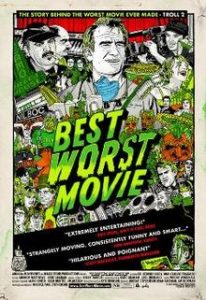
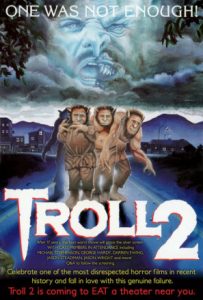
In our last class discussion on the “Landfill Legend” article and the Atari E.T. video game, Dr. Sample briefly brought up the concept of paracinema, specifically the idea of “bad” film. People discussed the entertainment value of bad movies or video games, and the idea of something being so ridiculously bad that it becomes good. I found it interesting to note that the “Landfill Legend” article mentions that people tend to not be as tolerant of bad video games as bad film. I was fascinated by the cult followings some bad movies have gained over the years, seemingly to the extent that intentionally bad film has become a sort of art form in itself. For me, the movie Sharknado comes to mind as an example when I think of a cringe-worthily bad film that has gained an enthusiastic fanbase. Of course, these films can’t just be simply bad, but a specific type of bad – usually involving self-awareness of its badness and irony. For example, I examined the movies Troll 2 (1990) and its spinoff, the Best Worst Movie (2009). I haven’t seen either of these films in their entirety, but Troll 2 is often considered one of the worst movies ever made of all time. The Best Worst Movie was directed by Michael Stephenson, one of the child stars in Troll 2, and is a documentary about the making of Troll 2, acknowledging the film as infamously bad.

Troll 2 Movie Poster
Best Worst Movie Poster

If you compare the ratings between this film and Troll 2, you’ll see that while the original film received atrociously low ratings, the documentary received quite positive reviews. This made me think about the question of what makes a film “good.” And if a bad movie can become good, is there even distinct criteria? In modern cinema, with the rise of experimental film and film that can’t quite be placed into categorical boxes, there seems to be not only a blurring of the distinction between high art and low art, but between genres as well. Many previously recognizable genres have died out over time – i.e. the old western, film noir, etc. Now, in the era of the Internet, the accessibility of all kinds of film has made genre virtually infinite. There are now subgenres, and even subgenres within those subgenres – and the rise of parody, fanfiction, and remix culture. Sure, paracinema can be considered a genre of film, like any other, but it makes me wonder if the idea of genre overall is dying out as we progress into the digital age.

Unlocking your fingerprint passcode without your fingers

Passcodes can be hacked, but now it seems that fingerprints can be hacked too. A pair of detectives asked Anil Jain, a professor of computer science and engineering at Michigan State University, to help them unlock a phone that was evidence in a murder investigation. The victim’s Samsung Galaxy S6 phone required fingerprint identification to unlock. The detectives already had the victim’s fingerprints (he had been arrested before) on plain printer paper. However, human skin is conductive and the whorls and ridges on our fingerprints create unique conductive patterns that biometric use. So the computer scientists tried printing copies of the fingerprints onto special conductive paper (similar to photographic paper). After some trial and error, the team was able to digitally enhance a victim’s fingerprints and print these improved images onto conductive paper, successfully giving detectives access to his phone.

The fingerprint passcode for the Samsung Galaxy S6.

What gave me pause toward the end of the article was the distinction between an alphanumeric passcode and a fingerprint passcode in the courts. A passcode is considered an intangible thought in the owner’s mind and so police can’t order a suspect to reveal his or her password. But a fingerprint is physical evidence, like blood, so the suspect can be ordered to produce his or her fingerprints. By this logic, a person who is concerned about the police requisitioning their phone should always use an alphanumeric passcode as a precaution. You can be legally forced to unlock your phone if you use a fingerprint passcode so an alphanumeric passcode would protect you from that situation. Yet breaking that passcode is much simpler – watch the person enter the code, see if there is a pattern on the glass, guessing birthdays or other common passwords, etc.

For the detectives, the phone they were trying to access belonged to a deceased man. Since he was the victim, the detectives were allowed to access his phone. The victim’s fingerprints were already on file so the detectives didn’t need to request his fingerprints. But what should the average person do if they are concerned about the privacy of their phone after their death? In the interest of preserving privacy, should people request that their phone password be changed to an alphanumeric code by a trusted loved one before they die? This would preserve their phone from being used by any law enforcement and would give the loved one access to the phone. Or should a person use a fingerprint passcode, which would allow the police access to their phone but would restrict their friends and family from accessing the phone? In a way, I suppose it depends on what kind of secrets your phone holds and who you’re trying to keep them from: the police or your loved ones.

Being foreign is the equivalent of having green blood

With the introduction of the internet to our lives the dynamic of communication has changed forever. One significant change is the fact that our present is most different from any other time in our history, or at least has the potential to be. What I mean by that is that we aren’t using the full potential of the internet and our present technology to change our current reality. We’re merely adapting this new technology to our old ways. Instead of using the internet to better communicate and prevent propaganda and ignorance, we use it to further confuse and manipulate reality.

Kocurek writes about using green blood for enemies in video games to make killing them seem less impact and important. That enemy, with green blood, is someone other, someone unlike me, so it’s okay. This is a very troubling line of thinking which we actually employ heavily in the western world. Take a look at Hollywood for instance, and count how many villains are foreign people. It’s troubling, because xenophobia is an incredibly dangerous phobia which can one day even end the world, or at least the human race. Making a villain foreign is the equivalent of giving the villain green blood. The only difference is that being foreign is a very common thing, having green blood isn’t real. The green blood in our reality comes in the form of accents we’re used to seeing on “bad guys” in any kind of media.

The sad thing is it’s just bad writing. The problem isn’t that the villain is foreign, but that most times, the villain isn’t given the spotlight enough to connect with the audience. It’s actually a very powerful and important part of writing, that when executed successfully, tends to create much better stories. The Dark Knight is a great example of that, but there are many others. The Joker becomes a character we understand better and in many ways sympathize with. When a “bad guy” is shot, and the only thing we ever learn about them is that they have an accent, or they’re wearing a turban or whatever, then that’s just shallow writing. I am a firm believer that viewers of all media should always care when a death happens. We shouldn’t be desensitizing people to death, we should be working towards an approach where we treat the deaths of others like we do of our own.


Tesla Magic

We’ve read articles on the dangers of the auto-driving Tesla features, the fears of depending on artificial intelligence, the future of technology in our everyday lives.

But however much some people may fear the advancement of technology, we will continue to be enamored with the progress of technology. Tesla’s technology isn’t perfect – far from the futuristic intentions of a self-driving car. Yet, Tesla is the hottest car on the market. On April 10th, The Washington Post reported that Tesla is the most valuable car company in America. Even when the car is ridiculously expensive and the company ends up losing money with profit versus the cost of producing the car, the shares of the company continue to rise.

The technology surrounding the Tesla is captivating for people. Much of that draw is due to the founder of the company, Elon Musk. A billionaire businessman and entrepreneur, Musk is responsible for some of the most innovative technological companies of the 21st century. In addition to Tesla, Musk also runs SpaceX, a new private space firm that may take rich people up into space for commercial reasons in the near future.

Photo of Elon Musk, courtesy of his Twitter page.

When celebrities are involved, the products that they stand by are sought after, even if all the bugs haven’t been worked out yet. We’ve seen in the news articles that the Tesla can kill you when the auto-pilot tool doesn’t work probably. Death by robot is not what the companies Musk runs are aiming for, but many of them are dangerous enough to potentially lead to that if anything goes wrong. In the “Death by Robot” article by The New York Times that we read for class, they talk about how cars have to know how to play the “game” of navigating the world of driving, which involves making decisions based on the environment around you. Tesla isn’t ready for this yet – the car can drive itself at one speed, but can’t make decisions that humans can to completely drive from one place to another.

But as long as Elon Musk continues to promote the virtues of the Tesla, and his influence continues to spread far beyond the sphere of business, his shares and public interest in his advanced cars will continue to climb. The Washington Post lists his worth at $14.5 billion, and his influence extends to the Trump administration, tech companies, and the general public. Tesla isn’t the self-driving car of the yet, but with the celebrity figure of Elon Musk backing it, regardless of the technology, people will keep buying it.

Death in the Digital Age and 13 Reasons Why

Last Friday, Netflix released its adaptation of Jay Asher’s 2007 Novel Thirteen Reasons Why. The show centers around a a group of high school students dealing with the aftermath of a girl who committed suicide, who recorded thirteen tapes before she died, each one addressing a particular person and detailing how they influenced her decision to end her own life. The show expands to deal with a variety of topics, including high school relationships, substance abuse, sexual assault, and suicide, but the show immediately struck me with the two ways it marries technology and death.

Here’s a link to the trailer: ► 1:59

The first and obvious way the show and book marries death and technology is with the tapes that Hannah records before she kills herself. Clay, who the show mostly centers around as it moves between past and present as he works his way through the tapes, initially receives them in an ambiguous package, only to pop in the tapes and hear Hannah addressing him seemingly from the beyond. The premise reminded me of the spirit phone even though we know Hannah is very much dead. While the book came out the same year as the iPhone, Netflix updates the technology for today’s high schools, but stays true to Hannah’s decision to use tapes – an outdated form or recording – to address her classmates. There are a few exchanges surrounding this decision: Clay struggles at first to find something to listen to the tapes on, and there is a scene in which one of Hannah’s friends tells her mixtape are a lost art. Just like how burning someone a CD in high school rather represented a thoughtful act rather than just sharing a playlist with someone, the nostalgia and intimacy of the tapes seem to be a more appropriate medium for a posthumous address. While the technology is modern enough for Hannah to address her classmates after death, they seem to represent the fact that these students are haunted by their past, and I do not believe a simple recording on an iPhone or a purely digital medium would have had the same effect.

The show also speaks to how technology has affected high school relationships and friendships and how it exacerbates a lot of problems people that age already face: cliques, rumors, and reputations. Hannah’s downward spiral begins when she’s on a date and a playful photo taken at a playground ends up becoming a photo of the view up her skirt. The boy’s friends see it and quickly spread it, and by the next class period all of the phones in Hannah’s class are pinging off with the photo, and suddenly like a virus the rumor spreads that they did a lot more than just kiss. This rumor haunts her as she tries and forms friendships at her new school, and if you believe in the butterfly effect, a single photo ended up driving a girl to kill herself. The show can be tough to watch at points given some of its content, but definitely still worth watching.

Love in the Digital Age

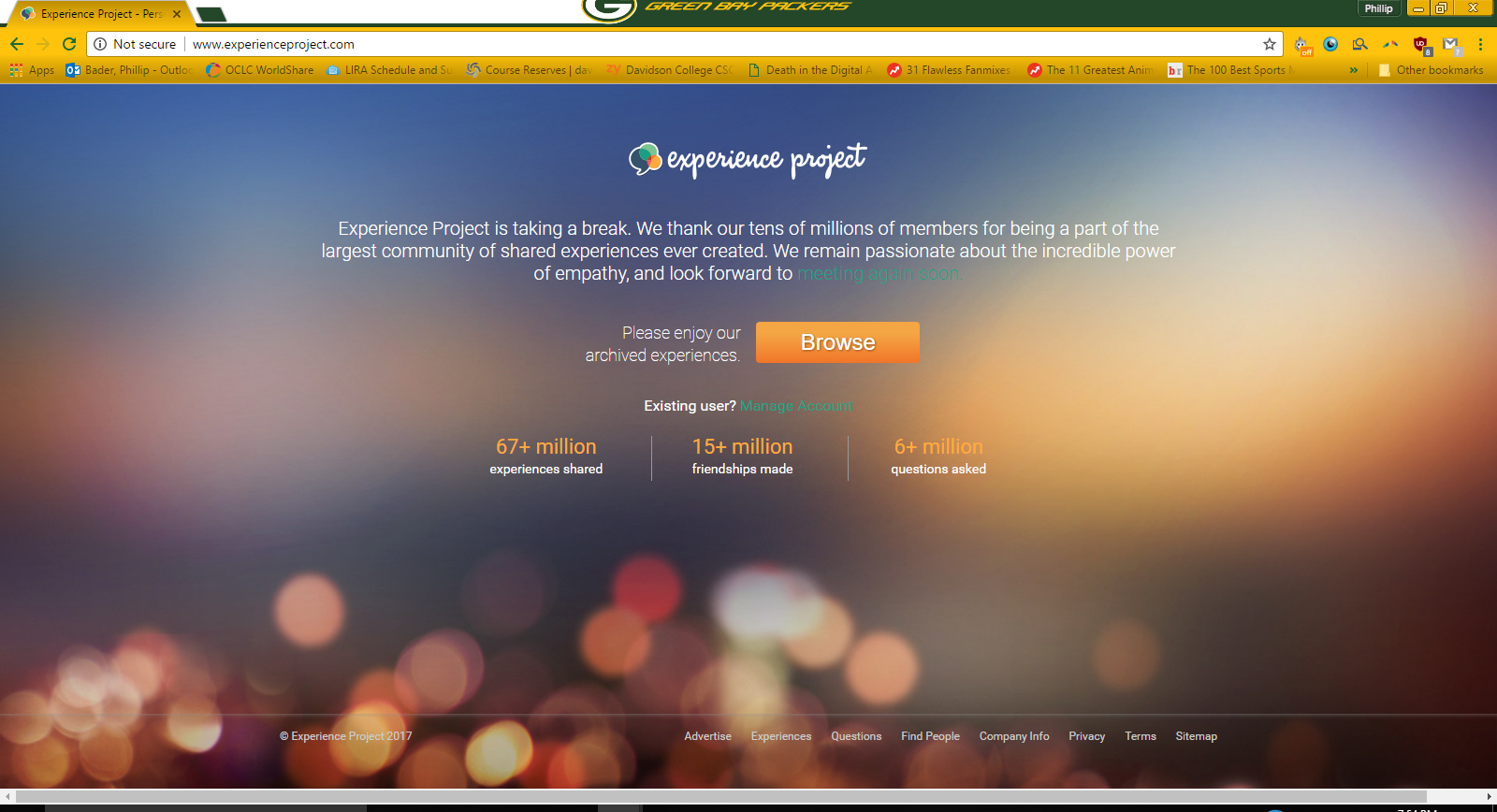
I found a Verge article that I found pretty interesting, and I think it brings up some good discussion points. It follows the online relationship of two people, IamDRock and Rainbowdasher, on a now-dead site called the Experience Project (or EP for short). While much of the article follows the course of their relationship, it also brings up questions about relationships, both on- and off-line, as well as how the internet affects the universal human desire for connection.

myworldsthoughts.wordpress.com/2012/11/26/how-does-online-relationships-work, Accessed 4/6/17

But first, some background. The way EP worked was that users could post a story,  thought, or even just a feeling, and other users could “join” that experience, enabling people to connect in ways beyond simply both going to the same high school or both rooting for the same basketball team. Unfortunately, this inventive format proved to be unwieldy and hard to decipher, and EP shut down early last year. The site still exists (you can visit it here) but only as an archive, a collection of past memories and moments. For people who never used it, it’s like “uncovering a yearbook in someone else’s attic” as the author of the article puts it.  The ups and downs of IamDRock’s and Rainbowdasher’s relationship is in plain view for all to see, in its entirety. You can read Rainbowdasher’s post about their first kiss, or see IamDRock defend the fact that Rainbowdasher even exists at all. As the article says, EP “allowed their narrative to be told in real time, with an interactive Greek chorus following along. The downside of that immediacy meant the death of the forums also signaled the death of the story.” When EP was live, users could follow along, joining in with their criticism and comments. When EP died, they were cut off.

What Experience Project currently looks like

While the author attempted to follow how the relationship fared once EP shut down, I was more interested in this idea of love or relationships becoming…outdated. Think of how many social networks are out there, from Facebook to the multitude of start-ups in Silicon Valley right now. While each one is unique, bringing something slightly different to the table, the basic service is the same: to connect people with each other. While we focus mainly on how the digital age has affected death as a cultural force, it’s easy to forget the internet has affected relationships just as much, if not more. It has never been so easy to find like-minded people, to make some sort of connection, even without ever actually meeting them. And yet, at the same time…it’s never been harder. The sheer amount of social websites and apps means that we create different versions of ourselves in each one. It has become so difficult to parse through all the filters and fronts to reach the real people behind them.

With all that going on, maybe that’s why i found IamDRock and Rainbowdasher’s tale so moving. Here are two people who, despite all odds, seemed to have made a genuine connection. But then, through no fault of their own, it was severed. If Facebook went under tomorrow, what would happen to all those relationships? Would you put in the effort to move to another website, to try and remake all those connections? At what point does a digital connection become a meaningful connection? I don’t really have an answer to any of this, I just believe it’s worth thinking about.

True Funeral or True Bullsh*t?

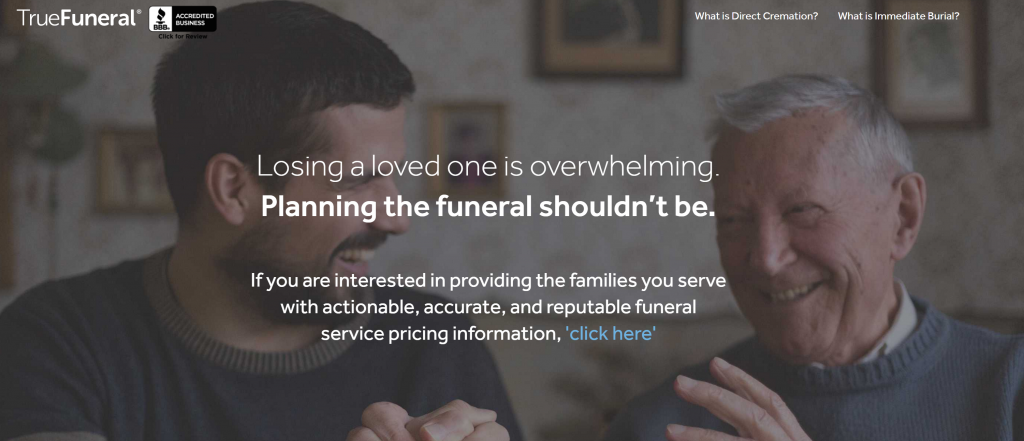
screenshot of TrueFuneral’s homepage

In the midst of stressful job applications, one of my apartment-mates told me about an interesting startup that she had applied for called TrueFuneral.  Basically, their whole mission is to provide “online platform that empowers families with accurate and actionable funeral service pricing information” (quoted from their LinkedIn page). A couple things about this startup company strikes me as interesting with respect to our class discussion and readings. I checked out their TrueFuneral’s website, which was very straight-forward, clean, and simplistic in design. The first image that is spread across the home page is a young man and an old grandfather seeming to be in mid-laughter during a conversation. The words spread over their faces in large font size but non-aggressive font are “Losing a loved one is overwhelming. Planning the funeral shouldn’t be.” I immediately notice how this website and this company make the topic of death as “happy” and life-like as possible. No one is mourning, natural-like lighting is used for the photograph, people are laughing and living, there isn’t a funeral, coffin, ern, or any implication of a recent death in sight.


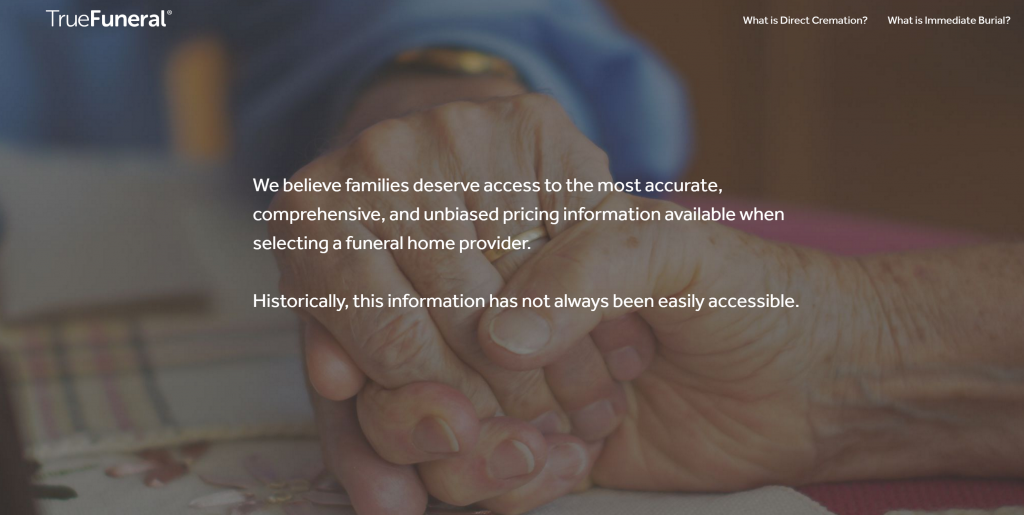
If you click the “About Us” link, more general information about the company shows up with similar photos. Mainly young people or families apparently dealing with a recent loss of their loved one. The only picture that displays old people is a zoomed in photo of a couple holding hands, but the frame of the image contains only their hands that are holding. Knowing that TrueFuneral is a company trying is profiting off of individuals and families grieving the loss of a loved one, whether there is mal-intent or not, this makes me feel a little conflicted. This company seems to do a good job of showing the best prices and options available for funeral services (or at least their website is doing a good job of convincing me of this). However, the fact that this company seems fixated on making its branding as far from death as possible makes me think about who is behind the scenes saying something along the lines of “Hmm… If we use this picture, will it attract more people to use our services over others and subsequently bring in more money for us?” This website made me think about the Australian memorial page that we looked at in class, and how the memorial pages that got the most “likes” were of those who were the least likely to have been associated with death (a natural one at least). I think it is also important to mention that my apartment-mate said that the company is going through a name change! Instead of TrueFuneral, the company will soon be called TrueSolace! So even the name of the company shifted its attention from the dead to the mourning. I guess it makes sense, this company can’t profit off of the dead!

screenshot from the “About Us” page on TrueFuneral

Though in class we discussed and read in class on whether there is a place for us to police grieving, I think in this case my policing of this company is different from that of our class’ criticisms on the Australian memorial page. The pages on the Australian website were made by those who were mourning. The TrueFuneral website, however, is made by a company trying to target those who are grieving.

Heaven is a Place on Earth…in a Database

After discussing various episodes of Black Mirror in class, I decided to go ahead and binge watch all of the episodes. One of the episodes that stuck out to me specifically for this class was episode 4 of season 3,  “San Junipero.”  The episode is ultimately about life after death through technology. San Junipero is a virtual town full of dead people’s consciousness who are able to live as their younger selves forever. The living but dying can visit the town for up to 5 hours per week as a trial to test whether they would like to be uploaded into the town. As with many Black Mirror episodes, the music can explain what’s really going. The songs: “Heaven Is a Place on Earth”, “Fake,” “Living in a Box,” and “Girlfriend in a Coma,” almost have ironic meanings since this heaven on earth is “fake” and is a literal box of data. The episode plays with our society’s notions of heaven and fear of death.

Different religions have different explanations as to what happens to humans after death. San Junipero provides it’s own explanation and relief from the anxiety of impending death and the fear of the unknown. The dying know exactly what to expect and have a choice of when to die and where they will go after death. The episode, like “Be Right Back” also plays with the notion of intimacy and love of something that isn’t totally real. If someone you loved chose to be in San Junipero would you follow? The episode shows the romance of an elderly dying woman and a middle age paraplegic woman, yet in San Junipero they are young, beautiful and healthy.  The question still remains   can technology replicate personality and unique qualities that make up a person? If stripped away of all the imperfections, are you still the same person?

I also found a very interesting article about a company that claims it can transfer consciousness to an artificial body. The company “Humani“, promises that within 30 years they can cheat death. Using nanotechnology, and artificial intelligence, Humai is saving the way people talk, their behaviors and thought process to recreate consciousness. The CEO of the company, Josh Bocanegra said, “I don’t think of it as fighting death. I think of it as making death optional. I personally cannot imagine why someone would want to die, but I respect everyone’s wishes.” I would imagine this endeavor is very expensive and if the technology is sound, will only provide access for the very rich. It is also problematic since we all know how finicky technology could be. What happens if the data becomes corrupted or broken, a virus is installed or God(?) forbid hackers try to infiltrate the system. The last scene of the episode truly shows the frailty of San Junipero and this technology as the after life of individuals is stored in a huge warehouse run by robots. If an accident occurs, will your afterlife be cut short?

Painting Dead Celebrities as Saints

During our class activity on Tuesday about the re-enchantment of dead celebrities, people seemed to agree that Robin Williams stood out from the other names on the list because he was always perceived as a “real person” while the others had been idealized and iconicized. My group discussed how this reverence for celebrities was a phenomenon that almost always occurred after their deaths – this was a trend we saw especially in great artists and musicians throughout history.

After David Bowie’s death, I read a lot of articles pondering how we should reconcile his musical genius and legacy with the fact that he, and many other rock artists of the time period, unapologetically had sex with underage teenage girls.

www.thedailybeast.com/articles/2016/01/17/david-bowie-and-rock-n-roll-s-statutory-rape-problem.html

This specific article goes on and on for a while about other examples, but I want to focus on the first part in particular. The writer says, “Rock star escapades from that period have been glamorized for decades with no regard for how disturbing or illegal the behavior was. It became a part of the mythos – a disgusting testament to how little the writers documenting the happenings of the day cared about taking their heroes to task.” He goes on to add, “It’s convenient to go after Tyga and R. Kelly when we see hashtags or trending stories, and their behavior warrants every bit of scrutiny and criticism it’s gotten. But we cannot write off the alarming behavior of superstars past just because they’re older, greyer, or in the case of Bowie, newly-departed.”

Jimmy Page of Led Zeppelin and Lori Maddox, his 14-year old girlfriend

The idealized re-enchantment of celebrities after their deaths is interesting to think about in relation to the digital age because our relationships with celebrities have changed so much over the years. Think about Hollywood’s Golden Age. Celebrities like Marilyn Monroe were able to maintain a certain aura of mystery behind their image because of the distance between the famous and their fans. You pretty much only knew what you saw on television or read in the papers. Some people say that the rumored affair between President John F. Kennedy and Marilyn Monroe would certainly not be plausible in today’s world. Now with social media like Twitter and Instagram, people can keep up to date with their favorite celebrities by the minute. With the Internet and the modern speed of information, the lives of the famous are not so mysterious as they once were. (Hence, the article’s reference to the controversy surrounding Tyga’s relationship with Kylie when she was underage). This partly explains why the rock stars of the 1970s were able to get away with their behavior. Perhaps as technology continues to advance and our relationships with celebrities continue to evolve, celebrities will seem less like icons and more like “real people,” and the re-enchantment of dead celebrities as saint-like legends might be harder to come by.