Ghost In the Bear Guy – Ghostly Audio in Grizzly Man (sightings post)

This week I watched the documentary film Grizzly Man and I found some of the ideas intriguing and applicable to this class. The film is about a man named Timothy Treadwell who lived alone in the Alaskan wilderness and tried to make friends with grizzly bears. In order to help protect grizzly bears and spread awareness about them he films himself and makes documentary-style clips of him going through outdoor survival practices as well as explaining facts about the bears he spends time with. After about 15 years of living with and filming these bears as well as some other woodland friends (the movie feels a bit like Snow White with schizophrenia at some points) he ends up getting eaten by one of the bears he previously called a friend. Because he was making the film of his interactions with the bears he left the camera rolling during the entire time Treadwell and his girlfriend (who was accompanying him on the trip at the time) were struggling for their lives and eventually were eaten by the grizzly bear. In one clip of the movie Werner Herzog, the director of the film, listens to the audio from the bear attack (the video wasn’t recorded as the lens cap was left on the camera) and his reaction is what one would expect when seeing someone listening to the audio of another person dying a violent death.

[youtube www.youtube.com/watch?v=wUf0QFFi2Mk&w=560&h=315%5D

I find the existence of this recording to be a unique type of ghost-centric haunting and I can’t honestly imagine why anyone would want to keep the footage. I think the reasons are grief-centric, making me think back to our post-modern grief-based product design and wonder – if a business offered to sell people audio or recordings of their loved ones’ final moments would people buy them? Would they listen to them? As with a lot of these goods and services I can’t imagine investing myself because it’s very disturbing to me but I actually think people might like the idea.


Dying art: Urs Fischer’s sculptures are processes, not artifacts

Full view of the 2011 Venice Biennale installation

When reading the Fusion article by Ethan Chiel,  a particular moment immediately reminded me of art I’d seen. The pieces I thought of were two sculptures by Urs Fischer, and they were displayed at the 2011 Venice Biennale. The most visually striking of these sculptures, to me, is his reconsideration of a classical sculpture, Rape of the Sabine Women, but his rendition of contemporary man  is certainly more chilling conceptually.

Fischer’s “Rape of the Sabine Women”

Jonathan Jones, an art critic who saw the exhibition, wrote that “Fischer’s candle-man haunted me later when I was walking the decaying streets of Venice. It will haunt me for a long time. It is a beautiful, funny, frightening emblem of time’s fatal arrow.” Times fatal arrow, then (death) dramatically effects not only the emblem of classical and “eternal” sculpture, but those of us who observe and admire it. Even art cannot be so idealized as to stop death.

Chiel reports that the manager of a Twitter-bot account, which strikes me as something in between performance and technological experimentation, said: “Bots are ‘processes, not artifacts.'” He continues, “A bot’s survival beyond his lifetime or the lifetime of Twitter is ‘about longevity of the algorithm, more so than the actual piece of code running.'” The “code,” here, is Fischer’s wax, continuing to run down its own form until it disappears. Think of slowing this process to the point that even after the death of the artist the sculpture would still be changing and evolving as the artist intended. I think that here’s an interesting intersection, here, between art, technology, intentionality, time, and death.

Fischer’s melting man
Continuing to melt

When the Cloud Breaks: Amazon’s Cloud Glitch

While I was sitting with a friend this afternoon at on campus Summit, she received an email which read,“As you know, there is a nation-wide cloud outage, and Handshake is not working. In order to alleviate any concerns that you have, we are extending the Davidson Impact Fellowship application deadline to at least tomorrow evening at 11:59 pm. Please stay tuned to our social media accounts for any additional updates.” The rhetoric of the email immediately reminded me of this class, so I figured that this would make a pretty appropriate “Sightings” post!

After doing more research about this nation-wide cloud outage (which I had no idea existed until my friend showed me this email), I discovered that Amazon.com was the culprit that triggered this lengthy problem on its cloud storage service, which caused widespread frustration among other online services. Reactions to this occurrence spread like wildfire onto outlets such as Twitter, with the hashtag, #awsoutage becoming an instant trend. Below are some screenshots of some humorous tweets in response to this problem:

In an article written earlier today about the issue, Ángel González states, “In Amazon’s case the cloud service may have been so robust that it lulled users into an exaggerated sense of security, and yielded a bigger shock upon failure.” This comment reminded me of our conversation in class about the “technological imaginary” and the binaries we created about what we imagine technology to be versus what it really is. We imagine technology to be safe, secure, and ideally, unbreakable. However, situations like this nation-wide cloud outage obstruct the trust we normally attribute to our devices. I find it especially interesting how the people who were frustrated about this issue took their complaints to spaces like Twitter, which also exists within the larger cloud. It is almost as if it has become human to turn to technology to express emotions regarding the “death” of other aspects of technology.  

Additionally, the wording of the email quoted earlier is also definitely worth some inspection. It begins with “As you know,” which indirectly blurs the division between the technological world and the world we are living in. It was assumed that my friend already knew about the issue because of the interchangeable qualities of real life and technology. We have gotten to the point where digital malfunctions limit what we can do and dictate how we live our lives. Although it appears as if the normal course of operations is back on track, it is important to use this occurrence as a reminder of how much “trust” we put into our devices and how we let the seemingly “secure” parts of technology control our everyday lives.

Works Cited:

González, Ángel. “Site of Amazon’s cloud glitch made it especially disruptive.” The Seattle Times. The Seattle Times Company, 28 Feb. 2017. Web. 28 Feb. 2017.

And the Terror Rained Down

I am an avid podcast consumer, and I was walking and listening to one particular podcast that struck me as postmodern horror happening in the real world way before its time.

The podcast I was listening to was Radiolab by NPR, the episode entitled “Fu-Go”. You can listen to it here.

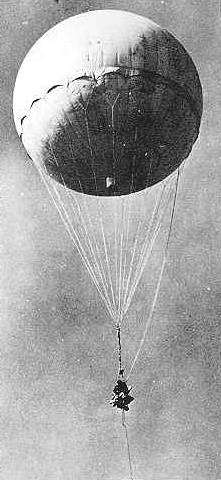
The story is about the Japenese hoping to rain terror down on the United States as retribution for some air force attacks the US conducted after Pearl Harbor. The Japenese military was stretched so thin during WWII that they couldn’t commit troops to go and attack the U.S., so they put their minds to work, and came up with this:

A historical image of the Fu-Go balloon bombs made by the Japenese. Photo found here.

A bomb, a very special bomb. The huge helium balloon is big enough to carry it in the Jet Stream, a tunnel of air that can take objects from Japan and carry them all the way over to the West Coast of the U.S. Attached are sandbags, which loosen when the balloon floats too low, allowing it to stay in the wind current. When all the sandbags were gone, it dropped bombs.

Here’s a map of how the balloons got to the U.S. and where they were found or seen in North America. Imagine the horror of the people felt seeing the balloons and watching them cause explosions. No one knew where they were coming from until scientists analyzed the sand inside the sandbags and the fabric used for the balloons.

Map of the path the balloons took across the Pacific from Japan to the US and where they were found or seen in North America. Courtesy of National Geographic.

While these bombs never created the true terror that the Japenese were hoping for, in its own way, they are a kind of technological monster that follows some of the disaster scenarios that Susan Sontag lays out in her essay. This thing, this strange balloon, arrives, but no is sure quite what it is or what it does. And it was not until the bombs start blowing up near big cities that the military took it seriously and started investigating where they came from. There is also a hero of some kind in this story: a sheriff that sees one of the balloons and wrangles it to stop it from flying away, which finally allows the military to find out what it is. And while there is no ultimate weapon needed to attack Japan, this real-life version of creating a disaster horror does follow some of the main points typically seen only in fiction.

Similarly, these bombs can fit into Cohen’s “Monster Culture” essay, in Thesis IV, which describes how history itself can become a monster, incorporating the events of real life into a kind of monster. As revenge for America’s destruction to their cities, Japan hoped to introduce their own technologically advanced, mysterious, deathly monster to the United States.

To learn more about the Fu-Go bombs, visit NPR History, the History Channel, and Project 1947.