With recent developments in all technology, military technology has followed closely, producing more and more unique answers to warfare. Countries around the world are spending billions of dollars competing for military power. Some of the most sophisticated and in turn terrifying military advancements come directly from the US. The notion of fighting a war from your backyard is something truly remarkable and questionable.I personally did not think something like drone warfare existed until a few months ago. I heard about it, but I did not understand what it actually meant. In just the last few years around two and a half thousand people were killed by drones. Despite the many advantages drone warfare adds, it remains a questionable topic due to the ease with which it can be applied, and how little needs to be sacrificed. Originally, one of its main purposes was to put a soldier in the situation that would allow him to operate without fear, which would save the life of civilians. However, this purpose fails as results showed that hundreds upon hundreds died since U.S. military introduced drones to the warfare. This technology allows soldiers to have a wrong perception of war, in many ways trivializing the topic. You have a remote control that allows you to kill people without any connection to the aftermath. In the article Death by Robot by Robin Martinez, a robot is asked to give a dose of painkiller to a woman that suffered from two broken ribs. Although the robot is not capable of deciding whether or not a woman really needs painkillers, it still must make a decision, bringing about a problem. When we, and we definitely will, start using AI to fight our wars, the ethics of warfare will need to be entirely rewritten.
A postmodern-horror-video-delivered-in-a-postmodern-medium sighting! Alan Resnick emerges!
Resnick is a video artist whose first YouTube creation was an uncanny video series on the tutorial genre. “alantutorial” oscillated between hilarious and disturbing as a high-pitched, odd character demonstrated how to eat a bag of chips or pick up a blue chair off the ground. His seemingly useless tutorials often escalated in unexpected and weird ways — like when he starts crying and throwing a tantrum when he can’t actually figure out how to pick up the blue chair off the ground.
Resnick proceeded to create short videos for Adult Swim; his combination of dark humor with uncanny horror became his signature. In “Unedited Footage of a Bear,” the frame opens on a literal bear. He is majestic, calm, and free. It’s the only moment of peace in a video that quickly devolves into chaos, panic, and violence.
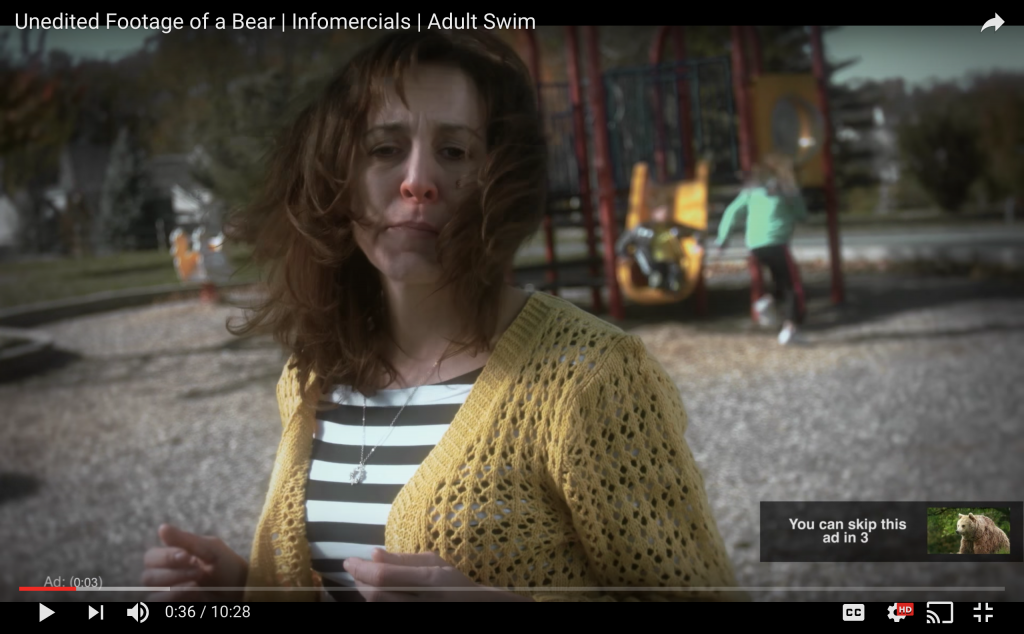
But first, the footage fades into an ad. A mom sneezes and looks miserable as her kids beg to play — she happily pops a pill and get back to her regular life!
Screenshot “Unedited Footage of a Bear” YouTube
If you let the video continue to play, the mom gets into her car, smiling widely. She is still performing for the “commercial” as a cheerful female voice lists off a barrage of side effects in rapid succession. Slowly, as the voice fades, the mom’s facial performance drops. She drives back into her “real life,” looking exhausted as she rolls through her neighborhood.
Yes, that ad and that performance was a little postmodern Russian doll! This is media embedded in media, a video that sprawls beyond the typical YouTube format, an ad and a performance of an ad embedded into a larger narrative. If the viewer clicks “Skip Ad,” it actually directs them to a fake website for the drug the fake commercial was touting, Claridryl.
The rest of the video imagines the mental breakdown of this mom, as her Claridryl alter-ego — spun out on pharmaceuticals that triggered total darkness rather than enhanced health– hijacks her life. There is one scene where the mom is literally beaten and run over by this alter-ego, suggesting a total lapse of control.
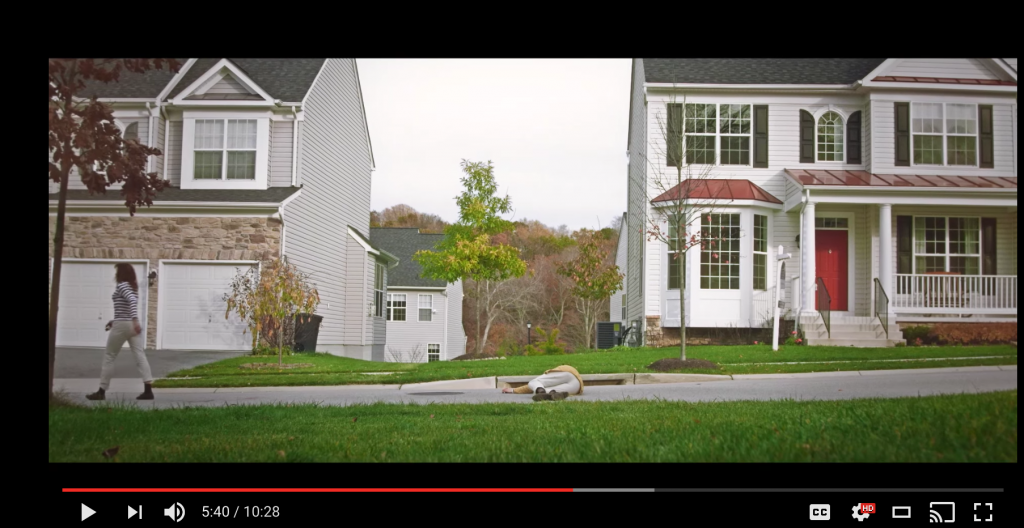
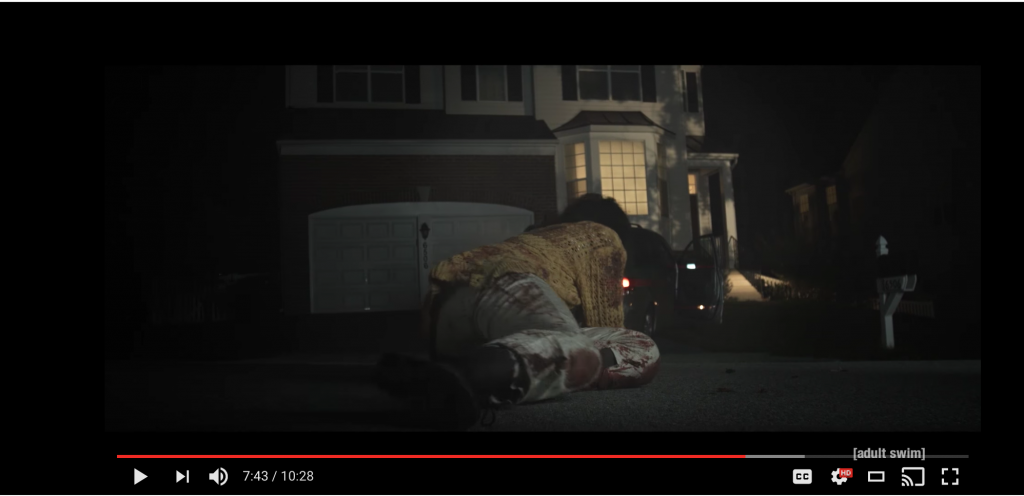
This is reminiscent of the postmodern body horror we discussed in Paul Tremblay’s A Head Full of Ghosts. The horror is located in failure of the body to adhere to societal standards, an ambiguous loss of control and the tension between mental illness and demonic possession. This all appears the case in UFOAB as the alter-ego proceeds to ransack the mom’s house and threaten her children while the mother writhes on the ground outside the house, beaten and bloodied, able to witness the destruction but not get up or control it.
Mom (right) is beaten in the street by her alter-ego (left). Screenshot.Mom does not have the power to stop the horror inside the house. She crawls on the ground outside but cannot get up. Screenshot.
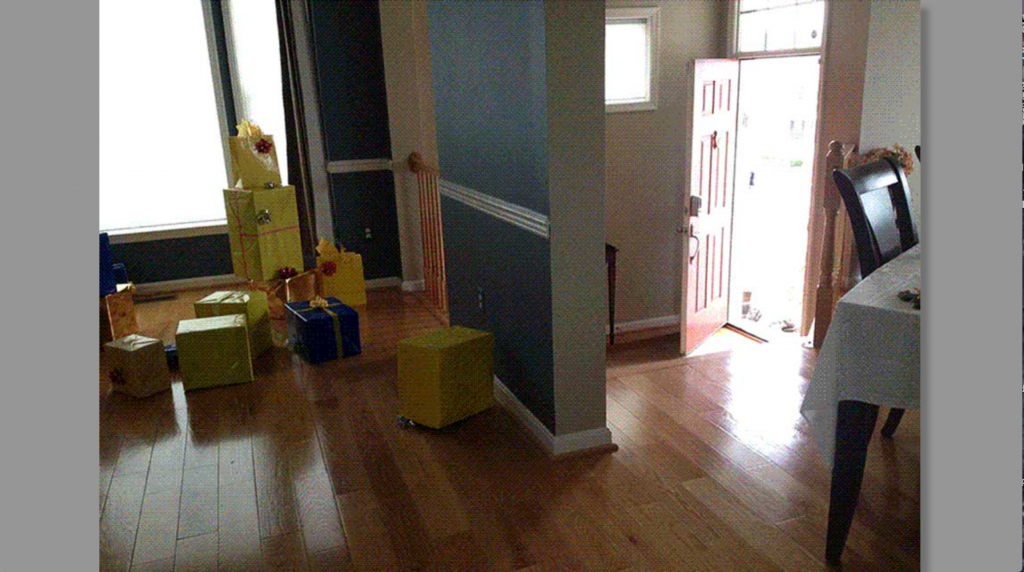
This postmodern narrative is set within an equally postmodern media format that combines nested video footage with an interactive website. As users click around on the Claridryl website, they will find surprising hidden “easter eggs.” For instance, you’ll notice a house in the background of the main banner image. If you click on the house, it draws it slowly into the foreground — and then it takes up the entire screen, but becomes an interactive, click-able image-scape. You can actually enter and explore the house as it appeared in the video in scenes where the alter-ego took over.
Entering the house from the video via the Claridryl website. Screenshot.
Linger on the main part of the website for too long, and it will slowly fade to grey…with a tiny GIF of the alter-ego perpetually running towards you.
Screenshot Claridryl website with alter-ego running figure.
Resnick achieves a totally creepy experience by layering his content and diversifying his mediums. The horror or Claridryl spans beyond the ten minute video; that horror builds and builds as you click through the nauseatingly designed website, as you find the house discover other uncanny imagery within it, as you are left with so many unanswered questions as blue and red police lights descended on the mom’s still bloodied body.
I’ve written previously about online public grief and how I think that it is an inappropriate method to mourn. I have since then run into a phenomena that doesn’t exactly change my views, but absolutely does give more credibility that to the opposing side.
Enter gatekeeping. The Urban Dictionary defines gatekeeping as “when someone takes it upon themselves to decide who does or does not have access or rights to a community or identity.” Upon reading this definition, I realized that I’ve been seeing this online for quite some time now, and very often at that. The idea resonates very strongly with the concept of snobby, ‘elitist’ preferences. Have you ever heard someone berate music tastes? How can you say you like abc music when you don’t even listen to xyz?!?
The premise is that unless one meets some arbitrary rules or thresholds, they are not “allowed” to identify with a particular group or collective. A similar statement may be made of ‘grief police’, who publicly condemn those who publicly express grief online. You’re not seriously mourning! True mourners stay off the internet and express grief alone! While I still hold true to the assertions that I made in my previous post, I do concede that there is a non-insignificant amount of people who engage in grief policing that fall into the ‘gatekeeping’ category. These are individuals that want maintain a sense of exclusivity and elitism for the right to mourn. They come up with absolutely arbitrary cutoff points-which oftentimes, and very conveniently so, happen to just barely include themselves.
When I made my previous post, I alluded to the fact that while public online grieving might be inappropriate, it does not necessarily imply that the strong reaction that it garners is appropriate. In the lieu of having discovered (or rather, having become aware of its consistent presence in social interactions) gatekeeping, I definitely agree that those who bully people online into hiding their public online grief are just as bad as those I mentioned are milking the opportunity of loss for attention.
The topic we discussed a lot throughout the semester was how robots are taking over in the future. To be honest I found this topic absurd until I found myself in the self-driving Uber in the middle of Pittsburgh. In the article Death by Robot by Robin Marantz Henig there is an example of a robot who is taking care of an elderly woman who just broke two ribs. The real concern about the robot started to happen when Sylvia (an elderly woman) asked him for a dose of painkillers. How should the robot handle that situation? A robots priority should be to help a human without hurting one, but what criteria is the robot supposed to use in deciding what the best option is for a human? When my teammate and I got in the Uber, there were two guys sitting in the front seat. The guy who was sitting behind the wheel turned out to be the guy who created the self-driving uber. He explained to us later on that there are only couple of them throughout the United States and that they were still being heavily tested. He acknowledged the pitfalls of a self-driving uber, but he strongly believed that in the range of five to ten years we won’t be able to see an uber with a driver in the car. While he had to drive through downtown himself, he let the car drive itself once we got on a highway. It was a pretty amazing experience to watch how the car was reacting to other cars. To be honest there was not a single moment where I did not feel safe in the car. As I stepped outside the uber I couldn’t stop thinking about it, I was amazed at how technology is beginning to dominate more and more facets of our lives. For the first time I was able to acknowledge that things that seemed so distant from reality are actually right around the corner. Robots and AI are definitely going to replace humans in a lot more complicated tasks, which leads to the logical assumption that a lot of jobs will be rendered useless for humans, and then one has to wonder, where does our economy go from there?
r/place is a place dedicated to pixels. On April Fools Day 2017, Reddit administrators created r/place, an interface where users could place one pixel on a massive canvas once every 5 minutes. At first, the canvas was dominated by primitive, random or algorithmic drawings. However, once internet warriors formed factions to coordinate group efforts to draw more complex creations, the results were absolutely extraordinary:
This video (90fps!!! 4K!!!) gets better literally every single watch. There are literally thousands of small, intricate, drawings that end up populating the final product. But what is more relevant to the subject of the course (and in my opinion, more interesting) is the journey upon which each region of the canvas embarks. As r/place became more and more popular, each pixel became valuable real estate, and drawings fought tooth and nail for survival, or sometimes what can only be described as… pure aggression.
There were so many French jokes here that I could make that I’d rather leave it up to your imagination.
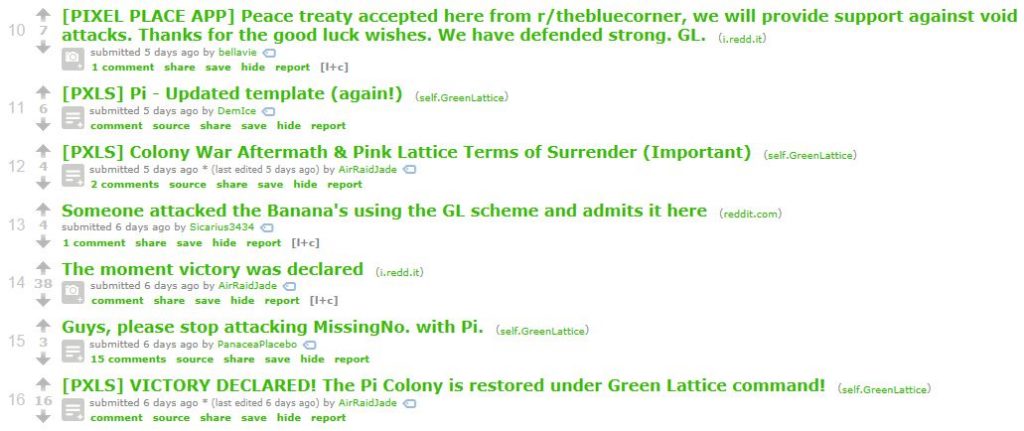
So how does this relate to death in the digital age? Simply put, There were thousands of little deaths on the canvas throughout the 72 hours it was active. Often, larger, more coordinated groups were able to overwhelm smaller and less dedicated groups and claim larger territories for their pixel art. And what’s especially fascinating is that much of the dialogue both internal to these groups and between them are recorded in the various subreddits that popped up during r/place’s lifetime.
Other, less populated subreddits’ posts are dominated largely by confusion, panic, fear, and posts blaming other subreddits.
I found the reaction of various factions to losing their territory on the canvas to be eerily similar to how groups of people might react in the real world to impending doom. Often, when drawings were being vandalized or drawn over, there was a certain point where it was clear that the battle would lost (when around a third of the pixels were gone, more or less). It was during these times that the losing subreddit would behave in ways that reminded me of the stages of grief. In any case, r/place is an absolutely fascinating case study for internet group dynamics and how individuals can form vast social networks in very short time spans, and how these networks can behave as an individual.
I was just reading through some of the posts and stumbled on Dusan’s post about power cuts in Serbia. I figured it’d be interesting to post one of my own experiences of the same situation in Montenegro.
So my family is sitting on that balcony, I’m inside the house (sorry, no pictures of the interior), watching some the very primitive TV we have available. I’m not really paying attention. In any case, it comes to be very late when suddenly everything just shuts off. Now, we’re not near the city, we’re in a village. A power cuts means complete darkness. It’s an interesting feeling being unwillingly exposed to the darkness, it feels very invasive actually. In any case, we all kind of conglomerate on the balcony to see what we’re going to do. My brother finds one of those wind-up lanterns, and before we know it, we notice wind-up lanterns and flashlights start going off on the balconies and porches of other nearby houses.
The first thing that follows is some form of communication between neighbors which usually never talk to one another when there is power. We wave our lantern, they wave there’s. There’s little background noise, soon we start shouting to one another across the field that is in the middle of all these houses (visible in the first picture). Before you know it, the entire neighborhood is throwing jokes from their own porches and balconies, usually serious people now making noises at each other and laughing. Inevitably, being that the power is out for so long, everyone conglomerates in the field in the middle, people bring food, and we sit around these windup lanterns talking about life, acting like a larger family. All conflicts are set aside, stories are being told, laughs are being shared. And then we hear distant yelling, and we know what it means. A nearby village has gotten power. I look over (again visible in the first picture, but not too well) the valley that’s beside our village, and spot a wave of lights turn on in different villages across the country. We start cheering as well, the lights go on in our village. We all separate, and tomorrow, everyone goes back to not talking and just minding their own business.
It really reminded me of some of the moments in Station Eleven, and I can’t get any of these images out of my head when we read the book. This post isn’t an argument against technology, but more of an interesting insight on a possible effect of a temporary lack of technology. I’m sure that if the power cuts lasted for much longer, that camaraderie would soon turn into chaos.
While growing up in Serbia, I witnessed some extreme events in the country. I am not talking about crime in the country or wars, I am talking about the world with power cuts. Just couple years after NATO bomb Serbia, the country was still trying to rebuild itself. During those tough times people all over the country would lose power and water for days. The same fate effected my family as well, for almost a week. After reading the book Station Eleven, from Emily St. John Mandel, I was able to recall so many of those memories. While she makes people think about life with no technology, I can vivid memories of it. There is not a better way to imagine life without technology than to take it away, and that is exactly what Mandel did to show her readers how reliable to technology we actually are nowadays. Back to my story, once the power cuts happened in the country my family and my cousins were all in one house. Phones did not work, lights were off, computers did not work…etc Bringing back these memories brought me to realization that at that time we lived like people in middle age did. Would it be weird if I tell you that one of my best childhood memories were made at that time? Even though we did not have all of the “unnecessary” things to be happy, my family and I had some of the best times together. My parents and my cousins were not able to go to work, they did not have a job (they were unemployed) and all of them were living in the moment with no stress. Every night my dad would make a fire and everybody would come together around the fire. We would be there for hours listening to funny stories and singing.
Nether isn’t exactly the best example for what I’m going to write about, but it is a good example nevertheless (and a personal one, which is more important)!
Basically, Nether was marketed as a game with a lot of potential, and it certainly stood out from its counterpart online survival horror experiences. It stood out because of its incredibly stunning visuals and vertical level design, which is very unique in the genre. Most online survival horror games are very flat, in that they span over large amounts of land, and the buildings are usually never actually tall. I don’t know why it took so long for someone to make a survival horror game in a city, but it doesn’t matter. What’s more important is how this game has simulated the apocalypse in a way it couldn’t even anticipate.
What started off as a very successful marketing campaign, and many followers, is now a dead game, with about 8 empty servers still running. It’s a meta-apocalypse that no designer intentionally accounted for, but playing through it the last few days, has made me think how incredibly effective it actually is. So I used to play this game when I had some free time a few years back, when it was full of players, and full of player killing. It was a very action-packed experience, with many conflicts and many climactic moments in ever playthrough.
Playing it last night was a completely new experience, and I actually loved it. The server was entirely empty. Basically, I was the last person alive, other than a few merchants in the game. And the experience was so much more immersive, I felt so alone and vulnerable. I realized the importance of other people in a horror game like this. There was nobody to clear the safe zones! So all the safe zones were overrun constantly, and I had to just hide out from building to building, snacking on some things I’d find to eat and drinking the occasional bottle of water. Being that the safe zones were overrun, I could never reach the merchants to store items, so everything I did had so much more gravitas.
It’s interesting, and I don’t think it would work in any other scenario. It’s not a single player game, so when it becomes single player, the experience is incredibly unique. I don’t think if the game was designed to be single player, the effect would be the same. In fact, I’m certain it wouldn’t. It was the lack of design for this to be a single player game that made it so incredibly new and fresh.
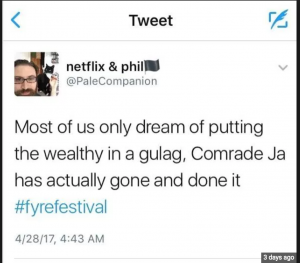
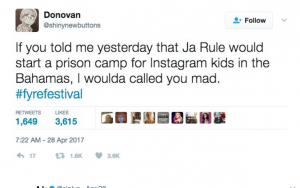
If you’ve been on the web this past week, you saw the panic of festival attendees unfold on Twitter while the rest of the web savored the moment to witness rich kids get punked by even richer kids in real time. Fyre marketed itself as a luxury get-away party, made complete by the presence of celebrities, models, and five star cuisine. Bored between musical sets? Hop on a jet ski and hunt for hidden treasure around the island — you may find cash, jewelry, or even cocaine from the eighties! (Somehow, a selling point in promotional materials was that the “private island” was “once owned by Pablo Escobar”).
Of course, the festival presented in the flashy videos and sexy social media posts was never going to be a reality. Co-founders Ja Rule and McFarland cobbled together a media Frankenstein/siren hybrid from fantasy and the transmission of digital bits. Social sirens — the models and celebrities paid to post about the event — lured the masses close enough to be entranced by the slick surfaces constructed out of other festival footage.
Video game scholar Raiford Guins detailed the lifecycle of failed 1980s Atari game E.T. The Extra Terrestrial. The game was panned by critics and returned en masse by consumers; Atari’s solution was to take all their copies of the game and unceremoniously dump them into a landfill. At this point, the game was cemented literally underground but also as a mythical representation within video game history. The physical death of the game cartridges was only the first step to immortalize the story of the game.
Just as Atari enthusiasts endeavored to uncover the game, I’m sure that Great Exuma island will begin to see its share of tourists searching for relics of dead Fyre Festival. The Festival died — in fact, it never really came alive outside of the digital promos — but the commentary and curiosity will live on. Enabled by the digital lens that shifted into hyper-focus on the event (cascades of tweets, incredulous Reddit threads, barrage of news articles), Fyre morphed from a festival into a totem where we can critically confront (and see, on uncomfortable display) celebrity obsession, conspicuous consumption, erosion of the social contract, and class consciousness among other abstract concepts. The fest may be dead, but Fyre-as-symbol lives on.
In class we talked frequently about our social media accounts after we died. We were interested in knowing whether the black mirror episode could become true in our lifetime. Later in the class, we created morbid social media services that would cater to different aspects of our life after we die. Although we all laughed awkwardly talking about these social media projects- come on, “DeadBook” or a tree-planting service for our bodies, really?- Dr. Sample suggested that many of these sites probably already existed.
I was interested in seeing whether these applications and websites did actually exist so I looked into it. The first one I found, called “LivesOn” was first created to tweet for you when you were busy doing other things. But then the marketers realized they could make more money and buzz if they advertised it for the dead. Their tagline was “When your heart stops beating, you’ll keep tweeting.” Unfortunately, it seems like the app only spliced together your old tweets to provide an unintelligible string of something that sounds like you. I believe it failed after people realized the tweets were unintelligible, but this service mirrors almost exactly what one group brainstormed in class.
I actually found many different sites that promised to tweet after you died, or upload a video to Facebook if you died, and things similar to that- but many of them had failed and their websites led nowhere. (One was even called “DeadSocial“, so we were close with DeadBook or DeadSpace!)
It made me wonder why people were either against this idea, or why these projects kept failing. Let’s preface this by saying I have no idea, but I think it’s likely because of two reasons. Either the technology is so far off from the infamous black mirror episode that it is impossible to “recreate” you without reliable Artificial Intelligence. Or second, that people are against the idea of reading/interacting with people like that after they died. That there is something disingenuous and fake about interacting with a robot pretending to be a human rather than having their own self-created personality. It would get really boring interacting with a personality or avatar that you know someone else created, right? We’ve always thought of technology as a force that makes our lives easier or more manageable, but never thought of it as its own being. So if we create artificial personalities, it just seems that we would never really get over that unless the personalities create themselves.

 Retrieved from: www.hardwarezone.com.my/tech-news-ai-experts-and-researchers-demand-ban-ai-used-warfare%5B/caption%5D



 Retrieved from:




 Source