
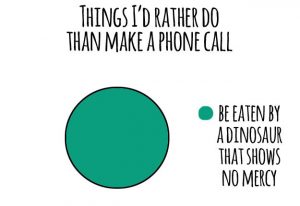
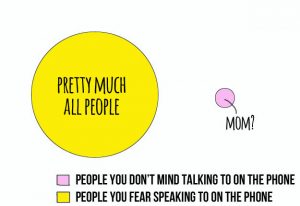
Although modern telephone calls differ from the type of audio reproduction we read about in Jonathan Sterne’s “A Resonant Tomb,” I couldn’t help but think about how the way we communicate in 2017 has evolved throughout the past hundred years or so and has come a long way since the invention of the telegraph. Some people believe that we have reached an age of the death of the phone call – at least, for millennials and younger generations. We tend to prefer text over voicemail to get a message across to someone, and often dread making phone calls. The following memes demonstrate this sentiment:


Nowadays, phone calls are often thought of as an interruption or inconvenience. Moreover, they seem more intimate than a text message conversation, perhaps in large part because of the audio of a personal human voice. With the increase of phone apps and services, we can often even avoid making phone calls to set up appointments. Phone calls have typically become reserved for very close friends, family members, and romantic partners. It’s interesting to note that Skype and FaceTime, which more closely resemble face-to-face interaction, still seem to remain popular. So perhaps it’s not simply the intimacy, but something about the voice itself, or the voice only, that makes us uncomfortable? It’s also interesting to note that with the exception of voicemail, text communication is preserved in the sense that Sterne discusses, while audio communication is fleeting. In fact, while a voicemail or voice recording can only last for so many minutes or hours, a text thread can capture days, weeks, months, even years worth of back-and-forth conversation. It’s quite common for people to delete their text threads with their ex-significant others after they break up. Some people find rereading old text messages to be painful because they are reliving the experience in some ways. Can people be preserved through their texts messages after their death, despite text having no physical human characteristics such as image or voice?
Work Cited
Sterne, Jonathan. “A Resonant Tomb.” The Audible Past: Cultural Origins of Sound Reproduction. Durham: Duke University Press, 2003. Pages 287- 311. Print.