
The cinematic survival-horror game Until Dawn and the zombie-apocalypse short story Zombicorns may both fall under the “horror” umbrella but the jump scares in the video game provide a much greater shock to the system than the philosophic, rambling musings of the narrator in the short story. As late postmodern horror, both exploit the subtle terror themes hidden in our daily lives. In her article “Recreational Terror: Postmodern Elements of the Contemporary Horror Film”, Pinedo writes that “horror exposes the terror implicit in everyday life: the pain of loss, the enigma of death, the unpredictability of events, the inadequacy of intentions” (26). In drastically different methods, both Zombicorns and Until Dawn amplify these commonplace terrors: the pain of the loss of a sister or close friend, the enigma of death and whether the undead are no longer human, the unpredictability of characters and effects of decisions, and the insufficiency of intentions when no action or unintended consequences follow. By analyzing how Zombicorns and Until Dawn incorporate these implicit everyday terrors, we discover these media ultimately continue the discourse on what makes a monster and how our actions impact our fate.
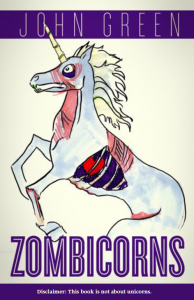
While the title Zombicorns may lead the reader to anticipate that the short story about zombie unicorns, author John Green quickly dismisses that idea with a disclaimer[1]: “This book is not about unicorns.” The “corn” part comes from how the zombies are created, which is from mutated corn. The narrator Mia explains that “the z’d” (the zombies) aren’t technically zombies; a person’s transformation is a result of contracting a virus called AMRV from the consumption of a variety of corn called Devotion131Y (D131Y). When a person becomes infected, they gradually become obsessed with D131Y to the point of devotional worship.
As Mia refers to them, the “z’ed up” are like zombies in that z’s will eat your brains but they will also “eat anything else, except for Devotion131Y… once you get infected, you don’t want to eat it, because you’re too busy loving it” (Green 13). The z’s spend their time planting and caring for the corn. Mia acknowledges various theories about the motivations of the z’ed up but she believes that the z’ed are an extension of the corn: they attack anyone who threatens the corn (drives over it, walks through a cornfield, etc.). The z’ed stay alive by briefly taking breaks in their agricultural activities to eat; consuming anything from piñatas[2] to humans but never the corn. Forcing humans to eat the contaminated corn is also a worthwhile activity for the z’ed, further ensuring the survival of the corn by creating more corn caretakers. Because of all of the planting, the z’ed are hunched over and grimy and have yellow-ringed pupils as a side effect of the virus.
In Mia’s “re/accounting of human life post-virus” – the context of the short story – she is only remaining member of her immediate family who hasn’t been z’ed up. The only beings in her life are her dog Mr. President, her z’ed-up little sister Holly who she cares for from a distance, and her compatriot Caroline who no longer views z’s as humans (Green 72). Caroline and Mia’s contrasting attitudes towards z’s and the apocalypse help fuel the tension in the story and demonstrate the implicit terrors in everyday life.
The “enigma of death” is the most divisive terror between the friends. Caroline explains, “it’s very easy to look at them and know they don’t have souls, that the virus stole their souls, and that you aren’t killing them, because their themness has already been killed. You’re killing the virus, which is a frakking privilege as far as I’m concerned” (Green 37). This impersonal attitude toward murdering fathers and sisters, especially children, is difficult for Mia to accept. She counters Caroline: “‘Maybe they don’t have souls,’ I said, thinking of Holly’s empty eyes ringed in yellow. ‘But they used to be people’” (Green 48). Pinedo’s remaining three aspects of “terror in the everyday” (the pain of loss, the unpredictability of events, the inadequacy of intentions) compile in the climax of the short story when the z’ed Holly shuffles to get Mia’s daily food ration (via sombrero piñata) and Caroline shoots her:
I could still see my little sister. It was the best part of every day.
And then the gunfire rained down on Holly as she knelt there eating, her body spasming as the bullets filled her up, animating her ever so briefly until the gunfire stopped and she did too, her body hideously still, cuddling the sombrero, bleeding out onto the candy I’d brought her.
(Green 70)
The immense anguish of the loss of her sister and the unpredictable betrayal by Caroline, leave Mia reeling. Her shock is furthered by insufficiency of Caroline’s intentions; Caroline defends her actions by saying, “‘She wasn’t a person anymore, Mia. This game needs teams. I can’t go north alone, and there’s no one else to go with, but we need to go… I did it for you, you know. I did it because you couldn’t, and I hope you’d do the same for me’” (Green 70). With this, Mia reacts: “I raised the pistol from my hip and shot Caroline once in the face. The chair fell backwards with her in it and I stepped forward. She started to say something or at least her mouth was moving, and I shot her twice more in the head to make it quick” (Green 70). In this instant the real monster is no longer the z’s but could be Caroline, whose hardened personality was a result of the z’ed “stealing” her normal life, or for Mia, for impulsively shooting Caroline. Caroline emotionally hurt Mia and so Mia implicitly decides not to join Caroline on their northern journey and shoots her, emotionally and physically hurting her. Mia is agonized about the death of her sister and so shooting Caroline provides brief justice but her “regret was immediate and permanent and useless” (Green 70). Both of the teenagers’ unpredictable actions caused permanent hurt and changed their fate changed by the other.
Although Pinedo’s “terror elements of the everyday” were shown emotional and philosophical lens in Zombicorns, the same elements manifest themselves in a much scarier and intense way in Until Dawn. The plot of the game is reminiscent of a ‘90s teen horror flick: a group of friends is reunited for a holiday at a remote ski lodge with a murderous psychopath lurking around. Adding to the tension is that this spot is where two of the teens, twins Beth and Hannah, died from falling off a cliff in a snowstorm after a prank turned sour. We eventually learn that Beth died fairly quickly from her injuries and the cold and so Hannah resorted to cannibalism, eating her sister to remain alive. This tragedy looms over the heads of the remaining eight friends and drives some of their motivations, such as their older brother Josh.
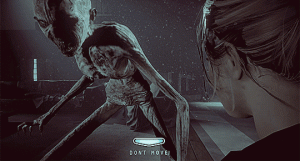
In the game the player is rotated through playing as each of the eight characters. Periodically, the player is given the power to make significant choices for the character that impact the outcome of the game. Called “Butterfly Effects”, these decisions range from as trivial as taking a “safe” route versus a “fast” route to life-or-death decisions like jumping from a platform to safety versus saving a friend who is dangling off the platform (Seppala). The game explains this philosophy at the start: “A tiny butterfly flapping its wings today may lead to a devastating hurricane weeks from now” (TetraNinja). The decisions the player makes throughout the game impact situations later in the game, as well as the deaths of the other characters. Supermassive Games, the developer of Until Dawn, proclaims that with all of the choices and scenarios, there are “hundreds of endings”. While there aren’t literally hundreds, the numerous endings make replaying the game a puzzle, trying to figure out which decisions result in a character’s deaths (spoiler: there is a way for all 8 characters survive – and likewise an ending in which all characters die (Thielenhaus). Of course there are numerous variations between these extremes).
The generic terror of the psychopath and the emotional connection to wendigoes captures all the aspects of Pinedo’s everyday terrors but in a gorier and “jumpier” way than Zombicorns. The pain of losing Hannah and Beth haunts the group, especially their brother Josh, who eventually goes insane. The wendigoes and lurking killer create many jump scares, emphasizing the unpredictability of the characters as both beings have human-like intellect and plan traps for the teens. Unique to Until Dawn is how the Butterfly Effect plays with the insufficiency of intentions and the seemingly random effects of decisions. In order to obtain a specific outcome, several play-throughs of the game are required in order to properly align the effects. Instinct will help initially guide the player but a moral compass also helps. In “Death Games and Survival Horror Video Games: On the Limits of Pure Torture Show Entertainments”, Patrunjel acknowledges the centrality of morality within horror: “in horror fiction the moral law and the concept of nature itself as rational order are deeply chained one to another representing the same reality the hero stands for” (42). Just as decisions for the good of the group are rewarded, acts that upset nature like cannibalism (turning into a wendigo) or shooting a wolf (instead of befriending it) have negative effects for the character.
Finally, Until Dawn also emphasizes the undead versus dead enigma like Zombicorns. The hideous depiction of the wendigo and the cannibalism emphasize them as the Other but the Hannah-turned wendigo shows there is still human aspects to them. When given the chance, she doesn’t kill Mike, who she had a crush on while alive. In one of the sequences, if Josh recognizes her via her tattoo and calls out to her, she leaves him alone. As Mia recognizes in Zombicorns, the undead were once human too and their human memories remain with them in Until Dawn. Although both pieces affect the audience in drastically different ways, the themes of terror in the everyday recur and have a haunting impact.
[1] John Green also disclaims the quality of the story in the preface: “Dearest Reader, This is a bad zombie apocalypse novella. It was written in a hurry. It is riddled with inconsistencies. And it never quite arrives at whatever point it sought to make.”
[2] Yes, pinatas. Mia visits her z’ed up little sister Holly each morning and delivers her a piñata stuffed with actual food like protein bars and mini-boxes of cereal.
Works Cited
Green, John. Zombicorns. (n.p), 2011.
Patrunjel, Flaviu. “Death Games and Survival Horror Video Games: On the Limits of Pure Torture Show Entertainments.” Scientific Journal of Humanistic Studies, vol. 4, no. 7, Oct. 2012, pp. 38-45.
Pinedo, Isabel. “RECREATIONAL TERROR: POSTMODERN ELEMENTS OF THE CONTEMPORARY HORROR FILM.” Journal of Film and Video, vol. 48, no. 1/2, 1996, pp. 17–31., www.jstor.org/stable/20688091.
Seppala, Timothy J. “The Real Horror of ‘Until Dawn’ Is That Sony Sent It to Die.” Engadget. Engadget, 14 July 2016. Web. 27 Feb. 2017.
TetraNinja. “Until Dawn Walkthrough Part 1 – First 2 Hours! (PS4 Let’s Play Gameplay Commentary).” Online video clip. YouTube. YouTube, 24 Aug. 2015 Web. 28 Feb 2017.
Thielenhaus, Kevin. “Save (Or Kill) Everyone in “Until Dawn” With These Choices.” The Escapist. Defy Media, LLC, 25 Aug. 2015. Web. 28 Feb. 2017.