I found the perfect word for the eerie feeling of Chapter 20 of Station Eleven, when Kirsten and a few others are exploring the abandoned school: kenopsia.
Kenopsia: (n) the eerie, forlorn atmosphere of a place that is usually bustling with people but is now abandoned and quiet.
While it may or may not be a real word (was on several “Obscure Words” websites but not in the OED), the word does encapsulate the aura surrounding an empty school. Even if the school isn’t abandoned, wandering around school after hours or during the summer leaves one feeling unsettled.*
The desolate environment is eerie, and everyone in the raiding party feels a little uneasy as they approach the school. Viola is really agitated: “Schools give me the creeps” and “Creepy as hell.” The group sees abandoned classrooms, remains of a fire, and no instruments but Jackson finds a skeleton in the men’s room. He’s troubled by this but Kirsten is unperturbed and August simply says a prayer over the remains, as per usual. As they walk out, Jackson asks Kirsten and August “how you two can stand going into these places” (130). August replies that they don’t go into public bathrooms because “someone always got executed in the bathroom” (130). My question is why. Why is there always a dead body in a public bathroom? The drains would make it easy to clean up spilled blood and since it’s a confined space, a person would be an easy target. But is there some other significance? The reasoning for this type of death could be linked to the symptoms of the Georgia Flu, which may be further revealed later in the book.
Passcodes can be hacked, but now it seems that fingerprints can be hacked too. A pair of detectives asked Anil Jain, a professor of computer science and engineering at Michigan State University, to help them unlock a phone that was evidence in a murder investigation. The victim’s Samsung Galaxy S6 phone required fingerprint identification to unlock. The detectives already had the victim’s fingerprints (he had been arrested before) on plain printer paper. However, human skin is conductive and the whorls and ridges on our fingerprints create unique conductive patterns that biometric use. So the computer scientists tried printing copies of the fingerprints onto special conductive paper (similar to photographic paper). After some trial and error, the team was able to digitally enhance a victim’s fingerprints and print these improved images onto conductive paper, successfully giving detectives access to his phone.
What gave me pause toward the end of the article was the distinction between an alphanumeric passcode and a fingerprint passcode in the courts. A passcode is considered an intangible thought in the owner’s mind and so police can’t order a suspect to reveal his or her password. But a fingerprint is physical evidence, like blood, so the suspect can be ordered to produce his or her fingerprints. By this logic, a person who is concerned about the police requisitioning their phone should always use an alphanumeric passcode as a precaution. You can be legally forced to unlock your phone if you use a fingerprint passcode so an alphanumeric passcode would protect you from that situation. Yet breaking that passcode is much simpler – watch the person enter the code, see if there is a pattern on the glass, guessing birthdays or other common passwords, etc.
For the detectives, the phone they were trying to access belonged to a deceased man. Since he was the victim, the detectives were allowed to access his phone. The victim’s fingerprints were already on file so the detectives didn’t need to request his fingerprints. But what should the average person do if they are concerned about the privacy of their phone after their death? In the interest of preserving privacy, should people request that their phone password be changed to an alphanumeric code by a trusted loved one before they die? This would preserve their phone from being used by any law enforcement and would give the loved one access to the phone. Or should a person use a fingerprint passcode, which would allow the police access to their phone but would restrict their friends and family from accessing the phone? In a way, I suppose it depends on what kind of secrets your phone holds and who you’re trying to keep them from: the police or your loved ones.
I’m making a bold statement: the following sentence is in Dr. Sample’s Top 10 Favorite Sentences among the articles we have read for DIG 215:
“Chernobyl is a heterotopia that allows us to gaze upon a post-apocalyptic world in which the familiar and uncanny collide.” Stone (2013, p. 91)
This sentence is taken from “Dark and toxic tourism in the Chernobyl exclusion zone“, who originally quoted it from P. Stone’s “Dark tourism, heterotopias and post-apocalyptic places: The case of Chernobyl.” Not only is the sentence construction elegant and word choice exquisite, but the use of the word “uncanny” really seals the deal here with a spot in the top 10. Admittedly, the word caught my eye, I reread the sentence, hemmed and hawed for a bit, and then realized I had a very small understanding of what the sentence was saying. Let’s unpack the sentence in the context of today’s article, starting with “heterotopia”.
As I learned from the very helpful Wikipedia article, heterotopia is a human geography term used to describe spaces of otherness, with multiple layers of meaning yet irrelevant, simultaneously physical and mental. Often the term is used to describe moments, like looking at yourself in a mirror or coming of age while away at boarding school. From my understanding (and please help me clarify this), describing Chernobyl as a heterotopia conveys that it has become a moment for examination, a memory, that has been perversely protected by its radiation and remains in a timeless state as a “ghost town” (Yankovska and Hannam 1). This preserved town allows us to view a “post-apocalyptic world”, one that has resulted from “the darker aspects of scientific advancement and human experience” (Yankovska and Hannam 2). After all, nuclear power and weaponry are controversial topics today, with their benefits for energy production and devastating consequences. In this world the effects of the nuclear power plant explosion are everywhere, via warning signs and protective clothing visitors must wear. But signs of the everyday remain everywhere in this sort of “ghost town” because during the accident people were inaccurately promised that they would be able to return home for their belongings in a few days. Thus, the “familiar” home scene and “uncanny” nuclear accident wreckage have collided to create a memorable, unsettling scene.
A perfect example of the collision between the familiar and uncanny: a brand-new amusement park in Pripyat that never opened. The article can be found here.
Ganna Yankovska & Kevin Hannam (2014) Dark and toxic tourism in the Chernobyl exclusion zone, Current Issues in Tourism, 17:10, 929-939, DOI: 10.1080/13683500.2013.820260
My daydreams about this project were grounded in reality: I wanted to discover what information I could glean from the tweets by using skills from my computer science courses. Eager to flex my coding muscles, I jumped into the project. But I started running into roadblocks: I couldn’t get as many tweets as I wanted, I struggled with remembering the syntax of JavaScript, the data wasn’t as easy to work with as I had hoped. With the clock ticking, I mentally reset and reminded myself that this project is intentionally not grounded in reality. We’re supposed to take an almost-plausible idea, one that nearly fits into our reality, but add an element of the uncanny to it, something that makes us examine the object and shudder with relief that the world isn’t that screwed up. Keeping this in mind, I adjusted my mindset and developed Impakt, a macro-social media site that distills down a celebrity’s death to handful of figures to deliver one final reading of the social climate surrounding him or her.
The Impakt of Social Media Grief Competition
Impakt analyzes the millions of para-social relationships that Twitter users have with a given celebrity. This data analysis gives a large-scale representation of the impact a celebrity had on society around their demise. The obvious goals of Impakt as a “brand” are to make the user aware of the impact of a death of a celebrity, to highlight the para-social relationship between the fans and the public figure, and to trivialize death by making it another social media gimmick. As an art piece, its “goal” is to push social-media grief into the realm of the uncanny by further distancing users from the actual death of the celebrity and turning generating attention into a competition, valuing the quantity of social media attention over the quality. The cultural attention shifts even farther from death to trivial “here-and-now” things, like the Internet and the media. Sherlock suggests that these media “facilitate a new type of ritualized, collective mourning that potentially serves to distract mourners from the physical reality of death” (169). The deluge of images and messages in mourning and memorializing tweets provides a distraction for the Twitter user from being reminded of his or her own impending end. As Sherlock states, “to control the corpse is to control death, disorder, and chaos”, and so “a culture that promotes the notion of a symbolic immortality” would aid in distracting us from our own mortality (169). If we create a culture that minimize the finality of death by continuing to celebrate a celebrity after their demise, we cultivate the belief that we will also be celebrated and respected after our death, capturing a sort of immortality. Impakt attempts to enhance this mindset and take it to an extreme. By making popularity and impact a social competition, people are even more concerned about their image after death, and may choose to include in their will the hiring of tweeters or bots to preserve their social relevancy after death.
Postmortem Digital Identity
Yet, what role should be assigned one’s digital identity after death? What are the moral and cultural guidelines that the bereaved should be expected to follow? Brubaker, Hayes, and Dourish touch on these questions in their examination of online memorials and the digital identity postmortem on Facebook. Facebook’s protocol when handling the passing of a user consists of “memorializing” a user’s page, which partially freezes the page so no new friends can be added and no personal information can be modified. Brubaker et al. argue this protocol “prioritizes the needs of a now-dead individual over the grieving community that remains” (161). The grieving community can post memories and content on the deceased’s wall, adding detail to the postmortem identity and creating a divergence between the pre- and postmortem identities of the deceased. Since the owner of the page no longer can filter the content allowed on their wall, survivors may take offense to posts or images added to the page by commentators (Brubaker et al. 161). Even the deceased might not have approved of some of the content.
The Do’s and Don’ts
How much control should you have over your postmortem social identity? What should the moral standards be for grievers and commenters? Odom et al. suggest paying attention to the “delicate social arrangements” surrounding managing these digital representations and not simply allowing a profile to exist with restrictions. Impakt places no such restrictions on the information displayed on the site: any publicity is good publicity. The philosophy of Impakt encourages tweets of any kind about the celebrity, with a weighting system that centers more on the sincerity of a tweet rather than the sentiment. Negative tweets (“Insults”) impact the algorithm just as much as positive tweets (“Compliments”) (see section “The Tunes of Tweets”). This reflects Walter’s idea of postmodern death, by which private feelings of the dying and bereaved are publicly proclaimed as a form of individual expression. Regardless of the motivation or sentiment behind a tweet, any form of grief in a public place does not ensure the same level respect that one receives by grieving in private. An individual has the right to express themselves as they wish in public, accounting for the repercussions of posting anything on a public platform.
The Tunes of Tweets
The tweets posted in relation to a public figure’s death run the gamut from insults to tweets of concern to impartial headlines. The categories used for Impakt’s Popularity Breakdown were inspired by Cutrona and Suhr’s (1992) five types of social support as described by in an analysis by Lee and Goh on Twitter’s response to Michael Jackson’s death. This scheme has been applied to studies involving online social support and so Lee and Goh adapted this scheme for the death of a public figure. I expanded Cutrona and Suhr’s five types of social support to seven tweet categories (names of the original types are denoted in brackets):
Info [informational support]
Emotions [emotional support]
Compliments [esteem support]
Connects [network support]
Rumors
Insults
Other
The categories are explained on the Impakt FAQ page. The tweets regarding Michael Jackson were primarily info (46%), with emotions being the second greatest proportion of the tweets (23%). Through during their study of Michael Jackson’s death, Lee and Goh discovered “categories not normally associated with grieving, such as spreading of rumors, expressions of hatred, and spam, also occupied a large proportion of tweets” – nearly 30% (rumors, insults, and other). The authors suggested that these contributors took advantage of the high Twitter traffic “for a variety of purposes such as spreading rumors, spamming, marketing, and advertising” (473). I emulated these results in the Popularity Breakdown section of Impakt. For most the tweets, they “seemed more like personal and social expressions of emotions and thoughts” with no response necessary from other users, like a condolence book (Lee and Goh 473).
The Nature of the Bird
Twitter’s public, event-driven nature, and 140-character restriction requires tweets to be deliberate, timely, and pithy. These characteristics make it a perfect metric for examining the effects of major events, providing “insight into traumatic events and experiences and elucidate how youth view the world, self, and others from the perspective of youth tweeting about social events and experiences they deem significant and important in their lives. (Patton et al. 229) Even more ideal when dealing with public figures is how commonplace tweeting has become for them to use to interact with their fans. While a celebrity is alive, their Twitter page is a critical part of maintaining para-social relationships and thus is an intuitive medium to turn to when expressing sentiment toward the celebrity. Although Twitter, Facebook, and other social media sites are typically centers for lighter content, people engaging with content on these sites “often alter and modify the original intent of software to fulfill a need or desire” (Patton et al. 229). Patton explains that the Internet can ease that need to commune with other mourners and “strengthen group bonds by allowing users to share experiences of mourning… and memorialize the deceased with the use of text, photographs, music…” (Patton et al. 228). The online community also has the side effect of popularizing someone’s death, drawing more publicity than a news story or obituary would have generated. Patton et al. examined a case study of a young woman in a gang who was killed and noted “the public may never have known about Gakirah’s story without the communication capabilities of social media. In the pre-Twitter era, she might have been a name in a back-page newspaper story” (238). This attention may have positive repercussions (e.g. another source of outlet and support for mourners) or attract negative commenters (e.g. RIP trolls or advertisers). For better or worse, Twitter is public. If you wish to keep your mourning private, don’t post on Twitter. Alternatively, online memorializing can provide support and community for geographically-restricted groups so sharing online may help you find a connection and ease the grieving process.
The takeaway
Currently, grieving on social media is still weird, but so is mourning someone you never met. As we’ve seen, the peculiarities of Twitter lend itself oddly well to mourning celebrities and other para-social relationships. Yet the idea and culture surrounding mourning on social media haven’t quite settled into acceptable norms. I challenged the idea of what could be deemed appropriate via Impakt, essentially making celebrity deaths into a quantifiable popularity contest. Since social media is more of a superficial grief setting, mourners generally do not post deep, emotional posts, especially on character-restricted Twitter. With that mindset, it’s perfectly eerie to consider what happens when valuing trivial social media stats takes priority over grieving the loss of someone.
Note: While the finished product didn’t include access to live data, I hope I communicated the general idea of the site. The rankings were an amalgam taken from various tabloid articles. As mentioned, the percentages used were based on Lee and Goh’s results. The most favorited/retweeted tweet, the top 5 words and hashtags, and the frequency graph were generated from actual tweets surrounding Chuck Berry’s death (specifically the last 10,000 tweets returned from the query “chuck berry” taken during the 18 March – 19 March 2017 window).
Works Cited
Brubaker, Jed R., et al. “Beyond the Grave: Facebook as a Site for the Expansion of Death and Mourning.” Information Society, vol. 29, no. 3, May/June 2013, pp.152-163. EBSCOhost, doi:10.1080/01972243.2013.777300.
Lee, Chei Sian and Dion Hoe-Lian Goh. “Gone Too Soon: Did Twitter Grieve for Michael Jackson?.” Online Information Review, vol. 37, no. 3, May 2013, pp. 462-478. EBSCOhost, doi:10.1108/OIR-05-2012-0082.
Patton, Desmond U., et al. “I Know God’s Got a Day 4 Me.” Social Science Computer Review, vol. 35, no. 2, Apr. 2017, pp. 226-243. EBSCOhost, doi:10.1177/0894439315613319.
Sherlock, Alexandra. “Larger Than LIfe: Digital Resurrection and the Re-Enchantment of Society.” The Information Society, vol 29, no. 3, May/June 2013, pp. 164-176. EBSCOhost, doi:10.1080/01972243.2013.777302.
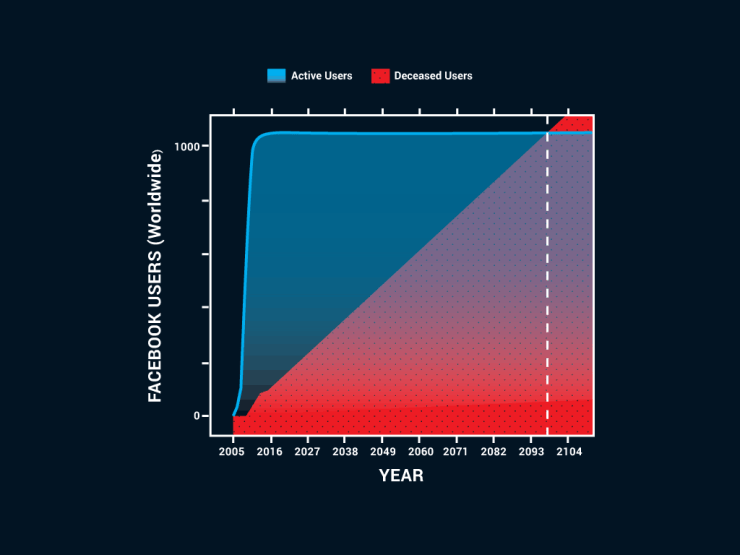
Hachem Sadikki, a Ph.D. candidate in statistics at University of Massachusetts, predicted that the year the number of dead people on Facebook outnumbers the living is the surprisingly-close 2098. I could hypothetically be around to see that (assuming I still care about social media at that point – I’ll be 103). There are some understandable assumptions Sadikki had to make: he assumed that everyone who dies is memorialized, that Facebook’s exponential growth will eventually plateau, and he used the U.S. death rate (provided by the CDC) for the entire globe. But his results have been confirmed by others, such as Randall Munroe (of xkcd fame) who estimated that this outnumbering will occur in the 2060s (assuming Facebook’s growth plateau’s, like Sadikki) or in the 2130s (assuming Facebook continues to grow).
Sadikki’s results. Note the astonishing explosion of growth in active users from 2005-2016 and the intriguing slight plateau in number of deceased users around 2014-2016 (comments about reasons why are welcome!)
These numbers are intriguing but with the recent “death” of Vine, I wonder which will die first: Facebook or its user base? Meaning, will we reach this cross point of number of deceased users equaling the number of active users before Facebook becomes obsolete? Munroe briefly explores Facebook’s future in his post and his take-away is that either Facebook falls out of favor (generating the 2060s scenario) or it continues on its current path (the 2130s scenario). I like exploring the Facebook-falling-out-of-use scenario, envisioning a Facebook that eventually evolves into the memorial sites that we’ve chuckled at in class. What if Facebook becomes an acceptable, everyday, communal mourning site? People wake up each day get a reminder to write on someone’s wall for their “death day”, comment and reminisce on pictures and videos, perhaps even chat with family members of the deceased. The idea probably won’t catch on, but it’s an amusing future to envision.
And standards. As cruel as internet trolls can be, there is such thing as “crossing the line”. There is a whole culture of trolling with various unspoken rules regarding who to target and “traditions” of content for situations, which fascinated me. Who knew there was a methodology what content was posted and who was okay to troll? Whitney Phillips delves into this subculture in her article “LOLing at tragedy: Facebook trolls, memorial pages and resistance to grief online”. She focuses on RIP trolls, which she defines as “online instigators [who] post abusive comments and images onto pages created for and dedicated to the deceased.” Recognizable by their profile pictures and names (like “Soveri Ruthless” or “Frank Bagadonuts”), RIP trolls friend each other and then lead organized attacks on a public Facebook memorial page. They specifically target “I didn’t know you but I’m very sorry you’re dead” posts, which they view as insincere and cheap. For RIP trolls, Facebook is never the appropriate place for grieving, especially for tragedies such as car crashes or kidnapping cases.
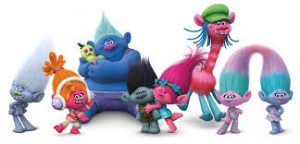
No, not these kinds of trolls. Internet trolls generally intend to ruin the intended conversation, via rude and insensitive comments or images. Dreamworks, accessed 15 March 2017.
No one should have the power to judge others’ behavior, specifically reactions to death, and determine what is appropriate or not. But hearing the trolls’ perspective made me wonder if their view of online expressions of grief has some credibility. Wilson Mouzone, one of the trolls Phillips interviewed, said that family members don’t deserve the disrespectful treatment by some of the most vicious trolls. Generally, these pages (often private) and users are left alone. But the “grief-tourists” with no real-life connection to the victim are considered free game. Will trolling help curtail these “insincere” postings? If so, are we amid a culture shift in online grief culture? Since experiencing death on Facebook is a relatively new phenomenon (as opposed to newspaper obituaries and funerals), we haven’t determined what is culturally acceptable. An analysis of public memorial pages over the past few years regarding the ratio of genuine posts to troll posts would be insightful to examine. Perhaps the RIP trolls’ behavior is having their desired effect and reducing the number of inauthentic postings. More likely, their derogatory comments only incite internal debate/attacks/rage on the memorial page regarding the trolls, not about the insincere postings.
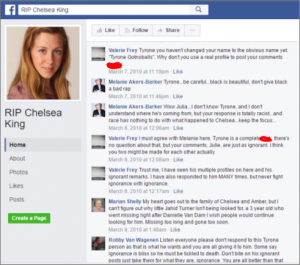
A memorial page for Chelsea King. Note that the administrators of the page have done a better job of deleting troll comments (or perhaps the account was reported – in which case, all comments are deleted automatically) and so the discussion revolves around a comment that is no longer there. Screenshot of original page taken and edited by author, 15 March 2017.
The cinematic survival-horror game Until Dawn and the zombie-apocalypse short story Zombicorns may both fall under the “horror” umbrella but the jump scares in the video game provide a much greater shock to the system than the philosophic, rambling musings of the narrator in the short story. As late postmodern horror, both exploit the subtle terror themes hidden in our daily lives. In her article “Recreational Terror: Postmodern Elements of the Contemporary Horror Film”, Pinedo writes that “horror exposes the terror implicit in everyday life: the pain of loss, the enigma of death, the unpredictability of events, the inadequacy of intentions” (26). In drastically different methods, both Zombicorns and Until Dawn amplify these commonplace terrors: the pain of the loss of a sister or close friend, the enigma of death and whether the undead are no longer human, the unpredictability of characters and effects of decisions, and the insufficiency of intentions when no action or unintended consequences follow. By analyzing how Zombicorns and Until Dawn incorporate these implicit everyday terrors, we discover these media ultimately continue the discourse on what makes a monster and how our actions impact our fate.
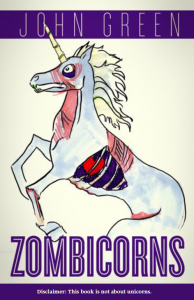
While the title Zombicorns may lead the reader to anticipate that the short story about zombie unicorns, author John Green quickly dismisses that idea with a disclaimer[1]: “This book is not about unicorns.” The “corn” part comes from how the zombies are created, which is from mutated corn. The narrator Mia explains that “the z’d” (the zombies) aren’t technically zombies; a person’s transformation is a result of contracting a virus called AMRV from the consumption of a variety of corn called Devotion131Y (D131Y). When a person becomes infected, they gradually become obsessed with D131Y to the point of devotional worship.
As Mia refers to them, the “z’ed up” are like zombies in that z’s will eat your brains but they will also “eat anything else, except for Devotion131Y… once you get infected, you don’t want to eat it, because you’re too busy loving it” (Green 13). The z’s spend their time planting and caring for the corn. Mia acknowledges various theories about the motivations of the z’ed up but she believes that the z’ed are an extension of the corn: they attack anyone who threatens the corn (drives over it, walks through a cornfield, etc.). The z’ed stay alive by briefly taking breaks in their agricultural activities to eat; consuming anything from piñatas[2] to humans but never the corn. Forcing humans to eat the contaminated corn is also a worthwhile activity for the z’ed, further ensuring the survival of the corn by creating more corn caretakers. Because of all of the planting, the z’ed are hunched over and grimy and have yellow-ringed pupils as a side effect of the virus.
In Mia’s “re/accounting of human life post-virus” – the context of the short story – she is only remaining member of her immediate family who hasn’t been z’ed up. The only beings in her life are her dog Mr. President, her z’ed-up little sister Holly who she cares for from a distance, and her compatriot Caroline who no longer views z’s as humans (Green 72). Caroline and Mia’s contrasting attitudes towards z’s and the apocalypse help fuel the tension in the story and demonstrate the implicit terrors in everyday life.
The “enigma of death” is the most divisive terror between the friends. Caroline explains, “it’s very easy to look at them and know they don’t have souls, that the virus stole their souls, and that you aren’t killing them, because their themness has already been killed. You’re killing the virus, which is a frakking privilege as far as I’m concerned” (Green 37). This impersonal attitude toward murdering fathers and sisters, especially children, is difficult for Mia to accept. She counters Caroline: “‘Maybe they don’t have souls,’ I said, thinking of Holly’s empty eyes ringed in yellow. ‘But they used to be people’” (Green 48). Pinedo’s remaining three aspects of “terror in the everyday” (the pain of loss, the unpredictability of events, the inadequacy of intentions) compile in the climax of the short story when the z’ed Holly shuffles to get Mia’s daily food ration (via sombrero piñata) and Caroline shoots her:
I could still see my little sister. It was the best part of every day.
And then the gunfire rained down on Holly as she knelt there eating, her body spasming as the bullets filled her up, animating her ever so briefly until the gunfire stopped and she did too, her body hideously still, cuddling the sombrero, bleeding out onto the candy I’d brought her.
(Green 70)
The immense anguish of the loss of her sister and the unpredictable betrayal by Caroline, leave Mia reeling. Her shock is furthered by insufficiency of Caroline’s intentions; Caroline defends her actions by saying, “‘She wasn’t a person anymore, Mia. This game needs teams. I can’t go north alone, and there’s no one else to go with, but we need to go… I did it for you, you know. I did it because you couldn’t, and I hope you’d do the same for me’” (Green 70). With this, Mia reacts: “I raised the pistol from my hip and shot Caroline once in the face. The chair fell backwards with her in it and I stepped forward. She started to say something or at least her mouth was moving, and I shot her twice more in the head to make it quick” (Green 70). In this instant the real monster is no longer the z’s but could be Caroline, whose hardened personality was a result of the z’ed “stealing” her normal life, or for Mia, for impulsively shooting Caroline. Caroline emotionally hurt Mia and so Mia implicitly decides not to join Caroline on their northern journey and shoots her, emotionally and physically hurting her. Mia is agonized about the death of her sister and so shooting Caroline provides brief justice but her “regret was immediate and permanent and useless” (Green 70). Both of the teenagers’ unpredictable actions caused permanent hurt and changed their fate changed by the other.
Although Pinedo’s “terror elements of the everyday” were shown emotional and philosophical lens in Zombicorns, the same elements manifest themselves in a much scarier and intense way in Until Dawn. The plot of the game is reminiscent of a ‘90s teen horror flick: a group of friends is reunited for a holiday at a remote ski lodge with a murderous psychopath lurking around. Adding to the tension is that this spot is where two of the teens, twins Beth and Hannah, died from falling off a cliff in a snowstorm after a prank turned sour. We eventually learn that Beth died fairly quickly from her injuries and the cold and so Hannah resorted to cannibalism, eating her sister to remain alive. This tragedy looms over the heads of the remaining eight friends and drives some of their motivations, such as their older brother Josh.
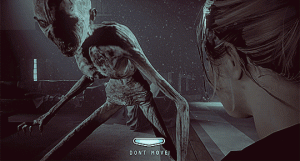
A wendigo from Until Dawn. Wendigoes can’t detect movement so during a “Don’t Move” event, the player has to hold the controller completely still.
In the game the player is rotated through playing as each of the eight characters. Periodically, the player is given the power to make significant choices for the character that impact the outcome of the game. Called “Butterfly Effects”, these decisions range from as trivial as taking a “safe” route versus a “fast” route to life-or-death decisions like jumping from a platform to safety versus saving a friend who is dangling off the platform (Seppala). The game explains this philosophy at the start: “A tiny butterfly flapping its wings today may lead to a devastating hurricane weeks from now” (TetraNinja). The decisions the player makes throughout the game impact situations later in the game, as well as the deaths of the other characters. Supermassive Games, the developer of Until Dawn, proclaims that with all of the choices and scenarios, there are “hundreds of endings”. While there aren’t literally hundreds, the numerous endings make replaying the game a puzzle, trying to figure out which decisions result in a character’s deaths (spoiler: there is a way for all 8 characters survive – and likewise an ending in which all characters die (Thielenhaus). Of course there are numerous variations between these extremes).
The generic terror of the psychopath and the emotional connection to wendigoes captures all the aspects of Pinedo’s everyday terrors but in a gorier and “jumpier” way than Zombicorns. The pain of losing Hannah and Beth haunts the group, especially their brother Josh, who eventually goes insane. The wendigoes and lurking killer create many jump scares, emphasizing the unpredictability of the characters as both beings have human-like intellect and plan traps for the teens. Unique to Until Dawn is how the Butterfly Effect plays with the insufficiency of intentions and the seemingly random effects of decisions. In order to obtain a specific outcome, several play-throughs of the game are required in order to properly align the effects. Instinct will help initially guide the player but a moral compass also helps. In “Death Games and Survival Horror Video Games: On the Limits of Pure Torture Show Entertainments”, Patrunjel acknowledges the centrality of morality within horror: “in horror fiction the moral law and the concept of nature itself as rational order are deeply chained one to another representing the same reality the hero stands for” (42). Just as decisions for the good of the group are rewarded, acts that upset nature like cannibalism (turning into a wendigo) or shooting a wolf (instead of befriending it) have negative effects for the character.
Finally, Until Dawn also emphasizes the undead versus dead enigma like Zombicorns. The hideous depiction of the wendigo and the cannibalism emphasize them as the Other but the Hannah-turned wendigo shows there is still human aspects to them. When given the chance, she doesn’t kill Mike, who she had a crush on while alive. In one of the sequences, if Josh recognizes her via her tattoo and calls out to her, she leaves him alone. As Mia recognizes in Zombicorns, the undead were once human too and their human memories remain with them in Until Dawn. Although both pieces affect the audience in drastically different ways, the themes of terror in the everyday recur and have a haunting impact.
[1] John Green also disclaims the quality of the story in the preface: “Dearest Reader, This is a bad zombie apocalypse novella. It was written in a hurry. It is riddled with inconsistencies. And it never quite arrives at whatever point it sought to make.”
[2] Yes, pinatas. Mia visits her z’ed up little sister Holly each morning and delivers her a piñata stuffed with actual food like protein bars and mini-boxes of cereal.
Works Cited
Green, John. Zombicorns. (n.p), 2011.
Patrunjel, Flaviu. “Death Games and Survival Horror Video Games: On the Limits of Pure Torture Show Entertainments.” Scientific Journal of Humanistic Studies, vol. 4, no. 7, Oct. 2012, pp. 38-45.
Pinedo, Isabel. “RECREATIONAL TERROR: POSTMODERN ELEMENTS OF THE CONTEMPORARY HORROR FILM.” Journal of Film and Video, vol. 48, no. 1/2, 1996, pp. 17–31., www.jstor.org/stable/20688091.
Seppala, Timothy J. “The Real Horror of ‘Until Dawn’ Is That Sony Sent It to Die.” Engadget. Engadget, 14 July 2016. Web. 27 Feb. 2017.
TetraNinja. “Until Dawn Walkthrough Part 1 – First 2 Hours! (PS4 Let’s Play Gameplay Commentary).” Online video clip. YouTube. YouTube, 24 Aug. 2015 Web. 28 Feb 2017.
Thielenhaus, Kevin. “Save (Or Kill) Everyone in “Until Dawn” With These Choices.” The Escapist. Defy Media, LLC, 25 Aug. 2015. Web. 28 Feb. 2017.
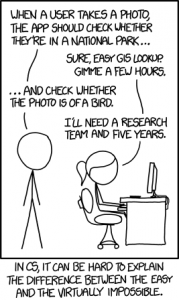
During the 1920’s, astonishing inventions such as the gas-powered car and Edison’s phonograph captured the public’s imagination about what technology could do. Suddenly, “communicating with spirits didn’t seem much more impossible than harnessing electricity“. Both Thomas Edison and Thomas Watson, assistant to telephone inventor Alexander Graham Bell, experimented (separately) with building a “spirit phone” to connect with the dead. Inventors and the public eventually realized that the dead don’t answer, preferring the caller to leave a voicemail, and the idea of communicating with spirits via telephone died. But this disconnect between what we imagine technology can do and the actual limitations of technology is theme that continues to baffle us, as shown in the comic below.
The comic xkcd demonstrates our idealistic expectations for technology and the reality we’re confronted with.
Elizabeth Losh highlighted some of the aspects of this disconnect at her recent talk at a FemTechNet conference. In the case of the spirit phone, the “material vs. transcendent” dichotomy is the most relevant. When people could suddenly converse hundreds of miles away over the telephone using this new, non-tangible force called “electricity”, it seemed just as conceivable that a spirit could physically exist as micro-particles. Telephone users in the early twentieth century didn’t understand the physics of electricity and of phones like we do today. As magical as a telephone seems, a phone functions because of material reasons, like wiring and microphones. As we mentioned in class, saving files to the cloud generates a similar confusion today about “material vs. transcendent”. While the user may think their files go to some literal, intangible “cloud”, the files are actually stored at a remote server farm. While it seems the amount of storage is limitless, you could eventually run out of your allotted space in your cloud, forcing you to delete some fire selfies.
So far in my viewing of the first two episodes of Dead Set, a British television series about filming a Big Brother TV show during a zombie apocalypse, no one has used the word “zombie”. The characters use vague pronouns like “it” or “them” of “things”, but never settle on a name for the undead* monsters.
Devina as a zombie. Source: Zombie Guide Magazine
Why not use the z-word? As a novice to the zombie apocalypse genre, perhaps referring to the monsters as “things” and not “zombies” is common. This does add to the confusion and heightens the terror around the monsters. By not calling them “zombies”, a well-known and defined category of monster, the audience is left more uneasy and does not know (entirely) what to expect from the creatures – like these creatures, which are fast-moving zombies (who can’t climb gates, or swim, apparently).
Another reason could be that in the world of the show, the idea of a zombie doesn’t exist. As a result, the characters have never seen horror films or TV shows with zombies and don’t have that familiar classification for the undead.
Since we knew several of these characters before they changed, perhaps the show avoids “zombie” because referring to them as an other is dehumanizing. Often the characters still refer to known zombies by their given names, such as the producer Peter and contestant Pippa when talking about the (now zombie) host Davina. By still using their names, killing them has an emotional aspect since the characters still associate their human versions with the creatures.
Whatever reason the writers used, not using the term “zombie” irked me as a viewer and resulted in several fumbling “th-th-those THINGS” in the dialogue.
* Shakespeare frequently used “un” words to draw certain emphasis to the opposite of the word or the revocation of a verb, such as “unking” or “unbroke” (both from Richard II). Since one becomes a zombie after dying from a zombie’s bite and returning to “life”, using a Shakespearean interpretation of “undead” makes the for an interesting analysis of the zombification process. Terming them “undead” reflects their transformation back through a reversed process of dying.
As I have continued reading A Head Full of Ghosts, the evolution of Marjorie’s schizophrenia constantly changes how I view the horror in the book. Throughout the story, Marjorie has been the cause of the majority of the terrifying events but the lens through which I view these has shifted from fear to pity. My perspective shifted in chapter 16, simultaneously with Merry’s view of her sister, when Marjorie explains, “I’ve been faking it… What do you mean why?… then I started hearing the voices, stress induced probably, yeah, but still it sort of freaked me out… I decided I’d just keep pushing it, see how far I could go… You guys should be thanking me. I saved the house. I saved us, all of us, and I’m going to make us famous” (124-25).
As artist Louis Wain’s schizophrenia progressed, the image of a cat becomes more difficult to discern.
Marjorie’s elaborate story comes across as fake and her pretense of control makes Merry realize she “was afraid for her instead of being afraid of her” (125). Merry’s pity humanizes Marjorie. Marjorie is no longer some wild animal, lurking around the house, whose behavior is erratic and unsettling (to say the least). Now that she has talked about her behavior and has some memory and understanding of the damage, Marjorie is elevated from her status as a rabid, mindless, demon-possessed monster to a human recognizing her behavior as her own (not the act of a demon). As readers, we can now evaluate future scenes and recall previous scenes and question how Marjorie’s strange behavior is influenced in combination by her schizophrenia, her own theatrics, and her own fears. Terrifying as reading these scenes may be, imagining being Marjorie is much more painful.