
In “Be Right Back” from Black Mirror (season 2, episode 1), I was blown away with the technology like the ultra-slim, durable phones and the protagonist Martha’s design display that she uses for work. Even though we have similar technology today, or at least the “grandparents” of such devices, I found it fascinating to imagine using such technology. However, I wasn’t as amazed with the text-based virtual “Ash” that Martha interacts with when her husband first dies. With the recent expansion artificial intelligence into our everyday lives, such as through Apple’s Siri or Amazon’s Alexa, interacting with various artificial intelligence machines (AIs) is becoming commonplace. Creating a text-based AI to represent a person from their publicly available social media data seems like a plausible technology within the next five years.
Note that this prediction does not mention that the AI would even come close to passing as the specified human. The widespread AIs in today’s world (such as Siri or Alexa) are weak AI, meaning they excel on narrowly defined tasks, such as “Siri, who sings this song?” or “Alexa, how warm is it today?” To mimic a human, a strong AI is needed, one that has a broad, robust, human-like intelligence that can learn new things. Strong AIs are much more difficult to develop and getting humans to believe the machine is thinking is even more challenging. A common test (known as the Turing test) to determine whether an AI is “thinking” or not is to have humans spend five minutes individually interacting with the AI through the computer terminal. At the conclusion of the trial, the human decides if she was interacting with a person or a machine. If the machine fools humans in over 70% of the trials, the machine is considered to be thinking. In the episode, Martha goes through periods of believing in “Ash” (far beyond the 70% threshold) but each mistake “Ash” makes jars Martha into immediately emotionally reclassifying “Ash” as an imitation of her dead husband, and not his reincarnation. Since there is such as strong emotional connection between the user and the AI, the mistakes are more costly and Martha becomes less inclined to want to believe in the bot, limiting its effectiveness. Taking this episode as a “case study”, I think that using social media would enhance a generic AI’s personality but given the emotional toll seen in Martha, using this data to represent or recreate a specific known person would detract from its believability and effectiveness.
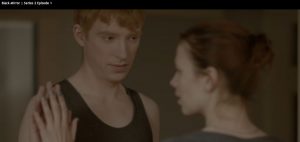 Martha becomes so attached to Ash’s AI, she orders a full-sized replica of Ash to complete the illusion of his reincarnation. katalinawatt2012. Digital Image. seenthefuture.blogspot.com/2013/02/studies-in-dystopia-black-mirror-be.html%5B/caption%5D
P.S. Messaging with Cleverbot is a fun way to experiment with human-AI text discussions.