
Fueled by the compulsion to both look and not look, conflating fear and repulsion with curiosity and attraction, horror thrives as a narrative paradox. Often tightly circumscribed by its own generic structures, much of contemporary horror has clearly defined conventions that rely on formulaic constructions and tropes. The formula is in fact so inviolable that it has been made narratively explicit in films such as Wes Craven’s highly influential Scream (1996), a self-reflexive and intertextual postmodern masterpiece that grossed upwards of $100 million in the US alone.

Craven, along with a brilliantly written script by Kevin Williamson, breathed new life into the slasher film. They took all of the archetypical constructs of the slasher sub-genre and directly exposed them to the audiences while still staying within the confines of the genre. This was not new, parodies had done this in the past, but Scream managed to both keep a straight face and produce fear. Scream and other postmodern horror films that followed in its wake reinvigorated the flagging genre in the mid-1990s, due in large part to their extreme self-reflexivity, along with numerous intertextual references to earlier horror landmarks. The postmodern conceit is simple: Scream is a slasher movie in which the characters are well versed in the rules and conventions of slasher movies, to the self-referential point of characters talking at length about earlier slasher pics. It is a film in which the intertextuality, in effect, constitutes the text; and its media literacy and genre-bending are markers of the arrival of the postmodern era in horror film. Isabel Pinedo argues, “the postmodern horror film transgresses the rules of the classically oriented horror film, but it also retains features of the latter, which form the backdrop against which violations of the rules are intelligible as such” (“Recreational Terror”, 19). In its postmodern iteration, the horror film acknowledges its generic lineage before it subverts the formula thereof.
In Scream‘s opening scene, we watch as Casey (played by Drew Barrymore) has what originally seems to be a flirtatious phone conversation with a friendly stranger turn into a deadly game of horror trivia. The mysterious stranger asks Casey a series of questions about horror movies, such as who the killer in Friday the 13th was, with rather unfortunate punishments for Sydney and her boyfriend.
www.youtube.com/watch?v=ZgKukhIw5eY
While this was a surprise for audiences in that many expected Barrymore to be one of the central characters, perhaps even the stereotypical “Final Girl“, this scene also set the stage for the rest of the film. The teens of the 90’s had grown up on slasher and horror flicks, knew the rules, the tropes, the characters. As such, horror movies had to evolve, had to change to suit the new experienced and cynical mood of the times. The characters in Scream know horror films and are constantly citing genre titles. The irony is that they are living in one.
Influenced by the widespread success of Scream, other postmodern horror films soon followed, films that both emphasized sameness by reveling in the established generic tropes while also crafting disjunctive, ironic narratives that acknowledged and played with those very same generic conventions. Films such as I Know What You Did Last Summer (1997), Urban Legend (2000), Final Destination (2000), the wildly successful The Blair Witch Project (1999), and reboots of both the Friday the 13th and Nightmare on Elm Street franchises all exhibit this postmodern tendency toward self-awareness, intertextuality, and hybridity. These films reflect the conception of postmodern anxiety as acute self-consciousness about the formal, constructed nature of the work. Just as postmodernism can be viewed as a crisis of systems of regulation, the postmodern horror film reflects anxieties about the horror genre. The commonplaces of generic tropes and conventions are concomitantly a source of both restrictive apprehension and creativity. The postmodern horror audience enjoys the reiteration of The Rules while simultaneously celebrating the subversion of them. Here occurs what Andrew Syder contextualizes as a postmodern “rhetorical deconstruction,” the move from strict sets of rules governing rhetorical creatures such as vampires, werewolves, and other classic horror monsters to a postmodern demystification of the “rhetorical nature of representations of the unknown” by tacit acknowledgement of the fictionality of the monster as narrative device (Syder 84-85). Essentially, the postmodern reframes traditional horror narrative, rupturing the unity exhibited in classic horror films and instead invites participation in the signification of the narrative rather than a distanced remove from it.
Following this new tradition of self-aware horror films, 2012’s The Cabin in the Woods, written by Joss Whedon and Drew Goddard, also tidily fits these definitions of the postmodern as multilayered, ironically detached, and simultaneously traditional and subversive. We begin with a couple of middle-management types going to work talking nonchalantly about their weekend plans. A sequence normal enough to the realm of drama or comedy, but unsettling in the slasher genre. We then turn to our group of college friends and our worries are laid to rest. They are going on a weekend trip. We know this story. At this point we understand there will be some inane banter that will hopefully allow us to care about the characters long enough to fear for them and in turn mourn their demise. We know they will fit in one of five stereotypes: “the fool,” “the jock,” “the scholar,” “the virgin,” and “the whore.” We know a moral compass will emerge from the group and during our final sequence we will switch our perspective respectfully from the killer/monster to the heroine “virgin” of the group. We also know the prophet of doom will attempt to save them, but through misguided fear and machismo our characters will remain stubborn to their plan. There will be sex, drug use, and incomprehensible reactions to dire situations.
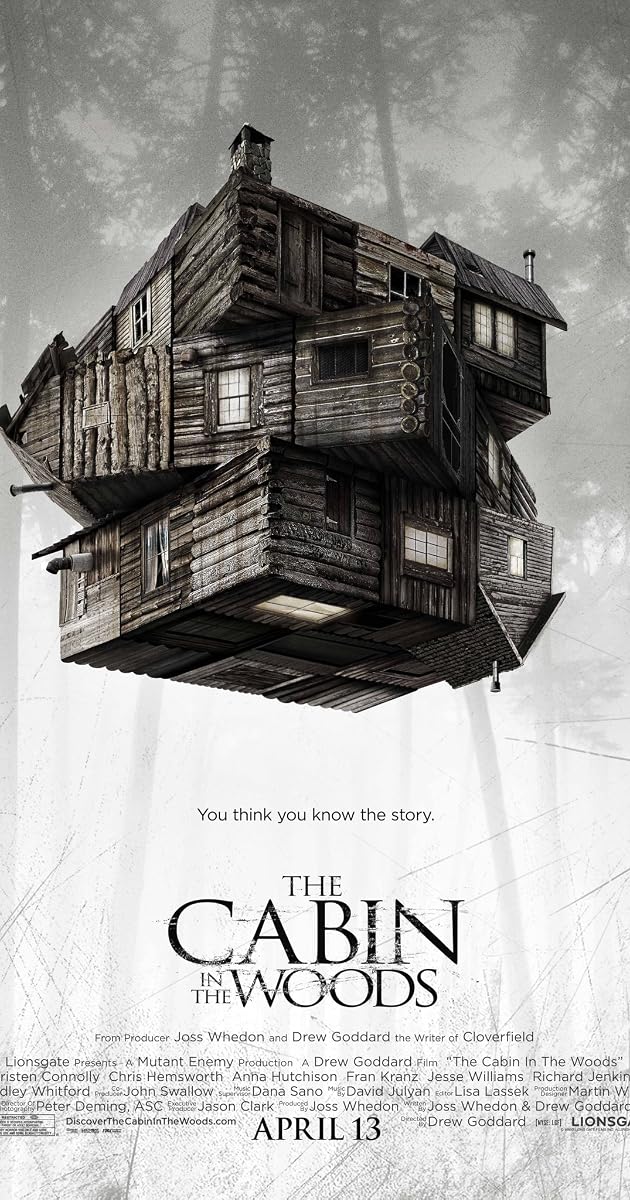
The Cabin in the Woods is a perfect example of postmodern parody. Crucial to the idea of parody is a sense of historicity, a refiguring of the past rather than a denial or departure from it. Cabin not only exhibits this sense of historicity through its thick intertextuality but also by its appropriation and subversion of genre conventions and horror tropes. Cabin relies on these tropes as a way to establish a cultural continuity and as an appeal to a horror audience familiar with the trappings of the genre. Tropes themselves are a cultural signifier, and the rather shameless and flagrant use of tropes in The Cabin in the Woods is used as a stylistic method to investigate and deliberately call into question the fictional device of the trope.
Like Scream, Cabin in the Woods is tauntingly circular. The final 20 minutes of Scream, which borrow heavily, and with complete openness, from Halloween, have become iconic in their own right. One character is commenting on and narrating Halloween, which is playing on TV, warning Jamie Lee Curtis to turn around, while a masked killer is directly behind him. Someone even says, “I’ll be right back” after being warned to never, ever say, those exact words
The irony is gleefully obvious, which makes it all the more likeable. It doesn’t reek of pretentiousness. The curious contrast between Wes Craven’s satiric slasher and Cabin‘s bloody Rubik’s Cube is the acidic quality with which Whedon and Goddard etch their characters and plot twists. The movie is at times barely coherent, but it doesn’t matter because it moves at a furious pace and, unlike Craven’s film, has some anger behind its eyes. Whereas Craven wanted to dissect his own movie and took great pleasure in cutting clichés into bits, Whedon and Goddard are out for blood, taking swipes at Eli Roth and his torture porn cronies in particular.
Tropes act as a shorthand, an appeal to cultural memory, easily recognizable and familiar. Most horror films make repeated use of tropes as a tool of storytelling, but the tropic references in The Cabin in the Woods are practically legion. TVTropes.org, a wiki site dedicated to cataloguing tropes not only in television but also in film, videogames, and other media, maintains an extensive collection of user-inventoried tropic content. Based on the content there, Whedon and Goddard include, to name only a portion: The Abandoned Area, The Adjectival Man, The Creepy Basement, Death by Sex, an Ominous Music Box Tune, a Surprisingly Sudden Death, a Torture Cellar, the list goes on and on. These are all immediately recognizable conventions that border on horror film clichés, but the manner in which Goddard and Whedon utilize these tropes, however, is a complete subversion of the tropes themselves. As the film plays out, we learn the rural, abandoned cabin that belongs to a cousin of Curt (Chris Hemsworth) is in fact solely for the purpose of hosting these five sacrifices, and further, that Curt does not actually have a cousin who owns a cabin—the trope was employed as a believable fiction by the mysterious and shadowy organization who manipulates the environment. The Adjectival Man, a mysterious and peculiar figure in horror film who acts as a warning to the main characters (think the creepy hillbilly at the gas station, or the old woman in the small town) is seldom given an actual name, but is in this instance is explicitly named The Harbinger (Tim De Zarn) by the mechanics of the postmodern, self-reflexive sacrificial experience. More than that, he’s ridiculed by other characters for his over-the-top, almost biblical manner of speaking.
In postmodern fiction, narrative conventions like plotting, use of metaphor, and omniscient narrator are parodied so as to expose their role in the fabrication of meaning; so as to present the text as a fiction-making apparatus. Here, the movie is literally laughing at the absurdness of The Adjectival Man, using the trope even as it ironically comments on it. The generic device of the grotesque figure warning the protagonists away from their path is here parodied as a way to foreground the fictional construct of The Harbinger within Cabin’s narrative. All of the facets of traditional horror are there—the clichéd characters, the obviously menacing location, and the warnings that something bad is about to happen—and yet, Whedon throws these iconic concepts on their heads by acknowledging how completely ridiculous they are.
Likewise, the Creepy Basement is deliberately and absurdly creepy, in service to the sacrifice, complete with mechanical cellar door that flies open at a narratively opportune moment. The deliberateness of the creepy factor as well as the plethora of items that horror filmgoers will recognize as Summoning Artifacts both appeals to horror historicity while, in terms of the framing narrative, emphasizes the free will of the characters to make the choices that lead to them being sacrifices. Also a classic hazard of horror films, the danger of standing in front of a window exists in Cabin as well; the film toys with viewer expectation by having Marty (Fran Krantz) linger in front of the dark window, silent for a beat before Judah Buckner (Matt Drake) smashes through and pulls Marty out the bedroom window. Anyone versed in horror parlance knows that something is going to burst through the window, and the trope plays out, but the traditional outcome of that trope is subverted when we discover Marty was the victor in the skirmish, dismembering Judah with a trowel. Despite cognitive tampering, the Dumb Blonde in the film, Jules (Anna Hutchison), retains enough sense to be aware that it is a culturally-acknowledged bad idea to have sex in the woods (thereby echoing the audience’s knowledge of the generic motif), but the combination of a temperature-controlled environment, moonlight produced on cue, and aerosol pheromone mists lull her into the act, manipulating her into the perfect sacrificial Whore in order to fulfill the narrative requirements.


In fact, it is established early in the film that Jules has just dyed her hair blonde, and Dana (Kristen Connolly) indicates that Jules is pre-med, but the Chemistry Department’s Lin (Amy Acker) explains that they’ve slowed cognition through the hair dye, literally shoehorning Jules into the Dumb Blonde trope. Likewise, Dana is introduced as having just ended an affair with her professor, but ostensibly through more chemical interference, she assumes the role of the virginal girl, even confusing herself when she indicates such to Holden (Jesse Williams) while they are kissing. This both situates her as the sacrificial Virgin and positions her as the textbook Final Girl, the last girl standing in a slasher film, usually virginal, demure, and with a unisex name. Later, confronting the Director (Sigourney Weaver), Dana scoffs at being typecast as the Virgin, to which the director admits, “We work with what we have,” acknowledging that the pressing of each character into these stereotypes is frustrated at best. The Virgin, the Whore, the Fool, The Athlete, and the Scholar are all stereotypes, but the essential, specific nature of them is not “real” and for the means of the ritual, the characters in Cabin are shoehorned into the roles. This acts as a way of highlighting and criticizing the stereotypical characters so prevalent in the horror genre; as each character is forced into the stereotype in order to fit the demands of the sacrifice, Cabin calls into question the widespread use of these stock characters in other films in which there is no cognitive tampering to reduce characters to one-dimensional caricatures.


The use of other tropes reemphasizes the “fiction-making apparatus” so crucial to The Cabin in the Woods and its postmodern inversion of traditional horror films. When Dana drops the knife she used to stab Matthew Buckner with, we see Sitterson (Richard Jenkins) in the control room operating a joystick that sends an electrical shock to the knife, causing her to drop it, at last providing the audience with an explanation for this disturbing tendency in horror films for the protagonist to mindlessly discard her weapon—or, rather, making a self-reflexive comment upon the inane trope. The generic tendency of characters to discard their weapons is repeated, yet is reinterpreted by the offering of an explanation for the behavior. This tiny moment in Cabin illustrates exactly this postmodern tendency—the paradoxical reiteration and subsequent subversion of horror tropes.
Similarly, the Ominous Music Box Tune that emanates from the jewelry box Holden plays with in the basement isn’t merely an object that justifies some diegetic, dissonant music in a minor key for atmospheric benefit—we later discover through musical refrain that the object would have summoned the unnerving Ballerina Dentata monster. In fact, it is not a singular Summoning Artifact in the basement, but rather an entire collection of them linked to different monsters and different means of death. These items mesmerize the five students, as arcane items in horror films do, and when it is revealed that this was a garden of forking paths with which to decide their fate, the audience’s previous experience of horror films informs the imaginative possibilities of what nightmare each object would have summoned. The objects are a literal catalogue of nightmares, and the trope of the inescapable allure of the Summoning Object is here placed in the basement because the film acknowledges that very inescapability of the allure of arcane items to characters in horror films. Further asserting itself as self-referentially postmodern, even the advertising campaign leading up to the film’s release acknowledged and subverted classic horror tropes, featuring movie posters that included phrases such as, ”You think you know the story” and “If something is chasing you… split up.”
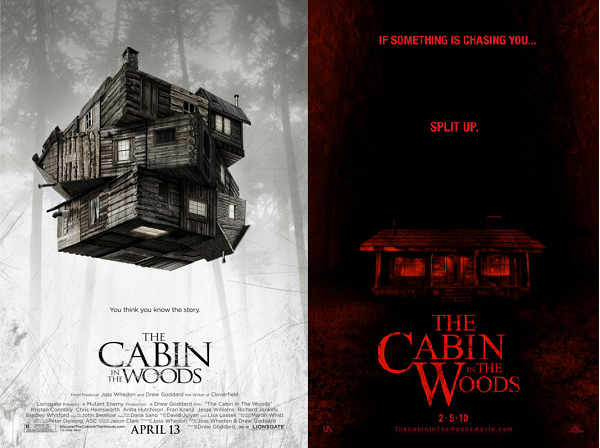
This genre-specific pieces of advice are indeed employed in the film; while the cabin is being attacked by the Buckner family of zombies, Curt suggests they all stay together—until a controller flips a switch and releases some aerosolized drug that makes Curt pause, sway, and then decide the group should instead split up. It is the immediate familiarity with these classic horror tropes and the explicit acknowledgement of them within the story that pushes this ironic treatment into the realm of postmodern parody.
Perhaps most notably, however, is that whereas a film like Scream may contain, as Syder argues, an intertextuality that “in effect constitutes the text,” The Cabin in the Woods escapes such a reductive charge by using its own postmodern establishment of itself as self-referentially intertextual as a means to craft a framing narrative that uses its intertextuality in a creatively constructive way. The narrative creates a space in the interior story—that of the five protagonists on a nightmare vacation to a cabin—that participates in tropic generic convention, while the framing narration—that of Sitterson and Hadley and the ambiguous entity for which they become architects of the sacrifice—acts as a means of ironizing and criticizing overreliance on these conventions while simultaneously inscribing a larger cultural meaning onto these conventions as a means of appeasing the Old Ones. Implicit in such a narrative turn is an argument that, though overly familiar, horror tropes approach a mythic importance.
In a film like Scream, knowing the rules of the genre may possibly help a character survive the film; in Cabin, Whedon and Goddard have crafted a world in which those rules serve more than merely filmic generic tradition, and there is a very good reason why the characters should perhaps not survive. “The postmodern paradigm blurs the boundaries between good and evil, normal and abnormal, and the outcome of the struggle is ambiguous at best,” writes Pinedo, and in Cabin this coded ambivalence is prevalent—which outcome would be good (Pinedo 22)? Is the Director’s agenda evil, or good by definition of the wider common interest? Do we root for Dana and Marty, knowing it means our own (simulated) demise?
Postmodern parody is both deconstructively critical and constructively creative, and this is the force we see at work in these two films. By appropriating horror tropes and including a thick intertext, they have used the narrow formula as both a site of creative storytelling and a means of foregrounding the implications of these horror stereotypes. Where Scream is gleeful in its celebration of the ironclad rules of horror and the chaos that follows from those rules, Cabin is implicitly critical of the generic tendency to use rote characterizations in place of more complex, individualized characters of agency. By simultaneously inscribing and subverting generic conventions, these movies concurrently reemphasize the tropes while they subvert them, a simultaneity of conflicting juxtapositions that is so perfectly postmodern.
I’ll end with this, one of my favorite moments from Cabin, and one that perfectly sums up how postmodern films approach horror. In one of the films early comedic moments, the token stoner (“The Fool”) pulls out a telescopic bong that, when collapsed, looks like a coffee thermos. Later, he uses the thermos-bong as a weapon against a zombie. Maybe it’s a reference to the permeation of the Devil’s Lettuce and all things horror; after Halloween was labeled a morality play, its characters seemingly punished for acting immorally, smoking became a death sentence for horror characters. Instead, Whedon’s pothead uses his bong as a weapon against the enemy. Maybe it’s a sign of changes to come, a challenging of stale tropes and norms, a reawakening of a genre and a bored audience.


Or maybe it’s just a bong.
Works Cited
The Cabin in the Woods. Dir. Joss Whedon. Perf. Kristen Connolly and Chris Hemsworth. Lionsgate, 2012.
Pinedo, Isabel Christina. “Recreational Terror: Postmodern Elements of the Contemporary Horror Film.” Journal of Film and Video Vol.48 (Spring/Summer 1996): 17-31. JSTOR.
Scream. Dir. Wes Craven. Perf. Neve Cambell and Courtney Cox. Dimension Films, 1997.
Syder, Andrew. “Knowing the Rules: Postmodernism and the Horror Film.” Axes to Grind: Re-Imagining the Horrific in Visual Media and Culture. Ed. Harmony Wu. Spec. issue of Spectator 22:2 (Fall 2002): 78-88.