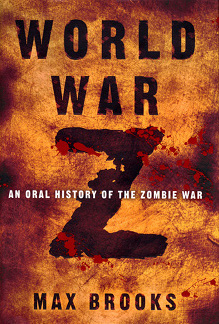
As I’ve been reading Station Eleven, I find that the book very much reminds me of one of my favorite “end of the world” novels, World War Z. If you haven’t read it, WWZ is presented as an “oral history of the zombie war”, and is set some years after the zombie apocalypse has both come and gone. The book is a collection of interviews with various figures from the zombie war, from Presidents to soldiers to astronauts to housewives turned warriors, as well as everything in between.
What sets both WWZ and Station Eleven apart from other apocalypse stories is their focus on the day-to-day and reality rather than any grand “saving the world” narratives. It’s angle I find fascinating, as it is often overlooked in these kinds of stories. Whenever we see a zombie movie, or read an infection/disease story, we never stop to think about anything beyond what we are shown. Yes it can be exciting to read about scientists scrambling to find some sort of cure, but how often do we stop and wonder about what happens to any astronauts stranded on the International Space Station? Or how governments and societies would undergo monumental shifts in policies? Or even how art and culture would survive and change as the years go on. There are real people hidden in the pages of every apocalypse story, and I think that often goes overlooked.
At its core, Station Eleven isn’t about saving the world or bringing things back to the way they were, there’s no “chosen one” or miracle cure. It’s just a small melancholy story, about a small melancholy group of people, doing the best they can with what they can to keep the dream of the human spirit alive. There’s something so romantically admirable about that. What other stories are out there that we have missed, that have been left out of the grand apocalypse narratives?
Luke already talked about this a little in his post, but I was wondering what is it about post-apocalyptic narratives that makes them so popular. It’s an odd trend, when you take a step back and really look at it. Why do we enjoy reading and watching stories that describe a world where society has collapsed, millions (possibly billions) of people are dead, and the way of life we know has forever disappeared? It’s rather macabre, in a way, the imagining of a “post-human” world. Station Eleven does a great job of creating just such a world, giving us just enough details to flesh it out, but not too much as to leave our imagination out of the process. In a strange way, the novel relies on our previous encounters with post-apocalyptic narratives. When we read about the “Georgia Flu:, we don’t need a bunch of chapters detailing how society collapsed. We know how those stories go. We’ve read them, we’ve seen them, they’re almost everywhere these days. So, what’s the reason for the popularity of this type of story? What draws us to them?
One possibility is what I mentioned before, the vaguely thrilling sense of macabre. There’s something in us that wants to read stories of destruction, of death and ruin, of something so terrible it has the potential to wipe out the most successful species in Earth’s history. It’s like a penny dreadful or the murder scene in a mystery novel, just on a global scale. We’re drawn to death, however much we hate to admit it. Any sort of apocalypse would be a tragedy, by any and every measure, something tragic, awful, and ruinous. And yet…wouldn’t you almost want to watch it happen? Not to you of course, maybe to some other planet as you sit on the moon and watch, but the feeling is there. It’s odd, this fascination with what happens after the end. We sit in our air-conditioned houses, staring at smart phones, watching tv, playing video games, boarding flights to far-off countries, secure in the knowledge that there has never been a better time to be alive than right now. But then our minds begin to wander, and we almost start to wish it would all come crashing down around us.
The most fascinating part of the readings were, to me, the ones about “programming morality.” As we move closer and closer to a world filled with automation and artificial intelligences, it becomes clearer and clearer just how much gray area there is involved in creating those very things. The human decision-making process is already a fairly complicated one, recreating that process is even more so. As the New York Times article puts it, “These situations can be difficult enough for human minds to wrestle with; when ethicists think through how robots can deal with them, they sometimes get stuck, as we do, between unsatisfactory options.” We humans can have the benefit of acting first, then explaining later, secure in the knowledge that whatever action we take, we will have the benefit of explaining it later. Robots and other AI’s, however, do not have that luxury. Every decision must be programmed beforehand, every little choice mapped out.
My question is this: in this situation, where does the buck stop, so to speak? Who is responsible for the actions of programmed AI’s? Say a driverless car drives off the road to avoid hitting a group of children crossing the road, but injures or even kills the driver in the process. We might agree that was the “morally correct” choice, but does that help the driver’s family? If they decide to sue, are the programmers responsible? Dealing with these ethical conundrums is already hard enough without adding in the bonus ingredient of legality.
Isaac Asimov, the science fiction writer, famously came up with the “Three Laws of Robotics,” which are still used in robotics today. They are: 1) A robot may not harm a human being, or through inaction cause a human being to be harmed, 2) A robot must obey orders given it by human beings except where such orders would conflict with the First Law., and 3) A robot must protect its own existence as long as such protection does not conflict with the First or Second Law. Now, as far as laws go those aren’t bad, they’re rather tidy and all-encompassing actually. What makes me feel weird about all of this is that these issues shouldn’t be so easy. They’re hard, they’re supposed to be hard, and I worry that in our haste to welcome the future with open arms we’ve lost sight of that. It has taken centuries of philosophy and thought to create the morality system we have today, and now we’re trying to streamline all of that as we hurry to reach the future we so desperately want. These questions take time, they take effort, they take thought. I hope that we don’t fixate on the destination and miss out on the path we need to get there.
As far as literary and cultural studies go, comics are often overlooked. They’re seen as too childish, too commercial, too commonplace to have any sort of relevance to grand cultural narratives. Now, in recent years that has started to change, but the fact remains that when people think about the “artistic” and the “intellectual,” comics often get the short end of the stick. However, I believe that to omit comics from these sorts of studies is to neglect a subject full of points to make and questions to ask. Comics, and the place they hold in our culture, are unique. They straddle the line between high art and low art, form and content, picture and text. They cross boundaries and borders, bringing people together in support of a diverse cast of heroes and villains. As opposed to a book or a movie, where the plot is self-contained from the very beginning, comics give readers ongoing storylines that continue week to week and month to month. However, what happens when those storylines are broken? What happens when death, the great disruptor, interrupts the stories and fictional lives that millions of people hold so dear?
For my project, I wanted to look at death in comics, specifically how fans react to it. It’s no secret that dying in a comic isn’t exactly the most lasting of things, with about the same level of severity as a slight fever, with a quicker recovery time to boot. Still, when a fictional character dies, that tends to mean something to people, no matter the medium. However, in a place where characters are killed and resurrected with alarming regularity, does death begin to lose its impact? How do people grieve or mourn when they expect to be seeing the deceased in next month’s issue? What does a para-social relationship look like when it goes both ways? Where does the willing suspension of disbelief enter into all this? These are all questions I was seeking to both pose and answer with my project, Death is Cheap, an online compilation of the lives, deaths, and resurrection of comic book heroes.
The title of my project comes from the tvtropes page on this very subject, and I felt it fit. I wanted to create something that compared the grieving of both the fictional comic world and our own reality. To that end, I chose multiple heroes from both DC and Marvel, whose deaths (and resurrections) I felt were unique and meaningful enough to have significant impact in both their world and ours. I wrote in-universe tributes and memorials about each hero, immediately following those with comments and thoughts taken from different comic-related message boards, internet forums, and blogs. There is a definite tonal shift, a change from open grieving to a sort of cynical analysis. To be clear, it’s not that people didn’t miss or mourn for the fallen heroes, but rather that they were genre-aware, secure in the knowledge that their idols would eventually return, whether in a few months to a few years.
One subject I wanted to explore with my project was that of online memorials, of how grieving and mourning sites on the web differ from those in real life. Now, obviously it’s probably a little different when the mourning subject in question is in fact fictional, but there are still many themes that carry over. The article “Gravesites and Websites: a Comparison of Memorialization,” by Connor Graham, Michael Arnold, Tamara Kohn, and Martin Gibbs, talks about how “each and every gravesite has, on one hand, a static, enduring component and, on the other, a dynamic, changing on” ( Graham 49). There is the unchanging tombstone, and the flowers that cycle week to week. However, for “memorials” of dead comic book characters, this dichotomy is altered. While the posts and tributes are indeed constantly changing, with fans constantly weighing in with their opinions and feelings about the character, the “static, enduring” part is, in fact, the comic itself. Even though the character is “dead”, the comic continues to be printed, continues to serve as a lasting memorial to their legacy and impact. The digital forums serve as places where fans can gather to discuss the comics, acting as a sort of permanent wake for the dead character.
When it comes to online memorials specifically, there is a definite ongoing sense of “continuing relationships with the dead…a sense that the dead are receiving messages” (Graham 50). Memorial and tribute sites are, by their very digital nature, constantly changing and updating, always revising and renewing themselves. However, the key difference in regards to comic books is that the dead are, in fact, receiving messages. Comic writers and artists are known to habit different popular forums, trying to see what is and isn’t working for their fans. If a character is killed off and there is a massive outcry, that character can be brought back. The dead, for these memorials, are very much “active listeners”, as Graham puts it. To reflect that, I created a space on my site where users could submit characters they felt particularly strongly about, or whose death (and resurrection) they felt had an especially large cultural impact. Digital memorials are not static like their physical counterparts, and I wanted my site to show that.
Another aspect of comic book fandom I wanted to explore was the para-social aspect, specifically as it relates to the willing suspension of disbelief. In their paper “Mass Communication and Para-social Interaction,” Donald Horton and Richard Wohl define a para-social relationship as one between a “performer” and an audience, wherein the audience feels connected to and invested in the performer, despite a lack of any actual contact between the two. Think about the cult of celebrity that is so prevalent in this era. We have entire magazines, TV shows, large portions of the web, all devoted entirely to what famous people are doing, where they are doing it, and who they are doing it with. Remember how the world reacted when Brad Pitt and Angelina Jolie got divorced? People were distraught, crying about how love was dead, how their faith in marriage was shattered. Now, obviously some of that was tongue in cheek, but for many people those feelings were very real. That is what para-social interaction refers to, the imagined give and take between celebrities or icons and their fans. As Horton and Wohl put it, “The more the performer seems to adjust his performance to the supposed response of the audience, the more the audience tends to make the response anticipated. This simulacrum of conversational give and take may be called para-social interaction” (Horton 215).
It is no great revelation that many people have this relationship with comic book heroes. However, since in this case the “performers” are fictional, the “simulacrum of conversational give and take” has a much wider range. The audience has the freedom to imagine their heroes in any scenario or situation, can shape them to fit their own personal narrative. While Ryan Gosling can only ever play “Ryan Gosling”, Batman can mean many different things to many different people. In this way, comic heroes paradoxically have both much more and much less symbolic meaning than performers in “traditional” para-social relationships. While they can appeal to a wider range of people with their ability to shift and stretch as the times and customs demand, they also do not have one singular personality, making it harder to find one defining aspect. It’s an interesting question. Is it better to be a monolith, powerful yet inflexible? Or is it better to be amorphous, adaptable yet thin and diluted? There’s no “correct” answer, but it does raise some interesting questions about the nature of fictional para-social relationships.
Another way comic-based para-social relationships are different is that, rather uniquely, the relationship actually goes two ways. Typically, a para-social interaction is “one-sided, nondialectical, controlled by the performer, and not susceptible of mutual development (Horton 215). However, comic heroes need their fans, in a very real and literal sense. After all, if nobody reads or buys the books, then the character dies the only true death that can be found in comics: cancellation. Comic characters need fans just as much, if not more, than the fans need the characters. Actors and actresses aren’t competing for our attention, they will have it no matter what. Yet every dollar we spend on a Superman comic is a dollar we aren’t spending on a Fantastic Four comic. Even in movies and TV shows, which are self-contained with an expected eventual end, the characters (and actors) don’t need our attention in quite the same way. Comics are expected to go on in perpetuity, there’s no anticipated “series finale.” Indeed, if such a finale does occur in comics, it’s usually not a good thing, meaning the book has been cancelled or the writers fired. When you look through the real-world tributes on the site, notice how many talk about “dropping” the book, or buying a death issue merely as a collector’s item. Money rules determines everything in the comic world, a fact of which readers are often uncomfortably aware.
This brings up my next point, the role of the willing suspension of disbelief. In her article “Larger Than Life: Digital Resurrection and the Re-Enchantment of Society,” Alexandra Sherlock states that “WSOD relies on a tacit understanding and cooperation between the author and the reader, or director and audience. The audience members let down their defenses and skepticism, and the director includes elements of reality in order that the imaginary parts seem more believable—all resulting in the increased enjoyment of the production” (173). We all know that being bitten by a radioactive spider most likely wouldn’t actually give someone spider powers, but isn’t it more fun to pretend it would? WSOD is more present in comics than perhaps any other medium, and requires a constant balancing by the writers to make sure they don’t stray too far in either direction, towards fiction, or towards reality. As a result, comic fans have become accustomed to separating the “reality” of comics from the “fun” of comics. However, the issue with WSOD is that, over time, people can build up a tolerance of sorts. Comics are always looking for greater and showier events, flashier and more complex heroes, anything to wow the fans (and get a leg up on their competitors in the process). Sherlock also writes about media consumers’ increased appetite for the spectacle” (174), about how we are always looking for something bigger and better than what came before. So, when comic studios realized killing off a major character could be such a “spectacle”, they pounced on the opportunity.
While that worked at first, the fans soon built up their WSOD tolerance, to the point where no any death feels like a marketing ploy or a cash grab, no matter how it moves the plot or motivates characters. Comic deaths are events now, something for people to tweet and blog and post about, to anticipate feverishly before dissecting it in a myriad of ways. Sherlock’s article mentions how participation in online memorials or death rituals is motivated “less by the loss of the individual and more by the sense of social solidarity that generates around their death” (169). We react to comic deaths not just because they may or may not be affecting, but because we know others are reacting as well. We feel involved, part of something greater than ourselves. However, we are only able to react as such because of our knowledge that, eventually, things will return to normal. If DC announced that Batman would be dying in a few issues, it would of course be a big deal. Yet the only reason there wouldn’t be a torch and pitchfork mob storming the DC offices is because we know that it is only a matter of time before Bruce Wayne is alive and well again. Comics are an ongoing story, one where the status quo is king. Everything will reset. It has to. Clark Kent will always be Superman, Peter Parker will always have Mary Jane, no matter what the comics might actually say. Comic characters belong to the readers as much as the writers, are part of the popular imagination as much as they are the intellectual property of the studio. When a superhero dies, that means something to people. What is happening in modern comics is that the constant cycle of death and resurrection is starting to drain those deaths of any meaning at all.
I realize I’ve said a lot here, and rambled on a bit more than I should have. I guess I just wanted to press upon you just how much comics and the worlds they give us mean to people. We forget just how many relationships and interactions we have with fictional creations, how much they can represent. I wanted to explore those relationships in a field that appeals to our innocence and allows our imaginations to run free, yet is also driven and informed by a materialistic culture that demands instant gratification. They push us to be the best we can be, yet also shows us how low we can sink. They’re full of laughter and weeping, hope and despair, compassion and cruelty, life and death. In a word: they’re fun. We know they aren’t real. But that doesn’t stop us from looking up at the sky, seeing a shadow pass over a cloud, and thinking “Could be a bird. Probably a plane. But maybe, just maybe…..”
Works Cited
Graham, Connor, Michael Arnold, Tamara Kohn, and Martin R. Gibbs. “Gravesites and websites: a comparison of memorialisation.” Visual Studies 30.1 (2015): 37-53.
Horton, Donald, and R. Richard Wohl. “Mass Communication and Para-Social Interaction.” Psychiatry 19.3 (1956): 215-29.
Sherlock, Alexandra. “Larger Than Life: Digital Resurrection and the Re-Enchantment of Society.” The Information Society 29.3 (2013): 164-76
I found a Verge article that I found pretty interesting, and I think it brings up some good discussion points. It follows the online relationship of two people, IamDRock and Rainbowdasher, on a now-dead site called the Experience Project (or EP for short). While much of the article follows the course of their relationship, it also brings up questions about relationships, both on- and off-line, as well as how the internet affects the universal human desire for connection.
But first, some background. The way EP worked was that users could post a story, thought, or even just a feeling, and other users could “join” that experience, enabling people to connect in ways beyond simply both going to the same high school or both rooting for the same basketball team. Unfortunately, this inventive format proved to be unwieldy and hard to decipher, and EP shut down early last year. The site still exists (you can visit it here) but only as an archive, a collection of past memories and moments. For people who never used it, it’s like “uncovering a yearbook in someone else’s attic” as the author of the article puts it. The ups and downs of IamDRock’s and Rainbowdasher’s relationship is in plain view for all to see, in its entirety. You can read Rainbowdasher’s post about their first kiss, or see IamDRock defend the fact that Rainbowdasher even exists at all. As the article says, EP “allowed their narrative to be told in real time, with an interactive Greek chorus following along. The downside of that immediacy meant the death of the forums also signaled the death of the story.” When EP was live, users could follow along, joining in with their criticism and comments. When EP died, they were cut off.
What Experience Project currently looks like
While the author attempted to follow how the relationship fared once EP shut down, I was more interested in this idea of love or relationships becoming…outdated. Think of how many social networks are out there, from Facebook to the multitude of start-ups in Silicon Valley right now. While each one is unique, bringing something slightly different to the table, the basic service is the same: to connect people with each other. While we focus mainly on how the digital age has affected death as a cultural force, it’s easy to forget the internet has affected relationships just as much, if not more. It has never been so easy to find like-minded people, to make some sort of connection, even without ever actually meeting them. And yet, at the same time…it’s never been harder. The sheer amount of social websites and apps means that we create different versions of ourselves in each one. It has become so difficult to parse through all the filters and fronts to reach the real people behind them.
With all that going on, maybe that’s why i found IamDRock and Rainbowdasher’s tale so moving. Here are two people who, despite all odds, seemed to have made a genuine connection. But then, through no fault of their own, it was severed. If Facebook went under tomorrow, what would happen to all those relationships? Would you put in the effort to move to another website, to try and remake all those connections? At what point does a digital connection become a meaningful connection? I don’t really have an answer to any of this, I just believe it’s worth thinking about.
What I found really fascinating about the QR article was how it brought up the aspect of obsolescence, which I think is often overlooked in these discussions. While I do think that adding QR codes to gravestones is, if nothing else, an interesting wrinkle to traditional grave plots, I wonder what those relatives will think in five, ten or twenty years. On the one hand, there is something to be said for creating something that explicitly links the grave with the deceased. Imagine taking a small child to the grave of a relative they never got the chance to meet, or perhaps they only distantly remember. You could pull your phone out, and by simply pointing it at the grave’s QR code you could pull up pictures, articles, perhaps even video messages from the deceased themself, all giving the child a sense of who their great-grandfather/second cousin/whomever actually was. I think that’s admirable. There’s something to be said for giving people the ability to try and choose what their legacy is, what they are leaving behind and what people will remember about them.
What happens when technology inevitably moves on? The article goes into this a little, but QR codes aren’t exactly cutting edge anymore. They’re not very widely used, and have already begun to move into that strange area where the only people or groups that use them date themselves by doing so. You know, like how when companies try and appeal to #millennials by turning old memes into ads. It’s the equivalent of your grandmother proudly telling you about how they finally got one of those new-fangled flatscreen televisions. It’s still a big step, and useful, but the world’s already started to move on to bigger and better things. That’s how things go these days, unfortunately. There’s always some new exciting app that is a total life changer until one day, with no warning, it isn’t.
Now, usually this isn’t that big a deal. Phone models come and go, headphone jacks are added and taken away, and the world spins on. People adapt. However, what about when it is our graves that are no longer relevant? Cemeteries are supposed to be places of quiet, stillness, and a certain sense of timelessness. Death is universal, and a gravestone is supposed to be something that will be able to speak throughout the decades and the centuries. From the pyramids to the modern day, graves were places where people stop, reflect, and remember. They exist outside of time, outside of trends, fashions, and fads. By adding QR codes into the mix, people are crossing this boundaries. You shouldn’t ever look at a grave and think “Wow that is so five years ago.” Maybe I’m just being traditionalist, and am already behind the times, but respecting and honoring the dead is as universal as any human trait. It does not, and should not, go out of style.
One part of mourning and the grieving process that sometimes gets overlooked is the social aspect, how people navigate the complicated customs, mores, and traditions we associate with death and funerals, while also trying to find time to personally grieve. There are two clearly-defined sides of grieving, the public and the private, the outward and the inward. We expect a grieving family to behave a certain way at the funeral, at the memorial service, in the immediate days afterward. It can be hard to find time to mourn on one’s own, to work to begin the difficult process of grief and letting go.
Social media complicates all that even more. Take Facebook. When someone with an account dies, it’s pretty common for people to post goodbye messages on his/her wall, not anything too in depth, just something to serve as an outlet for their personal grieving process. Now, I want to stress that this is not necessarily a good or a bad thing, just a complicating factor. For one thing, the nature of social media is public. By posting these personal messages on a public social networking site, people are blurring the boundaries between the private and public sides of grieving. They are opening up their mourning to others, showing them how they are feeling and what they are going through. At least, in theory that’s what they’re doing. In reality, everything people post on Facebook (for the most part) is edited and created with a specific lens in mind. Are people posting for themselves, or for other Facebook users? Not to be too cynical, but I would find it hard to believe that there isn’t a certain percentage of people who spend a lot of time crafting their post to hit just the right chords, to get just the right amount of likes and comments.
Part of this is natural, people like to make good impressions, there’s nothing wrong with that. Yet doesn’t it feel a little…off? We like to think of grieving as an intensely personal experience, something raw and honest, unique to each person. So if someone begins to manufacture or reframe their grief, it feels a bit like cheating, like they’re commercializing something sacred. Maybe I’m just being too emotional or naive here, but at least for me, my grief is not easily put into words, or summarized with a few pithy lines, a couple emojis, and a picture of my dead friend smiling. I’m being overly harsh, but you get my point. Facebook, along with other social media sites, complicate the grieving process, force the public and private sides to merge in new and often uncomfortable ways. As is typically the case, technology continues to surge ahead, while culture struggles to catch up.
Fueled by the compulsion to both look and not look, conflating fear and repulsion with curiosity and attraction, horror thrives as a narrative paradox. Often tightly circumscribed by its own generic structures, much of contemporary horror has clearly defined conventions that rely on formulaic constructions and tropes. The formula is in fact so inviolable that it has been made narratively explicit in films such as Wes Craven’s highly influential Scream (1996), a self-reflexive and intertextual postmodern masterpiece that grossed upwards of $100 million in the US alone.
Craven, along with a brilliantly written script by Kevin Williamson, breathed new life into the slasher film. They took all of the archetypical constructs of the slasher sub-genre and directly exposed them to the audiences while still staying within the confines of the genre. This was not new, parodies had done this in the past, but Scream managed to both keep a straight face and produce fear. Scream and other postmodern horror films that followed in its wake reinvigorated the flagging genre in the mid-1990s, due in large part to their extreme self-reflexivity, along with numerous intertextual references to earlier horror landmarks. The postmodern conceit is simple: Scream is a slasher movie in which the characters are well versed in the rules and conventions of slasher movies, to the self-referential point of characters talking at length about earlier slasher pics. It is a film in which the intertextuality, in effect, constitutes the text; and its media literacy and genre-bending are markers of the arrival of the postmodern era in horror film. Isabel Pinedo argues, “the postmodern horror film transgresses the rules of the classically oriented horror film, but it also retains features of the latter, which form the backdrop against which violations of the rules are intelligible as such” (“Recreational Terror”, 19). In its postmodern iteration, the horror film acknowledges its generic lineage before it subverts the formula thereof.
In Scream‘s opening scene, we watch as Casey (played by Drew Barrymore) has what originally seems to be a flirtatious phone conversation with a friendly stranger turn into a deadly game of horror trivia. The mysterious stranger asks Casey a series of questions about horror movies, such as who the killer in Friday the 13th was, with rather unfortunate punishments for Sydney and her boyfriend.
While this was a surprise for audiences in that many expected Barrymore to be one of the central characters, perhaps even the stereotypical “Final Girl“, this scene also set the stage for the rest of the film. The teens of the 90’s had grown up on slasher and horror flicks, knew the rules, the tropes, the characters. As such, horror movies had to evolve, had to change to suit the new experienced and cynical mood of the times. The characters in Scream know horror films and are constantly citing genre titles. The irony is that they are living in one.
Influenced by the widespread success of Scream, other postmodern horror films soon followed, films that both emphasized sameness by reveling in the established generic tropes while also crafting disjunctive, ironic narratives that acknowledged and played with those very same generic conventions. Films such as I Know What You Did Last Summer (1997), Urban Legend (2000), Final Destination (2000), the wildly successful The Blair Witch Project (1999), and reboots of both the Friday the 13thand Nightmare on Elm Street franchises all exhibit this postmodern tendency toward self-awareness, intertextuality, and hybridity. These films reflect the conception of postmodern anxiety as acute self-consciousness about the formal, constructed nature of the work. Just as postmodernism can be viewed as a crisis of systems of regulation, the postmodern horror film reflects anxieties about the horror genre. The commonplaces of generic tropes and conventions are concomitantly a source of both restrictive apprehension and creativity. The postmodern horror audience enjoys the reiteration of The Rules while simultaneously celebrating the subversion of them. Here occurs what Andrew Syder contextualizes as a postmodern “rhetorical deconstruction,” the move from strict sets of rules governing rhetorical creatures such as vampires, werewolves, and other classic horror monsters to a postmodern demystification of the “rhetorical nature of representations of the unknown” by tacit acknowledgement of the fictionality of the monster as narrative device (Syder 84-85). Essentially, the postmodern reframes traditional horror narrative, rupturing the unity exhibited in classic horror films and instead invites participation in the signification of the narrative rather than a distanced remove from it.
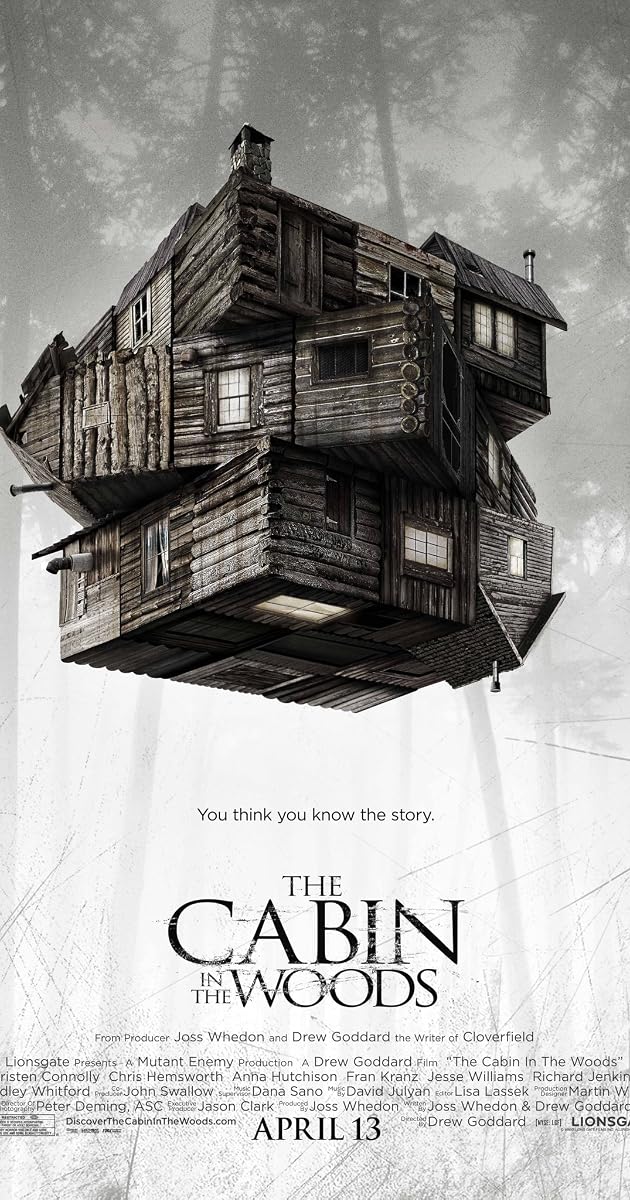
Following this new tradition of self-aware horror films, 2012’s The Cabin in the Woods, written by Joss Whedon and Drew Goddard, also tidily fits these definitions of the postmodern as multilayered, ironically detached, and simultaneously traditional and subversive. We begin with a couple of middle-management types going to work talking nonchalantly about their weekend plans. A sequence normal enough to the realm of drama or comedy, but unsettling in the slasher genre. We then turn to our group of college friends and our worries are laid to rest. They are going on a weekend trip. We know this story. At this point we understand there will be some inane banter that will hopefully allow us to care about the characters long enough to fear for them and in turn mourn their demise. We know they will fit in one of five stereotypes: “the fool,” “the jock,” “the scholar,” “the virgin,” and “the whore.” We know a moral compass will emerge from the group and during our final sequence we will switch our perspective respectfully from the killer/monster to the heroine “virgin” of the group. We also know the prophet of doom will attempt to save them, but through misguided fear and machismo our characters will remain stubborn to their plan. There will be sex, drug use, and incomprehensible reactions to dire situations.
The Cabin in the Woods is a perfect example of postmodern parody. Crucial to the idea of parody is a sense of historicity, a refiguring of the past rather than a denial or departure from it. Cabin not only exhibits this sense of historicity through its thick intertextuality but also by its appropriation and subversion of genre conventions and horror tropes. Cabin relies on these tropes as a way to establish a cultural continuity and as an appeal to a horror audience familiar with the trappings of the genre. Tropes themselves are a cultural signifier, and the rather shameless and flagrant use of tropes in The Cabin in the Woods is used as a stylistic method to investigate and deliberately call into question the fictional device of the trope.
LikeScream, Cabin in the Woods is tauntingly circular. The final 20 minutes of Scream, which borrow heavily, and with complete openness, from Halloween, have become iconic in their own right. One character is commenting on and narrating Halloween, which is playing on TV, warning Jamie Lee Curtis to turn around, while a masked killer is directly behind him. Someone even says, “I’ll be right back” after being warned to never, ever say, those exact words
The irony is gleefully obvious, which makes it all the more likeable. It doesn’t reek of pretentiousness. The curious contrast between Wes Craven’s satiric slasher and Cabin‘s bloody Rubik’s Cube is the acidic quality with which Whedon and Goddard etch their characters and plot twists. The movie is at times barely coherent, but it doesn’t matter because it moves at a furious pace and, unlike Craven’s film, has some anger behind its eyes. Whereas Craven wanted to dissect his own movie and took great pleasure in cutting clichés into bits, Whedon and Goddard are out for blood, taking swipes at Eli Roth and his torture porn cronies in particular.
Tropes act as a shorthand, an appeal to cultural memory, easily recognizable and familiar. Most horror films make repeated use of tropes as a tool of storytelling, but the tropic references in TheCabin in the Woods are practically legion. TVTropes.org, a wiki site dedicated to cataloguing tropes not only in television but also in film, videogames, and other media, maintains an extensive collection of user-inventoried tropic content. Based on the content there, Whedon and Goddard include, to name only a portion: The Abandoned Area, The Adjectival Man, The Creepy Basement, Death by Sex, an Ominous Music Box Tune, a Surprisingly Sudden Death, a Torture Cellar, the list goes on and on. These are all immediately recognizable conventions that border on horror film clichés, but the manner in which Goddard and Whedon utilize these tropes, however, is a complete subversion of the tropes themselves. As the film plays out, we learn the rural, abandoned cabin that belongs to a cousin of Curt (Chris Hemsworth) is in fact solely for the purpose of hosting these five sacrifices, and further, that Curt does not actually have a cousin who owns a cabin—the trope was employed as a believable fiction by the mysterious and shadowy organization who manipulates the environment. The Adjectival Man, a mysterious and peculiar figure in horror film who acts as a warning to the main characters (think the creepy hillbilly at the gas station, or the old woman in the small town) is seldom given an actual name, but is in this instance is explicitly named The Harbinger (Tim De Zarn) by the mechanics of the postmodern, self-reflexive sacrificial experience. More than that, he’s ridiculed by other characters for his over-the-top, almost biblical manner of speaking.
In postmodern fiction, narrative conventions like plotting, use of metaphor, and omniscient narrator are parodied so as to expose their role in the fabrication of meaning; so as to present the text as a fiction-making apparatus. Here, the movie is literally laughing at the absurdness of The Adjectival Man, using the trope even as it ironically comments on it. The generic device of the grotesque figure warning the protagonists away from their path is here parodied as a way to foreground the fictional construct of The Harbinger within Cabin’snarrative. All of the facets of traditional horror are there—the clichéd characters, the obviously menacing location, and the warnings that something bad is about to happen—and yet, Whedon throws these iconic concepts on their heads by acknowledging how completely ridiculous they are.
Likewise, the Creepy Basement is deliberately and absurdly creepy, in service to the sacrifice, complete with mechanical cellar door that flies open at a narratively opportune moment. The deliberateness of the creepy factor as well as the plethora of items that horror filmgoers will recognize as Summoning Artifacts both appeals to horror historicity while, in terms of the framing narrative, emphasizes the free will of the characters to make the choices that lead to them being sacrifices. Also a classic hazard of horror films, the danger of standing in front of a window exists in Cabin as well; the film toys with viewer expectation by having Marty (Fran Krantz) linger in front of the dark window, silent for a beat before Judah Buckner (Matt Drake) smashes through and pulls Marty out the bedroom window. Anyone versed in horror parlance knows that something is going to burst through the window, and the trope plays out, but the traditional outcome of that trope is subverted when we discover Marty was the victor in the skirmish, dismembering Judah with a trowel. Despite cognitive tampering, the Dumb Blonde in the film, Jules (Anna Hutchison), retains enough sense to be aware that it is a culturally-acknowledged bad idea to have sex in the woods (thereby echoing the audience’s knowledge of the generic motif), but the combination of a temperature-controlled environment, moonlight produced on cue, and aerosol pheromone mists lull her into the act, manipulating her into the perfect sacrificial Whore in order to fulfill the narrative requirements.
In fact, it is established early in the film that Jules has just dyed her hair blonde, and Dana (Kristen Connolly) indicates that Jules is pre-med, but the Chemistry Department’s Lin (Amy Acker) explains that they’ve slowed cognition through the hair dye, literally shoehorning Jules into the Dumb Blonde trope. Likewise, Dana is introduced as having just ended an affair with her professor, but ostensibly through more chemical interference, she assumes the role of the virginal girl, even confusing herself when she indicates such to Holden (Jesse Williams) while they are kissing. This both situates her as the sacrificial Virgin and positions her as the textbook Final Girl, the last girl standing in a slasher film, usually virginal, demure, and with a unisex name. Later, confronting the Director (Sigourney Weaver), Dana scoffs at being typecast as the Virgin, to which the director admits, “We work with what we have,” acknowledging that the pressing of each character into these stereotypes is frustrated at best. The Virgin, the Whore, the Fool, The Athlete, and the Scholar are all stereotypes, but the essential, specific nature of them is not “real” and for the means of the ritual, the characters in Cabin are shoehorned into the roles. This acts as a way of highlighting and criticizing the stereotypical characters so prevalent in the horror genre; as each character is forced into the stereotype in order to fit the demands of the sacrifice, Cabin calls into question the widespread use of these stock characters in other films in which there is no cognitive tampering to reduce characters to one-dimensional caricatures.
The use of other tropes reemphasizes the “fiction-making apparatus” so crucial to The Cabin in the Woods and its postmodern inversion of traditional horror films. When Dana drops the knife she used to stab Matthew Buckner with, we see Sitterson (Richard Jenkins) in the control room operating a joystick that sends an electrical shock to the knife, causing her to drop it, at last providing the audience with an explanation for this disturbing tendency in horror films for the protagonist to mindlessly discard her weapon—or, rather, making a self-reflexive comment upon the inane trope. The generic tendency of characters to discard their weapons is repeated, yet is reinterpreted by the offering of an explanation for the behavior. This tiny moment in Cabin illustrates exactly this postmodern tendency—the paradoxical reiteration and subsequent subversion of horror tropes.
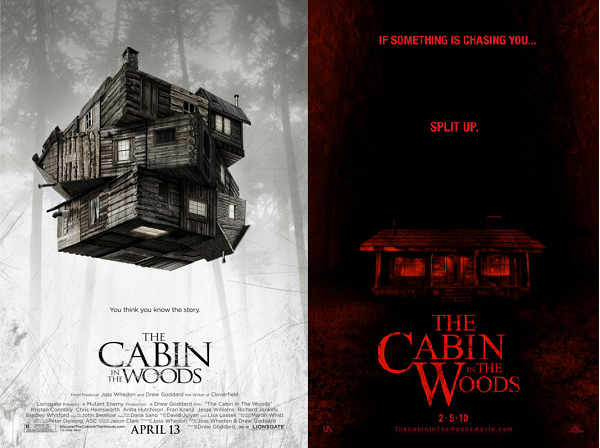
Similarly, the Ominous Music Box Tune that emanates from the jewelry box Holden plays with in the basement isn’t merely an object that justifies some diegetic, dissonant music in a minor key for atmospheric benefit—we later discover through musical refrain that the object would have summoned the unnerving Ballerina Dentata monster. In fact, it is not a singular Summoning Artifact in the basement, but rather an entire collection of them linked to different monsters and different means of death. These items mesmerize the five students, as arcane items in horror films do, and when it is revealed that this was a garden of forking paths with which to decide their fate, the audience’s previous experience of horror films informs the imaginative possibilities of what nightmare each object would have summoned. The objects are a literal catalogue of nightmares, and the trope of the inescapable allure of the Summoning Object is here placed in the basement because the film acknowledges that very inescapability of the allure of arcane items to characters in horror films. Further asserting itself as self-referentially postmodern, even the advertising campaign leading up to the film’s release acknowledged and subverted classic horror tropes, featuring movie posters that included phrases such as, ”You think you know the story” and “If something is chasing you… split up.”
This genre-specific pieces of advice are indeed employed in the film; while the cabin is being attacked by the Buckner family of zombies, Curt suggests they all stay together—until a controller flips a switch and releases some aerosolized drug that makes Curt pause, sway, and then decide the group should instead split up. It is the immediate familiarity with these classic horror tropes and the explicit acknowledgement of them within the story that pushes this ironic treatment into the realm of postmodern parody.
Perhaps most notably, however, is that whereas a film like Scream may contain, as Syder argues, an intertextuality that “in effect constitutes the text,” The Cabin in the Woods escapes such a reductive charge by using its own postmodern establishment of itself as self-referentially intertextual as a means to craft a framing narrative that uses its intertextuality in a creatively constructive way. The narrative creates a space in the interior story—that of the five protagonists on a nightmare vacation to a cabin—that participates in tropic generic convention, while the framing narration—that of Sitterson and Hadley and the ambiguous entity for which they become architects of the sacrifice—acts as a means of ironizing and criticizing overreliance on these conventions while simultaneously inscribing a larger cultural meaning onto these conventions as a means of appeasing the Old Ones. Implicit in such a narrative turn is an argument that, though overly familiar, horror tropes approach a mythic importance.
In a film like Scream, knowing the rules of the genre may possibly help a character survive the film; in Cabin, Whedon and Goddard have crafted a world in which those rules serve more than merely filmic generic tradition, and there is a very good reason why the characters should perhaps not survive. “The postmodern paradigm blurs the boundaries between good and evil, normal and abnormal, and the outcome of the struggle is ambiguous at best,” writes Pinedo, and in Cabin this coded ambivalence is prevalent—which outcome would be good (Pinedo 22)? Is the Director’s agenda evil, or good by definition of the wider common interest? Do we root for Dana and Marty, knowing it means our own (simulated) demise?
Postmodern parody is both deconstructively critical and constructively creative, and this is the force we see at work in these two films. By appropriating horror tropes and including a thick intertext, they have used the narrow formula as both a site of creative storytelling and a means of foregrounding the implications of these horror stereotypes. Where Scream is gleeful in its celebration of the ironclad rules of horror and the chaos that follows from those rules, Cabin is implicitly critical of the generic tendency to use rote characterizations in place of more complex, individualized characters of agency. By simultaneously inscribing and subverting generic conventions, these movies concurrently reemphasize the tropes while they subvert them, a simultaneity of conflicting juxtapositions that is so perfectly postmodern.
I’ll end with this, one of my favorite moments from Cabin, and one that perfectly sums up how postmodern films approach horror. In one of the films early comedic moments, the token stoner (“The Fool”) pulls out a telescopic bong that, when collapsed, looks like a coffee thermos. Later, he uses the thermos-bong as a weapon against a zombie. Maybe it’s a reference to the permeation of the Devil’s Lettuce and all things horror; after Halloween was labeled a morality play, its characters seemingly punished for acting immorally, smoking became a death sentence for horror characters. Instead, Whedon’s pothead uses his bong as a weapon against the enemy. Maybe it’s a sign of changes to come, a challenging of stale tropes and norms, a reawakening of a genre and a bored audience.
The Cabin in the Woods. Dir. Joss Whedon. Perf. Kristen Connolly and Chris Hemsworth. Lionsgate, 2012.
Pinedo, Isabel Christina. “Recreational Terror: Postmodern Elements of the Contemporary Horror Film.” Journal of Film and Video Vol.48 (Spring/Summer 1996): 17-31. JSTOR.
Scream. Dir. Wes Craven. Perf. Neve Cambell and Courtney Cox. Dimension Films, 1997.
Syder, Andrew. “Knowing the Rules: Postmodernism and the Horror Film.” Axes to Grind: Re-Imagining the Horrific in Visual Media and Culture. Ed. Harmony Wu. Spec. issue of Spectator 22:2 (Fall 2002): 78-88.
I should start off by saying that I am more than little biased when it comes to video games and their popular perception. I have been in love with video games from the day i first picked up a Nintendo 64 controller, and that love has continued to this day (at the expense of my bank account and social life). So, whenever I read commentary or criticism like that of Kocurek, I tend to get a little defensive. Okay. With that out of the way, on to my actual post.
One question I had when reading the article was what about movies? It seems to me there is a difference in perception as to how we judge violence in movies versus violence in video games. Why is it okay for Bruce Willis or Tom Cruise to kill/injure/generally maim wave after wave of generic “bad guys” in action movies, yet it’s not okay when I do it at home on the couch? We don’t question any of that. We just assume they’re “bad guys”, because obviously they’re somehow working for the antagonist. The level of violence and bloodshed is still there, sometimes even more so, but because it’s in a movie, not a video game, it’s somehow more acceptable. Here’s a video showing Sylvester Stallone’s killcount in the fourth Rambo movie (I know, I thought they stopped at three too):
As you can see, bloodshed is not unique to video games. So why the focus on them? One obvious answer is the factor of player choice. Instead of being a passive audience, gamers (a term I really dislike, but that’s another discussion) make conscious, active decisions that directly affect the game world. When you play a game like Call of Duty or Halo, you quite literally make the decision as to whether or not to pull the trigger. In that regard, I can see why people might have reservations about allowing young children to play particularly violent games. Yet as Peter mentioned in his post here, is that the child’s fault? There is already a rating system in place for video games, much like the one for movies, and you can’t legally buy a “Rated M” game (the equivalent of a rated R film) without showing ID. Kids will always want to play what’s cool or new, but isn’t it the parents’ job to filter and decide what content is suitable for their children?
I stated this at the beginning of the post, but I’m obviously pretty biased here. To me, the notion that playing first-person shooter games when I was younger (or even playing them now) somehow has caused me to become more violent in real life is ludicrous. I play NBA 2k and Madden NFL, I don’t suddenly become a better athlete; I play car racing games, I don’t break 100 mph on the way to Chipotle. To me, Kocurek’s article felt like it was written specifically to scare suburban soccer moms into throwing away their children’s gaming systems. I’m exaggerating of course, but at the end of the day what Kocurek calls “the monstrous” in video games, I just call “obstacles”, or “part of the plot”. You have to create some challenge for the player to overcome in order to advance, that’s the entire point of the medium. Whether it’s demons in DOOM, natives in Lego Indiana Jones, or zombies in Red Dead Redemption, I find no difference between the “bad guys” in video games and the “bad guys” in movies. So why are we only concerned about one of them?
One of the most famous horror tropes is the “surprise cliffhanger” ending. You’ve seen it before. The camera zooms in on the supposedly-dead body of the villain when suddenly the eyes of the monster spring open, the murderer’s fist breaks through the rubble or grave they were buried under, the fingers of what is supposed to be the corpse of the serial killer begin to twitch. It’s not quite a twist or a cliffhanger in the traditional sense, in that it doesn’t really affect the plot or character development in any way, but it does do just enough to shift the ending away from the nice traditional “happily ever after” side of things (if you have a lot of time to waste, I recommend looking at the TVtropes page about this, linked here).
While in actuality the purpose of these little twists is probably to ensure the sustainability of a film franchise, enabling studios to make more sequels and therefore more profits, but I think there is something to be said for the fact that a lot of times, horror doesn’t resolve. It goes on. Even A Head Full of Ghosts is not immune to this trope. In the very last chapter, Tremblay gives us just enough to think that perhaps everything is not quite over. There’s the confusion about the fingerprints on the jar of poison, for example, or the way Merry’s breath hangs in the air in the last sentence, reminiscent of Marjorie’s possession “performance.” The story is quite clearly wrapped up, yet there are still those loose threads, those little details that do just enough to keep your hair standing on end long after the book has ended.
My question is, what is the reason for this trope? Where does it come from? Maybe it’s for shock value, maybe its for future profits, but I think the answer is something simpler than that. Horror, by its own definition, can’t fully “end,” at least not in the way we normally expect stories to end. The whole point is to unsettle, to disturb, to shock. A simple resolved ending, much like real life, does none of those things. Horror is paradoxically the furthest and yet the closest genre to everyday life. On the one hand, we deal with things like ghosts, zombies, vampires, demons, and the like, creatures and beings far outside the world we feel control over. Yet at the same time, horror doesn’t just…end. It goes on. Just like life, sometimes it wraps up, sometimes it doesn’t. Either way you have to leave the theater, close the book, or turn off the tv.