

A couple weeks ago, while flipping through the featured stories on Snapchat, I stumbled upon a VICE article on hacking death through technology. Some Silicon Valley scientists are working on ways to convert human brains to code which can be converted to run on machines. Essentially, people can upload their brain’s memory to the cloud after they die and leave their bodies. Much of the conversation around this topic is hypothetical though, and is very different from the idea of literal immortality, because it is not attempting to defeat biological death. Instead, it is more of a merging of human memory and artificial intelligence. Mark O’Connell, author of the book, To Be a Machine, discusses this phenomenon of immortality through technology in an interview with VICE magazine: tonic.vice.com/en_us/article/imagine-how-creepy-itll-be-when-everyone-refuses-to-age
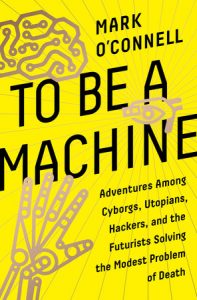
I found the ideas Mark O’Connell expresses to be especially interesting in light of Alex Senemar’s article, “What Happens to Your Data When You Die?” Senemar introduces the idea of how in the future, “software-based humans” will eventually rule the world and “mortality will be conquered by human machines.” He writes, “As the world grows increasingly dependent on internet technology, many human beings have already begun living like ‘cyborgs.’ Your electronics are collecting detailed information about you every second, not to mention the enormous amount of data you share about yourself while navigating the internet – meanwhile, internet corporations have harvested that data to assemble detailed profiles of your habits and behaviors, in hopes of more effectively predicting and analyzing human activity.” Although he writes that this data accumulated through the internet does not belong to the person, it nevertheless represents them. Its content can say a lot about a person. It also continues to exist after a person dies, which ties back to the idea of memories stored on a cloud transcending mortality. This made me wonder: is it reductionist to say that a human can transcend death if their memories live on, if a person is a sum of their experiences? And to what extent does the human brain resemble data?
Work Cited
Senemar, Alex. “What Happens to Your Data When You Die?” Medium. Medium, 27 July 2015. Web. 21 March 2017.
The media scholar Rita Raley has a term for the data collected on the Internet that doesn’t belong to a person per se but still represents them: your “data double.”
It’s an interesting mental exercise to compare yourself (or how you see yourself) with what you imagine your data double to be. It raises a good question: what aspects of yourself aren’t captured by your search history, Netflix recently watched, Amazon shopping cart, etc.? And do we have name for what to call that remainder?