
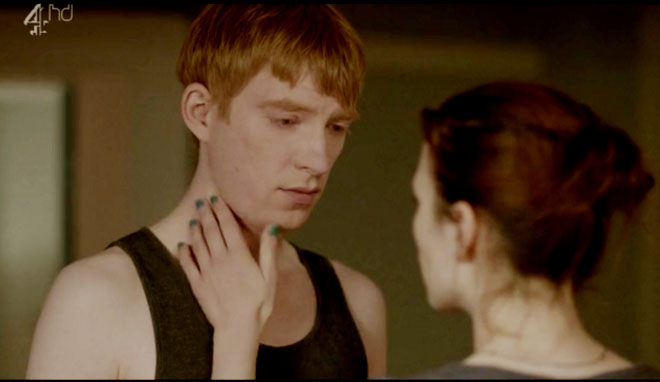
Episode 1, Season 2 of Black Mirror undertakes a close inspection of loss and intimacy in a technologically advanced future world. While the sudden death of Ash is shocking and heartbreaking for Martha, I found myself wondering whether this loss had in fact occurred on a smaller scale long before his physical disappearance. The episode opens on a scene characterized by disconnect; Ash is consumed by his phone and Martha recognizes his absence. She later refers to his phone as a “thief”, a place to which he “vanishes”. Her language paints the phone as a felt presence, a person or place rather than an object devoid of value or feeling. A following scene in the bedroom highlights Ash and Martha’s disconnect on a more physical level. Their underwhelming sexual encounter, which leaves much to be desired, ends with the two rolling over and falling asleep. Romance, love, and intimacy appear to be at a slight loss although not entirely absent. We are left with a fractured romantic landscape: a normalized disconnect peppered with moments of connection (including singing and laughing).
We are first introduced to Ash, Martha, and their technology as three acting forces that interact and interplay in a three-way relationship. This brings to light an important question: At what point does the interaction between administrator and application (such as Ash and his cell phone, Martha and her synthesized partner) threaten and consume human relationships? Can you be jealous of a phone the way one would another lover? Is it cheating if you are emotionally invested in your technological device? And finally, how do we understand monogamy in a world in which a person can design their own pleasure?
The concept of a technological romance is further explored in the relationship between Martha and the “synthesized” version of Ash. I was particularly struck by the use of this term “administrator” in reference to the relationship between Martha and this man-made being. This word adds an unprecedented power dynamic to their relationship, one in which Martha is master and commander. This control, while at first pleasing, ends in frustrating failure. Martha seeks human imperfection, not robotic precision. She wants messy love with all its bumps and burdens, sweetness and care. However, Martha is simply a customer who has purchased a product intended to fulfill her needs. Ash is a mere construction, reflecting back only what she puts into him. In this sense, his limitation is a cruel reminder of her own; she is, for all purposes, dating herself.
Because technological devices and tools are modeled primarily around the relationship between administrator/application, creator/product, user/device, I believe it’s impossible for technology to ever fully replace human relationships. More often than not, technological relationships inspire both obsession and self-loathing: Martha’s initial fascination with her virtual partner ends with her screaming in pure grief from the cliff’s edge, loathing the very thing that she has made. We see obsession when Ash distances himself from his painful childhood by snapping an ironic picture of an old photo with his phone, turning to the phone before he turns to Martha. For both, technology serves as a buffer from the harshness of the world around them, a virtual safe space that offers complete control and power, designed and programmed to please in all meanings of the term.
The interplay between human and technological romantic relationships in this episode reminded me of the movie Her (2013) in which the main character, the lonely Theodore Twombly, engages in a romantic relationship with the voice of his operating system, Samantha. As the film progresses, the plot explores the possibilities and limitations of virtual spaces and the types of relationships they offer humans. Both Black Mirror and Her expose the challenges of “synthesized” or technological relationships and introduce the question: How do we clarify the borders between relationships in a technologically advanced universe intent on sharing everything?
www.youtube.com/watch?v=WzV6mXIOVl4
I would like to comment on Hannah’s argument that technology will not be able to fully replace human relationships. Though Hannah brings up great points of analysis on the user-to-device relationship, I think that this argument as well as this entire episode “Be Right Back” is viewed within the bounds of human imagination and limitation. Nick Bostrom, a Swedish philosopher, wrote a book titled Superintelligence. One of Bostrom’s key arguments is that our brains, though they have an enormous capacity to learn, the rate at which we process or “upload” information is incredibly slow.
Bostrom wrote an article on his book and stated that, “Machines will have several advantages: most obviously, faster processing speed — an artificial neuron can operate a million times faster than its biological counterpart. Machine intelligences may also have superior computational architectures and learning algorithms. These ‘qualitative’ advantages, while harder to predict, may be even more important than the advantages in processing power and memory capacity. Furthermore, artificial intellects can be easily copied, and each new copy can — unlike humans — start life fully‐fledged and endowed with all the knowledge accumulated by its predecessors. Given these considerations, it is possible that one day we may be able to create ‘superintelligence’: a general intelligence that vastly outperforms the best human brains in every significant cognitive domain.” This means that if a machine that had the capacity to replicate dead loved ones were invented, this superintelligent machine would be able to masterfully replicate, manipulate, and learn. My argument is that theoretically, the “synthetic” Ash should not have made any mistakes in replicating the real Ash. Its superintelligent computation and learning would have been able to calculate, fix, and simulate even the messy type of love that Martha seeks. So maybe it is possible for technology to replace human relations. Maybe technology can help us completely be removed from grief and mourning because there can be a “synthetic” version of ourselves that cannot be distinguished from our real self.