Looking back through my blog posts, one thing is clear: it appears that I am not a fan of technology and that I tend to assume the worst in things. While obviously in reality this is not entirely true (I have a deep appreciation for my iPhone and BuzzFeed), these weekly blog posts served as a space in which I could air my fears and concerns while only slightly sounding like my mother. I noticed that this ever-present pessimism toward technology was a pattern that showed up in all my themes and arguments.
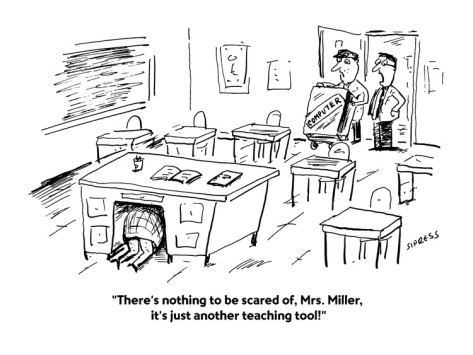
This is how I feel about technology…sometimes. Source: Cartoon Afraid of Technology. N.d. Keywordsuggests.com. Web. 12 May 2017.
In my first post, “Are you cheating? Designing Relationships in Black Mirror,” my inner pessimist worried about the impact of technology on our human relationships. While Ash’s physical death was framed as the plot-driving loss, another, metaphorical death seemed to have already taken place long before his funeral: technology’s substantial daily role and involvement in both Ash and Martha’s lives resulted in an absence, a void, and an unnoticed loss.
Incidentally—by magical coincidence alone—I actually ended up returning to this exact notion in my very last blog post about Station Eleven titled “Can You Be Dead While Still Alive? Exploring the Limitations of Humanity in Station Eleven.” In this final blog post, I readdressed the concept of metaphorical death and the loss of human relationships from technology. I argued that “…in a world increasingly dominated by social media, self-interest, competition, and materiality…,” performance often takes the place of authenticity, resulting in a symbolic death of both the self and humanity. It was satisfying to come full circle in this final blog post and also really interesting to see how preoccupied I continue to be by the threat of technology.
Interestingly, both my blog about internet policing and my post about death in a sharing economy also explored the “human cost” of technology. These posts focused on how online realities and commercial concerns come at the cost of human relationships.
Yet another theme that surfaced both in my final blog post on Station Eleven and in my post on A Head Full of Ghosts was the theme of truth/reality within technological spaces. In my post “How Do You Remember it? The Construction of Truth in A Head Full of Ghosts,” I noted how Paul Tremblay’s book “…destabilized the belief that there exists one version of reality, providing instead various conflicting accounts and retellings of one event to highlight the subjective and constructed nature of truth.” This conversation was particularly relevant for a book centered around a reality TV show. Similarly, in my discussion of performance and authenticity in Station Eleven, I explored the the idea that truth and the concept of the “true self” are subjective and thus impossible to define or obtain in a technologically-driven society.
Last but not least, mortality/immortality was another theme that surfaced in multiple posts, particularly in my blog titled “The Modern-Day ‘Spirit Phone’: Forever a Failure?” in which I argued that the “…fear of an absolute end without continuation is arguably the greatest tragedy of mankind for we must reconcile our finite existence and the feeling of insignificance this awareness engenders.”
These three central themes remained fairly consistent in my posting over the course of the semester and yet, as I compare my earlier posts with more recent submissions, I do notice a clear shift in how I approached these main themes. While many of my earlier blogs focused on more obvious quotes or main ideas in our readings that articulated a central theme, in my later writings I looked instead for smaller nuances and interesting details that spoke to these themes, but more indirectly. For example, my first blog post explored the effect of technology on relationships—a very important yet nonetheless rather obvious theme to take away from Black Mirror. However, weeks later for my post on internet policing I discussed the difference between the use of first and third person by internet trolls. This focus on a small detail from the reading helped me to consider the ways in which the theme of performativity is inscribed into language and the subtle ways in which we enact this distancing in human relationships.
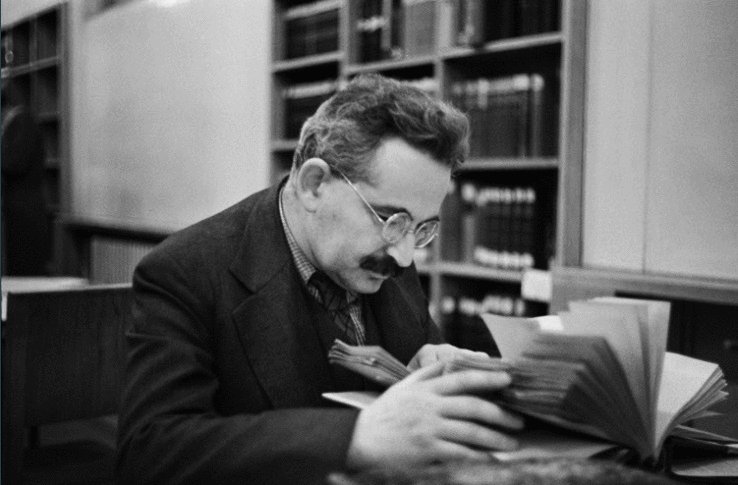
Funnily enough, the article I cited most was actually the very first article we ever read for class by Walter Benjamin titled “The Storyteller.” For example, in my post on A Head Full of Ghosts, I drew on Benjamin to explore how technology alters our relationship to memory by shifting our emotional responses since technology “…can’t capture feeling, only fact.” I referenced Benjamin yet again in my post “Fantasy or Reality? The Gray Line Between the Truth and the Story” about dark and toxic tourism in the Chernobyl Exclusion Zone. Here, however, I expanded upon Benjamin’s description of the storyteller to situate this figure within contemporary contexts.
As I read back through all my blog posts, I noticed that I actually didn’t do as much real-world application as I had intended: Yik Yak, the movie Her, and Airbnb were the only tangible examples I cited throughout all my posts. I think this is due largely to the fact that I’m generally more comfortable talking about theoretical questions and larger concepts rather than their practical application and real-life parallels (no thanks, I’m sure, to my French major which focuses almost entirely on literary analysis and theory). This hole in my analyses is a reminder to myself that sometimes I get so involved with the theory that I forget to ground myself in reality to remain critical of the very systems I depend upon in daily life.
As someone interested in art and fashion—industries in which the tension between truth and performance is always at play—these three main concepts of truth, mortality/immortality, and performativity remain highly applicable and relevant to my thinking even outside the classroom.
Despite his death as early as the first chapter, Arthur Leander remains a continual presence in Station Eleven, a common link between otherwise very different characters as both an abstracted celebrity icon and a flawed husband and friend. It’s significant that one of the most central characters in the novel is a celebrity, and Emily St. John Mandel emphasizes the role of his fame repeatedly. For example, even in Arthur’s personal off-camera relationships, the line between acting and real-life remains gray, and he wonders at one point: “Did he actually date those women because he liked them, or was his career in the back of his mind the whole time? The question is unexpectedly haunting” (79). Arthur’s inability to distinguish between the construction of himself as a character and his original self is haunting because truth and illusion are no longer differentiated. And in a world increasingly dominated by social media, self-interest, competition, and materiality, Arthur is merely the extreme of a reality we are already living—we perform in our daily lives and construct a better version of ourselves to the point that it’s hard to tell what’s real and what’s fabricated. We are not so different from Arthur after all.
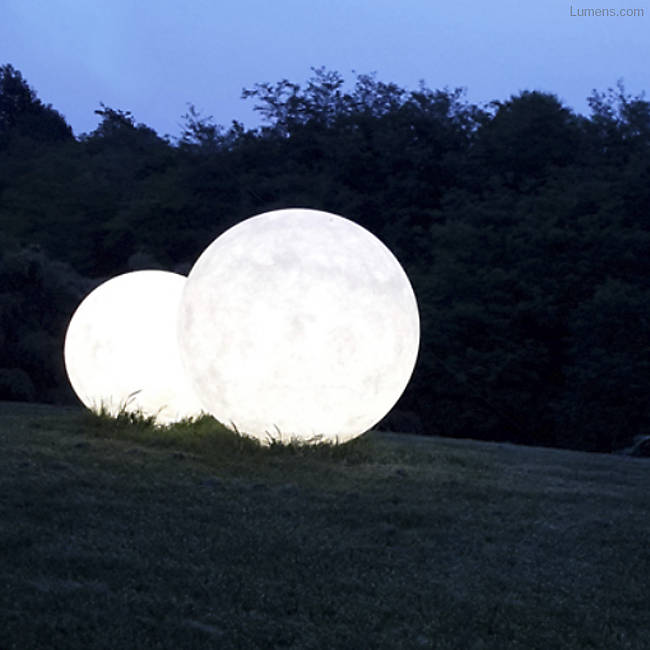
Arthur’s ex-wife, Miranda, observes this tension between illusion and reality while hiding from dinner guests in her backyard. She admires a lamp in the shape of a crescent moon, noting that “The fake moon, which has the advantage of being closer and not obscured by smog, is almost always brighter than the real one” (100). This observation highlights an important theme: a lie can often seem truer than truth itself. Truth is no more than a game of smoke (in this case smog) and mirrors (in this case the reflection on the water).
Both Arthur and Miranda demonstrate this loss of humanity through their depiction of reality as a performative construction. This made me think: where has the real death occurred in this novel? Obviously, the easiest response is that the death occurs during the flu outbreak and the loss of civilization as we know it. And yet, these earlier moments pre-destruction suggest something different.
Has mankind already died? Are the loneliness and emptiness felt by the characters prior to the end of civilization simply mourning by a different name?
Reframing the text in this manner allows us to better understand the fear foregrounding this book: if an apocalypse seems a fictive, impossible, or slightly less threatening reality, perhaps the horror lies instead in the metaphorical death of Miranda and Arthur that occurs long before—a far more relatable and imaginable demise.
The real tragedy here is that this death goes unnoticed. The thought that you could die without even realizing it is the scariest concept of all. So yes, this novel is technically about an apocalyptic event, but really, it’s about all the other ways in which we can die. Don’t get distracted by wild-west shootings and end-of-the-world survival; Arthur Leander died long before the first chapter.
References:
Mandel, Emily St. John. Station Eleven. New York: Vintage , a Division of Penguin Random House LLC, 2014. Print.
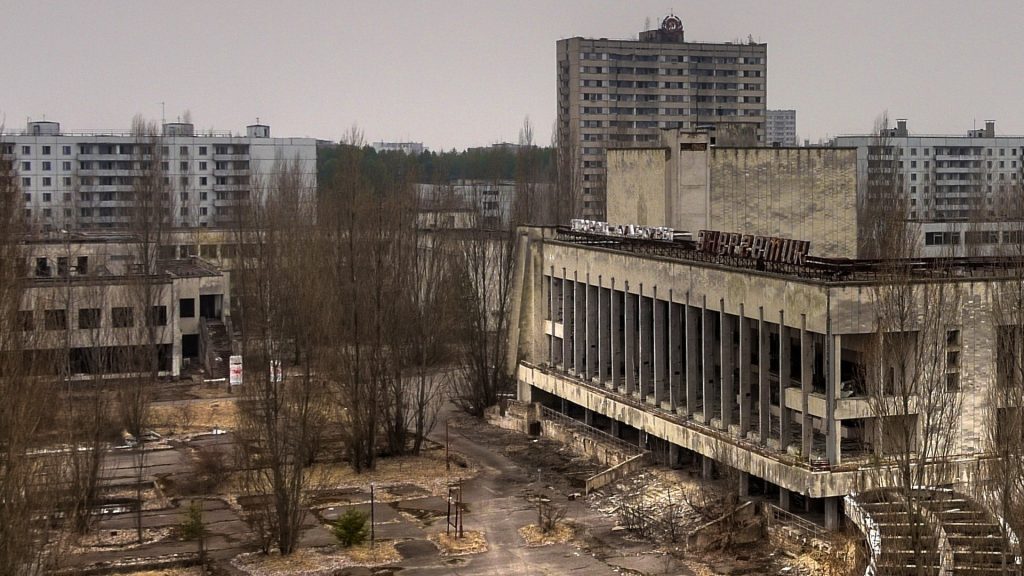
In their article “Dark and Toxic Tourism in the Chernobyl Exclusion Zone,” Ganna Yankovska and Kevin Hannam describe the Chernobyl exclusion zone as a site of both dark and toxic tourism. Through interviews with tour guides and agents, Yankovska and Hannam explore the various motivations of tourists depending on nationality and age. The researchers highlight how the exclusion zone lies at the tricky crossroads between entertainment and education and as such, tour guides must interpret and alter their presentations depending on the desired effect.
In reading this article, I was reminded of one of the first articles we read this year by Walter Benjamin, “The Storyteller,” in which Benjamin explores the notion of storytelling in a contemporary context in which information, press, and technological inventions threaten “…the art of storytelling…” (Benjamin 362). The role of the storyteller—as described by Benjamin through the language of “advice,” “instruction,” “useful,” and “wisdom”— seems a particularly accurate account of the role of the Chernobyl tour guides who often cited in interviews their educational function and the wisdom they hope to imbue on tourists (Benjamin 364).
And yet, while storytelling by tour guides often falls under this category of ‘useful wisdom,’ in the case of Chernobyl, there is an additional expectation of entertainment value and adventure that complicates the traditional role outlined by Benjamin. For example, in an interview with Yankovska and Hannam, Tour Guide C notes, “Interpretation is the main part of my work” (Ganna 935). Similarly, Tour Guide B says that “People believe in these games and horror movies too much. Consequently, they are not interested in real history and valid information anymore” (Ganna 936). These two accounts introduce certain questions: At what point are tour guides embellishing or altering history in order to appeal to demand? Is a “true” account possible within the commercial context of a museum or memorial? What is the difference (if any) between stories and history? As we get generationally further from historical events, their retelling can easily become skewed, either by simple mistake or to satiate consumer demand. We’ve talked in class about truth and its limitations and I think this article is relevant within that discussion – particularly within today’s context in which fake news and alternative facts are normalized.
This conflict between information and stories is a central theme in Yankovska and Hannam’s article. The article notes that interactions with local residents carry greater interest to tourists than the factual information itself (Ganna 935). The personal and even physical interactions thus trump the appeal of information, perhaps because they tap into “…the psychological connection of the events…” which allows “…an amplitude that information lacks” (Benjamin 366). Does this emotional, psychological component of these real-life interactions make the stories more real or truthful, or does it relegate them to a fantasy world of imagination and adventure, thereby removing them from practical application and real-world relevance? Are the local residents people or characters?
Physical interaction is a valuable tool in understanding and conceptualizing trauma, especially when that trauma is so large and geographically distant that it feels too abstract to engage with. Benjamin reminds us of the quote “‘an attic fire in the Latin Quarter is more important than a revolution in Madrid’” (Benjamin 365). Proximity is an important factor in determining how we relate to events and news. Dark tourism and toxic tourism may have a dark side (no pun intended), but they also speak to a human need to experience on a physical, intimate level a reality too hard to otherwise grasp. Sometimes, fantasy and imagination are the only way to comprehend the incomprehensible.
THE CREATIVE NARRATIVE BEHIND THE CRAIGSLIST AD, THE CUCKOO CLOCK, AND THE JOURNAL ENTRY
Backstory
Mort Lindheimer loves the author Ray Bradbury. So much so, in fact, that he carried Fahrenheit 451 in his backpack during college wherever he went, the pages tabbed down and thumbed soft. It was Bradbury’s short story, There Will Comes Soft Rains, that kept Mort up late at night, fascinated by the concept of a mechanical house that, in the absence of human touch, breaks down against the backdrop of a “radioactive glow” (Bradbury 1). Mort doesn’t trust technology and he gets goose bumps thinking about the charcoal silhouettes of a man, woman, and their two children inscribed onto the walls of Bradbury’s fictional house after an atomic bomb.
Part 1: The craigslist ad
For his fiftieth birthday Mort’s wife, Calliope, purchased a miniature model of the Bradbury house on craigslist: a collector’s cuckoo clock that promises to recite the poem played in the children’s nursery each time the hour strikes.
Part 2: The clock
Mort is thrilled with Calliope’s gift and the two excitedly wait for the hour to strike to hear the poem recited. However, to their great disappointment, the clock makes no noise and what’s worse, the hands tick counter-clockwise. Disheartened, the couple finally go to sleep, leaving the clock on the dresser.
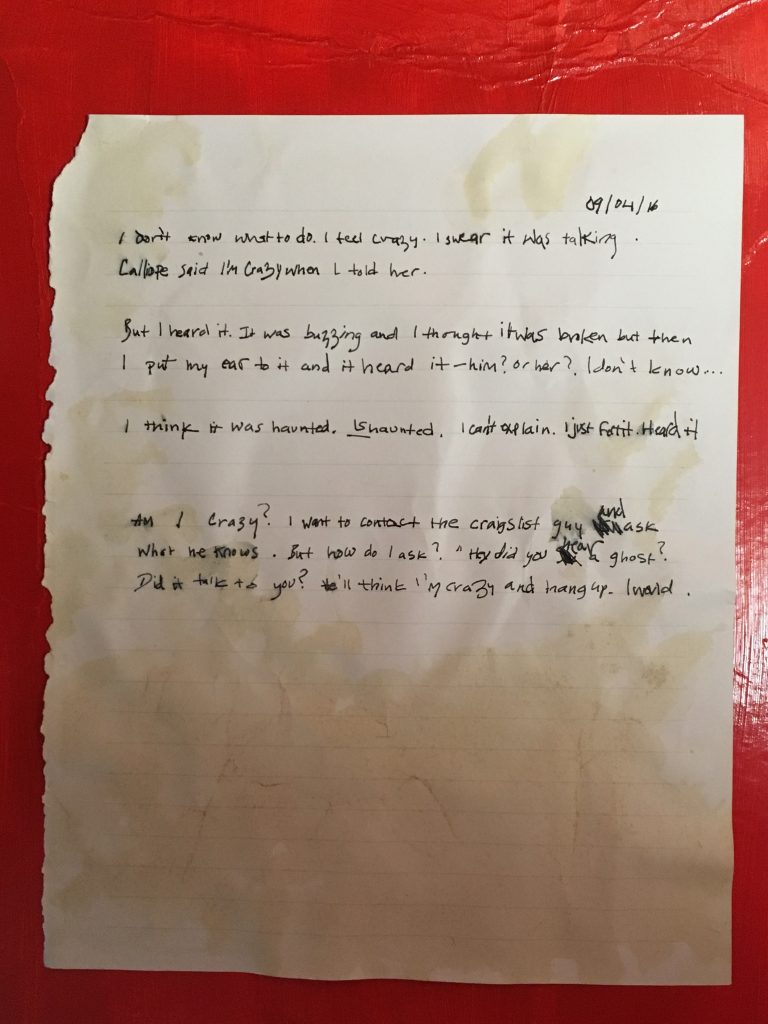
When they turn out the light, Mort hears a small buzzing noise, almost imperceptible and yet impossible to ignore. Exasperated, he realizes it’s issuing from the clock. He inches closer, pressing his ear against the clock to amplify the soft noise. What he hears is not a poem at all but rather a monotone voice repeating a short phrase with no inflection. It takes him multiple tries to decipher the fragmented words:
Intruder next to you
Do you see me here
Danger obscured
A chill runs through him and he looks instinctively around the room. Intruder? Thoroughly unsettled, Mort feels a sudden urge to get rid of the clock, sensing some inexplicable presence in the room. He grabs the clock and dumps it in the trash outside.
Part 3: Mort attempts to reconcile the events of the night by writing in his journal
In the morning, Calliope is outraged by Mort’s rash decision. He himself is unable to explain the strange happenings of the night, as reflected in his journal entry.
Mort attempts to make sense of the night’s events in his journal entry
Unbeknownst to the couple, the clock is haunted by the spirit of a real family of four from the Cold War era who met a similar fate to that of the fictional family outlined in charcoal on the walls of the house. When the artist created the clock he accidentally set the clock backwards, literally going back in time and summoning the dead of the historical past. The family became trapped within this miniature model, warning of danger and crying for help. This faulty clock is a home for the undead, a shrine for restless spirits. The “intruder” referenced in its warning isn’t a physical trespasser but rather the ubiquity of technology as an unrealized threat—danger obscured.
ARTIST’S EXPLANATION
The cuckoo clock is comprised of three main elements:
1. The charcoal images of the family on the wall that symbolize the danger of technology,
2. the light sensored-voice that speaks of imminent danger and symbolizes the intersection between advanced sound technology and death,
3. and the counter-clockwise clock, a nod to the postmodern blurring of boundaries between death and life and the construct of time.
When I first began this project I was inspired by Ray Bradbury’s concept of a mechanical house capable of self-regulating and functioning (almost) entirely independently. However, despite its human-like self-regulatory qualities, the house is ultimately unable to sustain itself without human presence. I tried to reflect this hyper-digitized space in my clock design. You’ll notice that the circuit playground is featured prominently. I chose this placement because I wanted to situate technology as central to the house’s identity. The decorations are also technologically produced; the bird is 3D printed, the engraved banner and wood birds are laser-cut, and even the grass is a synthetic silver color rather than green. Additionally, the warning message emitted by the circuit playground when the lights dim or go out is coded as a repetitive loop to highlight the limitation of the technology (it can only repeat, not respond or explain).
1. The charcoal images of the family on the wall symbolize the threat and danger of technology.
Bradbury’s reference to an atomic bomb is an important reminder that the ubiquitous presence of technology within society is dangerous as much as it is convenient. The black spots left by the family on the wall of the house are historically grounded. As Alan Taylor points out in “Hiroshima: Before and After the Atomic Bombing,” victims of the atomic bombings of Hiroshima left shadow-like imprints on buildings and roads. History is never far away in these discussions, and as Isabel Pinedo points out in her article “Recreational Terror: Postmodern Elements of the Contemporary Horror Film,” postmodernism itself can be understood as “the cumulative outcome of repetitive historical stresses, including the Holocaust, the bombing of Hiroshima, the Cold War, the war in Vietnam…” (Pinedo 18). References to Hiroshima can thus be seen as part of a larger cultural narrative that continues to haunt contemporary society through its unresolved memory in an increasingly technologically-driven world. Maria del Pilar Blanco and Esther Peeren note in their book Popular ghosts: the haunted spaces of everyday culture, “…ghosts therefore often operate as erratic monuments or hieroglyphs that signify a disturbing incident that happened in the past, a secret that has to be deciphered in order to understand the repercussions of the past” (Pilar 187).
With this in mind, I imagined the haunting in my project on multiple levels, both literally through the mechanized voice, and figuratively in the shadows that remind us of a larger technological death. When I was designing the audio element of the clock, I chose the circuit playground as my sound source, rather than a pre-recorded audio chip. The reason for this is because the circuit playground muffles sound and limits the contents of its message to Arduino’s basic speech dictionaries. The barely audible volume and incomplete message must thus be decrypted as cultural “hieroglyphs” —my attempt at exploring this concept of deciphering the past.
2. The light sensored-voice that speaks of imminent danger and symbolizes the intersection between advanced sound technology and death.
When designing and coding the sound component of the project, I was inspired by class readings regarding sound preservation and its connection to death. In his book The Audible Past: Cultural Origins of Sound Reproduction, Jonathan Sterne uses the example of the revolutionary introduction of the phonograph during the 19th century to explore the symbiotic relationship between popular conceptions of death and the power of the disembodied voice. Sterne describes popular beliefs of the time which justified a potential connection to the spirit world using the argument that “…media are forever setting free little parts of the human body, mind, and soul. If the voices of the dead were, indeed, free agents, perhaps they could then be enticed back into the world of the living” (Sterne 289). There’s a certain logic here; the fragmented, pixelated nature of technology offers the possibility of preserving human life in an equally fragmented (yet nonetheless present) continued existence. Given this logic, it’s not so hard to believe in ghosts: voices of the dead, fragmented as isolated parts, get trapped in human objects (such as a cuckoo clock). The clock serves as a metaphorical coffin for these spirits, “embalming” their voices (Sterne 293).
Blanco and Peeren speak of a similar relationship between sound and death, noting, “The utter non-referentiality of this medial space endorses a transgression of the dichotomy of ghostly and human realms, so that the dialectical questions evoked…(Is it ghostly? Is it real?) are swept off the table by the annihilating gesture of mediation” (Pilar 289). In other words, Mort can no longer distinguish what is real and what is merely a creation of his mind because he is a subjective mediator. His ears filter and interpret the sound of the clock in a meaning-making process subject to embellishment, mishearing, and forgetfulness. In his journal entry, Mort struggles to trust himself as a mediator and interpreter of what he heard. The transgressive nature of the auditory thus lies in the fact that it blurs the boundaries between the real and the unreal, placing the onus of this distinction on the human listener (Pilar 291).
This dissolving and blurring of boundaries through the hybridity of previously distinct categories and identities is characteristic of postmodernism and “…the erosion of universal categories, the collapse of faith in the inevitability of progress, and the breakdown of moral clarities” (Pinedo 17). Indeterminacy, the result of this erosion, leads to the conviction that we cannot know anything with certainty (from class discussion). This is reflected in Mort’s spiral of confusion and self-doubt in his journal entry. Equally important to the postmodern space is the triumph of intuition over rationality, and even the failure of rationality all together. Mort is unable to reason through this instinct to destroy the clock and he struggles to explain his actions to his wife for which there is no rational explanation.
3. The counter-clockwise clock is a nod to the postmodern blurring of boundaries between death and life and the construct of time.
Notice how the clock hands move counter-clockwise, the clock face is missing certain numbers, and the remaining numbers are off-center and miss-aligned. As we discussed in class, in postmodernism we witness a sort of “decanonization,” which is to say that those things that used to the be at the center of culture and society such as universal truth or linear time are questioned through a general skepticism of authority. In the case of the cuckoo clock, “decanonization” occurs through the destabilization of time as a construct. Traditional understandings of both death and life are informed by the perception of time as a finite, linear construct with a definite start and end. And yet, the ghosts that haunt the clock are summoned through the non-linear manipulation of time when the clock inverses its movement.
Elana Gomel explores the construct of time in great detail, emphasizing early on in her book Postmodern Science Fiction and Temporal Imagination that “…time is an illusion. The past, the present and the future coexist. This is not in flux, a flow, a rushing river, as it is so often envisioned in other texts…” (Gomel x). Linearity is an imagined ideal constructed in order to appeal to human rational and social organizational tendencies. But while postmodernism fractures and fragments “…both public and private time”, this does not mean that time ceases to exist (Gomel xi). Rather, as Gomel argues, “Time out of joint is still time, albeit crippled” (Gomel 4). In this postmodern reality, we must redefine time within new parameters of imagining; the counter-clockwise clock asks us to consider time outside traditional boundaries.
4. Additional thoughts
It’s important to note, too, the element of “participatory culture” at play in the design of the cuckoo clock. This term, discussed during class, refers to the fact that in modern society, anybody can make a fan video, a supercut, memes, fan fiction—etc. The cuckoo clock is the perfect example of this, itself a product of a fan base that seeks to replicate and reconstruct the reality of Bradbury’s narrative. This collector’s item must be situated within a larger concept of consumerist commercial culture. Historical trauma intersects with pop culture in an unsettling marriage between the real and the constructed.
5. Concluding remarks
Examining haunting from a technical perspective during production design allowed me to explore digital haunting on a hands-on level. It’s cool how a simple coding formula and a few basic words strung together can transform a product of logic into an object of the uncanny. Technology rides this line between the rational and the inexplicable in a way that makes its relationship to death all the more interesting.
Word Count: 2000
Special thanks to the Studio M Staff, particularly Brian Little and Tien Le, for their patience and support.
Gomel, Elana. Postmodern Science Fiction and Temporal Imagination. New York: Continuum, 2010. Web. Continuum literary studies; Continuum literary studies.
Pilar Blanco, María del., and Esther. Peeren. Popular Ghosts : The Haunted Spaces of Everyday Culture. New York: Continuum, 2010. Web.
Pinedo, Isabel. “Recreational Terror: Postmodern Elements of the Contemporary Horror Film.” Journal of Film and Video 48.1/2 (1996): 17-31. Print.
Sterne, Jonathan. The Audible Past : Cultural Origins of Sound Reproduction. Durham: Duke University Press, 2003. Web. e-Duke books scholarly collection.
In her article “Airbnb has a dead people problem: The morbid side of the sharing economy,” Kashmir Hill introduces yet another tension between death and technology: sharing economy start-ups such as Airbnb and Getaround (the Airbnb equivalent for vehicles). Renting a stranger’s car or home gets a lot more bizarre when that person accidentally happens to be dead. This phenomenon is not entirely uncommon; for example, “ghost cars in the system” from dead owners are often realized months late and “…it’s possible they’d continue to be rented post-owner-mortem as those rentals require no action by the car’s owner beyond checking to make sure it’s cleaned out between rentals.” Case in point: during his Airbnb stay, Jordan Ruttenberg discovered that the young woman whose home he was renting had died. In need of lodging and having already paid for the rental, Jordan decided to stay the two weeks until the end of his rental, describing the experience as creepy but necessary. His traveling companion, however, chose to leave immediately. The worst part? It took 4 months for Airbnb to even notice the woman had died—and only after Newsweek published an article describing Jordan’s experience.
Airbnb is one of the many sharing economy start-ups on the market. Source: Untitled Photo of Airbnb Logo. N.d. Airbnb. Web. 29 Mar. 2017.
So why was it so creepy for Jordan to stay in the woman’s apartment after her death? Nothing had physically changed in the apartment by her death (after all, she had died in an entirely different state) and besides, Jordan never knew or met the woman in person. Why was this space quickly transforming into an uncanny site rather than the vacation spot it was supposed to be? I believe the answer to this question lies in two fundamental problems. First, the concept of invasiveness is at play in Jordan’s unease. Occupying this woman’s space was only okay when she was living and thus able to consent to his presence in her home. But what happens then when she’s dead and he’s living in this intimate, personal, and (semi-) private sphere of her life. Does he no longer have a right to be there? There is a certain level of violation at play in this scenario; Jordan’s physical presence presents a threat to the preservation of this woman’s space.
Secondly, it’s important to note that Jordan continued to stay in the apartment after her death because he had already paid for the rental and he wanted his money’s worth. At its foundation, Airbnb is a transactional service. I myself always find it a little jarring to inhabit someone’s personal, private space often without ever meeting them in person. It’s certainly strange, commercializing the personal. How do we prioritize the dueling realities of a space that is at once a home and a business? The discussions we’ve had in class recently regarding social media and digital inheritance echo this Airbnb dilemma: When someone dies, what do we do with their highly personal artifacts (homes, Instagram, etc.) that also occupy a public domain? And how do we balance what is ethnical with what is fair; it may not be ethically right to stay in the dead woman’s apartment but it’s also not fair if Jordan, broke and without other lodging, loses both money and shelter through no fault of his own.
A New York street. Source: Untitled Photo of New York Street. N.d. The Daily News (New York). Web. 29 Mar. 2017.
Inhabiting the space of a dead person is a reminder of our own mortality. We are forced to bear witness to the mundane and banal continuity of an apartment that doesn’t die with the person or somehow disappear. The value and meaning of objects and furniture (and their intentional placement in a living space) are imbued by its owner, and not necessarily inherent to the objects themselves. Thus, when we die, our memories, photos and possessions, once so inherently tied to the space and our identity within it, lose their importance . The apartment, while unchanged physically, lost its human value, no longer a sacred embodiment of its inhabitant’s identity (“it’s a piece of me”), but rather a transactional piece of property.
From both commercial and personal perspectives, the internet and overall growth of social media platforms remain contentious in their public reception, expanding and encouraging new forms of social expression and communication but not without a troubling human cost. In her article “LOLing at tragedy: Facebook trolls, memorial pages and resistance to grief online” Whitney Phillips explores in depth the phenomenon of trolling, specifically on Facebook, unearthing the very tension between freedom of expression and harmful engagement within social media relationships and networks. From her extensive article one thing remains clear: trolling cannot be boiled down to the good guy/bad guy paradigm many use to unilaterally vilify internet trolls. While trolling can be downright destructive and harmful in its activity, this involvement equally reveals the greater hypocrisy of social media platforms themselves, which glorify and sensationalize human trauma for commercial or self-interested ends (not so different from trolls, after all).
What I find most interesting in Phillips’ article is her analysis of the different permutations of identity that appear online—a sort of shape-shifting which stems from a growing societal preference for anonymity and multiplicity (and the protection and freedom they afford). She notes in particular the rhetorical distinction between the use of first and third person on Facebook, observing:
For every “real” user who is continuously reminded of and interpolated by their own “I,” every troll user is continuously reminded of and interpolated by the “I” they’re not, an ongoing process of emotional repudiation that explains why Facebook trolls frequently shift to the third person to describe their own actions (and may also help explain the ease with which trolls detach from the havoc they wreak — in their minds, it’s not exactly them doing the damage).
Strikingly, the multiplicity of the self allows for a certain level of emotional distancing in these online relationships, further blurred by the impersonal digital environment in which they exist. As multiplicity within social identity becomes more commonplace, do we need to reimagine our definition of citizenship and social participation? To what extent to do these cloned or alternate identities possess authority and legitimacy? Where is the line between character performance and the “real” individual? And finally, at what point does this alternative identity become its own functioning entity, no longer an extension of its maker, but rather an individual actor with its own rights and responsibility?
With social media it is now possible to have multiple identities, creating virtual clones of ourselves and others. Source: “Cloning – A Useful Technique for Mankind.” N.d. Blogs. Web. 15 Mar. 2017.
Reading Phillips’ article I immediately thought of Yik Yak, a social media platform most simply described as an anonymous twitter, which initially gained popularity thanks to the liberating anonymity it afforded its “yakkers.” However, alongside this promise of freedom came an even greater cost, namely, that users were suddenly able to express harmful, offensive, and downright disgusting beliefs without any social consequence. Down-voting, a built-in protection within the app, allowed unpopular posts to be removed from the feed after five “downs.” However, this protection was limited at best, functioning to minimize damage rather than serving as a preventative measure. Any recipient of slander could still have their reputation publicly tarnished in the time it took to gather five downvotes. Trolling and Yik Yak posting may serve different functions and distinct communities, however their central reliance on anonymity suggests a more threatening reality within society at large: what humans are capable of if emancipated from society’s surveillance.
This leads us to a fundamental question: who do we protect and whose responsibility is it to do so? Phillips herself identifies this dilemma, stating, “Indeed, from the moment that memorial trolling took hold, Facebook has had to walk a very fine line between protecting its users and protecting itself.” Traditionally, crime within society falls under state and government authority. But what about when it occurs on digital platforms? Anti-trolling, itself a form of policing, is reminiscent of the lone ranger or even the classic cowboy—enforcing “justice” but with an unregulated, and arguably equally dangerous level of independence and subjective reign. So who is to blame? Most importantly, if a person has multiple identities, which gets persecuted: the social identity or the digital one? Where is this accountability located? Just take Phillips’ example of Sean Duffy, wrongfully arrested and accused of being the online persona, Pro Fessor. Can criminal justice accommodate the blurring of these identity boundaries? Unclear.
References :
Phillips, Whitney. “LOLing at Tragedy: Facebook Trolls, Memorial Pages and Resistance to Grief Online.” First Monday 16.12 (n.d.): n. pag. 5 Dec. 2011. Web. 15 Mar. 2017.
Cohen, Jeffrey Jerome. “Monster Culture (Seven Theses).” Monster Theory : Reading Culture. Minneapolis: University of Minnesota Press, 1996. Web.
Iles, Timothy. The Crisis of Identity in Contemporary Japanese Film : Personal, Cultural, National. Leiden: Brill, 2008. Web. Brill’s Japanese studies library, v. 30; Brill’s Japanese studies library, v. 30.
Pinedo, Isabel. “Recreational Terror: Postmodern Elements of the Contemporary Horror Film.” Journal of Film and Video 48.1/2 (1996): 17-31. Print.
Skloot, Rebecca. The Immortal Life of Henrietta Lacks. New York: Crown, 2010. Print.
Wada-Marciano, Mitsuyo. Japanese Cinema in the Digital Age. N.p.: U of Hawaii, 2012. Project Muse. Web.
I grew up believing in ghosts for a very simple reason: my mom had seen one. I know the story like the back of my hand, beginning with the vision of my mom running through her grandmother’s three-story farmhouse and then the moment when she says she saw her dead granddad, PopPop, pushing a cart of books into the library he had always loved. My mom remembers standing there, observing him as he slowly moved through the hallway. She swears by this. I used to make her promise to come back and visit me as a “good” ghost too.
My mother is not the only one to believe in ghosts. Journalist Tiffanie Wen describes her own encounter with the paranormal when she noticed the image of a phantom man in the background of a photograph who was not in the room when the photo was taken. In her article, “Why do People Believe in Ghosts,” Wen takes on the task of exploring both national and international views on ghosts, death, and life after death, reporting that “…if you already believe in ghosts, or are told a place is haunted, you are more likely to interpret events as paranormal” (Wen). The imagination is powerful and it’s hard to say whether there’s any real grounds for paranormal activity other than simple tricks of the mind, sleep deprivation, and random accidents.
The photo that sparked Wen’s interest in ghosts. Source: Wen, Tiffanie. Untitled. N.d. The Atlantic. Web. 27 Feb. 2017.
Thanks to my mother, I have been well-conditioned to believe in the paranormal. Which is perhaps why I personally identify with Thomas Edison and his belief that the dead can talk, which Natalie Zarrelli describes in her article “Dial-a-Ghost on Thomas Edison’s Least Successful Invention: the Spirit Phone.” Both Zarrelli and Wen highlight a connection between the belief in ghosts, spirits and souls and the human desire to deny mortality. Zarrelli quotes French journalist Philippe Baudouin who describes the promise of Edison’s “Spirit Phone” to “…turn the ancient dream of immortality into reality, in an attempt to cheat death” (Zarrelli). Similarly, Wen relies on the work of professor Christopher French who highlights “…the emotional motivation for these beliefs”, underscoring the fact that “The vast majority of us don’t like the idea of our own mortality. Even though we find the idea of ghosts and spirits scary, in a wider context, they provide evidence for the survival of the soul” (Wen). This fear of an absolute end without continuation is arguably the greatest tragedy of mankind for we must reconcile our finite existence and the feeling of insignificance this awareness engenders.
I argue that this fear of mortality stems from the fact that we are conditioned to understand human existence only through its embodied experience. This explains Edison’s determined conviction that personalities are in fact “entities” or small particles comparable to atoms, an interesting choice of language grounded in physicality. Edison’s language contrasts disembodied explanations for the afterlife (that is, those theories that don’t present ghosts, spirits and souls in an identifiably human or physical form) which are harder to grapple with. I imagine this is why science’s tangibility is often more appealing than religion’s indefinable concept of faith and God. Even in religion though, (and I can only speak to a Christian perspective here), God is often depicted as a white man because human tendency ascribes an image to the spiritual presence as a means of conceptualizing such abstract power.
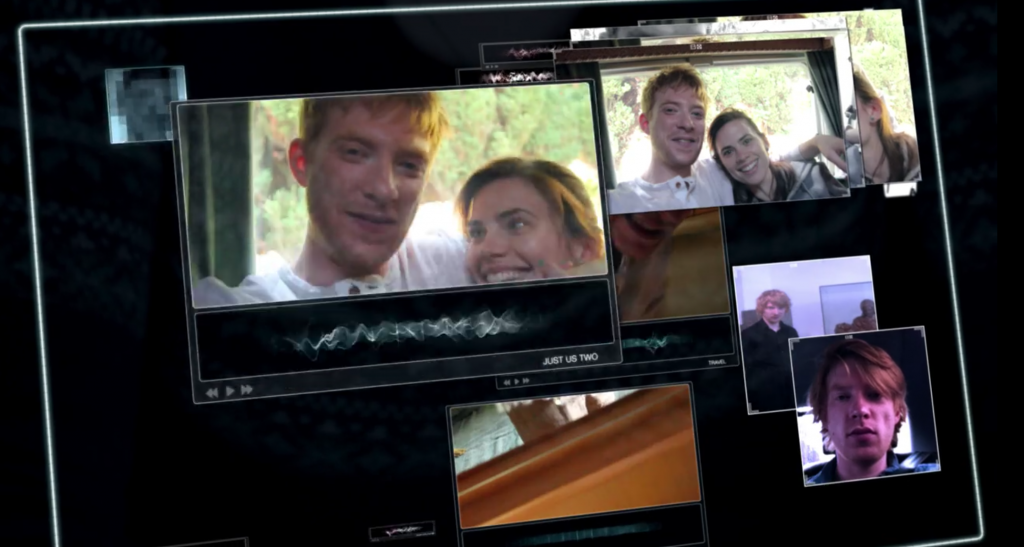
While it’s been almost a century since Edison’s failed “Spirit Phone” invention, Episode 1, Season 2 of Black Mirror demonstrates the extent to which Edison’s obsessive preoccupation with death remains ever embedded within our cultural conscience. For example, the program that Martha buys following Ash’s death serves as a sort of modern day “Spirit Phone,” relying on Ash’s social media presence to reconstruct the particles of his personality in a synthesized replica of his living body.
The program uses Ash’s social media to bring his personality back to life much like Thomas Edison’s failed “Spirit Phone” promised to contact the personalities of the dead. Source: “Black Mirror.” Season 2 Episode 1. Netflix.
Thomas Edison introduces the belief that our personalities continue to exist as tangible “entities” long after our death, describing “…a personality-based residue of loose memories and thoughts, containing part of who a person was during life” (Wen). Black Mirror applies this notion, using the power of technology to literally bring Ash’s personality to life. Edison notes, however, the fractured nature of these living personalities and Martha observes holes in Ash’s embodied performance, a fragmented version of the man she once loved. While Black Mirror demonstrates the possibility of a successful “Spirit Phone” (and even “Spirit Body”), this success is mitigated by the realization that even when we do communicate and interact with the dead, this communication is fractured at best, and traumatizing at worst.
References:
“Black Mirror.” Season 2 Episode 1. Netflix.
Wen, Tiffanie. “Why Do People Believe in Ghosts?” The Atlantic. Atlantic Media Company, 05 Sept. 2014. Web. 27 Feb. 2017.
Zarrelli, Natalie. “Dial-a-Ghost on Thomas Edison’s Least Successful Invention: the Spirit Phone.” Atlas Obscura. N.p., 18 Oct. 2016. Web. 27 Feb. 2017.
In the chapter “Monster Culture (Seven Theses),” of Monster Theory : Reading Culture, Jeffrey Jerome Cohen does exactly as his title suggests, interpreting seven different types of monsters as cultural embodiments of specific fears, taboos, and desires within cultures. His fourth thesis, titled “The Monster Dwells at the Gates of Difference,” struck me as particularly relevant to today’s global climate. In this thesis, Cohen claims that “The monster is difference made flesh,” a “dialectical Other” that represents “an incorporation of the Outside, the Beyond…” (Cohen 7). This cultural fear of the invasive, dangerous Outsider is highly applicable within the context of contemporary society where the widespread fear of the “Other” is linked directly to the fear of terrorism and the need for protection, whatever the cost.
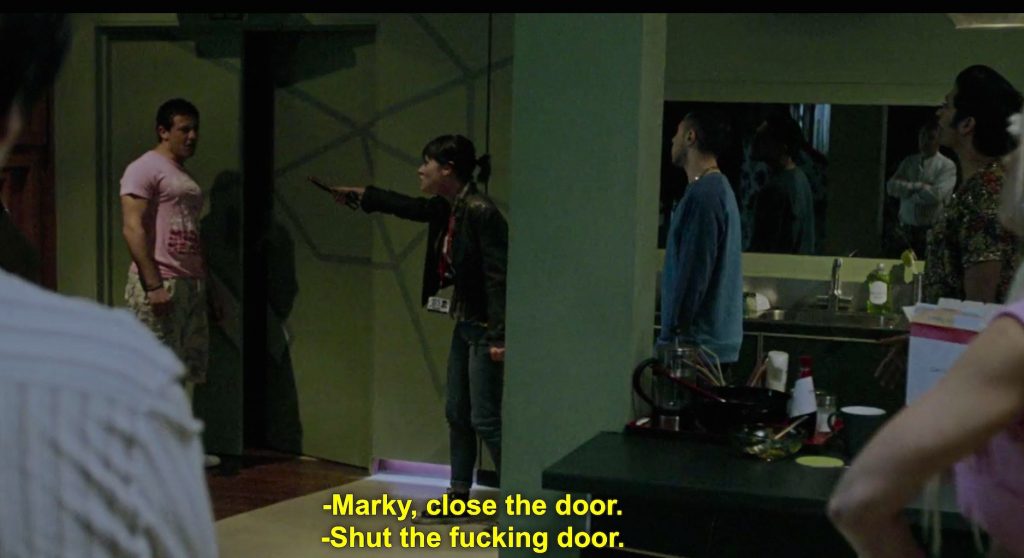
However, as I watched Episodes 1 and 2 of the TV mini-series Dead Set and attempted to apply Cohen’s fourth argument to the violent zombies on the screen, I began to wonder if perhaps there was an important nuance to be made in this thesis. While the zombies were physically on the outside of the safe house and then further estranged as “Other” by their cannibalistic behavior, they still existed right next door. Kelly is separated from a zombie by only a door just as Patrick and Pippa are cloistered away in a room while a zombie bangs in frustration on its entrance. Despite their positioning as Outsiders, the zombies’ close proximity put them in a different category all together: that of the neighbor (rather than the stranger).
The only thing separating the “Big Brother” cast from the zombies is this door. Source: “Dead Set.” Season 1 Episode 2/5. Netflix.
This imagery of the neighbor is further reinforced by the fact that the reality show Big Brother is filmed within a constructed house reminiscent of Foucault’s panopticon in which the cast can’t see out but the film crew can see in. The physical and literal invocation of the house and surveillance immediately establishes a relationship between the inhabitants within and those on the outside. In one scene, Kelly taps on the one-way mirror and the audience sees what she cannot: a hungry zombie growling on the other side of the glass. In this moment, human and monster coexist next door to each other, only inches apart. The one-sided mirror serves the same delineative purpose as the traditional white picket fence that separates properties and neighbors. However, this barrier is soon penetrated when the zombie gets in through the door.
These zombies are violent, cannibalistic, wild, disgusting, and without any trace of humanity. What’s even more unsettling is that they still resemble the familiar faces of the cast and crew we met at the beginning of Episode 1 when they were human. The cinematic choice to maintain the physical identification of these original characters even as zombies is effective because it confuses the Familiar with the Other. The zombies are at once different because of their violence and familiar because of their faces. In this sense, the Other does not represent an Outsider from far away lands but rather the monster that’s living next door. I’ll title this eighth thesis, “The Monster Dwells at the Gates of…your own home.” One thing is certain, you can’t trust your neighbor. Time to get a bigger fence.
References:
Cohen, Jeffrey Jerome. “Monster Culture (Seven Theses).” Monster Theory : Reading Culture. Minneapolis: University of Minnesota Press, 1996. Web.
In A Head Full of Ghosts, Paul Tremblay destabilizes the belief that there exists one version of reality, providing instead various conflicting accounts and retellings of one event to highlight the subjective and constructed nature of truth. When multiple “correct” versions of a situation exist, anything becomes possible; both logical and irrational explanations (mental illness versus a spirit possession) have equal authority. Horror is achieved through the realization that there are no limits, only different sides to the same story.
The concept of truth is less tangible and exact than we want to believe. Different versions blur together. Takemoto, Akio. Blurry People. 2015. Flickr. Web. 2 Feb. 2017.
The characters in A Head Full of Ghosts struggle to find the “true” story of Marjorie. Rachel makes it her mission to locate “An accurate account of what happened” (Tremblay 111) and Merry’s mother documents events in a red notebook (46). Merry grapples with this struggle for the “correct” version of events as well, questioning her memory each time it contradicts the accounts of those around her and the TV show’s interpretation. Merry undermines the validity of her memories by acknowledging that they ““…were mixed together with what other people told [her] about what had happened, and [she] included pop culture and media”” as influences (Tremblay 112). She often hesitates as she recounts her experience, offering excuses each time her memory differs from recorded happenings including “misremembering” (Tremblay 72) and the possibility that she blocked out the trauma or even confused reenactment with reality (73). Self-doubt, amplified by the 15 years that have passed since the incident, cause Merry to falter in her conviction.
Merry’s hesitation introduces a central dilemma: what happens when we can’t remember and when our memory fails us? In his article “The Storyteller: Reflections on the Works of Nikolai Leskov,” Walter Benjamin describes memory as a “…tradition which passes a happening on from generation to generation” (Benjamin 371). However, in A Head Full of Ghosts, the memory of what happened to Marjorie is passed via technology—the camera and the tape recorder. This shift from human memory to technological storage removes the human responsibility of “…reproducing the story” through memory (Benjamin 370). Technology serves as a vault of memories and traumas that will never be fully processed or interpreted outside of their factual value as information or cheep entertainment.
It is perhaps more accurate to say that technology preserves rather than remembers. Memories are rooted in emotion, tied to the feelings experienced in the moment. Because they are tied to emotion, memories are physical experiences that allow us to relive a situation in the past. Technology, however, can’t capture feeling, only fact. For example, when Merry uses her video camera to capture Marjorie’s invasion of her room one night, she is disappointed re-watching it, noting, “It didn’t look as scary as I remember it” (Tremblay 149). The video is unable to address Merry’s fear and anger, and as a result, it’s literal depiction no longer represents the truth. Without Merry’s emotional response, the recording fails to capture the integrity of the event.
This limitation in technology’s “memory” is reminiscent of Black Mirror. In her grief, Martha finds solace in the thought that Ash can be forever preserved, his memory left intact. The fear of forgetting him is removed as a burden. However, not unlike humans, technology has a selective memory and we soon realize that the synthesized version of Ash is missing the very qualities that made him who he was when living. Just like the cameras of the reality TV show The Possession in Tremblay’s book, Marjorie and Ash are remembered through their exterior, public construction of themselves. This concept of remembrance circles us back to the Benjamin reading, which introduces the term to signify what we remember and preserve of a person when they are dead or gone. Benjamin uses the example of the “Man…who died at thirty-five [who] will appear to remembrance at every point in his life as a man who died at the age of thirty-five. In other words, the statement that makes no sense for real life becomes indisputable for remembered life” (Benjamin 373). In the context of A Head Full of Ghosts, the confusion and hesitation of the real-life trauma experienced by the Barrett family is distorted into a single, condensed and indisputable account of the event by the single lens of technology. This one incident in Marjorie’s fourteen years on earth becomes her entire essence and identity in her absence.
Works Cited:
“Be Right Back.” Black Mirror, season 2, episode 1, Netflix.
Benjamin, Walter, and Hannah Arendt. “The Storyteller: Reflections on the Works of Nikolai Leslov.” Illuminations. Trans. Harry Zohn. New York: Harcourt, Brace & World, 1968. 83-109. Print.
Tremblay, Paul. A Head Full of Ghosts: A Novel. New York, NY: William Morrow, 2015. Print.