People’s Ticks

While observing the class this week, I chose to pay attention to people in the class’s “Ticks” or gestural habits. The two main areas I analyzed were upper body ticks (i.e., fiddling with their hands) and lower body ticks (i.e., heal tapping or knee jiggling). I also observed if people partook in both upper and lower body ticks.

Tuesday- 20 students in class

Lower Body Tick- 11

Upper Body Ticks-5

Both-5

Probability of Lower Body Tick- 55%

Probability of Upper Body Tick- 25%

Probability of Both- 25%

Thursday-21 Students in Class

Lower Body Tick- 7

Upper Body Tick- 5

Both-3

Probability of Lower Body Tick-33.3%

Probability of Upper Body Tick-23.8%

Probability of Both-14.2%


These findings were interesting to me because it became clear that many more students tend to have lower body ticks. Also, that people who had upper body ticks were very likely to have a lower body tick in addition to their upper body tick.

My estimation for their being less students with ticks on Thursday is because we did more group work than we did on Tuesday. I believe that group work makes for a more relaxed atmosphere, leading to less reasoning for students to engage in nervous ticks.


Developing an Opinion on Edward Snowden’s Leaks

When I first started reading the article, my knowledge of the Snowden leak was very limited. I knew he had taken classified documents and made them available to the public so that the public would be aware of privacy violations; however, anything beyond that I had not given a great deal of thought. After reading and listening through the article, I was still left with a sense of “Does it really matter?” All the article did was present to the reader that their privacy was being violated and that it was not a good thing; I never got any insight as to why violating a person’s data privacy was a bad thing, instead, the idea that it was bad was forced repetitively down my throat. So I spent some time in introspection and browsing through different articles online and I developed a very basic and short list of reasons why it was a bad thing (beyond the idea of it violating the Constitution).

  1. I found a TED Talk that was given by the journalist, Glenn Greenwald, with whom Snowden confided his story. In it, he gives his argument to the people who argue “We don’t actually need privacy if we are not acting like criminals.” His response is to give them one of his email addresses and asks them to send him the addresses and passwords for all of their email accounts. He has never received one.
  2. It leads the American public to believe that America is not as Democratic (yes I do know that we are more of a Republic than a democracy) as was once thought.
  3. Snowden only took some of the classified documents…there are many other secrets that are undoubtedly as bad if not worse than the documents he lifted.

My opinion on the matter is much more complex than this blog post (and my list of reasons) allows, but hopefully by pointing out that the article only tells us that the leaks are bad, and not the potential implications of the leaks, you develop an opinion that goes beyond the surface.

Greenwald’s TED Talk:

Edward Snowden: Domestic Enemy or International Hero?

In the wake of the 9/11 terrorist attacks, the US government had never been so exposed in failing to protect the country. The NSA, namely, admitted that they had failed in their intelligence gathering abilities and it was evident that surveillance needed to change in order to prevent another terrorist event from happen again. In the article published by “The Guardian,” the authors claim that the strong increase in surveillance can be credited to the 9/11 attacks and the major increase in cell phone and internet usage the past 10 years.

Enter Edward Snowden in 2013, who exposed the “unethical” actions of the NSA by releasing classified government information to the public. Amongst the documents that Snowden released, the US government was exposed for spying on its citizens using unethical methods, such as partnering with large communication companies and hacking online encryption codes meant to protect US citizens. Snowden rationale was that, “harming people isn’t my goal. Transparency is.”

So where does the finger pointing begin? As a government employee, Snowden was certainly exposed to classified information that, like much government information, was not meant to be seen by the public. So by releasing said information, he violated the obligation to his government and his nation. However, Snowden also exposed the NSA for, what he believed to be, questionable surveillance activity and gave attention to the questions: How much does the NSA know about our lives and have they taken domestic surveillance too far since 9/11?

The reason why I would favor the latter part of the previous argument is because of what the government could “hold over our heads” based on information they have collected. In the interview with Ladar Levison, Levison states that “a lot of people have nothing to hide” but “by collecting all of this information and making it only accessible to a small group of people, we are creating a world that is that close to becoming a totalitarian state.”

Nonetheless, Edward Snowden has created a near revolution that merge together elements of civil liberties, national security, and government surveillance power. Perhaps Snowden’s wrongdoing has sparked a change in the way we think about government surveillance that otherwise may have not come about for another couple of years.

Is The NSA Wrong?

nsa-auge

Edward Snowden leaking the NSA surveillance information has clearly caused both a media and social uproar. At this point in time, when American citizens perception of the government is very poor due to extreme partisanship and a recent government shutdown, this scandal only enhanced the publics lack of trust in the United States Government.

However, even though there clearly are multiple  opinions on the the constitutionality and morality of the NSA surveillance, this situation does differ from other similar situations. One relational situation is the IRS targeting scandal. Both of these situations involve the government taking surveillance of persons without them being away of this fact. Both of these situations also raise the questions of if the government is over-reaching its bounds and infringing upon privacy rights by partaking in such actions. However, the clear difference in these situations are that with the IRS, it was a matter of targeting a group of people based on political beliefs. With the NSA, it does not appear that their is any targeting that is not permitted within the “three hops” rule. Although this does allow for a vast amount of people to have surveillance taken upon them, it is still thought that their is probable cause for such surveillance to occur.

Even though the reported number of incidents prevented due to NSA the surveillance went from 54 to 1, it raises the obvious question, is one enough? Although it may be very unnerving to think of how much the NSA knows about you, if this information truly did prevent American lives from being lost, isn’t it worth it? Due to Snowden’s leakage, this debate has begun and will continue for many years, especially given the current political climate.

http://www.veteranstoday.com/wp-content/uploads/2013/10/nsa-auge.jpg


blowerblowerFile-Utah_Data_Center_of_the_NSA_in_Bluffdale_UtahFile-Utah_Data_Center_of_the_NSA_in_Bluffdale_UtahFile-Utah_Data_Center_of_the_NSA_in_Bluffdale_Utah (1)ap132411996867

In an era of fiber optic cables, enabling data to travel up to speeds of 2/3rds the speed of light, and the continuous flow of information across the web puts mass amount of data right at the fingertips of the NSA. As we have already talked about, anonymity is practically impossible when attempting to live a convenient life. However, it wasn’t until 2013 with the release of the Snowden files did we realize that not only were we not anonymous, but in fact we were actually quite well known.

Using handy counter on The Guardian website and a stop watch, I calculated that the NSA collects, according to The Guardian, around 20 terrabytes of information per minute. Most of this data would be turned around and stored in the NSA’s new Utah Data Center which, according to Fox News, cost the taxpayers $1.7 billion to build. Forbes.com estimated that this site could hold up to 12 exabytes of information. To put that in perspective lets do a calculation:

1 exabyte= 1,000,000 terabytes

12 exabytes= 12,000,000 terabytes

@ 20 terabytes per minute (12,000,000/20)

The NSA could hold 600,000 minutes of data

600,000 @ 60 minutes per hour (600,000/60)

The NSA could hold 10,000 hours of data

10,000 hours @ 24 hours per day (10,000/24)

The NSA could hold over 416 days worth of data

The NSA could hold all the data they collect, which using the talked about dragnet and the “three hops” would be most of the data available, for over 416 days. After they filter through the data to determine threat levels of information and remove the information deemed non-threatening, they would have enough space to hold enough data on all terrorist SUSPECTS AND THEIR FIRST TWO HOPS OF FRIENDS for far greater than any of them will actually live. At a time where cyber attacks are a real threat to not only nation security, but also things like economic attacks, identity theft, and anti-western hacking groups, can we trust the government with out data? What right does the government have to bully corporations without warrants like Lavabit to give over users data? These are both questions that need to be answered and are finally being talked about thanks to Edward Snowden.


More information can be found here:

http://www.forbes.com/sites/kashmirhill/2013/07/24/blueprints-of-nsa-data-center-in-utah-suggest-its-storage-capacity-is-less-impressive-than-thought/

http://www.foxnews.com/tech/2013/06/13/what-we3-know-utah-nsa-mega-data-warehouse/

Can There Be More “Snowdens”?

The “NSA Files Decoded” article notes that the NSA dramatically expanded the scope of its surveillance operations after 9/11, in an attempt to close the perceived gaps in America’s security network that may have allowed the attack to succeed. Put simply, September 11th, 2001 was a huge “wake-up call” for the NSA, and served as the catalyst for a great deal of reform and restructuring within the organization.

The Snowden leaks, I’m sure, have forced the NSA to re-evaluate its operations yet again. Whereas 9/11 pointed to a weakness in how the NSA and similar organizations collect information, Snowden’s actions seem to reveal a weakness in how these groups protect their intel.

I, for one, am amazed (and impressed) that a single man was able to leak so much. Of course, “knowing” (or, at least, having access to) necessarily comes before “leaking”, and Snowden definitely knew a lot. Regardless of whether the leaks end up producing any limitations on the organization’s activities, I’m sure that the NSA must be taking every measure possible to prevent this sort of incident from happening again. They can’t really afford “another Snowden,” so to speak.

To this end, the NSA is almost surely re-evaluating exactly who has access to their intel, and just how much access these individuals are granted. Yet they can only do so much. For now, humans are a necessary danger. To make sense and use of the mountains of information they collect, the NSA needs at least some high-authority individuals with the keys to the kingdom. And while these endowed individuals exist, so too does the possibility for more whistleblowers. Whistleblowers who, when acting responsibly, keep tabs on and boldly announce what even the most advanced AI can’t yet compute: the (im)morality of the actions they are witness to. The world needs more Snowdens/leakers/whistleblowers/whatevers – I just hope that there’s still room for them.

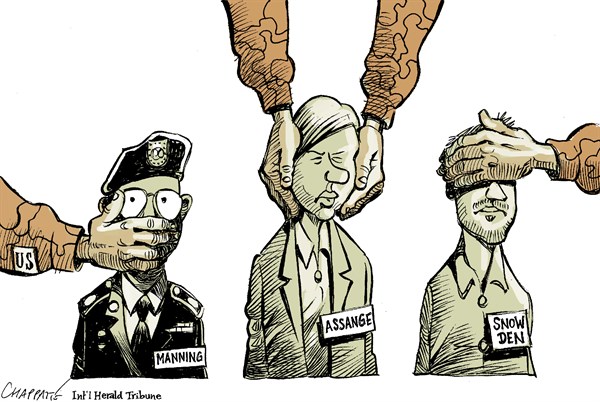
http://thecontributor.com/humor/five-cartoons-about-bradley-manning-and-war-whistleblowers

Your Package Has Arrived

amazon box

Does dataveillance let companies know more about ourselves then we know about ourselves? Everyone knows that Google tracks their users searches and emails to create targeted advertisement, but Amazon is taking to the next level. Amazon applied for a patent in August of 2012 that was approved in December of 2013 for an idea called “Anticipatory Shipping”. The theory behind this is that through tracking of peoples Amazon.com searches, previous buys, and wishlists, Amazon will expect you to buy a specific item as a certain time. Their computers would run their algorithm, based off their calculated probability of buying the product, and would then ship your product. If the computers found a very high certainty of a future buy, Amazon.com would ship the product to your doorstep automatically. For those will a little lower certainty, Amazon would ship the product to your area’s local distribution center, so the wait time on the product in minimal.

Now, obviously, this will only work for people they have collected enough data on, so the buyer would have to be a frequent shopper at the site. It is also important to note that any pre-shipping has not yet commenced, and they are still working on the program but wanted to make sure their idea was protected first. If only I could patent my privacy. This would be dataveillance you could avoid by just avoid Amazon; but if it works for Amazon, and considering american patents only last twenty years, how soon before other companies use programs like this? Do you think that other corporations would be willing to buy rights to the patent from Amazon in return for the ability to do this? Twenty years is a long time for business owners to let competitors get ahead.

You can find out more about Amazon’s anticipatory shipping here:

http://techcrunch.com/2014/01/18/amazon-pre-ships/