Exchange of Death with Autonomous Vehicles

Something I briefly brought up in class is agency in vehicle related deaths and how it changes with autonomous driving cars. I will acknowledge that ultimately people are expected to pay attention and be accountable for the car while the auto-pilot is on, however the action is still the vehicle killing a human (the vehicle accelerating itself into a tractor trailer killing the driver). Most vehicle deaths currently feature the vehicle as the tool or medium in which a person was killed by another person. How would opinions on driving change if a hypothetical 10,000 deaths from drunk drivers were prevented while 1,000 new deaths are caused by glitches in the vehicle itself?

One thing that I think is worth considering is the nature of vehicle deaths. If a function similar to the activity we did in class was ever implemented is it really ethical to kill an obese old woman legally going through a crosswalk if it saves a family of four in the vehicle? Perhaps the death toll is reduced to a quarter of what it would have been otherwise but is forcing someone who did nothing incriminating to bear the burden of the family that did not have their vehicle in proper condition the proper action? Since it is their property, the vehicle, along with all its failures, should in be their burden. Ultimately the value of a life is put on a scale against other life in a way that we do not currently have to face.

While these are serious issues that I think are worth contemplating I do believe that successful auto-piloting would be a great addition for a society where so much death is caused with vehicles, namely drunk and texting driving deaths.


Is AI blameworthy?

When I first opened the website for today’s reading I am a little confused about what it is about. But it doesn’t take long before I understand that it is a tragic and emotional story about humans with the wide use of technology. Before sharing my own thought about the story, I would like to sum up the narrative. The story is set in a futuristic world in which autonomous vehicles are ordinary transportations. From the fictional scholarly works Anna mentions, we may presume that the Artificial Intelligence (AI) for the autopilot cars in that world is so advanced that it learns from every human datum and is capable of “calculating” the consequences of accidents. In order words, when it comes to the dilemma which it (I am using the pronoun “it” here) will definitely kill something regardless of which choice to make, it can calculate the best outcome and act accordingly. In the story, Anna, the fictional “writer”, loses her three-year-old daughter Ursula because of the decision the vehicle-AI makes. Ursula falls in front of an autopilot car with an endangered bird, and the AI decides that the bird, which is listed as a protected animal by four Wildlife Preservations Acts, should be saved rather than the girl, thus killing her. What we read is a scholarly essay Anna writes about how autonomous vehicles are dangerous to people.

When I read it for the first time, I am sad about the hidden story and feel for Anna’s rage. However, when I read it again, I start to think about the other “protagonist” in this story – the AI. Undoubtedly, this tragic story may immediately arouse discontent and fear of AI, with the strong words “murder”, “manslaughter” and “kill” which usually refer to humans. However, does AI really have moral responsibility as a human do?

As the story is set in the future and most of the “books” cited in the text are fictional, I do not know how human-like AI is in the context (the fictional citation seems to mention that AI in that world has  consciousness, but we do not know the details.) Nevertheless, if I try to understand AI with today’s knowledge, I think AI does not have consciousness. When we talk about moral responsibility, free will is also required. Yet all the AI’s decision-making process are programmed, they do not have free will in our common sense (I am not going to go deep into the philosophical debate about free will here.) Moreover, for “murder”, the thing that commits it needs “intention”. And I do not believe that the AI intentionally kills although it can “think”.

Moreover, even if we assume that AI in the future world can be so advanced and human-like, why do human ask them to answer the question we human can’t? When you’re involved in a trolley problem, you are already in an unethical position – whatever you do or not do, you kill. There is no morally correct answer in the trolley problem for humans. And as AI is created by human and learns from human culture, why should we expect them to give a “correct” answer and blame them more severely than we do to human drivers? Yes, AI may be able to process more, if not all, information in a second than a human can ever be. However, even one day we are able to have all the information, cause and effect in our knowledge, I do not think there will ever be a correct answer for the trolley problem. It is because there will never be an objective measurement for lives. Even if we consider one of the most famous consequentialist approaches, Utilitarianism, Ursula’s case will not be solved too. For in some Utilitarianist theories every pain and happiness from all lives are counted, including humans and birds, how can we determine that a bird’s life (not to mention an endangered one and may affect the whole eco-system) is not more valuable than a 3-year-old human being?

So who is really blameworthy here? In my opinion, not the AI, but the people who think that AI can be god and solve all the human problems thus solely relying on them to do our job – thinking, feeling and trying to do the moral thing. It doesn’t matter that if AI has consciousness or not. At the end of the day, every individual needs to decide on their own and takes moral responsibility. Anna’s story is indeed heart-breaking, but I don’t think we should believe that AI is the culprit in this case.

Ramblings on STET + AI Ethics

Perhaps the most prominent fear around the growing artificial intelligence industry focuses on the autonomy of the robots.  More specifically, there seems to be a lot of anxiety about the unpredictability, or lack of morals, that these robots may exhibit when capable of making their own decisions.  As humans, we question the ability of machines to make rational, ethical decisions, which also must align with our own conceptions of morality.  However, figuring out just what our own societal morals and ethics are may be harder than originally thought.

In the STET piece we read for class, Ed, who appears to comment on the workings of a fictional Anna, expresses concern “about subjectivity intruding into some of the analysis” at the top of the article.  At first, I was highly confused by what this website was supposed to be but began to get a better idea once I figured out that “stet” is used by writers to let editors know to let the marked phrase stand.  As I reevaluated the article with this knowledge, I noticed that Anna writes “STET” in response to every comment that Ed has.  Ed gets progressively more personal with Anna as the comments continue, ending with “We haven’t seen you in months, Anna. Everyone here cares about you. Please let us help?”.  Predictably, Anna responds “STET”, meaning that she wants that statement to stand true.

So where do ethics regarding artificial intelligence fit into this?  Going back to the quote about subjectivity mentioned earlier, this brief interaction on a proofread between Anna and Ed shows the complex morality that varies between each human.  Unfairly, artificial intelligence is expected to have some objective, unflawed sense of ethics that are somehow more developed than that of humans.  If Ed and Anna are unable to reach an agreement, then how can the technology which we program avoid our own biases?  Ed and Anna represent a microcosm of the greater crisis we face–what do our morals ought to be?  Highlighting this dilemma also questions why we, as individuals, place value on certain things but not on others.  The issue is complex, and seemingly every answer raises at least 5 more questions.

With certain artificial intelligence like self-driving cars, the ethics typically follow a model of keeping the passengers safe and saving the most pedestrian lives as possible, which is relatively straightforward.  When the situation is not so clear-cut, all expectations are thrown out the window.  For example, an artificially intelligent lawnmower must choose between running over a cat or dog to avoid running over a rock and killing the man walking down the street.  The mower must have some program that allows it to make this decision in a split second.  Being the cat lover that I am, I’d program the AI to save the cat over the dog every time.  But obviously, this opinion is not universally popular.  So what should the robot do?  Is there even a ‘right’ answer?  Ed and Anna show us that an agreement will probably never be reached.

Wild West of Autonomy

As technology becomes smarter and smarter, society has hit a point where moral dilemmas are becoming a hot topic in the world of automation. One of the most exciting new technologies, I think, is the self driving car. Cars have had technology assisted driving for almost a decade now (rear-view backup camera, self-parallel parking, remote start, etc.), but we have finally reached the point where self-driving cars have hit the market. Unfortunately, that means we have also reached the point where these self-driving cars get someone killed. So what should we do?

As the articles state, Tesla’s autopilot had been used on public highways for tens of millions of miles before causing a single fatality. I think this reflects a lot of the misunderstanding behind automation and where society is at in terms of its implementation. Automation is a very new technology in the realm of day-to-day life, so it still seems very unorganized to many people. To me, it feels like we are living in the “wild west” days of robotics because we simply do not have a lot of rules regarding what they can or cannot do. This is important because the laws and regulations we put in place for robots now will dictate the kinds of advancements that can be made in this area of technology. Because of that, I think it is very important for people to understand just what kind of technology they have access to (driver assist, not full autopilot) in order to use them properly and not misattribute unfortunate events to the technology itself.

On the topic of self-driving cars, I do think that this is one of the most important areas in which this kind of technology can be implemented. Humans are bad drivers and there is almost no way to communicate with other cars on the road (except brake lights and blinkers, but HUMANS don’t even use those all the time). With self driving cars we have the ability to create a network of cars that can all communicate with one another. No more accidentally changing lanes into someone else’s car or failing to see that the cars in front of you just halted to a stop. Autonomous cars can already help you with these things. The really interesting thing is what this means for traffic. Cars that can communicate and adjust speeds accordingly would make things like highway merging more efficient (read: less slowing down) and intersections wouldn’t need stop signs or stoplights. These are also the areas of roads that see the most human error and the most accidents, but these could be greatly reduced through the use of computers and inter-car connections. Obviously this kind of stoplight-eliminating technology is a long way off, but it is something that could be possible if companies are given enough time to develop technology that can be more affordable for average drivers.

turning 1’s and 0’s into life and death

As a computer science major, I’m a pretty big supporter of technological advancement. I’d like to see autonomous robots helping us improve daily life, cars driving themselves, implanted health monitors — but I find articles like what we read for today almost more important than the technology itself. Robin Henig, author of the NY Times article we read for today, mentions that it’s not that big of a leap from Roomba to “autonomous home-health aide”.

It’s not so much that technology is holding us back, but instead we’ve slowed down to solve these moral dilemmas that stem from digital autonomy. Which is warranted. I’m therefore a huge fan of the collaboration mentioned in the article between computer scientists and “philosophers, psychologists, linguists, lawyers, theologians and human rights experts.” Mostly because I think we all recognize that we’re bound to make these technological improvements. I don’t think ‘forgetting to program’ something will be the issue; what resonated with me the most is this issue of how the bot supports its actions. Right now it’s all a human built, but not as good of a human-replicating practice. The robots are having to learn pretty binary decisions – like to dispense medicine or withhold medicine – through preset rules communicated to them, be it through connectivity, programming, learning, whatever. The good news is that maybe in the future the robot doesn’t need to contact the supervisor before giving the patient medicine, but rather double check its offline machine learning model to reinforce whether it should do something.

I mention this a lot in these blogs but we live in a cool time where we are connected to limitless information which makes these decisions easier and easier to support (even if the decision itself is hard). We have access to all sorts of stats and models now that definitely increase our understanding of the repercussions. We’ve also reached a really cool level in tech where we can model things digitally before we put certain things into practice. Take self driving cars, for example: without risking any physical damage, coders and programmers can test algorithms in video games. This person was able to test his driving algorithms in grand theft auto, for example. Or take Elon Musk’s OpenAI project. They programmed a bot that replicates human movement and decision making seamlessly in the video game Dota 2. While not perfect examples, they definitely illustrate how being able to do stuff digitally gives tech people room to code and incorporate emotion without endangering physical lives. Another plus being that you can test things at a personal level in addition to at bigger corporations like Tesla.

I want to point out, though, that these articles were written a couple years ago, and point out, again, how close we were to autonomy even just 4 years ago. I’d like to think we’ve come a long way in replicating human decisions even since then, so I find the New York Times article from 2015’s tone of not having the emotional replication in robots a little out of date. I like Jack from Wired’s way of putting it: “the system isn’t flawed. It just isn’t fully advanced yet.” One last point I want to bring up is this quote from the Times article: “a robot’s lack of emotion is precisely what makes many people uncomfortable.” I do think it’s still hard to fathom, let alone code, how a robot feels. I think the best practice is to model off of humans’ emotions, and even that is scary. In any case we’re turning 1’s and 0’s into life and death and I’m glad to see society is discussing that.

Can robots have ethical dilemmas?

Robin Marantz Henig’s article, Death by Robot, discussed the myriad of ethical dilemmas posed by those trying to blend the worlds of morality and humanity. Should Fabulon give their patient medicine to ease their suffering, even without permission? Should a military robot shoot someone because of the weapon it’s using, or because of what the person is wearing? Should a car on autopilot choose to hit another car or a pedestrian? The questions about self-driving cars seemed the most pressing because that technology was the closest to being actualized.

Illustration by Erik T. Johnson via The New Yorker


However, I think that the conflation of ethical dilemmas faced by humans and those faced by self-driving cars is inappropriate. Although John Seabrook’s personal story, Black Ice, Near-Death, and Transcendence on I-91 shows just how much your brain slows down during a car accident, I think that the decisions a driver makes are mostly instinctual reactions to an unfamiliar situation. You have a split second to choose whether you’ll hit a barrier, a car, or even another person. Often, this probably isn’t even much of a choice, but more of a subconscious response where our own internal auto-pilots take over. This is much different than engineers or ethicists thinking about a hypothetical car crash and programming in a response. The difference is that the former is spontaneous while the other is predetermined. The former is somehow an easier decision to make and to live with than the latter.

In another vein, I wonder if cars were programmed to hit safer car models over less-safe ones, such as a Volvo instead of a Mini Cooper, if that would discourage people from buying the safer models. If safety turns you into a target in accidents, why not go with something that is objectively more vulnerable, but might be less prone to be hit in the long run?

Deadly Liabilities

While reading the infamous death of the 40 year old man dying in a self-driving car accident starts to raise questions about the technology that is supposedly to be used to make driving safer. While incidents like these arises with this new type of technology, it starts to come down to liability issues of who really killed the driver, whose to blame, and why.  One of the more interesting things I’ve been analyzing is how a traumatic accident like this is supposedly “positive” for Tesla and it’s outlook on these types of cars.  According to After Probing Tesla’s Crash, Feds Say Yay to Safe Driving, this crash was not a negative experience for their company, but rather a beneficial one.  He mentions how with this crash bringing attention to self-driving, it emphasizes the stats of how rare this occurrence is, as well as looking at the safety this car still has in comparison to regular automated cars. Yes, Tesla may be facing this legally but why should they be worried?

Allowing for this crash to help the company and economical status rather than bring attention to the possible danger that this technology has takes away from the fact that this man who died was essentially a money booster, rather than a genuine human.  People are concentrating on the idea of money and power and taking away the fact that an innocent sole died because of the inaccuracy of a technological product.  With this in mind, who should ethically be the one to blame, the driver for putting on self-driving mode, or the car company who actually had the technology that malfunctioned the car?

Autopilot Speeds Up Into Wall?

I think the section “A Cautious Future” in the Wired article brought up some really important points that what Tesla calls “Autopilot” is “great for backing up humans whose attention drifts away from the raod, but not yet good enough to take over full-time” (Stewart par. 15). It makes me wonder how important marketing and the idea behind the word autopilot is and the effect is has on how the consumer treats the car. If Tesla were to re-brand the feature and call it something to the effect of assisted cruise control, would consumers give the car less control?

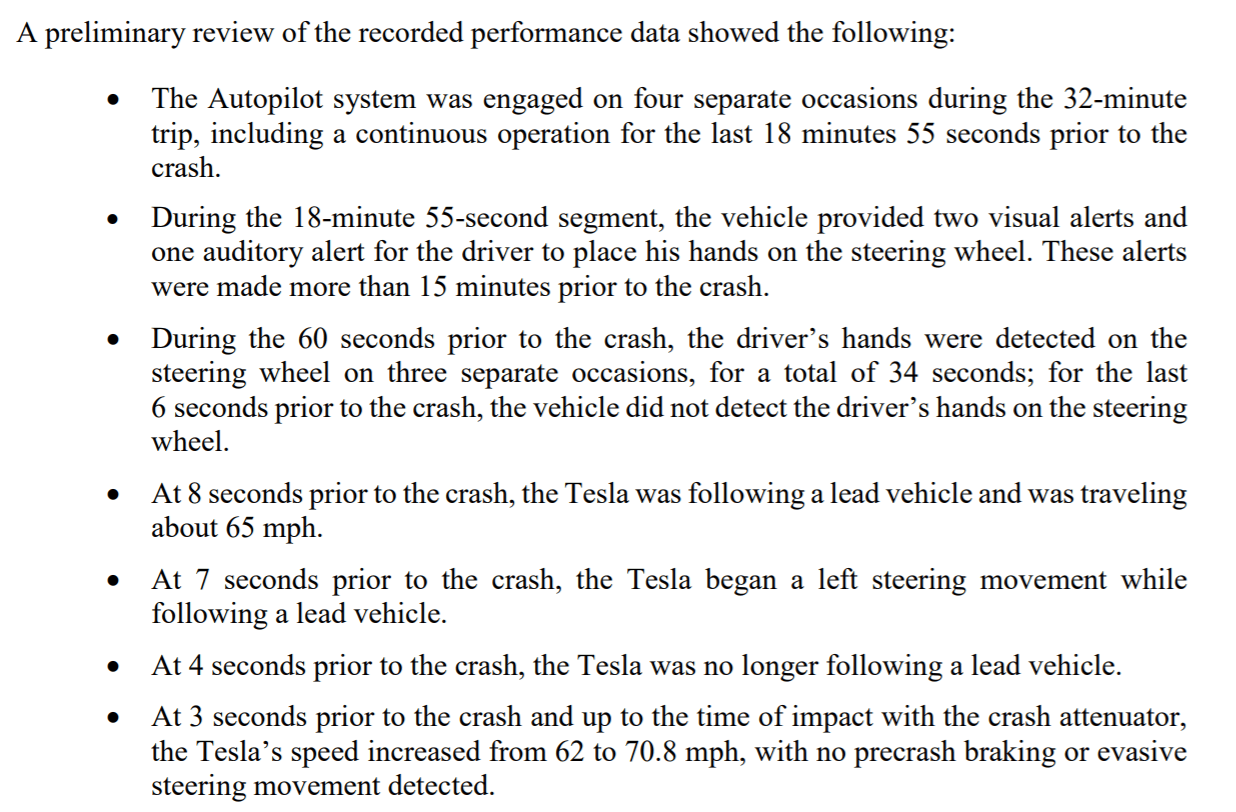
When reading the story about Joshua Brown, a related article about a more recent autonomous car accident related death appeared about Apple engineer Michael Huang (38 yo). Huang was in autopilot on US Highway 101 in Mountain View, California in the second lane from the left. The car approached the gore area (that triangular area dividing a split between lanes) dividing the main lanes from the exit ramp, but moved towards the gore area and collided into a crash attenuator. A Mazda and an Audi subsequently ran into it.

The odd thing about Huang’s accident was that in the last 3 seconds before the crash, the car sped up from 62 mph (under the speed limit of 65) to 70.8. The crash report by the National Transport Safety Board offers a step by step look at the events leading up to the crash:

Like Joshua Brown, Michael Huang did not survive so we can never really know what was going through the driver’s mind or the level of engagement, but the crash report indicates that Huang was alert because his hands were on the wheel during the 60 seconds prior to the crash. However, they were not on the wheel the last 6 seconds. In an effort to pin the blame on Huang, Tesla said “The driver had about 5 seconds and 150 meters of unobstructed view of the concrete divider with the crushed crash attenuator, but the vehicle logs show that no action was taken” (McCarthy par. 15) It is odd that the driver did not do anything, but Tesla’s argument kind of defeats the whole purpose of the idea of a car that drives defensively. Six seconds is such a quick time and could fall into the category of distraction and not reliance. In both Brown’s and Huang’s cases, Tesla seemed quick to convey their condolences but pin the blame on the driver. While it’s cool that we can access the car’s recorded performance data and know some more about what happened leading up to the crash, it still raises a lot of questions about the car’s technology. Why did the Tesla speed up? Why didn’t it detect that it was not in a lane? Why didn’t it detect the barrier? Was it trying to take the exit ramp or did it know/was effected by Huang’s intended route?

Works Cited

McCarthy, Kieren. “Oddly Enough, When a Tesla Accelerates at a Barrier, Someone Dies: Autopilot Report Lands.” The Register, 7 June, 2018. Web.

“Preliminary Report Highway HWY18FH011.” National Transportation Safety Board.

Stewart, Jack. “After Probing Tesla’s Deadly Crash, Feds Say Yay to Self-Driving.” Wired, 20 Jan. 2017. Web.

Reflections on the Ethical Use of Public Images

It seems like the overarching theme of this week’s discussion has been asking what is or isn’t ethical in regards to using a deceased person’s likeness. One person wrote, “When an actor or model participates in the creation of a piece, they are part of a community”, while another said, “The way I see it, the estate should have the right to sue in cases of unauthorized use AND misuses of the deceased’s image…”. While I agree that in an ideal world, estates or family members (or FNOKs) would have full agency over the deceased’s public image/works, I believe, like Jack said, that it’s nearly impossible to do that – and we have Barbara Streisand to thank for that. The Streisand Effect is the rule that if a famous person (or their estate) makes a fuss about something, say an unauthorized, scandalous use of an image, that image will then receive much more attention than it ever would have before.

Sorry, Beyoncé – this image is never going away.

Not to be super cynical, but like we’ve discussed in class before, it’s  extremely difficult to scrub things from the ‘cloud’ once they’re on there. In the case of celebrities, I think it’s just something they have to accept comes with the territory. For us regular Janes and Joes though, I definitely agree that there should be safeguards or channels in place for legal action to be taken against unfavorable use of images.

Digital Resurrection in a Different Light

After Wednesday’s class on digital resurrection, I was particularly interested in many of the moral or ethical questions that were brought up when we discussed our dead celebrities in small groups. The questions we explored about how we would treat the celebrity or interact with their art or music or image differently after they died compared to when they were alive were interesting to me.

After class I also began to explore more of the specific moral and ethical questions that are asked in the #metoo era that we are in, especially in regards to celebrities. My group discussed Michael Jackson and I found it interesting when the larger class discussion was brought up about whether or not it was morally wrong to still listen to or buy his music. My first thought was “he’s dead, why does it make a difference” but then I thought of what it stood for and what kind of image I was supporting and I started to change my mind. After a quick research session I found that writers had very strong options on either side. Suzanne Moore believes that Michael Jackson’s music is dead to her, while the Admin Team from MJ Vibe believes you should play his music now more than ever. Two very polarizing viewpoints that I think capture both sides of the debate.

I also started to think of the opposite digital resurrection of Michael Jackson, where a celebrity comes back after they have died with a better and more profound reputation based off of something that happened while they were alive but there was increased awareness of that action/circumstance after their death. My first thought was Robin Williams due to the mental illness he suffered from before taking his own life. I think he was digitally resurrected in a much stronger and positive light after people found out about his suicide and all that he was going through leading up to his death. Everyone was amazed with how much joy and energy he put into his films, while also experiencing a dark and terrible time of his life. Therefore, I noticed that digitally resurrecting someone in a different light than when they were alive, is normally based off of events that happened when they were alive, that are now being more highlighted once they have died.