I think the section “A Cautious Future” in the Wired article brought up some really important points that what Tesla calls “Autopilot” is “great for backing up humans whose attention drifts away from the raod, but not yet good enough to take over full-time” (Stewart par. 15). It makes me wonder how important marketing and the idea behind the word autopilot is and the effect is has on how the consumer treats the car. If Tesla were to re-brand the feature and call it something to the effect of assisted cruise control, would consumers give the car less control?
When reading the story about Joshua Brown, a related article about a more recent autonomous car accident related death appeared about Apple engineer Michael Huang (38 yo). Huang was in autopilot on US Highway 101 in Mountain View, California in the second lane from the left. The car approached the gore area (that triangular area dividing a split between lanes) dividing the main lanes from the exit ramp, but moved towards the gore area and collided into a crash attenuator. A Mazda and an Audi subsequently ran into it.


The odd thing about Huang’s accident was that in the last 3 seconds before the crash, the car sped up from 62 mph (under the speed limit of 65) to 70.8. The crash report by the National Transport Safety Board offers a step by step look at the events leading up to the crash:
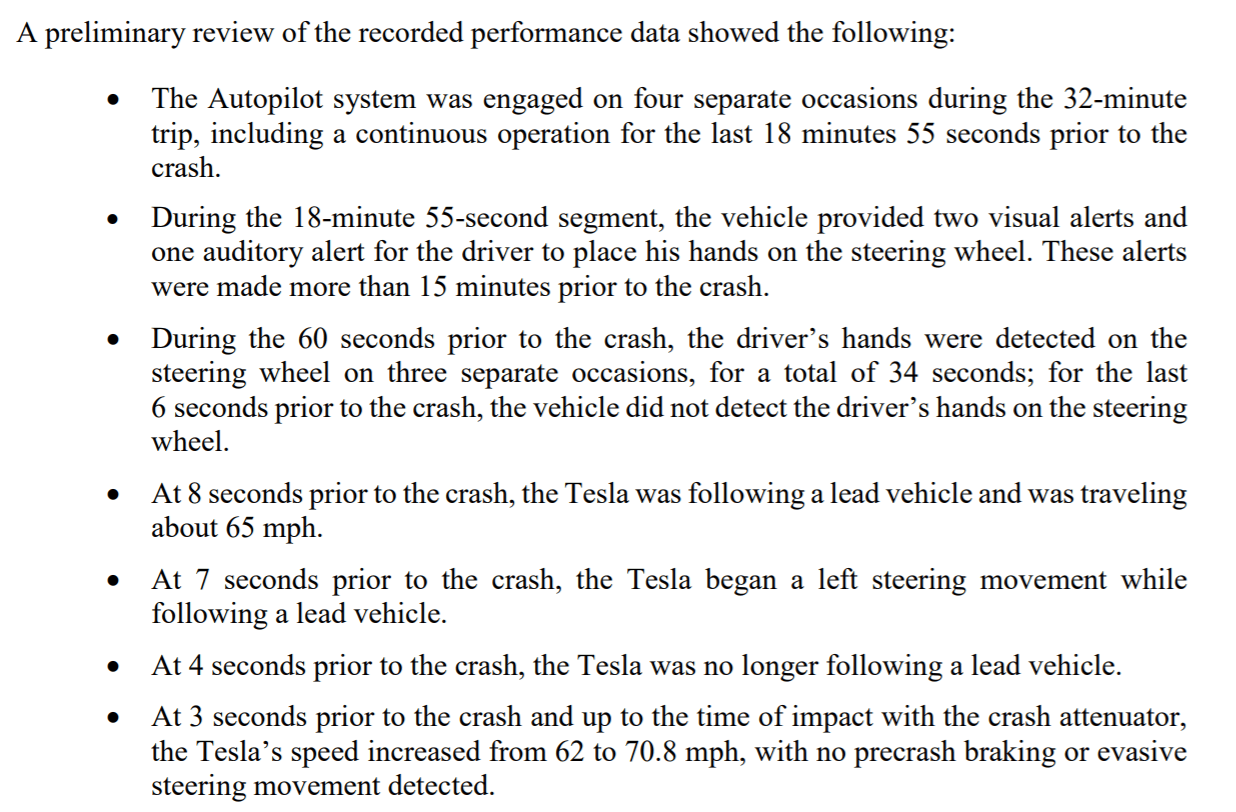
Like Joshua Brown, Michael Huang did not survive so we can never really know what was going through the driver’s mind or the level of engagement, but the crash report indicates that Huang was alert because his hands were on the wheel during the 60 seconds prior to the crash. However, they were not on the wheel the last 6 seconds. In an effort to pin the blame on Huang, Tesla said “The driver had about 5 seconds and 150 meters of unobstructed view of the concrete divider with the crushed crash attenuator, but the vehicle logs show that no action was taken” (McCarthy par. 15) It is odd that the driver did not do anything, but Tesla’s argument kind of defeats the whole purpose of the idea of a car that drives defensively. Six seconds is such a quick time and could fall into the category of distraction and not reliance. In both Brown’s and Huang’s cases, Tesla seemed quick to convey their condolences but pin the blame on the driver. While it’s cool that we can access the car’s recorded performance data and know some more about what happened leading up to the crash, it still raises a lot of questions about the car’s technology. Why did the Tesla speed up? Why didn’t it detect that it was not in a lane? Why didn’t it detect the barrier? Was it trying to take the exit ramp or did it know/was effected by Huang’s intended route?
Works Cited
McCarthy, Kieren. “Oddly Enough, When a Tesla Accelerates at a Barrier, Someone Dies: Autopilot Report Lands.” The Register, 7 June, 2018. Web.
“Preliminary Report Highway HWY18FH011.” National Transportation Safety Board.
Stewart, Jack. “After Probing Tesla’s Deadly Crash, Feds Say Yay to Self-Driving.” Wired, 20 Jan. 2017. Web.