Reflection: Injecting Death into Every Scenario

Looking back at my blog posts from this semester, it is hard to group them or assign one overall characteristic. They span the gamut from addressing Putin’s rise to power (and the death of truth) to critiquing zombie-horror as creatively cheap. I dragged the self-important digital natives who obsessively catalog their social media posts as if that would grant them immortality. The Atari games that ended up buried in a landfill achieved more mythic status than those solipsists.

I tended to make loose connections between my subjects and the traditional notions of death. Can a concept like “truth” die? How does social media change our relationship to the concept of dying? How does a video game “die” — and then become resurrected by social fascination and fetishization?

I felt most engaged when injecting discussions of death into unexpected places, whether it’s neo-liberal politics or the demise of Fyre Festival. I enjoyed considering death beyond its biological process; what are it’s cultural and social dimensions? How does it shape media we consume? How does our conception of death itself change over time?

My best posts responded to class content while also integrating readings from my other classes. I wrote “Postmodern Politics: Post-truth, Putin, and Power” in a state of crazed shock after watching Adam Curtis’ BBC documentary HyperNormalisation, which traces the rise of postmodern culture across a forty year timeline. I wrote “Fetishizing Trash: Atari and Material Lifecycles” after reading about how objects can provide concrete representations of abstract human concepts — whether that’s our sense of self or how we conceptualize video game culture.

I would have loved to write more about how death is being changed not just by our societal attitudes (it’s now socially acceptable to live-stream funerals!) but also by advances in technology. What ethical dimensions should we be concerned about when imagining the ability to upload and download consciousness, or mimic consciousness like in the Black Mirror episode “Be Right Back”?

If I take anything away from this class and my posts, it’s that elements of death and dying can be applied to almost any artifact or media in our postmodern, hyperreal world.

I Google searched “death in the digital age” and this was an image in the results. Photo from TheNextWeb.com; artist unknown.

I’m More of a Pessimist than I’d Like to Admit

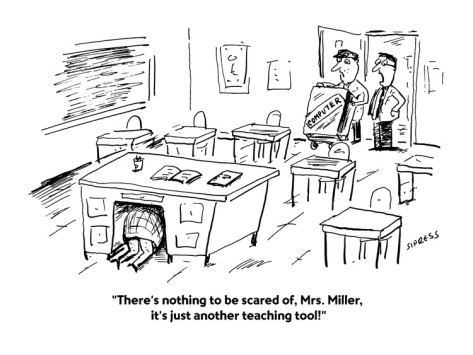
Looking back through my blog posts, one thing is clear: it appears that I am not a fan of technology and that I tend to assume the worst in things. While obviously in reality this is not entirely true (I have a deep appreciation for my iPhone and BuzzFeed), these weekly blog posts served as a space in which I could air my fears and concerns while only slightly sounding like my mother. I noticed that this ever-present pessimism toward technology was a pattern that showed up in all my themes and arguments.

This is how I feel about technology…sometimes. Source: Cartoon Afraid of Technology. N.d. Keywordsuggests.com. Web. 12 May 2017.

In my first post, “Are you cheating? Designing Relationships in Black Mirror,” my inner pessimist worried about the impact of technology on our human relationships. While Ash’s physical death was framed as the plot-driving loss, another, metaphorical death seemed to have already taken place long before his funeral: technology’s substantial daily role and involvement in both Ash and Martha’s lives resulted in an absence, a void, and an unnoticed loss.

Incidentally—by magical coincidence alone—I actually ended up returning to this exact notion in my very last blog post about Station Eleven titled “Can You Be Dead While Still Alive? Exploring the Limitations of Humanity in Station Eleven.” In this final blog post, I readdressed the concept of metaphorical death and the loss of human relationships from technology. I argued that “…in a world increasingly dominated by social media, self-interest, competition, and materiality…,” performance often takes the place of authenticity, resulting in a symbolic death of both the self and humanity. It was satisfying to come full circle in this final blog post and also really interesting to see how preoccupied I continue to be by the threat of technology.

Interestingly, both my blog about internet policing  and my post about death in a sharing economy also explored the “human cost” of technology. These posts focused on how online realities and commercial concerns come at the cost of human relationships.

Yet another theme that surfaced both in my final blog post on Station Eleven and in my post on A Head Full of Ghosts was the theme of truth/reality within technological spaces. In my post “How Do You Remember it? The Construction of Truth in A Head Full of Ghosts,” I noted how Paul Tremblay’s book “…destabilized the belief that there exists one version of reality, providing instead various conflicting accounts and retellings of one event to highlight the subjective and constructed nature of truth.” This conversation was particularly relevant for a book centered around a reality TV show. Similarly, in my discussion of performance and authenticity in Station Eleven, I explored the the idea that truth and the concept of the “true self” are subjective and thus impossible to define or obtain in a technologically-driven society.

Last but not least, mortality/immortality was another theme that surfaced in multiple posts, particularly in my blog titled “The Modern-Day ‘Spirit Phone’: Forever a Failure?” in which I argued that the “…fear of an absolute end without continuation is arguably the greatest tragedy of mankind for we must reconcile our finite existence and the feeling of insignificance this awareness engenders.”

These three central themes remained fairly consistent in my posting over the course of the semester and yet, as I compare my earlier posts with more recent submissions, I do notice a clear shift in how I approached these main themes. While many of my earlier blogs focused on more obvious quotes or main ideas in our readings that articulated a central theme, in my later writings I looked instead for smaller nuances and interesting details that spoke to these themes, but more indirectly. For example, my first blog post explored the effect of technology on relationships—a very important yet nonetheless rather obvious theme to take away from Black Mirror. However, weeks later for my post on internet policing I discussed the difference between the use of first and third person by internet trolls.  This focus on a small detail from the reading helped me to consider the ways in which the theme of performativity is inscribed into language and the subtle ways in which we enact this distancing in human relationships.

Funnily enough, the article I cited most was actually the very first article we ever read for class by Walter Benjamin titled “The Storyteller.” For example, in my post on A Head Full of Ghosts, I drew on Benjamin to explore how technology alters our relationship to memory by shifting our emotional responses since technology “…can’t capture feeling, only fact.” I referenced Benjamin yet again in my post “Fantasy or Reality? The Gray Line Between the Truth and the Story” about dark and toxic tourism in the Chernobyl Exclusion Zone. Here, however, I expanded upon Benjamin’s description of the storyteller to situate this figure within contemporary contexts.

As I read back through all my blog posts, I noticed that I actually didn’t do as much real-world application as I had intended: Yik Yak, the movie Her, and Airbnb were the only tangible examples I cited throughout all my posts. I think this is due largely to the fact that I’m generally more comfortable talking about theoretical questions and larger concepts rather than their practical application and real-life parallels (no thanks, I’m sure, to my French major which focuses almost entirely on literary analysis and theory). This hole in my analyses is a reminder to myself that sometimes I get so involved with the theory that I forget to ground myself in reality to remain critical of the very systems I depend upon in daily life.

As someone interested in art and fashion—industries in which the tension between truth and performance is always at play—these three main concepts of truth, mortality/immortality, and performativity remain highly applicable  and relevant to my thinking even outside the classroom.

Can You be Dead While Still Alive? Exploring the Limitations of Humanity in “Station Eleven”

Despite his death as early as the first chapter, Arthur Leander remains a continual presence in Station Eleven, a common link between otherwise very different characters as both an abstracted celebrity icon and a flawed husband and friend. It’s significant that one of the most central characters in the novel is a celebrity, and Emily St. John Mandel emphasizes the role of his fame repeatedly. For example, even in Arthur’s personal off-camera relationships, the line between acting and real-life remains gray, and he wonders at one point: “Did he actually date those women because he liked them, or was his career in the back of his mind the whole time? The question is unexpectedly haunting” (79). Arthur’s inability to distinguish between the construction of himself as a character and his original self is haunting because truth and illusion are no longer differentiated. And in a world increasingly dominated by social media, self-interest, competition, and materiality, Arthur is merely the extreme of a reality we are already living—we perform in our daily lives and construct a better version of ourselves to the point that it’s hard to tell what’s real and what’s fabricated. We are not so different from Arthur after all.

Arthur’s ex-wife, Miranda, observes this tension between illusion and reality while hiding from dinner guests in her backyard. She admires a lamp in the shape of a crescent moon, noting that “The fake moon, which has the advantage of being closer and not obscured by smog, is almost always brighter than the real one” (100). This observation highlights an important theme: a lie can often seem truer than truth itself. Truth is no more than a game of smoke (in this case smog) and mirrors (in this case the reflection on the water).

Miranda observes the real moon and the fake moon, truth and illusion. Source: Ocilunam. Ex.Moon Outdoor Lamp. N.d. Lumens Light and Living. Web. 27 Apr. 2017.

Both Arthur and Miranda demonstrate this loss of humanity through their depiction of reality as a performative construction. This made me think: where has the real death occurred in this novel? Obviously, the easiest response is that the death occurs during the flu outbreak and the loss of civilization as we know it. And yet, these earlier moments pre-destruction suggest something different.

Has mankind already died? Are the loneliness and emptiness felt by the characters prior to the end of civilization simply mourning by a different name?

Reframing the text in this manner allows us to better understand the fear foregrounding this book: if an apocalypse seems a fictive, impossible, or slightly less threatening reality, perhaps the horror lies instead in the metaphorical death of Miranda and Arthur that occurs long before—a far more relatable and imaginable demise.

The real tragedy here is that this death goes unnoticed. The thought that you could die without even realizing it is the scariest concept of all. So yes, this novel is technically about an apocalyptic event, but really, it’s about all the other ways in which we can die. Don’t get distracted by wild-west shootings and end-of-the-world survival; Arthur Leander died long before the first chapter.

References:

Mandel, Emily St. John. Station Eleven. New York: Vintage , a Division of Penguin Random House LLC, 2014. Print.

Ocilunam. Ex.Moon Outdoor Lamp. N.d. Lumens Light and Living. Web. 27 Apr. 2017.

Undead celebrities: Para-social celebrity relationships and the inauthenticity of digital images

sarahfunderburg.com/undeadcelebs

password: bobross

Artist Statement

“When the original ceases to exist, yet can be seen to live on in the media, the possibility of an extended immortality can be implicitly evoked. The fact that all this happens within the realm of entertainment and popular culture, where, for many, the exercise of a willing suspension of disbelief has become almost second nature, makes the entire proposal even more persuasive.” Alexandra Sherlock, 173

“Always the photograph astonishes me, with an astonishment which endures and renews itself, inexhaustibly. Perhaps this astonishment, this persistence reaches down into the religious substance out of which I am moulded; nothing for it: Photography has something to do with resurrection. (Barthes 2000 [1980], 82). [sic]” Roland Barthes, quoted in Sherlock, 174.

——–

I wanted to consider the idea of the celebrity in a captured image and its meaning in our digital era. The photograph was long considered an object of truth, far removed from art and reinterpretation, but with the advent of digital photography, the manipulation of photos has become ubiquitous, and practically synonymous with photos of celebrities. Whenever we, as a culture, see a photograph of a famous person, whether it be in a magazine or on the red carpet, we often assume that it has been “doctored”; that is to say, altered in a manner favorable to the celebrity.

Photographs have an aura of permanence—of a temporary moment permanently transcribed with the camera’s technology. When considering this, I found that the concept of the image reminded me of the way Sterne described early audio-recording technology in Resonant Tomb. Of course, the first rudimentary audio recordings and these high-definition photographs appear to have little in common—certainly not in terms of medium or quality. These altered photos are intended to strike the middle ground between ephemerality and permanence, just as the first audio recordings did (Sterne). Sherlock writes, “Photography marked a new era in the reproduction of self: Each time we are photographed we reproduce (Giles 2000, 51), and each reproduction lives on into the future as a record of our existence” (166). These reproductions are what I consider.

Consider this quote: “Barthes believed that all photographs (and potentially all forms of visual representation) contain a paradox between life and death—the moment is dead but the photograph is alive and present, and this paradox is the punctum that pricks our attention” (Sherlock 170). As Sherlock defines it, Barthes’ punctum “Is what punctuates a photograph: something that jumps out and grabs your attention, for whatever reason. It is usually something that the viewer does not fully understand and sparks the viewer’s curiosity” (170). Barthes names five possible punctums: the two I want to engage with in this project are “contortions of technique or trickery,” and “the ‘lucky find’” (Sherlock 170).

The trickery is my post-production digital manipulation of photos of award ceremonies and music festivals, altered to include dead celebrities, and on two occasions, celebrities who were killed on Twitter (more on that later). This is not quite necromancy as Sherlock has it (the celebrities aren’t talking back), but more of a reanimation or reinvigoration of the dead celebrity. The “lucky find” is also at work, being that hopefully the “Photoshopping” is effective enough to incur some searching on the part of the viewer for the uncanny subject: What haunts this image?

As Sherlock phrases it, “To suggest that we are fooled by these living images of the dead would be misleading—rationally we know that the subject is deceased. However, the cultural avoidance of death can provoke an ever-greater fascination and curiosity, a curiosity quenched by the further consumption of death-related popular culture (Durkin 2003). Images of those that have since died have a special effect and can evoke spine tingling feelings of creepiness.” (169-170) In this case, you all are hyperaware of these celebrities’ deaths given the nature of this context, which is why I included the Twitter deaths of still-living celebrities.

This project is also about the para-social relationships “the public” has with fame. As Sherlock explains, “Horton and Wohl coined the term para-social to explain the bond—facilitated by the media—that many viewers felt with particular television personalities and presenters” (168). Meyrowitz complicates this phenomena further, stating: “Even an awareness of the para-social mechanism is not enough to permit escape from its ‘magic’” (128). These photographs blur the boundaries between reality and fiction, honor and disrespect, and preservation versus peace. When do we let a celebrity rest? Think of Marilyn Monroe’s twitter—she is long gone, yet we still insist on conversation. To borrow a phrase from Sterne, these photos deal with “Death as a receding limit” (199). Imagine them as being captured at a fictional award ceremony that happened yesterday.

As mentioned earlier, Britney Spears and David Guetta had “Twitter deaths.” This is to say, these people are still among the living, but Twitter, at one point or another, insisted otherwise. Both Guetta and Spears’ names became trending topics alongside the hashtags #RIPDavidGuetta and #RIPBritney, in 2011 and 2016, respectively.

Britney Spears’ Twitter death included headlines the likes of “Everyone Thought Britney Spears Was Dead Because Of A Savage Twitter Hack” (Elite Daily), “PSA: Britney Spears Is Still Very Much Alive: The Sony Music account’s tweets reporting her death are false” (Elle), and “Sony Music apologizes for Britney Spears RIP tweets” (Fox News). Fox News explains Spears’ Twitter death with a strange tone: “Sony is well aware of the damage a hacked account can cause, especially when it impacts an entire service such as the PlayStation Network. The latest Sony hack is on a much smaller scale, though, with the only real consequence being lots of upset Britney Spears fans.” Indeed, Spears’ Twitter murder is of little consequence to them.

David Guetta’s Twitter death is treated with more levity and much less general coverage on the internet. His Twitter death is a kind of internet in-joke, more useable in memes than headlines, perhaps due to the fact that it occurred five years earlier than Spears’. As Twitter user @danababy97 has it:
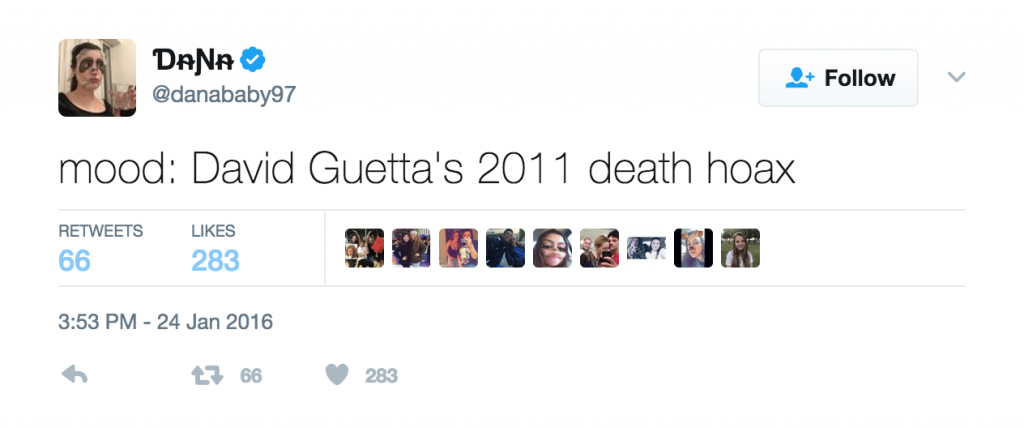
@danababy97’s tweet: “mood: David Guetta’s 2011 death hoax”

Meyrowitz discusses this strange kind of murder even though it’s unlikely he anticipated something like Twitter culture, having written No Sense of Place in 1985. He wrote:

The para-social relationship has also led to a new form of murder and a new type of murder motive […] The para-social murder. In both love and hate, normal and bizarre, the para-social relationship is a new form of interaction. It has some of the traditional characteristics of both live encounters and communication through books, but it is, in fact, neither” (121)

I would argue that these Twitter murders rely on para-social interactions, further complicated by the user reciprocity (retweets, etc.) that Twitter encourages. These celebrities, digitally murdered on Twitter, live on in the way that “matters.” However, as Sherlock phrases it, “To what extent can digital representations substitute for those they refer to, and how could the death of the “original” affect public perceptions of the representations that continue to be perpetuated in popular culture? Ultimately, what effects might these digital ghosts or even reincarnations have on popular perceptions of death and mortality?” (165)

Meyrowitz sums up what I hoped this project would access pretty well:

Ironically, but appropriately, the media provide the most ritualized channels of mourning. Radio and television present specials and retrospectives. And many people use the telephone to contact real friends who shared the intimacy with the para-social friend. But the final irony is that, in some ways, the para-social performer does not die. For the only means through which most people came to know him or her—records, films, and videotape—are still available. The relationship is frozen, rather than destroyed. In part, it is the potential and hope for increased intimacy that dies, and the never to be face-to-face consummation of the relationship that is mourned. (120)

With these manipulated images, I wanted to “unfreeze” and refigure the relationships, casting doubt in some cases on the living status of these celebrities. Imagine what Meyrowtiz would do with the knowledge of the expanse of internet-mourning today—the Twitter funerals, Oscar and Grammy in memoriam slideshows, the endless barrage of grief-stricken updates on Facebook and Instagram. Sherlock follows this thought: “Paradoxically, while death has become less visible, mourning, particularly in response to the death of a public figure, has become more visible. The Internet and the media facilitate a new type of ritualized, collective mourning that potentially serves to distract mourners from the physical reality of death” (169).

The nature of the “reality” I have created here depends on this idea about the reproduction of images given in Sherlock: “The representation is even more real if you have never met the original—it is the original” (168). Without further evidence, how do we know for certain that what we’re seeing isn’t true? The people who engineered the Tupac hologram knew this was a powerful question to ask of celebrity.

CONCLUSION:

I found several aspects of completing this project thought-provoking beyond the comparison/analysis of the photos I manipulated and the sources I included. One of those thoughts has to do with the format of this project, being an accessible/public page on my website. What does it mean for someone to look at this page not knowing the context? Would they imagine these celebrities/people as living again? Sherlock also accesses this thought: “To what extent can digital representations substitute for those they refer to, and how could the death of the ‘original’ affect public perceptions of the representations that continue to be perpetuated in popular culture? Ultimately, what effects might these digital ghosts or even reincarnations have on popular perceptions of death and mortality?” (165) The lack of clarity was unsettling enough for me to install a password. Furthermore, Is this illegal? Sure, the images are licensed for public use, but who owns the rights to these celebrities’ “personality rights”? (In reference to the article we read, “These are the most influential dead people on Twitter”). Would they have been O.K. with being visually included at these events?

The next thing I found myself concerned with was that I was performing a sort of celebrity audit; In making the images, I would ask: Would this famous dead person have been famous enough to be in this situation? This idea was particularly central to Alan Rickman sitting behind Ryan Gosling, the Smith family, and more (Image 8), and Paul Walker in the Ellen selfie instead of Bradley Cooper (Image 4). Furthermore, this audit reaches another level in terms of the celebrities I chose to include in the project at all; the ones I have included already passed some sort of fame test. I found myself wanting to continue in the vein of these arbitrary inter/intra-celebrity classifications. As uncomfortable as this made me, it occurred to me that this kind of categorization is someone’s job. Think of the “rest in peace” segment at the Oscars and Grammy’s every year: What is the criteria for making the cut?

Sherlock mentions this idea: “In his article on fame, Halberstam describes it as a measure of having lived a ‘worthwhile, or at least noteworthy, life’ (1984, 96), making a mark on the world and gaining assurance that one’s existence has been noticed” (167). That seems like a vague set of criteria to me.

The last element of the project I found unsettling was the effect the formatting of my webpage had of creating a sort of dead celebrity “Where’s Waldo,” a virtual necromancy game. Ultimately, what does it mean to visually bring these people back to life in this way? As one of our questions in class asked, what does a social life look like for the dead? Hopefully, these images do something to answer that question in the context of celebrity—though I may have more questions than answers.

Word count: 1,990

Works Cited document

PDF of Artist Statement

Photographic Paradox — Death, but Cybernetic

In “Digital Resurrection,” Alexandra Sherlock brings up a paradox first written about by Roland Barthes. A photograph is a paradox between life and death: “the moment is dead but the photograph is alive and present.” (170).

An embodied death can be overturned in our minds by the presences of images and media of that person. The absence of an animated body no longer means that person is out of reach. Indeed, we need only to turn to celebrity deaths — where estates and listening companies make millions — to see the self enduring past the physical body.

Does this change our understanding of finality? Death as an inevitable, totalizing concept is softened when we can stream living videos, images, and audio of the deceased. “It is a living image of the dead thing,” Barthes wrote: “the photograph surreptitiously induces belief that it is alive.” (Sherlock, 170).

Sherlock also addressed death as disruption. The dead body “reminds us of our own fate, resulting in the disruption of identity, system.” (169). A celebrity death is a highly publicized sort of disruption — if even this beautiful, wealthy, famous person can die, it shatters the illusion of escaping our own fate.

So it comes as no surprise that celebrity deaths are often “spun”: Tupac faked it to dip out of gang warfare and live anonymous in Cuba. The Illuminati killed Michael Jackson and Prince and Bowie. Combined with photographic paradox, it is as if celebrities are not really dead — they’ve simply reached a point where no new content is produced. It’s a tidy way to side-step the death disruption and avoid thinking about that one, inevitable fate.

This photo was circulated by conspiracists in 2011, showing that Tupac “alive” and in attendance at Occupy demonstrations.

Taken to the extreme, this type of thinking erases the concept of death from consciousness all together.

Check-In at Noon, Check-Out Never: Death in a Sharing Economy.

In her article “Airbnb has a dead people problem: The morbid side of the sharing economy,” Kashmir Hill introduces yet another tension between death and technology: sharing economy start-ups such as Airbnb and Getaround (the Airbnb equivalent for vehicles). Renting a stranger’s car or home gets a lot more bizarre when that person accidentally happens to be dead. This phenomenon is not entirely uncommon; for example, “ghost cars in the system” from dead owners are often realized months late and “…it’s possible they’d continue to be rented post-owner-mortem as those rentals require no action by the car’s owner beyond checking to make sure it’s cleaned out between rentals.” Case in point: during his Airbnb stay, Jordan Ruttenberg discovered that the young woman whose home he was renting had died. In need of lodging and having already paid for the rental, Jordan decided to stay the two weeks until the end of his rental, describing the experience as creepy but necessary. His traveling companion, however, chose to leave immediately. The worst part? It took 4 months for Airbnb to even notice the woman had died—and only after Newsweek published an article describing Jordan’s experience.

Airbnb is one of the many sharing economy start-ups on the market. Source: Untitled Photo of Airbnb Logo. N.d. Airbnb. Web. 29 Mar. 2017.

So why was it so creepy for Jordan to stay in the woman’s apartment after her death? Nothing had physically changed in the apartment by her death (after all, she had died in an entirely different state) and besides, Jordan never knew or met the woman in person. Why was this space quickly transforming into an uncanny site rather than the vacation spot it was supposed to be? I believe the answer to this question lies in two fundamental problems. First, the concept of invasiveness is at play in Jordan’s unease. Occupying this woman’s space was only okay when she was living and thus able to consent to his presence in her home. But what happens then when she’s dead and he’s living in this intimate, personal, and (semi-) private sphere of her life. Does he no longer have a right to be there? There is a certain level of violation at play in this scenario; Jordan’s physical presence presents a threat to the preservation of this woman’s space.

Secondly, it’s important to note that Jordan continued to stay in the apartment after her death because he had already paid for the rental and he wanted his money’s worth. At its foundation, Airbnb is a transactional service. I myself always find it a little jarring to inhabit someone’s personal, private space often without ever meeting them in person. It’s certainly strange, commercializing the personal. How do we prioritize the dueling realities of a space that is at once a home and a business? The discussions we’ve had in class recently regarding social media and digital inheritance echo this Airbnb dilemma: When someone dies, what do we do with their highly personal artifacts (homes, Instagram, etc.) that also occupy a public domain? And how do we balance what is ethnical with what is fair; it may not be ethically right to stay in the dead woman’s apartment but it’s also not fair if Jordan, broke and without other lodging, loses both money and shelter through no fault of his own.

A New York street. Source: Untitled Photo of New York Street. N.d. The Daily News (New York). Web. 29 Mar. 2017.

Inhabiting the space of a dead person is a reminder of our own mortality. We are forced to bear witness to the mundane and banal continuity of an apartment that doesn’t die with the person or somehow disappear. The value and meaning of objects and furniture (and their intentional placement in a living space) are imbued by its owner, and not necessarily inherent to the objects themselves. Thus, when we die, our memories, photos and possessions, once so inherently tied to the space and our identity within it, lose their importance . The apartment, while unchanged physically, lost its human value, no longer a sacred embodiment of its inhabitant’s identity (“it’s a piece of me”), but rather a transactional piece of property.

References:  Hill, Kashmir. “Airbnb Has a Dead People Problem: The Morbid Side of the Sharing Economy.” Fusion. N.p., 11 Feb. 2015. Web. 30 Mar. 2017.