Can You be Dead While Still Alive? Exploring the Limitations of Humanity in “Station Eleven”

Despite his death as early as the first chapter, Arthur Leander remains a continual presence in Station Eleven, a common link between otherwise very different characters as both an abstracted celebrity icon and a flawed husband and friend. It’s significant that one of the most central characters in the novel is a celebrity, and Emily St. John Mandel emphasizes the role of his fame repeatedly. For example, even in Arthur’s personal off-camera relationships, the line between acting and real-life remains gray, and he wonders at one point: “Did he actually date those women because he liked them, or was his career in the back of his mind the whole time? The question is unexpectedly haunting” (79). Arthur’s inability to distinguish between the construction of himself as a character and his original self is haunting because truth and illusion are no longer differentiated. And in a world increasingly dominated by social media, self-interest, competition, and materiality, Arthur is merely the extreme of a reality we are already living—we perform in our daily lives and construct a better version of ourselves to the point that it’s hard to tell what’s real and what’s fabricated. We are not so different from Arthur after all.

Arthur’s ex-wife, Miranda, observes this tension between illusion and reality while hiding from dinner guests in her backyard. She admires a lamp in the shape of a crescent moon, noting that “The fake moon, which has the advantage of being closer and not obscured by smog, is almost always brighter than the real one” (100). This observation highlights an important theme: a lie can often seem truer than truth itself. Truth is no more than a game of smoke (in this case smog) and mirrors (in this case the reflection on the water).
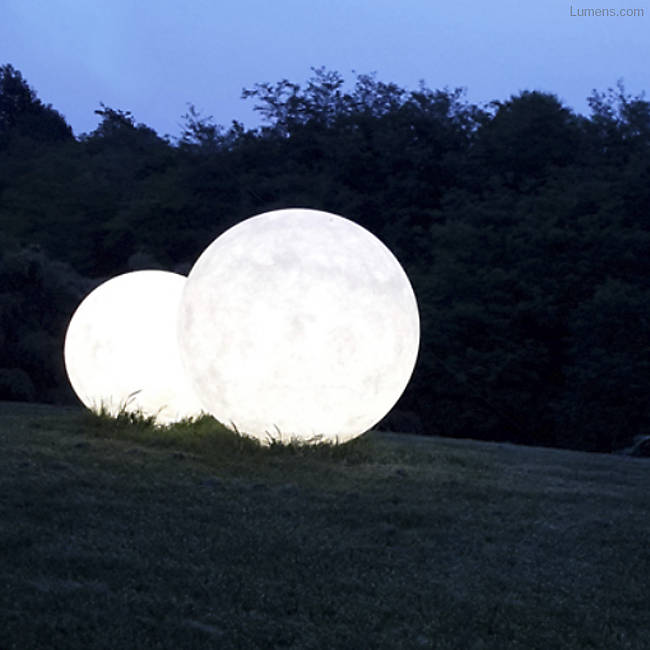
Miranda observes the real moon and the fake moon, truth and illusion. Source: Ocilunam. Ex.Moon Outdoor Lamp. N.d. Lumens Light and Living. Web. 27 Apr. 2017.

Both Arthur and Miranda demonstrate this loss of humanity through their depiction of reality as a performative construction. This made me think: where has the real death occurred in this novel? Obviously, the easiest response is that the death occurs during the flu outbreak and the loss of civilization as we know it. And yet, these earlier moments pre-destruction suggest something different.

Has mankind already died? Are the loneliness and emptiness felt by the characters prior to the end of civilization simply mourning by a different name?

Reframing the text in this manner allows us to better understand the fear foregrounding this book: if an apocalypse seems a fictive, impossible, or slightly less threatening reality, perhaps the horror lies instead in the metaphorical death of Miranda and Arthur that occurs long before—a far more relatable and imaginable demise.

The real tragedy here is that this death goes unnoticed. The thought that you could die without even realizing it is the scariest concept of all. So yes, this novel is technically about an apocalyptic event, but really, it’s about all the other ways in which we can die. Don’t get distracted by wild-west shootings and end-of-the-world survival; Arthur Leander died long before the first chapter.

References:

Mandel, Emily St. John. Station Eleven. New York: Vintage , a Division of Penguin Random House LLC, 2014. Print.

Ocilunam. Ex.Moon Outdoor Lamp. N.d. Lumens Light and Living. Web. 27 Apr. 2017.

Are Humans Broken?

I thoroughly enjoyed Steven Jackson’s Rethinking Repair as it brought to light a non-conventional method of thinking that is not often discussed. As a millennial in our modern-day society I am constantly targeted with words such as “new”, “innovative”, “high-tech”, and “groundbreaking” at least a few times a day. These words bring to mind a Back To the Future 2  mindset, one that has flying skateboards and futuristic technology.  They never make me think of innovations as something done to “fix” an issue or existing problem.


An example of the ads we are exposed to.


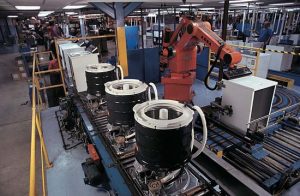
Taking Jackson’s mindset into account, I would like to pose the question: are humans broken? Jackson believes that constant changing world “is a world of pain and possibility, creativity and destruction, innovation, and the worst excess of leftover habit and power” (pg 222). Are humans a part of this besides being physically involved. One of the newest innovations that has hit the market is the self-driving Tesla that we covered in class recently. It has been marketed as a huge advancement into the robot-controlled universe where humans don’t have to do as much. There are already car manufacturers that have an assembly line of machines doing the work that humans could be doing.

Machines are taking over human jobs.

It is possible that we could see similar developments occur in other service fields(dining, mail, garbage collection) with the passing of time and the expansion of technology. These thoughts bring to light one question:

If we are making machines do the work for us, does that mean that the human species are broken?

Even then, what would the definition of broken mean when relating to a human. Furthermore, if we assume that humans are broken, then wouldn’t the machines made by them be broken as well? Or would we eventually get to a point in society where we build these machines and they begin to build themselves better? These are questions that we should keep in mind when discussing broken world thinking. It seems intuitive that humans would not want to think of themselves as ultimately obsolete, but  it is a good way to begin pondering the direction that broken world thinking can us.


The Shock of School

I found the perfect word for the eerie feeling of Chapter 20 of Station Eleven, when Kirsten and a few others are exploring the abandoned school: kenopsia.

Kenopsia: (n) the eerie, forlorn atmosphere of a place that is usually bustling with people but is now abandoned and quiet.

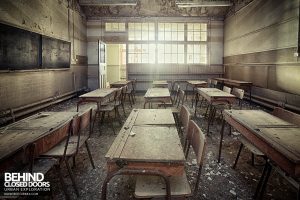
While it may or may not be a real word (was on several “Obscure Words” websites but not in the OED), the word does encapsulate the aura surrounding an empty school. Even if the school isn’t abandoned, wandering around school after hours or during the summer leaves one feeling unsettled.*

Easington Colliery Primary School in the UK

The desolate environment is eerie, and everyone in the raiding party feels a little uneasy as they approach the school. Viola is really agitated: “Schools give me the creeps” and “Creepy as hell.” The group sees abandoned classrooms, remains of a fire, and no instruments but Jackson finds a skeleton in the men’s room. He’s troubled by this but Kirsten is unperturbed and August simply says a prayer over the remains, as per usual. As they walk out, Jackson asks Kirsten and August “how you two can stand going into these places” (130). August replies that they don’t go into public bathrooms because “someone always got executed in the bathroom” (130). My question is why. Why is there always a dead body in a public bathroom? The drains would make it easy to clean up spilled blood and since it’s a confined space, a person would be an easy target. But is there some other significance? The reasoning for this type of death could be linked to the symptoms of the Georgia Flu, which may be further revealed later in the book.

*unless you’re a teacher

“Broken world” thinking and “The World Without Us”

While reading Jackson’s Rethinking Repair, the book The World Without Us kept coming to mind. Alan Weisman, the book’s author, describes it as a thought experiment: What if all humans disappeared? No catastrophic global disaster or epidemic, just the simple, nonviolent evaporation of humankind.

Almost immediately, the world would begin to rapidly decay. This is where Jackson comes in–it isn’t the threat of a violent end to society that would damage or end the existence of technology, it’s the possibility that humans would stop constantly repairing literally everything that keeps our lives invisibly in motion.

An effective example that Weisman gives is New York City’s subway system. Within days without humans, all of the tunneling would be flooded. Each day, those who work in for New York City Transit fight to keep 13 million gallons of water from flowing in, even without considering out of the ordinary rainfall.

As Jackson phrases it, this is the “extent to which such work is rendered invisible under our normal modes of picturing and theorizing technology.” I hadn’t thought of the maintenance of the subway system as an uphill battle, just a sort of neutral existence. What Jackson and Weisman seem to be circling around has to do with the adage, “If it ain’t broke, don’t fix it.” Jackson seems to think such a thing as “broken” only exists if people have stopped fixing it for too long entirely.

What Jackson calls “Broken world thinking” is interesting to consider as the ultimate postmodernism–the idea that these technologies we make and the systems around them can not only be recategorized or redistributed, but disappear altogether.


Technology Doesn’t Die; Humans Do.

The combination of Station Eleven by Emily St. John Mandel and “Rethinking Repair” by Steven J. Jackson shifted the way in which I am thinking about the death of technology. Ultimately, technology can’t really die. Sure, iPhone screens can crack and circuits can short, but technology is more than any given individual artifact; it is the sum of its many, many parts and the system that maintains them.

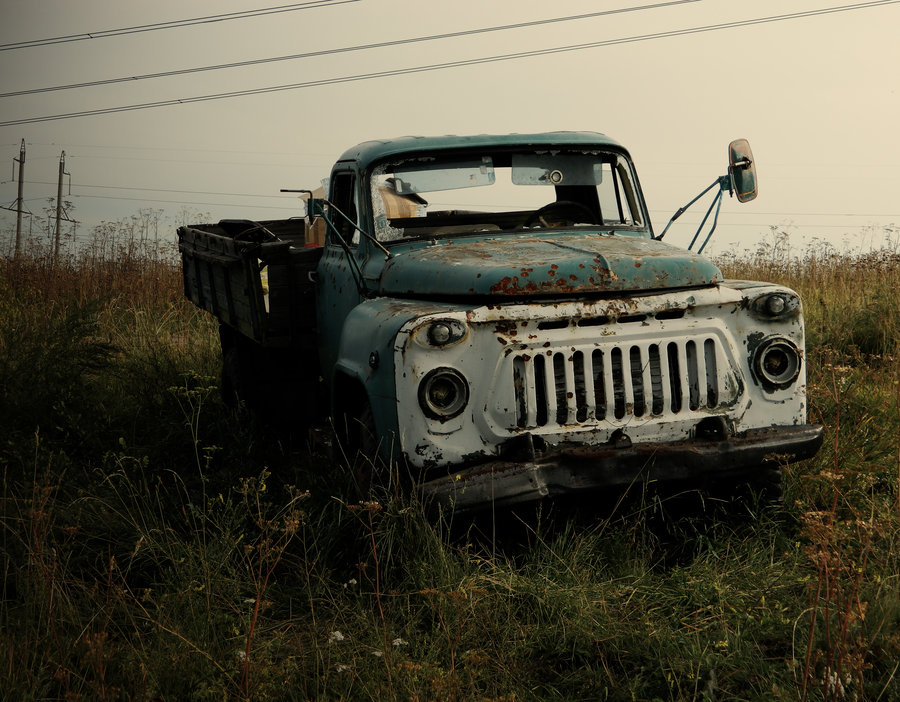
Jackson asks us to consider “broken world thinking,” which is the concept of innovation that begins after everything has already crumbled. In this way, technological innovation still exists. The difference is that where we used to innovate from raw materials — we would be working with the remnants of broken, crumbled technology. Take, for instance, the trucks that were repurposed in Station Eleven to serve as the horse-drawn carriages in the caravan.


Abandoned truck; What I imagine the repurposed caravan trucks may have looked like in Station Eleven; Source: Deviant Art

Jackson defines repair as “the subtle acts of care by which order and meaning in complex sociotechnical systems are maintained and transformed, human value is preserved and extended, and the complicated work of fitting to the varied circumstances of organizations, systems, and lives is accomplished” (222). In this way, repair and innovation go hand in hand, as the repairs we make transform the world in which we live.

As we continue to study the “death of technology,” I’m inclined to argue that technology never really dies, as it is simply a product of humankind. Station Eleven could be painted as a story in which we witness the death of technology, but what we really see is the death of humankind (for the most part) and with that the systems and manpower that technology requires to be sustained.

Death *of* the Digital Age

The first 12 chapters of Station Eleven left me thinking quite hard about what I would miss most about the Digital Age we are in now. I know that as a child who grew up surrounded with technology and easy access to the internet, I would have an immediate gut reaction of saying my phone or wifi or something to that effect. After this original reaction though, Station Eleven brought up all of the things that are 100 times more important than just one silly phone in the event of a catastrophe. Things like our cell phones are just a part of a past that is now contained in the wasteland of what I imagine to be city-wide landfills. I think things like not having access to medicine or having a permanent home might take the place of the most missed things of the pre-apocalyptic digital era in this book if I were to have lived in this type of scene with Kristen.

What really is intriguing in the chapters of 20 years post fall, is that there are so many still alive that don’t remember all this digital era nonsense. What would it be like to have almost no recollection of it and not be dependent on it like our society is today? If we aren’t dependent on technology and have somehow managed to figure out how to live without medics and pharmaceuticals, then I believe that things like food, safety, and water would be at the top of everyone’s priority list. However, Kristen and so many others don’t even live in houses! I understand the traveling theater and then giving life and beauty and joy to a landscape devoid of any type of happiness or other more digital type of entertainment, but what happened to all the houses? America is filled with suburbs and I don’t think those would’ve disappeared in this world, yet people are living in abandoned gas stations and Wendy’s and such. Why??? I want to know what happened to all the homes and houses!

Abandoned Wendy’s found here

After The End

Luke already talked about this a little in his post, but I was wondering what is it about post-apocalyptic narratives that makes them so popular. It’s an odd trend, when you take a step back and really look at it. Why do we enjoy reading and watching stories that describe a world where society has collapsed, millions (possibly billions) of people are dead, and the way of life we know has forever disappeared? It’s rather macabre, in a way, the imagining of a “post-human” world. Station Eleven does a great job of creating just such a world, giving us just enough details to flesh it out, but not too much as to leave our imagination out of the process. In a strange way, the novel relies on our previous encounters with post-apocalyptic narratives. When we read about the “Georgia Flu:, we don’t need a bunch of chapters detailing how society collapsed. We know how those stories go. We’ve read them, we’ve seen them, they’re almost everywhere these days. So, what’s the reason for the popularity of this type of story? What draws us to them?

tvtropes.org/pmwiki/pmwiki.php/Main/AfterTheEnd, accessed 4/24/17

One possibility is what I mentioned before, the vaguely thrilling sense of macabre. There’s something in us that wants to read stories of destruction, of death and ruin, of something so terrible it has the potential to wipe out the most successful species in Earth’s history. It’s like a penny dreadful or the murder scene in a mystery novel, just on a global scale. We’re drawn to death, however much we hate to admit it.  Any sort of apocalypse would be a tragedy, by any and every measure, something tragic, awful, and ruinous. And yet…wouldn’t you almost want to watch it happen? Not to you of course, maybe to some other planet as you sit on the moon and watch, but the feeling is there. It’s odd, this fascination with what happens after the end. We sit in our air-conditioned houses, staring at smart phones, watching tv, playing video games, boarding flights to far-off countries, secure in the knowledge that there has never been a better time to be alive than right now. But then our minds begin to wander, and we almost start to wish it would all come crashing down around us.

Death of Genre in the Digital Age?

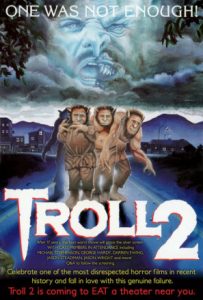
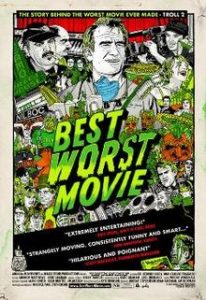
In our last class discussion on the “Landfill Legend” article and the Atari E.T. video game, Dr. Sample briefly brought up the concept of paracinema, specifically the idea of “bad” film. People discussed the entertainment value of bad movies or video games, and the idea of something being so ridiculously bad that it becomes good. I found it interesting to note that the “Landfill Legend” article mentions that people tend to not be as tolerant of bad video games as bad film. I was fascinated by the cult followings some bad movies have gained over the years, seemingly to the extent that intentionally bad film has become a sort of art form in itself. For me, the movie Sharknado comes to mind as an example when I think of a cringe-worthily bad film that has gained an enthusiastic fanbase. Of course, these films can’t just be simply bad, but a specific type of bad – usually involving self-awareness of its badness and irony. For example, I examined the movies Troll 2 (1990) and its spinoff, the Best Worst Movie (2009). I haven’t seen either of these films in their entirety, but Troll 2 is often considered one of the worst movies ever made of all time. The Best Worst Movie was directed by Michael Stephenson, one of the child stars in Troll 2, and is a documentary about the making of Troll 2, acknowledging the film as infamously bad.

Troll 2 Movie Poster
Best Worst Movie Poster

If you compare the ratings between this film and Troll 2, you’ll see that while the original film received atrociously low ratings, the documentary received quite positive reviews. This made me think about the question of what makes a film “good.” And if a bad movie can become good, is there even distinct criteria? In modern cinema, with the rise of experimental film and film that can’t quite be placed into categorical boxes, there seems to be not only a blurring of the distinction between high art and low art, but between genres as well. Many previously recognizable genres have died out over time – i.e. the old western, film noir, etc. Now, in the era of the Internet, the accessibility of all kinds of film has made genre virtually infinite. There are now subgenres, and even subgenres within those subgenres – and the rise of parody, fanfiction, and remix culture. Sure, paracinema can be considered a genre of film, like any other, but it makes me wonder if the idea of genre overall is dying out as we progress into the digital age.

Arguments Against Globalization

While reading Station Eleven, I could not help but think of two movies: Contagion and Outbreak. Both of these films have a premise similar to that of Station Eleven: an outbreak of mysterious disease decimates the world’s population. However, the diseases in Outbreak and Contagion—Motaba and MEV-1, respectively—do not lead to the failure of technology in the same way that the Georgia Flu of Station Eleven does.

Contagion, Outbreak, and Station Eleven are all examples of a common fear held by today’s society: a pandemic. Whether it be man-made or naturally occurring, today’s society is in a constant fear of biological villains or weapons. This is a theme that I have noticed in many other stories as well. But why are we so afraid of this theme?

Reflecting on this question, I thought that the greatest fear found in Contagion, Outbreak, Station Eleven, and other stories containing pandemics stems from the globalization of our world. Our world is so connected; we can travel great distances in almost no time at all. The ease with which we can spread around the world is something that we take for granted, as made evident by the Traveling Symphony’s traveling difficulties in Station Eleven.

If we are made to fear the connectivity of the world, we are therefore made to fear the world’s globalization. Are these stories thus arguments against the globalization of the world? To prevent the spreading of disease, should we not be able to travel as easily as we can? Does our globalization need to end?

Rebellion

“Because survival is insufficient”. It is the last line of chapter 11 in Station Eleven and a transforming sentence in my mind about the Travelling Symphony and their purpose in this post-apocalyptic world.

After reading that, our protagonists in this section of the book are not just passing through the days nor are they living passive lives in this new and difficult world. I see them now as people working to improve the lives of the people around them after the epidemic took everything they had away.

The Traveling Symphony doesn’t have much to work with to stand up for people, as even what we consider today as the most basic forms of technology, such as electricity and cars, are no longer available to the survivors. However, technology, as we have seen in other readings, does not have to be mechanical. The Symphony uses the tools they still have: their voices, bodies, costumes, instruments, and acting skills, to create productions of hope, joy, and power for the people watching. Their ability to from these productions is its own technology.

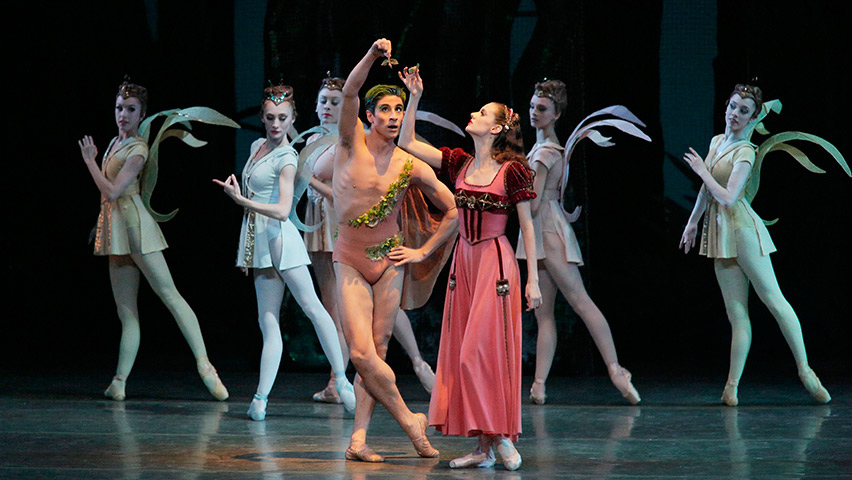
A performance of Midsummer’s Night Dream, also performed in Station Eleven. Photo courtesy of the New York City Ballet

“What was lost in the collapse: almost everything, almost everyone, but there is still such beauty” (57). With almost nothing left, the Symphony creates beauty, and with that, they can still positively impact others in this post-apocalyptic society. The Symphony shows that as long as people still have the ability to move their bodies and use their voices, no matter how terrible the apocalypse, disease, or tragedy, people will still come together to make something beautiful. Even the Georgia Flu couldn’t take this away from them, and this way they are rebelling against the death and despair to be part of a production bigger than themselves.