The main way I engaged with the blogging was to connect the reading to personal experience and sometimes other ideas relating to the subject matter in our class. I don’t often blog for other classes, so to me the exercise seemed more oriented towards personal experience or feeling, at least at first. My blog posts are often connect often connected to personal experience instead of abstract academic concepts—places I’d visited, things I’d read, etc. Though I maintain the first-person perspective an attitude throughout my posts, they have changed from more personal to professional, I’d say.
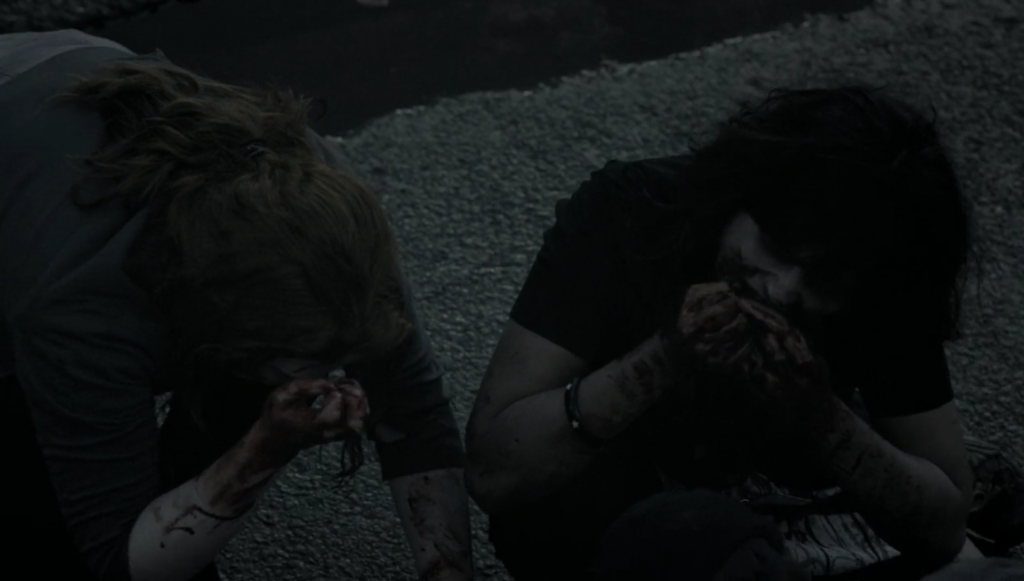
For example, in one of my first posts, I write: “The most disturbing element of Dead Set was certainly the gore, at least in my experience. I’m not a horror fan, and thus turn my head or close my eyes during the inevitably violent moments of my favorite TV shows or movies.” This is obviously a very firsthand and un-academic sentence, though I go on to talk about concepts and quotes having to do with the topic. However, by my last post, I did not mention personal reactions/feelings at all, but did relate the subject matter (Jackson’s “Broken World” thinking) to a book I had read.
In terms of concepts I revisit, the main two are haunting—haunted tourism, Edison’s spirit phone—despite that I haven’t considered this a topic in which I am particularly interested. The next topic is ethics of technology—Black Mirror, Slenderman, and dark/toxic tourism. I found myself circling around the topic of ethics with questions: Should we be doing this with technology? Should we be thinking about death this way? These questions, of course, apply to this class in general.
While reading Jackson’s Rethinking Repair, the book The World Without Us kept coming to mind. Alan Weisman, the book’s author, describes it as a thought experiment: What if all humans disappeared? No catastrophic global disaster or epidemic, just the simple, nonviolent evaporation of humankind.
Almost immediately, the world would begin to rapidly decay. This is where Jackson comes in–it isn’t the threat of a violent end to society that would damage or end the existence of technology, it’s the possibility that humans would stop constantly repairing literally everything that keeps our lives invisibly in motion.
An effective example that Weisman gives is New York City’s subway system. Within days without humans, all of the tunneling would be flooded. Each day, those who work in for New York City Transit fight to keep 13 million gallons of water from flowing in, even without considering out of the ordinary rainfall.
As Jackson phrases it, this is the “extent to which such work is rendered invisible under our normal modes of picturing and theorizing technology.” I hadn’t thought of the maintenance of the subway system as an uphill battle, just a sort of neutral existence. What Jackson and Weisman seem to be circling around has to do with the adage, “If it ain’t broke, don’t fix it.” Jackson seems to think such a thing as “broken” only exists if people have stopped fixing it for too long entirely.
What Jackson calls “Broken world thinking” is interesting to consider as the ultimate postmodernism–the idea that these technologies we make and the systems around them can not only be recategorized or redistributed, but disappear altogether.
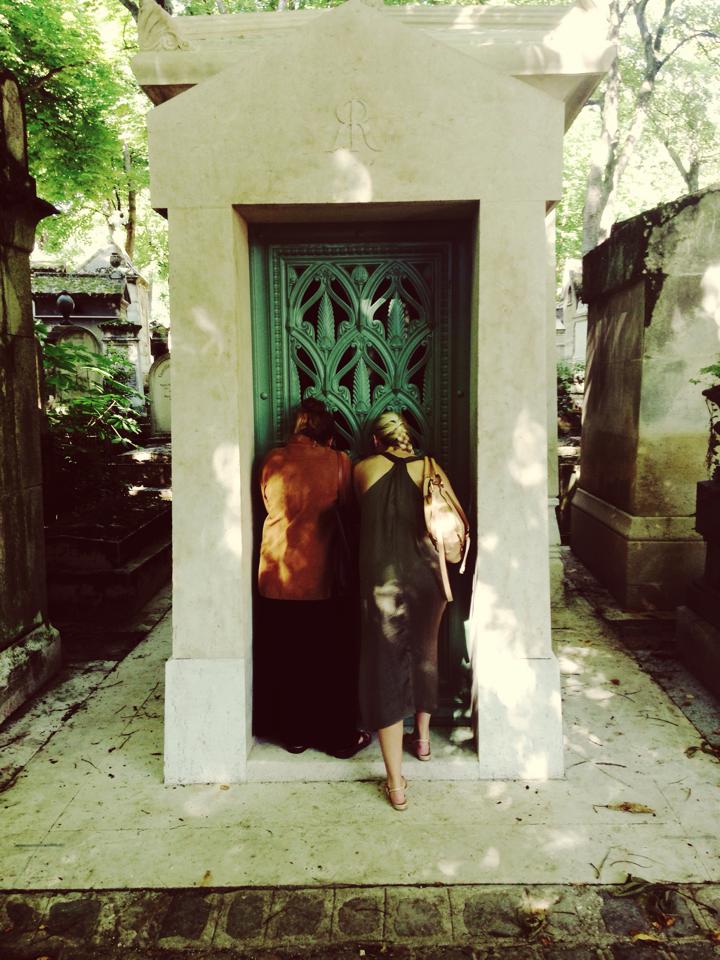
Before reading the Yankovska and Hannam article, I didn’t consider myself someone who had participated in dark or toxic tourism, but while reading, I realized I’ve been to several places that might constitute dark or toxic tourism. The ones that came to me off the top of my head were the Anne Frank house, D-Day site, and Père Lachaise cemetery. Père Lachaise is a massive cemetery in between the 11th and 20th arrondissements, and I visited it multiple times in the summer of 2014. This would be an example of dark tourism instead of toxic, since no environmental disaster occurred on the grounds.
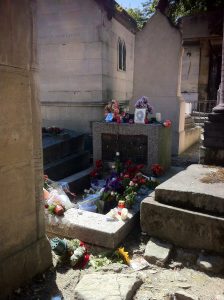
The reason Père Lachaise is such a draw to tourists is not only because of its size (it’s by far the largest cemetery in Paris) but also because the high number of famous people buried there: Chopin, Géricault, Oscar Wilde, to name a few. But I’d say the biggest attraction, at least to my generation, is the grave of Jim Morrison.
Jim Morrison’s grave
You can wander the cemetery for basically days without encountering a grave that you want to see–which is where the true dark tourism begins.
On our first trip there, my roommate and I picked up a scavenger hunt-like map with numbers and corresponding names to the most famous people at the cemetery. Though this map wasn’t particularly helpful, since the cemetery expanded in a completely arbitrary and confused manner, it still felt a bit strange to be hunting around in a solemn place like a cemetery, sometimes point and yelling when one of us found the “right” grave. The cemetery closes early–around 4–because it takes so long to clear the grounds and make sure no trespassers remain. This creates an eerie feeling as the afternoon winds down and you start to see fewer and fewer people around, until you realize it’s 4. Père Lachaise itself doesn’t do much to play up its spookiness for tourist purposes, but this probably has to do with the fact that entry is free. I’d still consider the general experience of wandering the cemetery actively looking for certain deceased people a kind of dark tourism.
“When the original ceases to exist, yet can be seen to live on in the media, the possibility of an extended immortality can be implicitly evoked. The fact that all this happens within the realm of entertainment and popular culture, where, for many, the exercise of a willing suspension of disbelief has become almost second nature, makes the entire proposal even more persuasive.” Alexandra Sherlock, 173
“Always the photograph astonishes me, with an astonishment which endures and renews itself, inexhaustibly. Perhaps this astonishment, this persistence reaches down into the religious substance out of which I am moulded; nothing for it: Photography has something to do with resurrection. (Barthes 2000 [1980], 82). [sic]” Roland Barthes, quoted in Sherlock, 174.
——–
I wanted to consider the idea of the celebrity in a captured image and its meaning in our digital era. The photograph was long considered an object of truth, far removed from art and reinterpretation, but with the advent of digital photography, the manipulation of photos has become ubiquitous, and practically synonymous with photos of celebrities. Whenever we, as a culture, see a photograph of a famous person, whether it be in a magazine or on the red carpet, we often assume that it has been “doctored”; that is to say, altered in a manner favorable to the celebrity.
Photographs have an aura of permanence—of a temporary moment permanently transcribed with the camera’s technology. When considering this, I found that the concept of the image reminded me of the way Sterne described early audio-recording technology in Resonant Tomb. Of course, the first rudimentary audio recordings and these high-definition photographs appear to have little in common—certainly not in terms of medium or quality. These altered photos are intended to strike the middle ground between ephemerality and permanence, just as the first audio recordings did (Sterne). Sherlock writes, “Photography marked a new era in the reproduction of self: Each time we are photographed we reproduce (Giles 2000, 51), and each reproduction lives on into the future as a record of our existence” (166). These reproductions are what I consider.
Consider this quote: “Barthes believed that all photographs (and potentially all forms of visual representation) contain a paradox between life and death—the moment is dead but the photograph is alive and present, and this paradox is the punctum that pricks our attention” (Sherlock 170). As Sherlock defines it, Barthes’ punctum “Is what punctuates a photograph: something that jumps out and grabs your attention, for whatever reason. It is usually something that the viewer does not fully understand and sparks the viewer’s curiosity” (170). Barthes names five possible punctums: the two I want to engage with in this project are “contortions of technique or trickery,” and “the ‘lucky find’” (Sherlock 170).
The trickery is my post-production digital manipulation of photos of award ceremonies and music festivals, altered to include dead celebrities, and on two occasions, celebrities who were killed on Twitter (more on that later). This is not quite necromancy as Sherlock has it (the celebrities aren’t talking back), but more of a reanimation or reinvigoration of the dead celebrity. The “lucky find” is also at work, being that hopefully the “Photoshopping” is effective enough to incur some searching on the part of the viewer for the uncanny subject: What haunts this image?
As Sherlock phrases it, “To suggest that we are fooled by these living images of the dead would be misleading—rationally we know that the subject is deceased. However, the cultural avoidance of death can provoke an ever-greater fascination and curiosity, a curiosity quenched by the further consumption of death-related popular culture (Durkin 2003). Images of those that have since died have a special effect and can evoke spine tingling feelings of creepiness.” (169-170) In this case, you all are hyperaware of these celebrities’ deaths given the nature of this context, which is why I included the Twitter deaths of still-living celebrities.
This project is also about the para-social relationships “the public” has with fame. As Sherlock explains, “Horton and Wohl coined the term para-social to explain the bond—facilitated by the media—that many viewers felt with particular television personalities and presenters” (168). Meyrowitz complicates this phenomena further, stating: “Even an awareness of the para-social mechanism is not enough to permit escape from its ‘magic’” (128). These photographs blur the boundaries between reality and fiction, honor and disrespect, and preservation versus peace. When do we let a celebrity rest? Think of Marilyn Monroe’s twitter—she is long gone, yet we still insist on conversation. To borrow a phrase from Sterne, these photos deal with “Death as a receding limit” (199). Imagine them as being captured at a fictional award ceremony that happened yesterday.
As mentioned earlier, Britney Spears and David Guetta had “Twitter deaths.” This is to say, these people are still among the living, but Twitter, at one point or another, insisted otherwise. Both Guetta and Spears’ names became trending topics alongside the hashtags #RIPDavidGuetta and #RIPBritney, in 2011 and 2016, respectively.
Britney Spears’ Twitter death included headlines the likes of “Everyone Thought Britney Spears Was Dead Because Of A Savage Twitter Hack” (Elite Daily), “PSA: Britney Spears Is Still Very Much Alive: The Sony Music account’s tweets reporting her death are false” (Elle), and “Sony Music apologizes for Britney Spears RIP tweets” (Fox News). Fox News explains Spears’ Twitter death with a strange tone: “Sony is well aware of the damage a hacked account can cause, especially when it impacts an entire service such as the PlayStation Network. The latest Sony hack is on a much smaller scale, though, with the only real consequence being lots of upset Britney Spears fans.” Indeed, Spears’ Twitter murder is of little consequence to them.
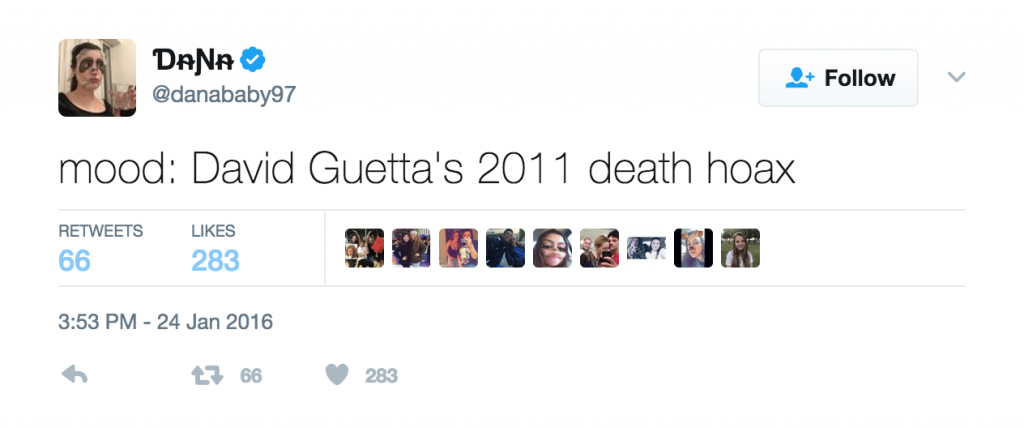
David Guetta’s Twitter death is treated with more levity and much less general coverage on the internet. His Twitter death is a kind of internet in-joke, more useable in memes than headlines, perhaps due to the fact that it occurred five years earlier than Spears’. As Twitter user @danababy97 has it:
@danababy97’s tweet: “mood: David Guetta’s 2011 death hoax”
Meyrowitz discusses this strange kind of murder even though it’s unlikely he anticipated something like Twitter culture, having written No Sense of Place in 1985. He wrote:
The para-social relationship has also led to a new form of murder and a new type of murder motive […] The para-social murder. In both love and hate, normal and bizarre, the para-social relationship is a new form of interaction. It has some of the traditional characteristics of both live encounters and communication through books, but it is, in fact, neither” (121)
I would argue that these Twitter murders rely on para-social interactions, further complicated by the user reciprocity (retweets, etc.) that Twitter encourages. These celebrities, digitally murdered on Twitter, live on in the way that “matters.” However, as Sherlock phrases it, “To what extent can digital representations substitute for those they refer to, and how could the death of the “original” affect public perceptions of the representations that continue to be perpetuated in popular culture? Ultimately, what effects might these digital ghosts or even reincarnations have on popular perceptions of death and mortality?” (165)
Meyrowitz sums up what I hoped this project would access pretty well:
Ironically, but appropriately, the media provide the most ritualized channels of mourning. Radio and television present specials and retrospectives. And many people use the telephone to contact real friends who shared the intimacy with the para-social friend. But the final irony is that, in some ways, the para-social performer does not die. For the only means through which most people came to know him or her—records, films, and videotape—are still available. The relationship is frozen, rather than destroyed. In part, it is the potential and hope for increased intimacy that dies, and the never to be face-to-face consummation of the relationship that is mourned. (120)
With these manipulated images, I wanted to “unfreeze” and refigure the relationships, casting doubt in some cases on the living status of these celebrities. Imagine what Meyrowtiz would do with the knowledge of the expanse of internet-mourning today—the Twitter funerals, Oscar and Grammy in memoriam slideshows, the endless barrage of grief-stricken updates on Facebook and Instagram. Sherlock follows this thought: “Paradoxically, while death has become less visible, mourning, particularly in response to the death of a public figure, has become more visible. The Internet and the media facilitate a new type of ritualized, collective mourning that potentially serves to distract mourners from the physical reality of death” (169).
The nature of the “reality” I have created here depends on this idea about the reproduction of images given in Sherlock: “The representation is even more real if you have never met the original—it is the original” (168). Without further evidence, how do we know for certain that what we’re seeing isn’t true? The people who engineered the Tupac hologram knew this was a powerful question to ask of celebrity.
CONCLUSION:
I found several aspects of completing this project thought-provoking beyond the comparison/analysis of the photos I manipulated and the sources I included. One of those thoughts has to do with the format of this project, being an accessible/public page on my website. What does it mean for someone to look at this page not knowing the context? Would they imagine these celebrities/people as living again? Sherlock also accesses this thought: “To what extent can digital representations substitute for those they refer to, and how could the death of the ‘original’ affect public perceptions of the representations that continue to be perpetuated in popular culture? Ultimately, what effects might these digital ghosts or even reincarnations have on popular perceptions of death and mortality?” (165) The lack of clarity was unsettling enough for me to install a password. Furthermore, Is this illegal? Sure, the images are licensed for public use, but who owns the rights to these celebrities’ “personality rights”? (In reference to the article we read, “These are the most influential dead people on Twitter”). Would they have been O.K. with being visually included at these events?
The next thing I found myself concerned with was that I was performing a sort of celebrity audit; In making the images, I would ask: Would this famous dead person have been famous enough to be in this situation? This idea was particularly central to Alan Rickman sitting behind Ryan Gosling, the Smith family, and more (Image 8), and Paul Walker in the Ellen selfie instead of Bradley Cooper (Image 4). Furthermore, this audit reaches another level in terms of the celebrities I chose to include in the project at all; the ones I have included already passed some sort of fame test. I found myself wanting to continue in the vein of these arbitrary inter/intra-celebrity classifications. As uncomfortable as this made me, it occurred to me that this kind of categorization is someone’s job. Think of the “rest in peace” segment at the Oscars and Grammy’s every year: What is the criteria for making the cut?
Sherlock mentions this idea: “In his article on fame, Halberstam describes it as a measure of having lived a ‘worthwhile, or at least noteworthy, life’ (1984, 96), making a mark on the world and gaining assurance that one’s existence has been noticed” (167). That seems like a vague set of criteria to me.
The last element of the project I found unsettling was the effect the formatting of my webpage had of creating a sort of dead celebrity “Where’s Waldo,” a virtual necromancy game. Ultimately, what does it mean to visually bring these people back to life in this way? As one of our questions in class asked, what does a social life look like for the dead? Hopefully, these images do something to answer that question in the context of celebrity—though I may have more questions than answers.
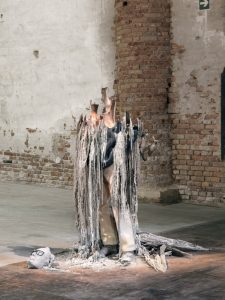
Full view of the 2011 Venice Biennale installation
When reading the Fusion article by Ethan Chiel, a particular moment immediately reminded me of art I’d seen. The pieces I thought of were two sculptures by Urs Fischer, and they were displayed at the 2011 Venice Biennale. The most visually striking of these sculptures, to me, is his reconsideration of a classical sculpture, Rape of the Sabine Women, but his rendition of contemporary man is certainly more chilling conceptually.
Fischer’s “Rape of the Sabine Women”
Jonathan Jones, an art critic who saw the exhibition, wrote that “Fischer’s candle-man haunted me later when I was walking the decaying streets of Venice. It will haunt me for a long time. It is a beautiful, funny, frightening emblem of time’s fatal arrow.” Times fatal arrow, then (death) dramatically effects not only the emblem of classical and “eternal” sculpture, but those of us who observe and admire it. Even art cannot be so idealized as to stop death.
Chiel reports that the manager of a Twitter-bot account, which strikes me as something in between performance and technological experimentation, said: “Bots are ‘processes, not artifacts.'” He continues, “A bot’s survival beyond his lifetime or the lifetime of Twitter is ‘about longevity of the algorithm, more so than the actual piece of code running.'” The “code,” here, is Fischer’s wax, continuing to run down its own form until it disappears. Think of slowing this process to the point that even after the death of the artist the sculpture would still be changing and evolving as the artist intended. I think that here’s an interesting intersection, here, between art, technology, intentionality, time, and death.
Two of the articles we read, “Inadvertent Algorithmic Cruelty” and “Enter the Grief Police” got me thinking about what we expect from technology as it relates to grief insofar as we can keep technology separate from the human people who use it. Eric’s chief complaint is that he was not consulted about his “Year in Review,” which Facebook’s algorithm selected an image of his deceased daughter to represent. He writes that those who have had years full of crisis “might not want to look at this past year.” However, I’d argue that some would–what about those who would share their year in review, even if it was a devastating one, as a form of mourning? The Garber piece in The Atlantic also touches on this territory–no one can establish what is and isn’t an appropriate reaction to grief (with the exception of the trolls Whitney Phillips elaborates on). As Garber phrases it, “The notion that there is but one way to grieve, and that the deviation from that way is wrong” has no place on the internet. Perhaps for every person who wouldn’t want to share their year in review, there’s one who does — one who doesn’t find Facebook grief to be “utterly insincere,” as Camilla Long’s tweets describe.
The kind of content we expect from the internet is changing. Eric writes that “The design [of Facebook’s year in review] is for the ideal user, the happy, upbeat, good-life user. It doesn’t take other cases into account.” I would argue that this vision of the internet’s / social media’s purpose is incomplete. Eric’s judgement brings to mind that the characteristics he describes are what we used to expect from content (importantly, self-advertised content) on the internet. But now, the internet is becoming an acceptable place to mourn. As Garber puts it, #RIPDavidBowie wasn’t just a trending topic–it was a digital funeral.
I would like to examine two postmodern horror narratives that engage with young women struggling with mental illness—specifically, schizophrenia—and how their status as both female and schizophrenic is depicted through their respective narratives. Furthermore, I want to consider how their digital agency—and how that digital agency is figured—compounds and contradicts the narrative’s status as a horror narrative. That is to say, what are these horror narratives saying about preteen girls with schizophrenia? How does digital media facilitate violence in the narrative? The two horror narratives I will look at are HBO’s documentary Beware the Slenderman, and Paul Tremblay’s novel A Head Full of Ghosts.
HBO’s trailer for Beware the Slenderman.
Beware the Slenderman
In June of 2014, two twelve-year-old girls stabbed their classmate and friend 19 times, leaving her for dead in the woods. The victim, named Payton (but confusingly nicknamed Bella by her friends), survives after being discovered by a cyclist. Regardless, Morgan and Anissa, the two girls who stabbed her, were charged as adults with attempted homicide.[1] Their motivation for the stabbing? A popular internet-generated horror meme called Slenderman. Earlier this year, HBO released a documentary about this story, called Beware the Slenderman.
Andrew Peck, a folklore scholar who is the go-to expert on Slenderman, had already published his studies on Slenderman, sometimes stylized as Slender Man, by the time of the murders. According to Peck, Slenderman is “A faceless, tall, eerily long-limbed humanoid clad in a black suit [that] emerged in an online forum as a pair of photoshops and a half-dozen lines of text.”[2] It originated on June 8, 2009 when SomethingAwful.com forum member “Gerogerigegege” created a discussion thread called “create Paranormal images,” inviting other users to create and share mundane images that had been manipulated to appear paranormal. Users began writing stories to accompany these images and suggested that the images were real by linking them to personal experience.[3] According to Peck, “Locating authenticity in ‘reality’ reflects one of the earliest shared expectations that emerged around Slender Man legend performances.”[4] In other words, the best Slenderman narratives were those that took place in our world, but held on to the sense of ill-intentioned mystery.
A digital version of a presentation Andrew Peck gave on Tall, Dark, and Loathsome.
According to legend scholar Bill Ellis, “Legend performances typically place events in the group’s [the “Something Awful” forum where Slenderman was conceived] conception of the real world while also challenging the boundaries of that world.”[5] When it comes to the case of Morgan Geyser, these boundaries were challenged to begin with: Morgan was beginning to show the signs of schizophrenia at the time of the murders. None of the subsequent news coverage, nor the first hour and twenty minutes of HBO’s documentary on the matter, bridge the topic of Morgan’s mental illness. The narrative structure of Beware the Slenderman is problematic because our discovery of Morgan’s schizophrenia operates as the narrative sucker-punch, co-opted into the twist at the end of the documentary as opposed to a sustainable explanation for her behavior throughout the film. Indeed, in one courtroom clip, the psychiatrist on the stand explains that “Believing that Slenderman is real is a delusion [symptomatic of childhood schizophrenia.]” He goes on to say, “What’s unique about Morgan’s case is that a severe course is so predictable.”[6] Morgan’s father also has a severe kind of schizophrenia, and even still her parents had neglected to keep an eye out for problematic behavior, or even to inform Morgan that her father also had schizophrenia. This information was unloaded upon Morgan at the hospital after the stabbing.[7] The majority of the narrative, however, would have you believe there is no such scientific explanation for Morgan’s actions.
The draw of Beware the Slenderman has its basis in Creed’s theory that “Possession becomes the excuse for legitimizing a display of aberrant feminine behavior which is depicted as depraved, monstrous, abject—and perversely appealing.”[8] Though Anissa and Morgan were not “possessed,” as it were, they were motivated by a demonic, mysterious figure all the same—or so the narrative of Beware the Slenderman would have you believe, seeing as the narrative of mental illness is largely absent. Creed writes that “Central to [possession films] was a strong sense of the vulnerability of the body and its susceptibility to possession.”[9] HBO’s official description of the documentary plays into this idea of vulnerability:
It was a local story that horrified the nation: two 12-year-old girls lured a friend into the Waukesha woods, where they proceeded to stab her 19 times in an effort to appease a faceless mythical entity known online as ‘Slenderman.’ This sobering documentary delves deep into the story and examines how an Internet urban myth could take root in impressionable young minds.[10]
Their “impressionable young minds,” (female minds) are the nexus of this vulnerability, the place where the seed of Slenderman could grow until it became too much to bear. These 12-year-old girls in the suburban Midwest commit unthinkable evil, inspired by digitally mediated horror narratives, and represent the intersection of “the major boundaries […] between innocence and corruption, purity and impurity.”[11] Ostensibly, this evil is a product of the internet.
Throughout the documentary, the internet and its digital mediations, specifically iPads, are demonized, especially by Anissa’s father. Morgan is depicted as the mastermind, and Anissa the friendless sidekick, willing to do anything. Indeed, much of the film is spent describing Anissa’s lonely, outcast status and how relieved her parents were when she found Morgan as a friend. He blames the iPad for his daughter’s “corruption,” as it were. Anissa’s independence in the digital world facilitates her penchant for violence—Anissa’s disturbing YouTube history is revealed in Beware the Slenderman, and the montage is among the most harrowing moments of the film.[12] As Peck explains it:
Of all the details of this gruesome story, the involvement of the Slender man resonated most in subsequent news coverage. The relative obscurity of the character and its de-contextualized association with the stabbing served to kindle a classic moral panic narrative. Headlines and sound bites focused on the dangers of unsupervised tween media use and the corrupting allure of the dark corners of the internet.[13]
A former FBI investigator, who happens to be female, described the case of the Slenderman stabbings as “very unusual — not just because is involves young females, but the brutality of it.”[14] Think of Creed and the monstrous woman—indeed, girl—and how “Horror emerges from the fact that woman has broken with her proper feminine roll—she has ‘made a spectacle of herself.’”[15]
To what extent can the internet be blamed for Morgan and Anissa’s actions? A recent study conducted by John A. Oyewole found that “at an average of 53.0% for males, and 53.3% for females across all ages, at least half of audiences who get exposed to violent media contents will develop a tendency to imitate such media contents.”[16] In fact, Oyewole mentions the Slenderman stabbing by name as an example of this statistic.[17] This statistic fits into the documentary’s message, which I believe prioritizes the demonization of the internet over a narrative of mental illness awareness.
From the original “Something Awful” forum. “‘We didn’t want to go, we didn’t want to kill them, but its persistent silence and outstretched arms horri ed and comforted us at the same time . . .’ 1983, photographer unknown, presumed dead.” Posted by Victor Surge, June 10, 2009.
A Head Full of Ghosts
Paul Tremblay’s A Head Full of Ghosts approaches the issue of schizophrenia in a less opaque way than it is presented to us in Beware the Slenderman. Indeed, the back jacket of the book intones, “The lives of the Barretts, a normal suburban New England family, are torn apart when fourteen-year-old Marjorie begins to display signs of acute schizophrenia. To her parents’ despair, the doctors are unable to stop Marjorie’s bizarre outbursts and subsequent descent into madness.”[18] Marjorie’s “descent into madness,” then, is at the forefront of Tremblay’s presentation of the narrative. The ambiguity of Marjorie’s schizophrenia relies on its “off-screen” (literally) nature—the drama having to do with her diagnosis and institutionalization does not take place in the house, nor does it operate as a plot factor in the reality TV show being filmed.
There are many moments when technology both mediates and facilitates the performance of Marjorie’s possession, which she claims is for the benefit of her father, who is really the sick one.[19] If you read the novel with the assumption that Marjorie is not actually possessed (which is certainly a possibility), Marjorie’s digital agency is crucial to her performance of possession: she gleans the knowledge she needs to fool the clergymen and viewers of the TV show from the internet. During the exorcism, the following exchange takes place:
Marjorie: I’m looking shit up on the Internet, looking up the same stuff over and over, and I memorize it because I’m wicked smart, because I have to fill my head with something other than the ghosts.
Father Wanderly: I suggest that you no longer allow her access to the laptop until after the rite has been performed successfully.[20]
This exchange demonstrates two things: one, that Wanderly’s belief in her demonic possession is too deep to accept this rational answer to her struggle with the “ghosts” (her schizophrenic delusions, perhaps); and his unwillingness to acknowledge Marjorie—the “you” here is her parents. Afterwards, when the adults are discussing Marjorie’s knowledge, one of the producers defends the internet standpoint: “She could’ve made the connection on her own. Or maybe she Googled my T-shirt, found Lovecraft and Yidhara on Wikipedia. Not a huge leap, there, I don’t think—“[21] Merry, writing as her blog persona, compounds the idea that the internet is the logical source of her knowledge, explaining that “John Barrett duly informs us that Marjorie claims she never heard of the Internet or the library [sic] doesn’t know where she heard the stories or the song […] but swears she hadn’t learned of them or heard them from outside sources.”[22] Her sarcastic strikethrough reads clearly: digital agency in the form of internet access facilitates Marjorie’s convincing performance of possession, as the adults around her refuse to believe she could pull such a thing off—consider this frenzied exchange after her performance:
“—even if she had looked it up on the computer—“
“—no way she could’ve memorized it all—“
“—a girl like her can’t speak as eloquently as she did—“
“—a girl wouldn’t ask the questions she asked—“[23]
Merry’s persona explains this phenomena well: “…Marjorie’s knowledge of the rite is again [sic] presented to us as proof positive of her possession. This is one of the most misogynistic aspects of the show: not only is it impossible for a silly girl [sic] to know what the patriarchy knows[…]we’re supposed to actively fear that she has acquired that knowledge.”[24]
Paul Tremblay is aware of the figuration of mental illness is his novel. Goodreads user Shiv Eloise asked of Treblay, “Where you at all considering what harm you might cause by linking schizophrenia and possession?” Tremblay responded curtly:
Harm? No. If anything, I wanted some readers to realize that religious figures have used and conflated the symptoms of various mental illnesses as (bogus) signs of possession for hundreds of years. On the other side of it, I certainly wasn’t intending to vilify people who suffer from schizophrenia. That’s not in the book either.[25]
The thread discussion continues regarding the debate between the merits of each side: religious “fanatics” mis-assigning possession to mental illness, and the potentially negative figuration of schizophrenia as the product of the devil’s spirit. Tremblay’s dismissive line, “That’s not in the book either,” makes me wonder to what extent Tremblay had considered the reception of his book—and if, as an author, he should even be asked to consider that. Regardless, the link between schizophrenia and possession in the book is obviously very strong—it drives its entire sense of ambiguous malaise. Furthermore, Marjorie’s digital agency mitigates her isolation even as it also operates as a mechanism for her to convince the adults she is really possessed: “Marjorie kept texting, fingers crawling over the phone’s keyboard screen while she talked at the same time.”[26] Marjorie navigates her schizophrenia by manipulating digital media to her advantage; it enables her to trick the bumbling adults around her that she is truly possessed.
Synthesis
We can pinpoint digital agency as the catalyst in each of these schizophrenia horror narratives. In Beware the Slenderman, Anissa and Morgan are motivated by the internet-made Slenderman, whose ambiguous digital presence is a perfect storm when combined with Morgan’s childhood schizophrenia. Indeed, Anissa’s father would rather blame technology than his daughter’s own troubles, and Morgan’s parents did not pay enough attention to their daughter’s slow disappearance into a virtual obsession with Slenderman. In A Head Full of Ghosts, internet access enables Marjorie to perform her possession in the face of her schizophrenia. On the structural level of each of these narratives, schizophrenia is figured problematically. Beware the Slenderman saves the reveal of Morgan’s mental illness for the end of the film, problematically placing her condition and her parents’ treatment of it as a plot twist. When it comes A Head Full of Ghosts, the author is ultimately unconcerned with thoroughly explaining the link he provides between mental illness and possession. We should think further about how the representation of schizophrenia, especially in young women, motivates and operates postmodern horror narratives, and what both the construction and reception of these narratives says about mental illness in the digital age.
[15] Creed, “Woman as Possessed Monster: The Exorcist,” 42.
[16] John Ayodele Oyewole, “Gory Attractions in the Threshold of the Contemporary Media: The Level of Influence on Young People,” in International Journal of Arts & Sciences 9.3 (2016): 334.
[17] Oyewole “Gory Attractions in the Threshold of the Contemporary Media: The Level of Influence on Young People,” 334.
[18] Paul Tremblay, A Head Full of Ghosts (New York: HarperCollins, 2013).
A spooky phone available for purchase on Terapeak.com
Edison’s experiment and the modern-day talk of it in the Atlas Obscura article harkens back to the idea of “haunting,” and how haunting manifests itself in our everyday use of technology. Edison’s “spirit phone,” though certainly not an effective apparatus for contacting the dead, is still at work haunting us today as we read articles about it. The trajectory of Edison’s spirit phone, too, has a haunted storyline. Think of the editor of the 1948 English version of his diary who “killed” the chapter on the spirit phone, thereby contributing to the murder of this part of Edison’s legacy (despite the recognition it got during his lifetime).
However, Edison’s failure to reach the spirit world with technological innovation does little to dissuade the belief in such a world—if anything, we could consider it a contribution to this mysterious place. Edison’s idea that the particles of every personality were indestructible lends itself to the idea that the whole world is haunted with these former humans. In some sense, to Edison, the debate was not over whether these “ghosts” existed, but rather if they could be reached. This thinking is a far cry from ghost-detecting apps or Ouija boards.
Edison’s failed spirit phone is not the most interesting part of the story, at least not to me—to think that Edison, a great innovator and inventor, would seriously consider accessing the personalities of the departed is one thing, but considering it in context is fascinating. When imagining a world in which the phonograph seemed an attempt to fool death, it’s not impossible to see why people of the 1920’s would believe that literally anything is possible, and why the phone call from the dead remains such a popular horror trope.
The most disturbing element of Dead Set was certainly the gore, at least in my experience. I’m not a horror fan, and thus turn my head or close my eyes during the inevitably violent moments of my favorite TV shows or movies. Watching Dead Set, a TV series with a pair of undoubtedly gory opening episodes, I began to wonder what the appeal of this horror was.
As Jefferey Jerome Cohen gets into in his article “Monster Culture (Seven Theses),” part of this horror has to do with the abject. According to Kristeva, the abject (in this case, the blood and guts of human bodies as zombies devour them, and the excrement of the survivors trapped in the house) is “tempting as it is condemned” (19).
This push and pull between attraction and disgust is obviously very relevant when explaining the appeal of the horror genre in general, especially violence and gore. The use of zombies plays into the idea of the abject quite effectively, as they are essentially the walking abject–humanoid figures completely devoid of humanity.
Claire, a former Big Brother employee, devours one of her victims. Source: Netflix
Another aspect of the zombies that I found interesting was the way in which they carry “haunting.” This occurred to me in the context of Claire and Kelly’s relationship. Shortly before the zombie apocalypse set in, Claire revealed that she had also slept with the man that Kelly cheated on her boyfriend with. Claire’s body now holds two sorts of haunting to Kelly: a reminder of the mistake she made in cheating on her boyfriend (she destroyed the zombie of the guy himself, which is interesting), and also the imminent haunting of death should Claire catch up to her. I’ll be interested to see how this zombie haunting continues as more people ostensibly succumb to zombiehood.
An image camera made out of cardboard boxes from Flickr.
Throughout the first part of A Head Full of Ghosts, Merry’s imaginary play-camera shifts to a real, digital one. On page 29 of the novel, Merry, our debatably reliable narrator, mentions that, “[she] didn’t feel 100 percent safe so [she] built motion-detecting surveillance cameras and a laptop computer out of cereal boxes.” Her feelings of unease are brought about by her sister Marjorie’s revelation that she has been sneaking into her little sister’s room every night and playing slightly sinister pranks on her. Her desire for safety-enforcing surveillance technology, imaginary or not, is understandable.
By page 139, one of The Possession’s producers, Ken, has given Merry her own camera (a “Merry-cam,” as he dubs it), and she is so obsessed with it that “[she] placed the camera where [she] could see it from [her] bed because [she] wanted to see when the light would turn to green” while she tries to fall asleep.
The idea of surveillance within the space of Merry’s room has turned on its head; professionals are now attempting to document every movement of each person on the house, and Merry, instead of using fake cameras as a safeguard, is using real cameras for a form of self-surveillance. On page 140, Merry films herself covering her play house with a blanket—the setup for the next terror scene in the novel in which Marjorie supposedly performs for Merry’s camera. Certainly, Marjorie admits that the show she put on was for the benefit of her little sister’s footage, but there remains the question of the extent to which all of the captured footage of Marjorie is performance.
At this point in the novel, the difference between real and fake, analog and digital, is still being teased out, and I image that Tremblay will continue to play with this as he introduces more of Merry’s disturbing blog entries (perhaps another sort of twisted self-surveillance).