Reflective Essay: Falling Prey to the Writing Quality Curve.

Looking through my previous blog posts, I notice that I am more likely to reject meaning in the works we examine than embrace it. For example, my blog post regarding the preservation of audio  addressed the applications and audiological fascinations of the modern day, rather than exploring the content presented in the article. Overall, rereading my work reveals the curve that I think every student at Davidson is familiar with.

A graph of student writing quality, with writing quality being on the y axis and semester time on the x-axis.

My overall quality of writing was at an all-time high at the beginning of the semester, and began to drop a work mounted. I found my blog posts regarding TV series and films much more thought provoking than my posts about literature. I believe that this is because sitting down with a pen and paper and watching a film is a much more interactive experience than reading an article, and allow ideas for writing come more naturally. Furthermore, I believe my writing was better regarding film and TV shows because I viewed these works in a group setting. For example, I wrote my blog post on the Black Mirror episode after watching and discussing it in great detail with another member of the class. I think it would be really impractical given everyone’s varying schedule at Davidson, but also really cool if there were something like a buddy system for reading articles, or some avenue to allow one-on-one discussions regarding the text before a blog post was to be written. I also notice in my writing that if I cannot generate ideas in a timely fashion then I often default to “Playing school” and stating the obvious in flowery language until I feel I’ve produced what is satisfactory for the grade I wanted. Furthermore, I found it kind of disturbing how implicit my reaction to do this was. Even if I set out with a novel idea, if it did not pan out my blog post would just transform into a restatement of the obvious without any explicit intent.

Thank you so much for an awesome class, Dr. Sample!

Frank and the meaning of Technology

Unlike many other works of apocalyptic fiction which cite technology as the bringer of destruction (Looking at you, Fallout series.) Station Eleven use of a biological agent to end the world allows it to explore the symbol and reality of technology in a much more subtle manner. Chapters 27-47 give the reader a front-row seat to the collapse to technology, as seen from the perspective of Frank’s apartment. As the two brothers try to wait out the pandemic, it is described how the news stations become more and more of a shell of their former shells, eventually ending with the broadcast camera just turning off. Obvious symbolism aside, this degradation of the news system disconnects people, and makes the world more localized. With this comes a return to naivety, which Jeevan expresses by comparing his brother’s apartment to the treehouse they would play when they were young. Jeevan frequently comments on how nice the calm snow is, and shows a reverence for naturalism. It makes sense that this sentiment would translate into his desire to leave the apartment, because in many ways he has unbound himself technology permanently. However, Frank is forever bound to the technology of his wheelchair, which even though is perfectly functional cannot coexist with the new, post-technology society.

The ordeal Jeevan undergoes in the apartment is representative of the larger, multi-faceted way Station Eleven handles all technology. Station Eleven puts a strong emphasis on communications technology by frequently mentioning blocked off highways and airplanes. These chapters equate the symbol of the airplane to the menacing presence of the prophet, in-line with how the airplane served as the angel of death which brought the virus to North America.


The route of the traveling symphony above stresses the importance of transportation technology.

permutations of our conceptions of technological death

The description of the state of the E.T. cartridges which the author was researching is one of the many permutations of views that we hold regarding technology. Many of the works we have examined in class have portrayed technology as having a timeless element. There Will Come Soft Rain captured this sentiment most poignantly, as it’s narrative portrayed a technological system running many years after humanity’s demise. However, this poem also flirts with the concept of technology’s death, in a much more gruesome way than E.T.‘s burial was portrayed in the current reading. The polluted atmosphere of the Bradbury poem is common imagery held throughout almost all views on the death of technology. Where the house in There Will Come Soft Rain squirts green bile from itself as it attempts to smother a fire, I imagine much more toxic pollutants will leach from the reactive metals used in constructing game cartridges (and whatever else the article classifies as “eWaste”). What I am ultimately driving at with these two examples is that what we consider to be the death of technology, in whatever form that may take, is an incredibly damaging thing to the health of the earth, and it is important for that connotation to carry through in portrayals of technological death such as the eWaste graveyard where the copies of E.T. were buried.

In an ironic twist, the lifespan of E.T. described by the article would have gone largely unknown if it were not for the “death” which the game experienced by having several thousands copies buried in a landfill. That spectacle turned a terrible Atari game into a cultural monolith, something gamers could point to as “the worst game ever made”.  It’s persistence after death has cultural significance which some of us have studied through our last class project and deserves to be further related to other works we have studied.

The reality of technological death and “ewaste”


An Experiment in Digital Grief

An Experiment in Digital Grief: the Death of Hubert Cunningham

Matt St. Lawrence

Davidson College Spring 2017

ABSTRACT

The advent of digital technology has redefined the ways in which mourning and grief is expressed. As the digital personality of Facebook users becomes more fleshed out, the question of grieving artificial bodies becomes increasingly relevant. What makes an automated Facebook “bot” more real than an online friend? As an experiment to explore digital grief, a Facebook automated “bot” with a small but devoted fan base was terminated. Its page was memorialized, and fans of its content were given permission to leave their respects. A variety of active commenters left memories and jokes, which exemplified the genuine connection Facebook users could have with an artificial being. 


INTRODUCTION

I’d like to start with a brief history of Hubert Cunningham. About three years ago I was involved in a local Dungeons and Dragons group. For one of the sessions I created a character named, “Hubert Cunningham”. The character became so beloved that even after the end of the game, the players wanted to keep hearing about what Hubert was up to. I decided to help everyone stay in touch with Hubert by making him a Facebook account. The first posts chronicled his adventures post-game, but eventually I ran out of creative steam and decided to make him a “bot”. His script was to draw from a dictionary of nouns at random, and post to Facebook once a week using the model, “Hubert knows a lot about (variable noun), ask Hubert anything!” From there I would just answer the questions posed by friends. The stiffness of the algorithmic speech gave rise to a unique sense of humor that was appealing to those who did not know the “Hubert” of the table-top RPG. By way of this experiment in digital death I sought to understand how people grieve for an entirely digital body, when compared to the digital footprint of a physical body.


EXPERIMENTAL PROCEDURES

Hubert’s page of four years was requested to be memorialized. While Facebook was processing the request, separate fan “Page” on Facebook was established named “Remembering Hubert Cunningham” and an invitation to ‘like’ the page went out to all of Hubert’s 79 active friends. The profile picture of the page was a picture of Hubert with crudely edited flowers beside him and text which read, “Remembering Hubert Cunningham”. A post was made that read:

“Friends, it is with a heavy heart that I inform you that our friend Hubert Cunningham passed away late last night .This page is a place for us to heal and honor his memory. Feel free to keep the conversation non-civil, we all know Hubert did.”

After that, the page was left to circulate for 7 days. This was a blind study, as nobody outside of the classroom knew the intent behind Hubert’s passing. Hubert’s profile was eventually memorialized, but experienced no traffic.


RESULTS AND DISCUSSION

From the experiment I sought to gain a greater understand of how individuals respond to the death of an artificial body. The reaction on Facebook over Hubert’s death is shocking, to say the least. Over the course of one week, this page was visited by 21 different accounts, gained 15 followers, and had 6 different accounts post on it. The most insightful part of this is the demography of the visitors. Asheville, Charlotte, Cary, Greenville, almost every large city in NC trafficked Hubert’s account. Much of the traffic was from Davidson students, but traffic from students at other UNC-system schools also made up a significant amount of visits. Several of the people who ‘liked’ “Remembering Hubert Cunningham” were people who I do not personally know, illustrating that Hubert in a certain sense had a social life of his own. Mourners paid homage to Hubert’s memory is by mimicking the flowery, semi-disjointed language that resulted from the bot’s imperfect code. For instance, one commenter references the bot’s tendency to flip certain phrases (‘Sea captain’ to ‘Captain sea’)


“The most Hubert sea captain to ever captain the sea. What a remarkable and most nautical life he lived.”


While quirks like this would often give away an account’s identity as a bot, many of Hubert’s followers found these glitches endearing and funny, making him seem far more human than if his language maintained any sort of stiffness. These comments show an innate desire of Hubert’s fans to leave their respects, just as they would want to if he was physical. However, instead of the sadness we associate with mourning, the comments left on his page hold a humorous tone. This speaks to the authenticity of the bot, and shows that although Hubert’s connection with his fans may have been one-dimensional, it was genuine. For those in mourning for Hubert, it seems fitting to connect with him one last time over humor, as humor was the bot’s primary function. For example, a fan-favorite of Hubert’s antics was the construction of intentionally low quality Photoshop edits of images. One commenter paid homage to this with a crude edit in memory of Hubert.

Overall, I found my bot’s memorial page to be effective at probing the kind of reaction, if any reaction at all, to the death of a program. The behaviors displayed by commenters do not stray too far from traditional grief. According to Jed Brubaker’s article “Beyond the Grave: Facebook as a Site for the Expansion of Death and Mourning.” Brubaker outlines four “Identity preservation strategies” which are used by those who are in mourning both in the physical and digital realm. The strategies are (1) Reinterpreting thoughts, memories, or objects. (2) Idealizing the deceased by redefining negative qualities. (3) Continued pre-death bonding activities. (4) Sanctifying meaningful symbols. Of these strategies, the most prominent on the bot’s memorial page is the reinterpretation of thoughts and memories. In many cases, commenters not only reinterpreted but also fabricated positive memories with the bot. One commenter posted:

 …I never saw him in person, no, but this was all apparent from his many Facebook posts and the long conversations we held on messenger into the night. 

The bot was only to post publicly, and was never functionalized to privately message anyone. Nonetheless, this commenter interpreted Hubert’s public algorithmic speech as a private conversation on messenger. This is not evidence that its fans are actually in mourning about the shutting down of a bot, but it is evidence that when faced with death, individuals tend to default to practices outlined by Brubaker that we are socialized to believe is the correct response to death.

A major factor disconnecting the death of a bot from the death of a human is the one-dimensional nature of the bot. Everything the bot was programmed to do was done with humor in mind. Its job was to make people laugh, and its fans appreciated that. Humor was the only possible emotional commodity that the bot could provide, and because of this it is understandable that its fans would treat the termination of the bot as just the last in a four-year series of jokes. However, the activity on the page shows that fans still desire to leave their sentiments, which gives rise to a sort of mourning without deep sadness. Let’s call this ‘Positive Grief’.

This positive grief allows the bot’s fans to toast his departure with humor, ironic eulogies, and fond memories of the jokes which sprung from the sentence structures the bot was programmed to output. Although far-removed from actual death, this experiment provided a public space where participants could explore interacting with the concept of death within the new and increasingly prominent digital setting. Megan Garber’s The Atlantic article “Enter the Grief Police” described how many people online try to reconcile how they portray their feelings online with how they have grieved traditionally. Garber cites the example of David Bowie’s passing, and how a “Grief Police”, made up of individuals who found some online expressions of grief offensive, pushed back against the commenting mourners. However, with no prototypical method of grieving for artificial bodies set in place, commenters on the bot’s page could post what they like without having to adhere to any pretense.

Given all of the humor surrounding the death of my Facebook-bot, is it fair to say that its death ultimately has anything to do with real death whatsoever? In Kendall Walton’s article “How Remote are Fictional Worlds from Real Worlds?” Walton explains that grieving for fictional characters springs from being able to understand a fictional character in their totality, as they are made up of what it written about them. The simplicity of fictional characters makes them sympathetic. Kendall also touches on the power of theatre to bring these sympathetic characters into the physical world, and how the blurring of fictional and physical worlds make death in plays so powerful. Programming and automation can similarly blend fiction and reality, as evidenced by Hubert making the leap from existing inside a role-playing game to having Facebook friends. A Facebook user that attends Davidson College but was unaware of Hubert’s identity privately messaged the page set up for Hubert, giving their condolences and asking if he had gone to Davidson.

The Huffington Post article, “Why We Grieve Fictional Characters” sums up the connection we have to fictional characters by describing them as “escapes from some of the stresses of life”. Commenters were most active under my bot’s statuses during finals. Fans clearly enjoyed being able to take a five minute break from studying and interact with a wacky, cartoonish pirate. Losing that outlet is why I imagine there is a sadness surrounding the death of Hubert Cunningham.


Remembering Hubert Cunningham: https://www.facebook.com/Remembering-Hubert-Cunningham-1761093254220481/?fref=ts


REFERENCES

Holmes, Lindsay. “Why We Grieve Fictional Characters.” The Huffington Post. TheHuffingtonPost.com, 29 Apr. 2015. Web. 05 Apr. 2017.

Walton, Kendall L. “How Remote Are Fictional Worlds from the Real World?” The Journal of Aesthetics and Art Criticism 37.1 (1978): 11. Web.

Garber, Megan. “Enter the Grief Police.” The Atlantic. Atlantic Media Company, 20 Jan. 2016. Web. 05 Apr. 2017.

Brubaker, Jed R., Gillian R. Hayes, and Paul Dourish. “Beyond the Grave: Facebook as a Site for the Expansion of Death and Mourning.” The Information Society 29.3 (2013): 152-63. Web.

Putting too much stock in digital recreation

Many of the recent articles have addressed the idea of digital immortality. Old scrapbooks are often compared to social media profiles, but I feel that the whole “Life in the digital world is forever” concept requires a little more unpacking than these articles are willing to dive into. Specifically referring to Alexandria Sherlock’s article “Digital Resurrection and the re-Enchantment of Society”, the jump from a digital memento to symbolic immortality is made almost immediately. This opens up numerous avenues for interesting discussion, but I feel that it is not quite an accurate description of the phenomenon at hand. In last semester’s FMS 321 class, “Interactive Digital Narratives” we discussed the new layer of portrayal that modern technology allows. Along with visual, auditory, and more sensory-focused portrayal in art, we can now functionalize our art as well. Video games are an example of procedure-based art, and the digital reconstruction of humans is just another expression of that art form.

A digitally recreated Peter Cushings playing Tarik in Star Wars: Rogue One. The “aura” of this recreation has weight because it accesses the authentic Tarik.

Take the 2-Pac hologram, for example. It resembles the likeness of 2-Pac, but the art on display is a procedure-based musical performance which doesn’t embody 2-Pac’s personality, but only makes reference to it. For example, When Snoop Dogg asked 2-Pac, “What kind of party is this?” 2-Pac responded by singing “Ain’t nuthin but a gansta party” making reference to a previous song. This is an example of Benjamin’s assertion that the “aura” of something must be connected to the original. Procedure-based artistic design lends itself extremely well to this, as seen in the episode of Black Mirror where the reproduced Ashe essentially accesses the “aura” of the original Ashe (via his Facebook profile) in order to seem more authentic. It becomes a procedure-based art form to construct a recreation of a being that can interact and interface with the viewer in an authentic way. Due to these likenesses being only portrayed in their own art form (rapping, acting, ect.) they are permanently bound to that space and become the spectacle themselves.

Ultimately, it is important to be cognizant of what is actually happening with digital recreations, and not go too far off the edge with postulation.

The Study of Habits

Alex Senemar in his article for Medium, “What Happens to you Data when you Die?” brings up a critical point which often gets lost in discussions regarding Facebook privacy. We have to be very honest with ourselves, and admit that social media came to prominence for two reasons.

  1. Economic/capitalist motivation.
  2. Easy data collection of populations.

Senemar points out the Facebook is and always has been a social experiment, which specifically collects data regarding the movement of ideas within a culture. Facebook has integrated itself into our lives to an intimate degree, and essentially translates thoughts, feelings, and habits into data which can be modeled. Every like, sad, love, “wow”, “haha”, and “angry” react is logged to show how you as a member of society connected with something or someone else. As a video is a series of continuous pictures, Facebook is creating a comprehensive series of sociological snapshots, compiled into a data set tracking large trends along with information regarding individual data points.

When participating in sites like Facebook, it should ideally be completely apparent that the data you input will be logged, or at least much more apparent than it is right now. Increasing awareness about the fate of one’s digital footprint is much more useful than debating the semantics behind privacy rights, because the data gathered from social media is a powerful tool not just to track modern trends, but for future historians to revisit and analyze.

Ethan Shiel writes on the subject of “Bots”, examining the fear of what an unchecked bot can post after the death of its care-taker. Having the bot turn off, or censored in some other way, is robbing the future historians mentioned in the New York Times article, “Cyberspace when you are Dead” of a cultural artifact that provides insight into early 21st century life. Just as it would be foolish to scratch out a line of an old poem, censoring the processes of a bot would injure it’s attempt to convey meaning and provoke thought.

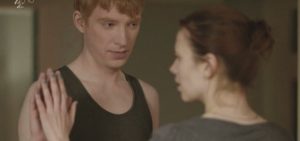
A scene from Black Mirror, where the protagonist meets a version of her dead boyfriend compiled from data gathered from his social media profile.

The pictured painted by the collection of data from a deceased generation is not perfect. Be Right Back from Black Mirror season 2 shows that data gathered from our social media profiles are only rough estimations of our lives. However, for the first time the habits society shares during a given time period can be both quantified and studied using primary source material, and when talking about the fate of our online profiles I believe it is incredibly important to remember the historical contributions that data of this scale could make.

Comparative Horror analysis – Matt St. Lawrence

Citations

Grant, Barry. “Digital anxiety and the new verité horror and sf film.” Science Fiction Film & Television 6.2 (2013): 153-75. Web. 1 Mar. 2017.

Diddi, Arvind, and Robert Larose. “Getting Hooked on News: Uses and Gratifications and the Formation of News Habits Among College Students in an Internet Environment.” Journal of Broadcasting & Electronic Media 50.2 (2006): 193-210. Web. 1 Mar. 2017.
Soundcloud link:

The Social Impact of Audio Preservation: Then vs. Now

The fervent desire to preserve the voice presented in this article among those in the sound reproduction community remained strong. The article addresses sound recording as “an extension of the art of oratory” and this remains incredibly true today. Much like how the article describes the emotional desire to preserve messages in vocal form, the desire of today is to capture a phonetic alphabet of one’s voice, one that could modulate itself in order to speak words in the matter with which the voices original owner spoke them. What the article presents as “preservation” is preservation of a speech, a sentence, a song. It is not preservation of the voice, or “chemical embalming” of a voice, that gives it way too much credit. The pronunciation of one sentence is a fraction of what constitutes a voice. Much like how the article gives the example of Crampton, a man who recorded his life story onto a phonograph before having his tongue removed for medical reasons, preserved his voice with the intention of reusing it, we have the chance to do the same thing with digital technology, but on a much more custom scale. Imagine being able to record the voice of a man going in for throat surgery, compiling a phonetic alphabet based around his speech patterns, and handing his voice back to him after the surgery. Imagine having a relative’s voice read an audiobook to you. That is preservation of the voice. The article seems to speak on this issue as if its cultural impact is over, but in fact what the article presents are just the first cultural hurtles the practice of archiving sound had to clear in order to take off.

Here, for fun, are the noise profiles of the phonetic alphabet. This is the cutting edge of sound preservation. Picture from:s-media-cache-ak0.pinimg.com/736x/d1/fa/c8/d1fac8222ca88592bce8aa4e62df4a59.jpg%5B/caption%5D

The existential nightmare of “Dead Set”

Faced with the news of the complete collapse of society,  the characters are faced with dismal fates based on their transgressions relating to their participating in the reality show Big Brother.

Most in line with the blunt zombie symbolism is Riq. Riq sees love beyond his initial safe house. He sees a viable future, even if it means leaving the safety of the farm house. It is also established that Riq doesn’t watch Big Brother. The zombie infection is a poison which the show defines as coming from the Big Brother TV show, and Riq is by all measures immune to it. Riq doesn’t have that ugliness inside of him that enjoys watching shows like Big Brother, which essentially makes him immune to the zombie plague. I know that comes off as kind of a leap, but Riq is the only person who doesn’t die at the hands of a zombie. Furthermore, when Joplin opens the gates they all run past Riq, not stopping to feed on him.  Of all the characters, Riq is one of the few that never ends up turning.

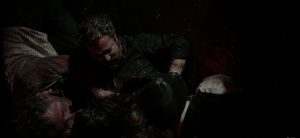
Patrick Getting eaten in the final episode of Yann Demange’s 2008 series Dead Set.

I make a point to say that Riq is “one of the few” that doesn’t turn because Patrick also doesn’t turn. Perhaps it is because Patrick is just too dismembered (a lovely bit of narrative symmetry there) to be able to become a zombie, but more likely is that Patrick’s disdain for his own program kept him from turning. Patrick’s production created the outbreak (on a figurative level, of course) yet he shows nothing but disdain for the cast and crew. In one particularly disturbing scene, Patrick cheers on the zombies as he feeds them with his own flesh, possibly analogous to him feeding the violent, tribal instinct which keeps reality shows like Big Brother on the air?

Finally, I’d like to give a big shout-out to Joplin for realizing the existential meaningless of what he has helped create. It is up to the viewer as to what was going through Joplin’s head when he opened the gate, but I like to think it went a little something like:

“I’m going to escape these horrible people who don’t like me and called me Gollum.”

“The horrible crowd of zombies (Big Brother fans) are similarly awful. This is a factor that in my previous rage blinded me to.”

“Patrick just killed an innocent, non-infected man. Perhaps I have once again been manipulated.”

“Well, if you can’t beat ’em, eat ’em!” *opens gate*

A Head Full of Ghosts and cinematic haunting

I would like to preface this blog post by ashamedly admitting that I have watched every episode of A Haunting that the Discovery Channel has ever produced. A Head Full of Ghosts is an almost perfect critique of this style of television. From my grand experience as a consumer of this media, and my limited experience as a film boom-operator, I have surmised the following about reality film crews:

1. There is a set formula that sells, and the creative director will get what they need regardless of the family’s consent.

2. Efficiency is prioritized.

Despite reassurances from Barry, the film crew is here to take as much dramatic material as possible. This is epitomized during Marjorie’s pre-exorcism evaluation, where Barry does not allow a shirt to be put over Marjorie’s sports bra. This example is particularly disgusting, because it shows that Barry knows that is his artistic medium sex sells, even the sexual image of a schizophrenic fourteen year old girl. The film crew manipulates the events of the story through father Waverly, who takes complete advantage of John’s desperation and drives his marriage apart to ensure that the exorcism happens. Sex appeal, then shock value, then a climactic exorcism is the formula employed by the film crew. While they come off as being on the side of the family, they haunt the house in order to get what they need. When Marjorie sneaks into Merry’s room and wraps herself in blankets, the first thing Merry describes is the LED of her camera staring at her at the foot of her bed. The crew also loads a dresser drawer to slam open and shut during the actual exorcism. Their cameras are everywhere, and their influence stretches through the entire house.

The film crew as a whole is an unfeeling, uncaring specter that floats through the house, twisting events to most efficiently and reliably produce episodes. Barry has no interest in whether Marjorie gets better, and he lets this show during the time between the evaluation and the exorcism. Marjorie is finally acting normal, and while the family is watching TV together Barry shouts at the family to provide entertaining, dramatic content. Even this desperate act was calculated, in order to efficiently create content through domestic disputes. In this regard, series writer Ken is almost more guilty. He builds a relationship with Merry in order to obtain footage that may not have otherwise shared. All of these transgressions of trust compound to create an entity that in many ways terrorizes the Barretts.

If you do not know what I mean when I say “Reality Horror television” check out this opening of A Haunting:

The opening to A Haunting (2005) Narration by Tony Call.