
I’m making a bold statement: the following sentence is in Dr. Sample’s Top 10 Favorite Sentences among the articles we have read for DIG 215:
“Chernobyl is a heterotopia that allows us to gaze upon a post-apocalyptic world in which the familiar and uncanny collide.” Stone (2013, p. 91)
This sentence is taken from “Dark and toxic tourism in the Chernobyl exclusion zone“, who originally quoted it from P. Stone’s “Dark tourism, heterotopias and post-apocalyptic places: The case of Chernobyl.” Not only is the sentence construction elegant and word choice exquisite, but the use of the word “uncanny” really seals the deal here with a spot in the top 10. Admittedly, the word caught my eye, I reread the sentence, hemmed and hawed for a bit, and then realized I had a very small understanding of what the sentence was saying. Let’s unpack the sentence in the context of today’s article, starting with “heterotopia”.
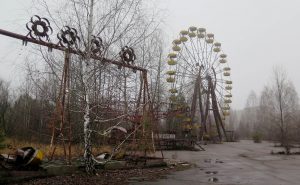
As I learned from the very helpful Wikipedia article, heterotopia is a human geography term used to describe spaces of otherness, with multiple layers of meaning yet irrelevant, simultaneously physical and mental. Often the term is used to describe moments, like looking at yourself in a mirror or coming of age while away at boarding school. From my understanding (and please help me clarify this), describing Chernobyl as a heterotopia conveys that it has become a moment for examination, a memory, that has been perversely protected by its radiation and remains in a timeless state as a “ghost town” (Yankovska and Hannam 1). This preserved town allows us to view a “post-apocalyptic world”, one that has resulted from “the darker aspects of scientific advancement and human experience” (Yankovska and Hannam 2). After all, nuclear power and weaponry are controversial topics today, with their benefits for energy production and devastating consequences. In this world the effects of the nuclear power plant explosion are everywhere, via warning signs and protective clothing visitors must wear. But signs of the everyday remain everywhere in this sort of “ghost town” because during the accident people were inaccurately promised that they would be able to return home for their belongings in a few days. Thus, the “familiar” home scene and “uncanny” nuclear accident wreckage have collided to create a memorable, unsettling scene.
Ganna Yankovska & Kevin Hannam (2014) Dark and toxic tourism in the Chernobyl exclusion zone, Current Issues in Tourism, 17:10, 929-939, DOI: 10.1080/13683500.2013.820260
Ha! Not only did I underline that sentence, I also requested its source (the Peter Stone chapter) from ILL. Heterotopia is definitely a difficult word to pin down. The French philosopher Michel Foucault coined the term in an important essay called “Of Other Spaces.” For him, a heterotopia is a “counter-site” that exists outside of everyday cultural spaces. They’re kind of no-places, which, because of their marginalized status, often blend what would otherwise be incompatible sites.
Foucault talks about cemeteries as heterotopias, but an even more illustrative example is a ship at sea. On one hand, the ship is a specific place, but on the other hand, the ship is “a place without a place,” floating on a vast indistinct ocean.
Anyway…it’s interesting to think about a place like Chernobyl as a heterotopia. I’ll leave that discussion for class…