
On September 12th, 2008, David Foster Wallace ended his own life by hanging himself on the patio of his home in Claremont, California, shortly after writing a two and a half page note to his wife and neatly arranging the manuscript and pages of edits for The Pale King under the light of the desk he worked from in his air-conditioned garage. In an interview for the guardian, his wife, Karen Green, said, “It all turns him into a celebrity writer dude, which I think would have made him wince, the good part of him,” but nonetheless she followed through on what seemed to be one of her husband’s last wishes and saw through the publication of The Pale King. As Taylor Marshall remarks in an analysis of the unfinished novel, “David Wallace’s 2008 suicide ignited intense public devotion to the man, both within and without the academy” (113).
David Foster Wallace’s suicide was the result of a long battle with depression that he ultimately lost after trying to switch, and then wean himself off the antidepressants he had been living on. He had earned a national audience and celebrity-author status with the publication and success of Infinite Jest a decade earlier, but his death brought him an even larger cult following and attention, even if he did not want or anticipate that. I was initially introduced to DFW’s writing through a friend who directed me to the graduation speech he wrote for Kenyon College in 2005 called “This is Water.” With it, I was introduced to DFW’s tendency to dole out advice for getting through life, specifically finding beauty in boredom (granted, it was a graduation speech). Within the mammoth of a novel that is The Pale King, DFW offers similar anecdotes, harping again and again on tedium, boredom, and little snippets of life advice.
The reason I was drawn to DFW for the Haunted Media project was exactly for his ability to offer a way through the monotony and bleak aspects of life while he himself was unable to overcome them. He wrote a story called “The Depressed Person” and even wrote a short blurb sympathizing with those who commit suicide. In retrospect, his suicide seems obvious and expected. The Pale King itself provides a particularly interesting case to work with. The mock memoir structure that DFW creates further casts the novel as a haunting piece of literature. At two different points he addresses the reader, saying, “Author here,” and going out to clarify in a footnote that “I won’t keep saying this each time that I, the living author, am actively narrating” (258). There are moments like this throughout the novel, moments where we’re abruptly reminded of the fact that DFW is not, in fact, a living author anymore, yet this book still seems to breathe. In his analysis of the novel, Robert Hamilton says, “In short, this is hardly the first of Wallace’s works to stop short in an abrupt and at least superficially unsatisfying manner,” and notes how the novel has been read as “(merely) a last will and testament” (169). In In the editor’s note prefacing the novel, Michael Pietsch refers to book as “an unfinished novel,” and said, “Although not by any measure a finished work, The Pale King seemed to me as deep and brave as anything David had written. Working on it was the best act of loving remembrance I was capable of” (xi).
Inspired by Megan Garber’s “Enter the Grief Police,” and Alexandra Sherlock’s piece on re-enchantment, I was interested in conflating the immense project of assembling the novel that Pietsch took on as an act of grief and the “google-able” quotes that DFW’s legacy has largely become. So who is right? Is Pietsch hiding an economic incentive behind what Garber’s Grief Police would call crocodile tears? There may not be a digital recreation of DFW, but how is his legacy complicated by the fame that his death and posthumous publication brought him to? Should an unfinished novel be thought of as the author’s last word? Sherlock makes the case that fame is a gateway to immortality, so despite DFW’s widow saying he would have hated to become so famous after his death, his suicide seems to have had the opposite effect, allowing him to transcend death rather than embrace it.
Plug in “The Pale King Quotes” – or anything followed by the word “quotes” for the matter – and you will almost always be greeted with a link to goodreads.com at the top of the page. For this project, I’ve taken every quote listed on Good Reads and a few from other websites (sifting through a lot of overlap) and have “highlighted” them in the text by blacking out every other word on the page. Pages without any quotes? Ripped out. Within the 549 pages of the novel, there are (not surprisingly) an incredibly small number of sentences left. Some of the pages are nearly covered in black, a single line or two buried within other pages not deemed worthy by Good Reads users. I chose to blackout certain elements of the paratext, underscoring his suicide while also getting rid of any plot description (there wasn’t much plot left after I roped out hundreds of pages). I chose to leave all of the opening pages that included blurbs, forewords, and legal information in order to highlight both the commercial nature of the project and the impact it had across the world of writing. I blacked out sections in two distinct ways. Some of the sections’ black lines run crisply in line with the sentences to evoke classified documents and parallel the tedium represented in the novel’s I.R.S. paperwork-content. Furthermore, blacking out sentences in such a way provides tedious work in itself, and as DFW says, “If you are immune to boredom, there is literally nothing you cannot accomplish” (440). Other sections are furiously scribbled out in swathes of black sharpie ink, speaking to the frustration of DFW’s decade-long editing process and his inability to finish the work, as well as provide an image symbolic of depression.
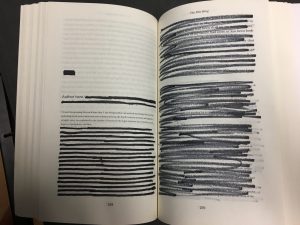
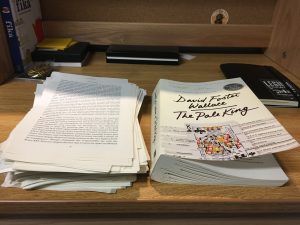
There were a few things that happened during the process of creating this artifact, this carcass of a book, that I did not expect going into it. First, I did not anticipate just how creepy some of the quotes would be in light of his death, and at points I had to step away from the project. Page 145 has only three lines blacked out, the rest consisting of a long anecdote all about our inevitable deaths and our attempt to distract ourselves from the fact that “we’re all less than a million breaths away from an oblivion more total than we can even bring ourselves to even try to imagine” (145). There were times that I so closely identified with a quote that my I had that beautiful moment of recognition of seeing my own feelings I didn’t know others felt written so eloquently put into words, and then throwing the book away from me after realizing its writer was unable to overcome these feelings. (Now is a good a place as any to note that while DFW wrote often about depression in a fictional sense, he never openly wrote about his own struggles).
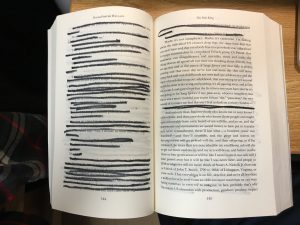
Secondly, and maybe it’s just my liberal arts English major speaking, but I couldn’t help but feel I was vandalizing the book. Of course DFW doesn’t care, he’s dead! But it felt a little bit like burning a photograph at a funeral. Sure, there are millions of copies out there and I even have the digital Kindle version, but the novel’s unfinished state and posthumous publication gave it a sense of delicacy that gave me unease more so than if I had taken a sharpie to any standard high school summer reading assignment (ripping pages out felt like straight blasphemy).
Thirdly, Good Reads may have a monopoly when it comes to Google-searching for quotes, but scrolling beyond the most “famous” quotes revealed a hidden intimacy between DFW and his readers. Good Read sorts the quotes based on likes from user profiles. The most-liked quote, “How odd can it be that I have all this inside me and to you it’s just words?” is ranked with 633 likes, but the numbers quickly drop. Scroll to the bottom of the page and you’re down to just 15 likes, and the last two pages of results are quotes uploaded and liked by a single user. Given DFW’s harping on loneliness and the sadness surrounding his death, there was something comforting in these singularly-liked quotes.
What I was ultimately left with was a haunted artifact that conflated the physical and digital legacies of an author published posthumously. In the digital age of clickbait and short attention spans, DFW’s The Pale King makes for both a good headline (suicidal author’s posthumous publication) and offers plenty of easily digestible quotes (because who has time to read that long of a book?). In an article for The New Yorker, D.T. Max argues that The Pale King “would show people a way to insulate themselves from the toxic freneticism of American life. It had to be emotionally engaged and morally sound, and to narrate boredom while obeying the physics of reading,” yet ironically most the of famous quotes on good reads are not the optimistic pieces of advice but rather the anecdotes that highlight the toxicity Max references. This haunted artifact serves as a conflation of literary and digital grief for the author, and while I was left with a skeleton of a quote book, I was also left with hundreds of torn, untouched pages that a man had poured his soul into.
Works Cited
Garber, Megan. “Enter the Grief Police.” The Atlantic. 20 Jan, 2016.
Hamilton, R. C. ““Constant Bliss in Every Atom”: Tedium and Transcendence in David Foster Wallace’s The Pale King.” Arizona Quarterly: A Journal of American Literature, Culture, and Theory, vol. 70 no. 4, 2014, pp. 167-190. Project MUSE, doi:10.1353/arq.2014.0029
Marsh, S. T. “Self-Sacrifice in the Autobiographical Narration of David Foster Wallace’s The Pale King.” Biography, vol. 39 no. 2, 2016, pp. 111-128. Project MUSE, doi:10.1353/bio.2016.0025
Sherlock, Alexandra. “Larger Than Life: Digital Resurrection and the Re-Enchantment of Society.” The Information Society, 29: 164-176, 2013.