
What struck me most about these articles, especially the New York Times one, wasn’t the concept of digital death, but the concept of a digital life. I think people in general are very quick to dismiss any online relationship as superficial or shallow. But this quote “Cyberspace When You’re Dead” really struck me – “But online [Tonnies] wasn’t some guy with a lot of strange ideas. He was himself. And he attracted an eclectic group of similarly minded friends.”
I think something unique about the digital age is the ease with which we can find like-minded people, and, often, friends. Never has it been easier to find support groups, fan communities, or any number of specialized social groups. Over the past few years, I’ve especially noticed LGBT youth turning to social media to find friends and mentors. Both the privacy and ease of access of social networking sites makes them very useful for people who otherwise feel isolated or marginalized.
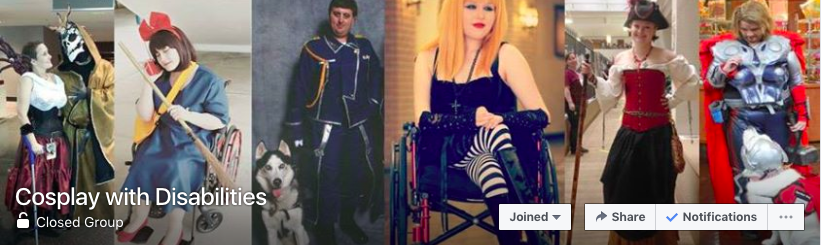
I admit that I might be a little biased – I’ve been involved in online communities for almost half my life and have had some really wonderful experiences there. I’ve recently found a Facebook group for cosplayers with disabilities where I’m not only getting practical advice on costume and prop construction, but also forming relationships. If you imagine it as a Venn diagram, the intersection of cosplayers and people with physical disabilities is very small. So the idea that I instantly got a dozen responses within a day of posting my initial question is staggering. Like Tonnies, I immediately found similarly minded people who I never would have known if not for the internet. On a similar note, a friend of mine is getting married in May to a man she met years ago playing an MMORPG. Their relationships was entirely digitally mediated, whether through FaceTime or emails, up until a year ago.
When discussing his interactions with Tonnies’s friends, Walker explains “each expressed a genuine sense of loss; a few sounded grief-stricken even more than a year later.” To me, those don’t sound like superficial relationships. Caring about what happens to your online accounts after you die indicates that the content on them matters in more than a fleeting, tweet-about-the-weather sort of way.
I acknowledge shortcomings of online friendships – the lack of eye-contact, for instance, which research has shown plays a big role in facilitating social connection and bonding. But what I took away from this article is that online friendships are valuable. Our online presences are part diary, part photo album, part correspondence – a unique confluence of expression and interaction. Not all tweets are valuable necessarily, but online interactions are not inherently worthless because they happen digitally. I know it’s trendy to denigrate all online interactions and behaviors, but I can’t imagine Tonnies’s “grief-stricken” friends would agree.