Check out the site here!
Artist’s Statement
Other than a short epilogue in which everyone has gotten married, had children, and is appearing to be living happily ever after, J.K. Rowling gives us little insight into the state of the Wizarding World after Harry Potter defeats Voldemort. As is the case among fans, I imagined a possible future for the universe. In this future, the events of the series are taught in a History of Magic class, and I theorized about the reactions of the muggle born students upon learning about the people who had died fighting to ensure their place in the Wizarding World. Therefore, my Haunted Media Artifact is an in-universe memorial page, The Phoenix Project, created by these muggle born students for those who died fighting Death Eaters in Harry Potter. In crafting my project, I combined elements of parasocial relationships, online memorial pages, and Internet trolling to reflect the complexities of online grieving.
Civil Rights in Harry Potter
I am currently in the middle of a Harry Potter re-read, and am struck by how integral civil rights are to the overarching plot of the entire series. Although I struggled to find much scholarship on it, the central conflict of Harry Potter is a fight against racial supremacy. While the struggle is represented allegorically through pure blood and muggle born witches and wizards, it is clearly speaking to a history of civil rights battles. In the Harry Potter universe, the slur “mudblood” is meant to denigrate the less privileged in society for their lineage. Authors, particularly ones as masterful as J.K. Rowling, are deliberate in their every move. Rowling invented a racial slur for her universe to emphasize that racism operates within it just as it does in the non-magical world. Voldemort rises to power by demonizing a disadvantaged minority group and asserting his, and his followers’, superiority over them. Under his rule, muggle borns cannot work in the Wizarding World, have their wands confiscated, and are liable to be jailed. In this re-read, I have found myself focusing on Hermione’s experience of racism in the Wizarding World, and I have thought a great deal about the experiences of muggle born students in such a hostile environment.
Parasocial Relationships
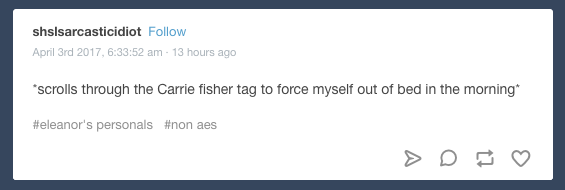
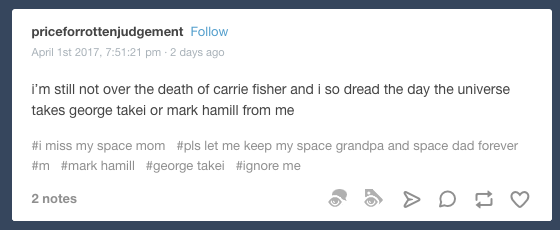
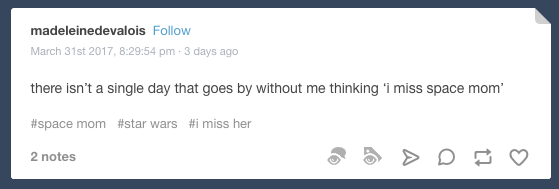
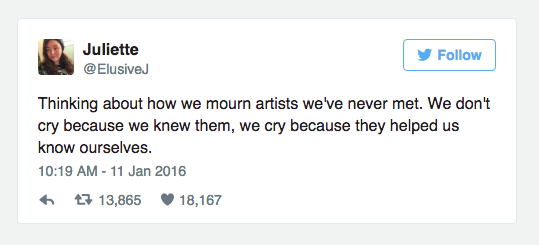
My project was heavily influenced by the concept of parasocial relationships. Coined by Horton and Wohl , parasocial relationships are bonds people feel with public figures despite not knowing them personally (215). While Horton and Wohl’s paper focuses mostly on television personalities, the concept of parasocial relationships has extended far beyond that original limited scope. These relationships, as we have seen with the amount of beloved celebrities who passed away in 2016, can be quite intense. In crafting my project, I wanted to draw on the idea of bonds with public figures. I imagined that in the Wizarding World, muggle born students would feel a particular affinity with those who had died fighting for muggleborn equality, and therefore created a backstory involving four original muggle born characters. Many of the characters who died in the Second Wizarding War were not famous at the time of their death, but like we have seen with scores of celebrities or public figures, from Bob Ross to Emily Dickinson, fame is frequently achieved posthumously. In our digital age, parasocial relationships are easier than ever to achieve. While the internet does not exist in the Wizarding World, and these figures would likely only appear in history textbooks, muggleborn students would have grown up with exposure to the internet. It is therefore their experiences with forming parasocial internet relationships, not only the importance of muggleborn rights, that make them particularly apt people to create such a project.
I acknowledge that it is probably unusual to form a parasocial relationship posthumously, I think it could be possible, particularly in the Wizarding World, where death operates somewhat differently than it does in ours. Pictures move in this universe, so it would be easier to understand and connect with someone deceased. Albus Dumbledore and Severus Snape both have talking portraits hung in the Hogwarts castle, allowing students to interact with them in a very life-like manner.
Website Design
In crafting the memorial page, I took some cues from existing online memorial pages, but also endeavored to depart from certain elements. As Brubaker et al. observed, online memorial pages usually include an obituary component as well as a memorial guestbook (154). I included both of those elements in my website, with individual biographies for the deceased and a guest book that allowed users to leave messages. In crafting those messages, I followed the observations Brubaker et al. had made that people who knew the deceased tended to address their comments to them directly, while those who did not know the deceased personally generally addressed the creators of the website (155). Also, acknowledging that some people do come to online memorial pages simply to wallow in false grief, I added a few inane comments. I also added messages from internet trolls, as they tend to be a common presence on online memorial pages, but I will address those comments in depth later in the statement.
While I did model my page using the general template of online memorial pages, I also wanted to depart from some elements I did not like. As Graham et al. found in exploring Australian memorial websites, some, such as the popular Heaven Address, contained “Featured” and “Most Visited” profiles (43). This design struck me as disrespectful and inappropriate. The idea of competing for online popularity even in death seems almost sacrilegious. Additionally, I found the world cloud component of the Heaven Address memorial pages as somewhat too silly for my website. The notion that death, particularly as casualties of war, deserves a certain seriousness drove the design of my website. I attempted to balance an attractive aesthetic with a degree of solemnity. While the color palate of Heaven Address is bright, featuring white, yellow, and green, my website is predominantly black with white text and some light red accents. I chose to emphasize black because it is the traditional color of mourning. This choice naturally lent itself to white text to make the website as easy to read as possible. However, in an effort to add visual interest to the page, I added some light red, which looks nice but maintains the seriousness I meant to convey in the site.
The choice of fonts was also very deliberate. I spent a good deal of time playing around before deciding on which three to use. All three fonts were deliberately sans serif, because I wanted a minimalist, elegant look to convey solemnity. For titles, I chose a font called Marzo, a thin, almost spindly font. I wanted something eye-catching for the titles, but did not feel that playful fonts with curlicues or fun shapes seemed appropriate, so this unusual but simple font seemed like a good middle ground. For the paragraphs, I chose Avenir Light, which was simply a plain, sans serif font that worked well for bodies of text. For other elements and accents, I used a font called Lulo Clean. I did not want all the sans serif fonts to look too similar, so this font was chosen in contrast to Marzo. While Marzo is thin, Lulo Clean is an all-caps, blocky font, which provided a good visual contrast without being too decorative.
Trolls
No corner of the Internet is complete without at least a few trolls, and as we have found, memorial pages in particular tend to attract a certain vitriol from anonymous Internet users. Combined with the fact that this page is commemorating people who died fighting for equality, trolls seemed inevitable. As Whitney Phillips found, trolls tend to target those whose grief they view as inauthentic. In general, trolls do not target the families of friends of the deceased, but rather mourners who never knew the deceased and yet still grieve publically. My memorial page is crafted by those who never knew the deceased, and therefore could be seen by trolls as simply an attention-seeking, tacky, unnecessary online grieving display. According to Phillips’s research, my website would be the perfect place for trolls.
The anonymity afforded by the website also opens the door for vicious, inflammatory comments. Haines et al. found that anonymity allows users to feel more comfortable expressing support for questionable or socially undesirable positions or behavior (779-780). In the real online world, there is no shortage of racist, sexist, homophobic, or otherwise bigoted sentiments, particularly on platforms like Reddit or Tumblr, where one can remain anonymous. As The Phoenix Project allows anonymous commenting, it seemed in-keeping with online culture to sprinkle in a few pure-blood supremacist comments along with the usual sensationalist trolling.
Conclusion
As with anything, our conception of death and methods of grieving are changing with the rapid expansion of technology. The Phoenix Project was meant to integrate several components of that changing landscape. I focused primarily on the idea of parasocial relationships with the dead, especially in light of the broader social context of the Harry Potter universe. I was very deliberate in the crafting of this memorial page, and tried to embody some of the best aspects of online culture—the accessibility of information and the ease of communication and community-building—while avoiding those elements—an obsession with popularity and the commercialization of nearly anything—that I find distasteful. I wanted to depict the potential value of public grieving sites in uniting people and creating a sense of community while still acknowledging the presence of grief-policing trolls. Ultimately, while The Phoenix Project, and those memorialized within it, are entirely fictional, I hope it provides some real insight into how the Internet challenges some of our attitudes surrounding death
Works Cited:
Brubaker, Jed R., Gillian R. Hayes, and Paul Dourish. “Beyond the Grave: Facebook as a Site for the Expansion of Grief and Mourning.” Information Society 29.3 (2013): 152-63.
Graham, Connor, Michael Arnold, Tamara Kohn, and Martin R. Gibbs. “Gravesites and websites: a comparison of memorialisation.” Visual Studies 30.1 (2015): 37-53.
Haines, Russell, Jill Hough, Lan Cao, and Douglas Haines. “Anonymity in Computer-Mediated Communication: More Contrarian Ideas with Less Influence.” Group Decision and Negotiation 23.4 (2014): 765-86
Horton, Donald, and R. Richard Wohl. “Mass Communication and Para-Social
Interaction.” Psychiatry 19.3 (1956): 215-29.
Philips, Whitney. “LOLing at tragedy: Facebook trolls, memorial pages and resistance to grief online.” First Monday 16.12 (2011): n. pag. Web.