Are data centers the new animal agriculture?


Warning: Undefined array key 0 in /home/digitald/public_html/courses/wp-content/plugins/radgeek-FWP---Add-Attribution-70acf52/add-attribution-feedwordpress.php on line 363

Surprisingly, the hamburger you ate for lunch and the cloud storage you sent the artsy photo you took of it to may have more similarities than you think when looking at them through the lens of environmental concerns.

In the article “The Environmental Toll of a Netflix Binge” by Ingrid Burrington, she discusses how the infrastructure behind the seemingly ephemeral and neutral Cloud could actually be quite disruptive to the environment. She explains how people view data centers as pristine, white “cathedrals,” when in reality they resemble crude factories. Of course, Apple and similar companies try to hide this infrastructure with glass-walled stores, minimalist interfaces, and sleek headquarters. Unless you did some digging, you may never know the environmental impact the Cloud has. For example, the article explains that “streaming an hour of video on a weekly basis uses more power annually than a new refrigerator.”

When reading Burrington’s piece, I couldn’t help but draw similarities between problems with Cloud infrastructure and problems with animal agriculture. First of all, many people like to think that livestock lives in large open pastures and then is humanely processed by a skilled butcher.  Instead, most of the meat we eat comes from large factory farming facilities with animals living and killed in horrendous conditions, similar to illusion hiding the dingy factories of data centers. Animal agriculture also has a detrimental impact on the environment. If you think that the ramifications of your netflix binge are bad, consider this: your quarter-pounder used up to 460 gallons of water, 65 acres of land to produce, and 4 pounds of total carbon footprint. 

Both data centers and factory farms are highly powerful and profitable businesses with horrendous environmental footprints. However, one critical difference is that for the data centers, it’s more feasible for them to cut back. For a factory farm to decrease their impact on the environment, they would have to severely cut back on production (and consequently, profits).

For now, the negative impacts of data centers are more under-the-radar than that of factory farms, as shown by the very different results you get with a google image search of both. In the future, though, will searching “data centers” give similarly grim results to the ones for “factory farming”

google image results for factory farm
google image results for data centers

Posted from Digital Studies 101 by Alivia

“The Single Biggest Thing We’re Going to Build as a Species”


Warning: Undefined array key 0 in /home/digitald/public_html/courses/wp-content/plugins/radgeek-FWP---Add-Attribution-70acf52/add-attribution-feedwordpress.php on line 363

In an article in the Atlantic, Gary Cook, a senior IT analyst at Greenpeace, is quoted saying that “the Internet is the single biggest thing we’re going to build as a species.” Surprising or not, that single biggest thing that we’re currently building may be an environmental hazard. Shockingly, the article cites that an hour of streaming online can use more energy than a refrigerator in a year. Maybe it’s time to log off Netflix.

But what about one of the biggest “things” we as humans have already created? When you think of enormous manmade objects, you think of skyscrapers, trucks, etc. You might not think of the Great Pacific Garbage Patch, a manmade, floating pile of junk in the Pacific Ocean. The patch of plastic and other debris is estimated to be twice the size of Texas.

In a way, the Internet can kind of be seen as a, well, giant floating patch of debris. As we consume and consume online, we use more energy and exhaust more resources. While some of these can be renewable, it’s still incredible just how much energy daily functions on our phone require. And the bigger it seems to get, the more that is required. More lights, more power, and more energy is needed to keep these big data centers running.

The effects of Internet use on the environment might not be as obvious as a giant floating pile of trash in the ocean, but the concepts are strikingly similar. We as humans, as we build things bigger and bigger, also generate more waste. The more we consume, the bigger the impact we leave on the environment. So maybe we need a different approach when considering the “single biggest thing we’re going to build as a species.”

Posted from Digital Studies 101 Blog by Grant L.

Technology: The Good and the Bad


Warning: Undefined array key 0 in /home/digitald/public_html/courses/wp-content/plugins/radgeek-FWP---Add-Attribution-70acf52/add-attribution-feedwordpress.php on line 363

I found it particularly jarring that even since 2005 communication technologies have been used in away to negotiate public and private space. Now with the vast array of technology available, we probably do this more. Social Topography In A Wireless ERA: The Negotiation of Public and Private Space illuminated how people use technology for privacy for me, even when in public. It sounds obvious but I’m interested in the way that technology is taking over our lives. I say this because I’ve noticed through the reading of this text and applying it to real life that we as technological consumers, and bystanders for that matter, subconsciously behave in a way that caters to our technology, whether it’s a smart-phone, cell-phone, laptop, or tablet.

One example that I’ve noticed a lot is when my parents called me on the phone last night. I was doing work while talking to a friend when my mom called me. So subconsciously my friend and I had this unspoken communication that I’ll see him later. To make it seem more like the article though, I subconsciously got up and started pacing around the room while talking to them-good thing I was alone in the room! Anyway, I said I was doing this subconsciously because I wasn’t aware that I, in fact, was catering to my phone call. I stopped my conversation with my friend, I stopped what I was working on, and I started pacing around the room. And now that I think about it I had my back to the door! I literally privatized a public area although I was alone in the room. Had there been people I probably would’ve left the room to protect “those bystanders from being infringed upon by the private matters” (380 Humphreys) of my phone call.

I think for the most part that technology that lets us take our private matters with us like cell-phones is good for society because it lets us connect.   But on the other hand I’ve always lived my life believing that a balance in everything is necessary to live a well-rounded life. For example, cell-phones are definitely necessary in today’s day in age, but I procrastinate all the time on my phone and on the internet and can miss out on learning, socializing with actual people, and sleep. However, we’ve seen this as a historical trend with kaleidoscopes and landline telephones. But now it seems that since technology is so widespread, there’s even more of a warning towards the distraction that technology can bring from actually enjoying life. When thinking about this, I recall a video that I saw two or so years ago about the negatives about technology. It’s well worth the watch I assure you.

Posted from My blog by Will M.

Social Escape


Warning: Undefined array key 0 in /home/digitald/public_html/courses/wp-content/plugins/radgeek-FWP---Add-Attribution-70acf52/add-attribution-feedwordpress.php on line 363

Technology is often criticized for its distracting presence, causing its users to be absent even when physically present. Parents may find it difficult to wrest their child’s attention away from an iPad screen, or a professor may be uncertain whether a student is using her computer to take notes or message friends during class. In such cases, the person or people being distracted are often unaware of their own level of distraction.

However, technology can also be used to escape a situation. Millennials are particularly adept at using technology for this purpose, and Bank of America’s Trends in Consumer Mobility Report finds that 40 percent of millennials admit to using their cell phones to avoid conversations. Here at Davidson this is readily apparent. Be it in the Union or at a weekend party in a Martin Court apartment, students are quick to draw their phones if approached by someone they would rather not speak to, or if they are afraid of being seen not speaking to anyone.

Taken from Bank of America report.

Both of these scenarios provide insight into millennials’ social behaviors. Now that people are constantly connected to their friends, they feel less need to put themselves in a position of vulnerability in order to meet new people. At the same time, millennials are intensely focused on creating a narrative of happiness and success that they share through their social media presence, and this narrative must be upheld in the physical world. So if a millennial is in a place where he does not know people and is uncomfortable meeting people, he may choose to simply pretend to use his phone in order to give the appearance that he is not awkwardly waiting for someone else to arrive that he can speak to, because appearances are everything.

Posted from DIG101 Blog by Noah R.

Technology as a Form of Vertical Relationships


Warning: Undefined array key 0 in /home/digitald/public_html/courses/wp-content/plugins/radgeek-FWP---Add-Attribution-70acf52/add-attribution-feedwordpress.php on line 363

In The Challenge of Absent Presence, Kenneth Gergen argues that our culture is moving from an emphasis on vertical friendships to a focus on horizontal registers (232). In layman’s terms, horizontal relationships are ones that barely scratch the surface of superficiality. A horizontally focused person may have 500 acquaintances, but is very close friends with almost none of them. In today’s terms, this person would have thousands of Instagram followers but few meaningful real life friends. “Relating in the vertical register,” on the other hand, “requires dedicated attention, effort, commitment and sacrifice” (233). Vertical relationships are ones where you would actually enjoy going on a 12 hour road trip together. A vertically focused person does not have a large number of friends, but he is deeply involved with all of the friends he does have.

Gergen argues that technology brings with it an absent presence – a phenomenon where a person is physically present but mentally or socially disengaged (in this case due to the use of technology). This absent presence, he further argues, is what leads to horizontal registers. We are no longer fully present around our friends, so we tend towards horizontal relationships as opposed to vertical ones.

I believe Gergen’s argument is flawed here. He needs to further develop the distinction he makes between dialogic and monologic technologies. Monologic tech activities (listening to music, streaming video, reading) are entirely disengaging, and Gergen is correct to assert that these activities lead to horizontal relationships. Dialogic technology, on the other hand, merely asserts a preference of one relationship over another. Consider the following example. A college student at a party chooses to text her best friend from her hometown instead of conversing with her friends who are physically present.

Gergen would say that this girl is promoting horizontal relationships with those friends that are present, but he would fail to notice that she could potentially be furthering a vertical relationship with the friend back home. I say potentially because it all depends on the situation. If this really is a true friend, then the girl is showing “attention, effort, commitment and sacrifice” by texting her hometown friend instead of socializing. On the other hand, if the friend is merely a common acquaintance then the girl would probably be better served focusing on the friends physically present.

Sources:

https://thumb1.shutterstock.com/display_pic_with_logo/1927106/532469638/stock-photo-beautiful-young-girl-looking-at-a-mobile-phone-while-at-the-home-party-532469638.jpg

Katz, James E., and Aakhus, Mark, eds. Perpetual Contact : Mobile Communication, Private Talk, Public Performance. Cambridge, GB: Cambridge University Press, 2002. ProQuest ebrary. Web. 10 September 2017.

Posted from My DIG 101 Blog by Matt B.

Facebook Would Like Access to You


Warning: Undefined array key 0 in /home/digitald/public_html/courses/wp-content/plugins/radgeek-FWP---Add-Attribution-70acf52/add-attribution-feedwordpress.php on line 363

For class we read a selection of text “The Challenge of Absent Presence” from Perpetual Contact: Mobile Communication, Private Talk, Public Performance which discusses the public use of private artifacts in an open, public atmosphere. Thinking about the space in which people access and communicate information got me thinking about Facebook. Particularly the access users give to their private and public profile.

How much does Facebook have access to?

I dove into the Facebook documentation to find an answer to this question, discovering directly from Facebook what intelligence they’re gathering.

Unlike information from last week’s post, personal information received by Facebook is consented. Facebook specifically asks you to describe yourself and your interests and provides an explicit medium for you to vent about your day in status updates or message your friend about private information.

Apart from the obvious bits of information that people literally post or answer in the “about me” section of a profile, Facebook also gathers information from your previous “sessions” online – gathering information like which browser, operating system, and IP Address you accessed Facebook from. Information which can pinpoint your location with incredible accuracy. It can also be used to steal your identity and grant the holder access to your computer’s files.

The documentation also mentions that “If you make purchases on Facebook (ex: in apps) [you] have given Facebook your credit card number.” Which is interesting purely for the fact that it is there to be accessed. Facebook, or even Hackers, has a database of sensitive information that just exists online. Granted, it’s very well protected – but it still exists for someone to crack into it.

How much do apps get access to?

Image result for facebook account access prompt

It’s curious, the most powerful point to be made is the fact that we consent to this data being collected and stored. When we install a new app which requires a Facebook login we are prompted with a dialogue, a form of consent for Facebook to release whatever information the app is requesting to pull. Apps use the Facebook API to simplify user account creation because they can get access to your full name, birthday, and email and let you only have to click a button. But, something to be careful about, they can also be given access to send and receive messages, manage your friends list, post statuses, and more.

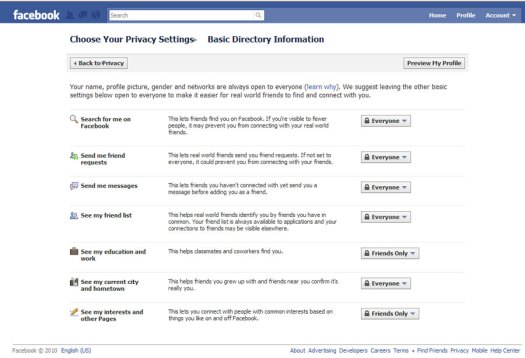
Image result for facebook information about me

As Facebook has gotten more mainstream, employers, partners, and friends have started to use Facebook as a preliminary source of information. Pages like the above are useful in selecting who of your peers gets to see what information. You can even remove yourself from being displayed in the Facebook search results and restrict people from sending you friend requests and viewing your photos/statuses.

Posted from DIG101 by Tucker C.

Cyber-Community and Tumblr


Warning: Undefined array key 0 in /home/digitald/public_html/courses/wp-content/plugins/radgeek-FWP---Add-Attribution-70acf52/add-attribution-feedwordpress.php on line 363

Embarrassingly, I owe my formative political education to a website called Tumblr dot com. Although I created my Tumblr in high school for the sole purpose of reblogging random lifestyle imagery, I eventually encountered folks who were really angry about injustices, so-called Social Justice Warriors, or SJWs (although this term now seems to be used almost exclusively by alt-right bullies). A few months into my engagement with radical bloggers, I became skeptical and distrustful of my teachers, parents, and community. Given the conversations I was involved in through my cyber-community, the people in my local community seemed unenlightened and uninitiated.

http://ibuprofemmme.tumblr.com/post/154467026511/comrade-medicine-bell-hooks-vs-beyonce-is

I immediately recognized this experience in Gergen’s description of how the realities of cyber-communities can destabilize local and communal realities. Gergen explains that “when the local ceases to hold sway [sic], bonds of communal trust are frayed” (232). My activity on Tumblr invested me in cyber-communal realities and frayed my trust in local institutions.

Online activist communities are an interesting case study in cyber-community because they should hypothetically diverge from Gergen’s idea of the “floating world” (235). An online activist community is a “floating world” in the sense that it is concerned with second- and third-order levels of communication (that is, conversations about ideas/concepts, and conversations about those conversations); in another sense, however, activist communities should not “float free” from the dilemmas of everyday life. The removed, absent, super-local discourse should translate into concrete change-making behaviors in local contexts.

Of course, online activist communities are often criticized for their removal from the issues they aim to address. (How does a Facebook profile frame help protect DACAmented people?) Perhaps, as Gergen claims, cyber-communities inherently decenter the local/communal, and thus online activist communities will always face a requisite level of estrangement from “on the ground” realties. Given that social media and cyber communities are such powerful tools for spreading information and building political alliance, however, I don’t see activists turning on Tumblr anytime soon.

Works Cited

Gergen, Kenneth J. “The challenge of absent presence.” Perpetual Contact: Mobile Communication, Private Talk, Public Performance, edited by James E. Katz and Mark Aakhus, Cambridge University Press, 2002, pp. 227-241.

Posted from Digital Studies by Hannah L.

Social Norms of a Digital Age


Warning: Undefined array key 0 in /home/digitald/public_html/courses/wp-content/plugins/radgeek-FWP---Add-Attribution-70acf52/add-attribution-feedwordpress.php on line 363

I believe there is an underlying misunderstanding of technology because people don’t realize that it reveals us more about ourselves than typical social interactions ever could. In Change of Absent Presence, the idea of social norms is constantly being brought up. The context is most often with the changing of behaviors. These changes are also often attached to a fear or negative opinion. For example, on page 235 the article says, “My concern here is with the emergence of a world of meaning cut away from the pragmatics of everyday life.” I take issue with a few things being said here. I don’t think technology necessarily takes away from the pragmatics of everyday life. I think that too often we distance ourselves from technological advances. We like to act as though technology is its own self functioning entity, not a creation of humanity. We adapt around our own creations and change how we interact, not because it forces us to, but because we decide the new social norm. On twitter the word count was not determined by the website, it was chosen by the developers. From their guidelines a new way of communicating was born and we chose to adapt to it. This adaptation should be recognized as it reveals how susceptible we are not only to change, but to social pressures we put upon ourselves.

All of this being said, I will admit that certain groundbreaking technologies such as computers and cell phones created far more radical changes in our society than the apps of today. I believe the article does do the social and societal changes caused by cell phones justice. It acknowledges the fact that we are glued to them, in this age of constant social media we seldom take the time to look around and interact with those around us. I often think of how often I spend time on my own devices. I would say 60% of my day, while awake, is spent on some sort of device. It is a strange thing to think about, yet it is true. Technology has been implemented into every part of my life. Movies like Her paint the picture of a man obsessed with the computer based in his phone more specifically an I whom he slowly falls in love with. This idea is fascinating. As I just said I spend more than half of my day on some form of technological device, but if my best friend was also in these devices I doubt I would ever put it down. I personally don’t use social media so I don’t know how I would feel about an interactive computer living with me. Either way I think that Her paints a picture that is not so far fetched. We already are buried within the technology we created, so it is not too far fetched to think we will soon build ourselves into obsoleteness. It is hard to imagine, but I think it is an important thought to consider as technology develops constantly around us.

ofaworldofmeaningcutawayfromthepragmaticsofeverydaylifez

Posted from My blog by Patrick H.

We’re Just Yet to Customize It


Warning: Undefined array key 0 in /home/digitald/public_html/courses/wp-content/plugins/radgeek-FWP---Add-Attribution-70acf52/add-attribution-feedwordpress.php on line 363

Unknown source and date.   http://giovanimarmitte.com/wp-content/uploads/2017/07/Challenge-Adaptation.jpg

Image courtesy: Gio Vanimarmitte

In Google type in “smartphones and relationships”. I guarantee you the first 5-10 links will be about why new technology is so bad, and how does it ruin our social lives. Don’t believe me? Well… way to ruin this relationship. On a more serious note, people have always complained about technology threatening social, in-person interaction. But does it really, or do we just not know how to use it?

After reading Perpetual Contact : Mobile Communication, Private Talk, Public Performance, the concept of progressive privatization has really caught my attention. Even though the authors connect this specific concept with technologies of monological presence, I view this concept as a part of user customization process. Any new technology needs time to acclimate, and while something like a smartphone does drag the users out of the current moment of their lives, the extent always depends on the individual’s choice.

Just like books did years ago, smartphones will eventually make everyone’s social lives more colorful. In my opinion, people will learn to filter the unnecessary distraction, and will eventually becoming more efficient and more knowledgable about the world around them. With all types of new information at their fingertips people will always feel the need to share it with others for social approval. This is where, just like people acknowledged books, people will start recognizing the value of taking some distraction time, to grow your inner self. You might argue that with all this efficiency, people will not have any time for every-day progressive incidents. However, they are called incidents for a reason, and the more one is involved, the more action is present in that person’s life.

To conclude, a smartphone is nothing but a set of tools available to an individual. How he/she chooses to use those tools, and to what extent, is always a personal decision.

Posted from DIG 101 Blog by Andriy M.

Some research gaps don’t need to be filled


Warning: Undefined array key 0 in /home/digitald/public_html/courses/wp-content/plugins/radgeek-FWP---Add-Attribution-70acf52/add-attribution-feedwordpress.php on line 363

The study “Social Topography in a Wireless Era: The Negotiation of Public and Private Space” by Lee Humphreys aimed to observe and explore how people negotiate their private and public senses of self and privacy when they use their cellphones in public spaces. The study was conducted from 2002-2003, years before the first iPhone hit the market. I think that is why this article at times feels idle and meaningless.

At the time the article was written, cellphone popularity was still in its infancy, and the scope of the technology was limited compared to the smartphones of today.

A Samsung SGH-T100, the type of cell phone likely used by participants in the study. Courtesy of Know Your Mobile

Because of this, I think that everything about the new technology seemed remarkable, surprising, and worth studying. But as a present day reader, I don’t feel that I need to be told that people like to not be interrupted when using their phones in public, or that they find it bothersome if people are talking too loudly. I also believe that these behaviors could be observed in the absence of mobile phones. If people were holding a private conversation with their friends in a public space, they likely would not want to be interrupted, would somewhat separate themselves from the rest of the “participation unit,” and would be bothered if a group of people were being too loud near them.

While I will concede that at the time of the study the idea of private cellphone use in a public space was worth observing, I think that Humphreys tends to draw conclusions from mere coincidences. I don’t believe that setting your suitcase down by your feet is a territorial marking, even when you’re engrossed in a private cellphone conversation. Instead, it’s likely that the person in the study was tired of carrying a suitcase around.

The article’s fascination with something that now seems obvious or natural to us now shows how much technology has been integrated into our lives.


Posted from Digital Studies 101 by Alivia