Is Google getting less racist? Or less controversial?


Warning: Undefined array key 0 in /home/digitald/public_html/courses/wp-content/plugins/radgeek-FWP---Add-Attribution-70acf52/add-attribution-feedwordpress.php on line 363
Source

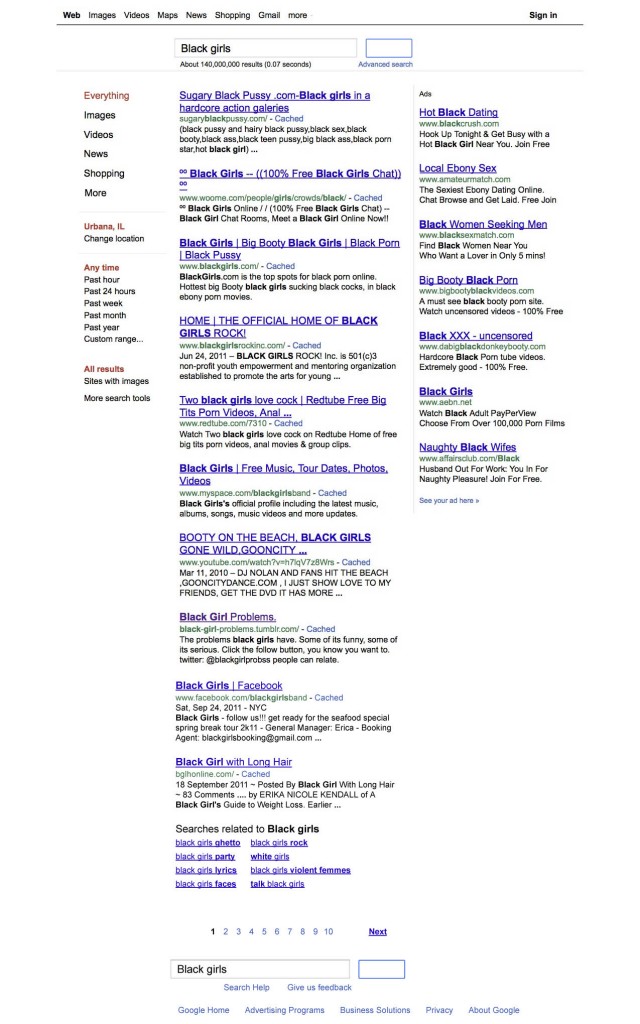
In Safiya Umoja Noble’s essay, “Google Search: Hyper-visibility as a Means of Rendering Black Women and Girls Invisible”, it was shocking to see the racist and misogynistic links appear when one searched “Black girls” in 2011. What was more surprising is how vastly different Google searches work within the span of just six years.

Fig. 1
Fig. 2

Fig. 1 above shows the searched links included in Noble’s essay, while Fig. 2 shows the searched links today in 2017. An immediate difference is that there actually no pornographic links or sites that display black women as a fetish. In fact, there are no major links within the first several pages of the Google search. Instead, we get a much more prominent focus on cultural identity, social issues, and celebration of identity. However, a quick search for “Hispanic girls” and “Asian girls” did not yield the same results. Within the first page… and second… and third, there were various links to pornographic or semi-pornographic sites that collectively objectifies the women. Whether it be inherently lewd (Found on first page) or under the guise of appreciation, Google has very obviously not become non-racist or non-sexist.

In comparison to searches for black women, there is a distinct lack of sensitivity towards other minorities (I conducted the same searches for “Middle Eastern girls” and ethnicities such as “Japanese girls” which yielded the same results). This raises the question: Has Google and algorithms in general on the internet gotten less racist over time? Or simply less controversial? In the context of growing racial tensions and the vocal Black Lives Matter movement, it appears that many sites are taking a step back on more hotly debated issues in order to protect their image instead of directly addressing them. The so-called “model minority asians” are still being underrepresented in all the right categories and overrepresented in all the wrong ones. Hispanic people still face discrimination and racism under the Trump administration, yet the internet continues to sexualize hispanic women. It is obvious that the internet, or rather the users behind it, are trying to stop appearing racist, rather than actually stop being racist.


Posted from our fascination by Tony N.

The Cruelty of Waiting


Warning: Undefined array key 0 in /home/digitald/public_html/courses/wp-content/plugins/radgeek-FWP---Add-Attribution-70acf52/add-attribution-feedwordpress.php on line 363
Source: Giphy

Since a young age, we’ve all been taught that anything important is worth the wait. In contemporary times, waiting has been engrained in our culture from waiting for a website to load to waiting for our food to arrive to even waiting days in lines for clothes. There is a sense of accomplishment and satisfaction when the wait ends and we are rewarded for our patience.

I had the pleasure of meeting the Mac’s spinning rainbow wheel several times just trying to get the gif above (Giphy’s site is not a fan of my laptop). But after several achingly long minutes of my laptop trying to comprehend the massive amounts of moving pixels on the screen, I was able to slowly quickly copy the url. This lead me to consider several things. Should I have used a different site? Should I get a better laptop? Instantly, I was looking for alternatives for waiting to be obsolete. In Jason Farman’s article “Fidget Spinners”, he claims that, “Waiting will never be eliminated and, deep down, we don’t want it to be.” I’m going to have to disagree on that one Jason.

When I saw the multitude of gifs on Giphy begin to slow down, anxiety overcame me. When everything had frozen, a piece of me died and I cursed at my own stupidity as Giphy had crashed on me many times before in class. While the loading icon does imply that something is happening, it brought me little comfort to see the little rainbow wheel pop up on my screen. There was only frustration and I wanted to take my anger out on the stupid, colorful icon that was unnecessarily happy. Saying that we are joyful after waiting X amount of time to receive what we want seems like an equivalent of our parents making us finish our homework before watching TV. It is merely a chore and an obstacle set upon us by outside forces.

I hate this thing. Source: Giphy

In conclusion, waiting is a cruel mistress. Sometimes, the end results is rewarding. Sometimes, it can be the bearer of bad news. My friends at Georgia Tech who have had their programs crash on them after hours of work will have more information on the latter.

Posted from our fascination by Tony N.

Fast Cash, Exploitation, and Racism


Warning: Undefined array key 0 in /home/digitald/public_html/courses/wp-content/plugins/radgeek-FWP---Add-Attribution-70acf52/add-attribution-feedwordpress.php on line 363
Youtube star Pewdiepie reacts to his Fiverr request

Lisa Nakamura’s article,”‘I WILL DO EVERYthing That Am Asked’: Scambaiting, Digital Show-Space, and the Racial Violence of Social Media”, reminds us that the exploitation of third-world countries persists to this day for the sake of amusement and personal vigilantism.

The article reminds me of a controversy surrounding Felix Kjellberg, widely known as Pewdiepie, not too long ago. Kjellberg is a Youtube star, currently holding the top spot on Youtube with over 57 million subscribers. In January of 2017, he came under fire after using Fiverr, an online marketplace where people offer their services for five dollars, to get a pair of Indian performers to hold up an anti-Semitic sign reading “DEATH TO ALL JEWS.” 

Unlike the examples in Nakamura’s article, Kjellberg does not fit under the category of “scambaiter.” He did not use the service in any sense of vigilantism or for personal vendettas against scammers. Instead, he used unsuspecting people in a third world country in order to spread a racist message. Although Kjellberg immediately made an apology video and claimed that he only did it because it was just “a funny meme” and that he “didn’t think they would actually do it.”

But whether or not Pewdiepie’s actions were anti-Semitic or just a poorly executed joke is besides the point. A quick look into the the Indian performers, Funny Guys, that Pewdiepie had used shows a picture similar to that of the Nigerian scammers within the articles. Their Youtube page is filled with short clips of them half-naked and fake-laughing along to messages such as “Happy B-Day” and “Berry Christmas”. This cements Nakamura’s point that racism is a pervasive force in the online world as people continue to exploit and emasculate other cultures by forcing them to become a primitive, uncultured stereotype.

Posted from our fascination by Tony N.

Animated Gifs


Warning: Undefined array key 0 in /home/digitald/public_html/courses/wp-content/plugins/radgeek-FWP---Add-Attribution-70acf52/add-attribution-feedwordpress.php on line 363

Fandom Gif

Example

Counter – Example

Analysis

The former gif shows The Doctor from Doctor Who exiting his time-traveling, teleporting phone-booth, the “TARDIS.” To many fans, the TARDIS is a cultural and significant element to the show, acting as an integral part of the Doctor’s adventures. The gif itself could signify the beginning of a new era in the show and act as a way for fans to transition from one Doctor to the next. In my counter-gif, it is a comedic remake of Doctor Who which utilizes many nonsensical elements that undermines the meaning of the TARDIS. The parody makes fun the TARDIS’s use and the show’s science-fiction plot by remediating it into a musical.

Sports Gif

Example

Counter – Example

Analysis

Sports gifs are primarily used to condense the highlights of games and matches into shorter clips. The clip above shows Lebron James’s athletic skills and competitive demeanor as he dunks a basketball over an opponent’s head during a game. The counter-gif shows a man that is the opposite of Lebron physically and emotionally. The gif shows an overweight man hilariously failing to dunk a basketball even with the help of a trampoline. In contrast to the Lebron gif, the man is not taking the dunk seriously and does not display the physical prowess that Lebron has. The counter-gif acts a comedic antithesis and downplays the intensity of a basketball game.

Reaction Gif

Example

Counter – Example

Analysis:

The first gif is Rick Grimes from The Walking Dead shaking weakly and staring blankly ahead. To fans, the gif shows a scene after a particularly traumatic and emotional experience that the protagonist had just gone through. To those unfamiliar with the show, it still depicts a scene of exhaustion and desperation. By adding a fake context in the form of subtitles to the counter-gif, I effectively strip away the context of the show and implemented a humorous one. By comparing the physical exhaustion of a man in a zombie apocalypse to one of a college student after finals, the gif displays both cultural knowledge and becomes relatable to a wider audience.

Posted from our fascination by Tony N.

Who pays for Instagram shares?


Warning: Undefined array key 0 in /home/digitald/public_html/courses/wp-content/plugins/radgeek-FWP---Add-Attribution-70acf52/add-attribution-feedwordpress.php on line 363
Instagram conversation between photographer Max Dubler and the owner of a small longboard brand.

In today’s reading, it discussed the evolution of physical and digital ownership in context of social media and the Cloud. Previously, a personal photo or work is considered to be the property of the owner until there is a given contract or agreement. However, in the case of social media, many apps such as Instagram find a loophole by being able to utilize personal content without claiming ownership.

But what does it mean if someone else on the app uses your photo?

In the above conversation, photographer and skateboarder, Max Dublin attempts to get a company that shared his photo (with proper credit) to pay him for using his work on their Instagram page. A lengthy exchange goes down in the DMs with the brand claiming that they gave him credit and that it gave him exposure. Dublin retorts that taking down his photo is meaningless as the intellectual value of his property has already been seen by many others. The argument ends with the small brand telling Dublin to “go extort someone else.”

This argument brings up the question of how the ownership of your property is translated when it is projected through a different medium, in this case, Instagram. In Instagram’s agreement policies, Instagram has the ability to use and sell your photos without consent or paying you. Yet, Dublin’s work was not stolen by the parent company, but instead, another user. Would the same rules and regulations apply?

The reading states that many people often don’t know where their property end up. What would have happened if the brand hadn’t tagged Dublin and gave him credit? Am I infringing on Dublin’s property by including his screenshots in this post? Ownership in the context of contemporary technological world is something that definitely needs to be reworked and established in order to set future standards.

Posted from our fascination by Tony N.

Internet and Capitalism


Warning: Undefined array key 0 in /home/digitald/public_html/courses/wp-content/plugins/radgeek-FWP---Add-Attribution-70acf52/add-attribution-feedwordpress.php on line 363
Information disclosed through websites

Towards the conclusion of Rosenweigz’s essay “Wizards, Bureaucrats, Warriors, and Hackers”, he mentions the transition of the internet’s “technolibertaranism” to an oligarchical structure headed by dominating ISPs. From the pressing issue of net neutrality and personal privacy to the bombardment of targeted online advertisements, the modern internet is not far off from its original intent of collectivizing information.

While online advertisements are not inherently bad, with many websites rely on ad revenue to survive, the buying and selling of consumer information breaches privacy boundaries. In 2017, the sharing on consumer info crosses various medias from our social media, our news, to our entertainment. I once looked up a jacket on Google, the same jacket was later see on an ad as I browsed a hip-hop forum and again when I was on Instagram. These advertisements become not only an increasing nuisance, but a danger as it exposes the weaknesses of our only identity being sold and bought by other websites.

The treatment of consumer info as a commodity was made even easier by Congress’s “wiping of landmark FCC privacy protection”.

The Senate has voted to nullify those measures, which were set to take effect at the end of this year. If Trump signs the legislation as expected, providers will be able to monitor their customers’ behavior online and, without their permission, use their personal and financial information to sell highly targeted ads — making them rivals to Google and Facebook in the $83 billion online advertising market.

With an increasingly worsening situation for the average internet user, the future lies within the hands of the bureaucracy.

Posted from our fascination by Tony N.

our fascination 2017-09-05 23:25:48


Warning: Undefined array key 0 in /home/digitald/public_html/courses/wp-content/plugins/radgeek-FWP---Add-Attribution-70acf52/add-attribution-feedwordpress.php on line 363
A Cluster of Cell Phones at a downtown LA concert in 2015

“All a kaleidoscope viewer had to do was put down the instrument of false beauty and look up at real beauty in nature.”

The first thing the Kaleidoscope article made me think of was people pulling out their cellphones at concerts. As playwright R.S. Dement said in the article, there is a certain degree of delusion to the beauty of the things we capture on our iPhones and mobile devices. Instead of capturing the live art that is being performed in front of them, people prefer to record for their own personal enjoyment.

Or are they?

Like kaleidoscopes, the things we post on social media are often nothing more than ephemeral status symbols. Why do we film Adele and not the guy strumming “Wonderwall” in the corner of a party? Why do we take pictures of garnished steak with a backdrop of lit candles and not McNuggets in the back of a 2004 Toyota Camry? Rarely will anyone go back through their camera roll and reminisce over the media that they capture because what they capture is for someone else. The sensation of being able to say “Yeah, I was there” is not to savor nostalgia but to inspire envy.

In a 2014 study, it revealed that people have poorer memories of what they capture on their phones in comparison to not using their phones at all.

 Henkel asked participants to walk around a museum and engage some objects with their eyes and others with their cameras. When asked to photograph an entire object, people didn’t remember it as well later on, creating what Henkel termed the “photo-taking impairment effect.

By using other devices to record what is in our lives, it ironically deteriorates the authenticity of our memories. Whether it be kaleidoscopes or iPhones, colorful tinted glass or Instagram filters, people are stripping down natural life in preference of an artificial aesthetic. This raises the question: Will social media reach a point where the new trend is raw, unfiltered content or will artificiality begin to dictate our memories?

Sources:

https://pitchfork.com/thepitch/1220-taking-photos-at-shows-is-messing-with-your-memories/

Posted from our fascination by Tony N.

Neuromancer and Case’s Remediation of Reality


Warning: Undefined array key 0 in /home/digitald/public_html/courses/wp-content/plugins/radgeek-FWP---Add-Attribution-70acf52/add-attribution-feedwordpress.php on line 363
Source

Remediation swings both ways toward hypermediacy and transparency. With the rise of technology and cyberspace, there is an ongoing battle between seeing something for what it is and seeing it through a lens. Modern transparency exists in video games, movies, and art as creators attempt to show everyday issues as well as recreate life onto a screen. Social media and online news sites, however, exemplify hypermediacy through multiwindow styles and creates convenience for their readers. This dilemma poses the question of which end of the spectrum is better? Should media be remediated at all?

In a bleak and superficial rendition, William Gibson’s Neuromancer remediates reality itself by having its protagonist Case enter a realistic world that is cyberspace. Within the eyes of Case, cyberspace and the sensations within it are synonymous with drugs and the high that goes along with them. Neuromancer took the route of transparency to an extreme. By eliminating the use of screens, the console allows people to “jack in” directly into an online world and destroys any form of mediation. However in a world without mediation, the lines between reality and the artificiality are blurred. In the character of Case, after being forcefully ripped from his artificial heaven, he dives into a world of self-destruction and paranoia. This could possibly be Gibson’s belief that the downfall of society will be caused by it’s obsession with technology.

Gibson’s story is not far off from modern technology today with the growing advancement in virtual reality games and movies. The remediation of media is a necessary act as society continues to grow and advance. Whether it is politics or entertainment, a fast access to information and connections is an integral part of modern life. Despite this, mediation must be contained to towards the center of the spectrum in order to have a strong connection with media as well as have a healthy disconnect from the virtual world.

Posted from our fascination by Tony N.