As a form of haunted media I created a theoretical twitter-timeline style stream of the people who are passing away in real time, titled “ObituaRSS”. My motivation was to put a twist on social media in an unsettling way, but demonstrate, as well, that the idea isn’t far fetched. The project started through creating a random-information generator that could spit out a random name and date of birth. I expanded upon this to include the current time (time of death) and cause of death. I spent so long rerunning code and double checking that the functionality of my generator worked that I created a front-end UI to display the information and continued to expand upon the appearance and components of the piece.
From there the morbid dead info stream was born.
The backbone of the project is built using Python, and the random-simulating-methods that come with it. I also wanted to add a human element to the interaction with the stream, so photos were added from the StyleGAN project. I added around 300 faces, so repetitions are common, but it’s mostly a proof of concept. What’s cool about the StyleGAN project, as mentioned in class, is that the faces are made using machine learning. So although they may look 100% real, they are 100% constructed by a computer program. I hooked these Python programs into a NodeJS application and hosted it on my Davidson Domain.
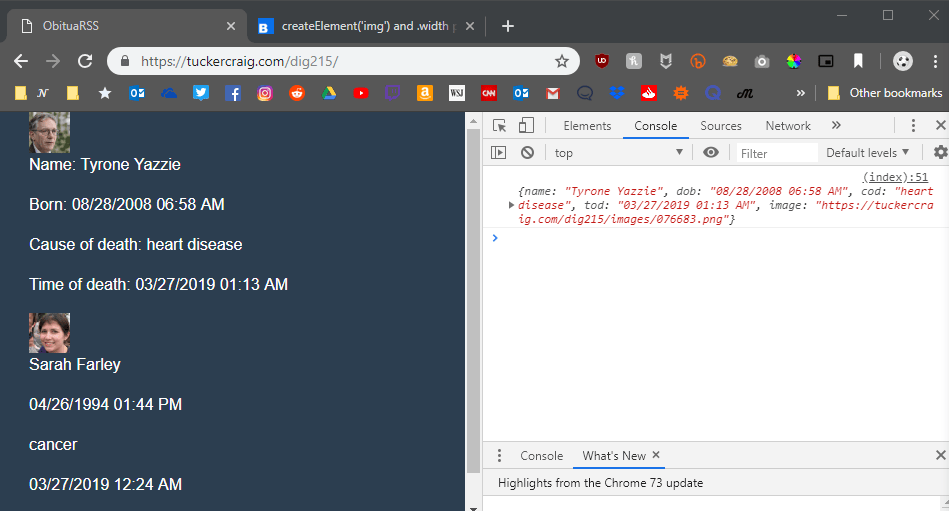
My first reaction while formulating the project was in connection to how eerie the piece is. Ordinarily private, a viewer can see information regarding each fictional, but seemingly real, death in real time. This blurred line between real and fiction was a big motivation to continue building onto the project, and reminded me of our discussions in class surrounding the eerie. The most critical points from discussions were the idea of something existing that shouldn’t normally. Giving life to death. Adding a personal aspect with the images did this two-fold, both in being able to see something dead and give it a face, but also in that the faces aren’t photographs of real people. It’s eerie because I give existence to something nonexistent. A condition for the eerie is being able to understand something “without the need for specific forms of cultural mediation.” (Fisher, 61) The faces were used to further establish a connection with the viewer, and to really capture their attention. “The face is the predominant way we recognize people.” (Sanders, 1) And I wanted viewers to know they were looking at people. Due to identifying faces being a primary nature of humans, there is no need for specific cultural mediation, thus the faces are not just good indicators to use to represent people but they’re also quite eerie.
The part of my project that motivates this idea of the eerie the most is that the probability that a cause of death will appear in the stream is equivalent to that reported by the CDC in 2016.
Simulating this stat, and modeling it, brings to life the data point. No longer is it a number on a screen, now it’s attached to a face scrolling down the stream of information.
Further, in attaching names and faces to the points, a life (or death) from anywhere around the world is represented. The goal for the scope of the project was to represent death nationwide, not just in any one location, and ordinarily the specifics of who has died is limited to listings in newspaper obituaries or what information is voluntarily put onto online obituary sites. The information certainly doesn’t reside in any one updating website, or in a way that is involuntary, as I propose my project would take form. It’s also interesting to think of the implications that come with having a single place where you can receive this data. How is it gathered, is it voluntary, who has access to it, is it anonymized, etc.
Because of how morbid the piece is, I left in some functions that ground it in the absurd, or arguably comical. For example, some images are of children’s faces while their date of birth may be 1927. Or, in addition, names may be inherently masculine like John or feminine like Jane but appear below an image of the opposite sex. Although not as obvious at first glance, when you do finally realize that things aren’t exactly adding up it gives you a psychological distraction to focus on rather than the grim subject at hand. There are validations and checks I could construct to solidify completely “the impression of an encounter with the real” (Kirkland, 117), but this interruption of the digital was a clear example of hypermediation.
I wanted the user to be aware that they were looking at something that was fabricated. It may look real, but somebody had to make it. Harping, again, on the idea of the eerie and unsettling.
Another thing I realized in working through the project is how the concept is not far fetched. Although morbid, who’s to say that a hacker with access to this data doesn’t dump information of the deceased in a similar way. Or, thinking about the future of technology, who’s to say that in the future we won’t have computer chips in us that report when we die, so someone somewhere would see a stream of information just like this.
Some additions and improvements that I wish I had implemented are mostly related to user experience. Although a tall order, implementing some sort of data visualization on top of the stream might have motivated the statistical element of the project more. In addition, in retrospect adding specific social media functions like “following” a cause of death or “blocking” something may have led to interesting phenomena. Finally something that may have motivated the more social-media-facing aspect, as well, would have been to design a logo, which would cost a lot of time and energy.
Works Cited
Fisher, Mark. “Approaching the Eerie.” The Weird and the Eerie, Repeater Books, 2016, pp. 61–64.
Kirkland, E. “Resident Evil’s Typewriter: Survival Horror and Its Remediations.” Games and Culture, vol. 4, no. 2, 2008, pp. 115–126., doi:10.1177/1555412008325483.
Sanders, Robert. “Human Faces Are so Variable Because We Evolved to Look Unique.” Berkeley News, 9 July 2015, news.berkeley.edu/2014/09/16/human-faces-are-so-variable-because-we-evolved-to-look-unique/.
http://www.nbcnews.com/id/6237364/ns/health-health_care/t/fda-approves-computer-chip-humans