Shann

Choice of Victory and Defeat as an Illusion – Chapter 3

In chapter 3 of How to Talk About Videogames, Bogost discusses the subtler meaning behind Mario Kart’s infamous Blue Shell powerup. Bogost starts off with a broad and shocking statement, mainly to lure in the reader and capture their attention. “The Blue Shell is everything that is wrong with America”. Is this true? Probably not but it will keep the reader reading and give them a foretelling glimpse of Bogost’s eventual point. Bogost claims that the Spiny Shell (because technically it’s not a “Blue Shell” – which Bogost pointedly says) represents the issue of victory and defeat, and how there is no real level playing field in true competition. The Spiny Shell is the redistribution of wealth, the consolation trophy that everyone gets, the advantage given to the losing side. The idea of a player being able to claim victory due to their skill, or lose due to their improficiency is a lie. Winners and losers get their status not from competition, but from chance. The lotto numbers falling in a line is what determines first place and last place. Whoever is graced by the Spiny Shell, and whoever is unlucky enough to be in its way.

Bogost drives these points home by examining several games while discussing the history and meaning of the Spiny Shell, as it makes appearances in several Mario games. He not only discusses Mario Kart, but also Super Mario titles ranging from Super Mario Brothers on the NES to New Super Mario Brothers on the Nintendo DS. He also alludes to the  Nintendo company itself, citing their economic issues from previous business flops and their ironic attempt to increase revenue. Nintendo had the special edition of Mario Kart 8 come with a statue of the infamous Spiny Shell. Bogost poignantly ends the chapter with a depressing notion: “There, the Blue Shell Participation Trophy overlooks the gray pavement of your cubicle… where, like Mario Kart players of every generation, you labor quietly under the false impression that someday you too will be a victor.” This stark and bleak reality that Bogost purports is a physical link between the confines of the video game and the reality of our world.

Shann in Uncategorized | 363 Words

Video Games as a Morality Training?

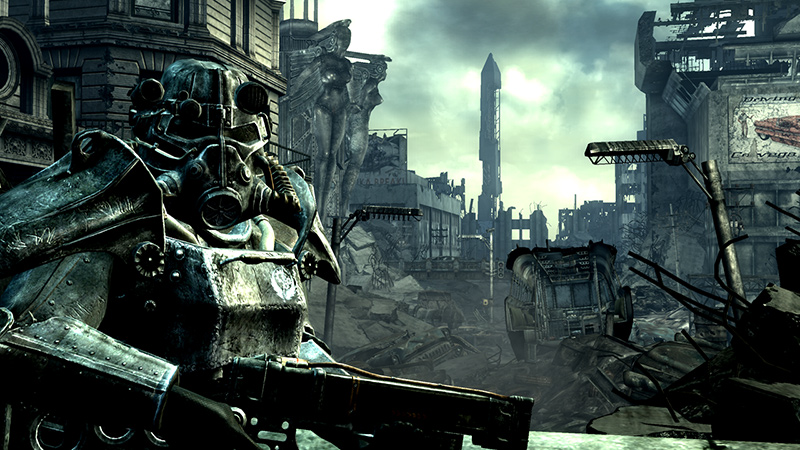
Schulzke’s asserts that Fallout (Fallout 3 in particular) serves as a moral training ground of sorts, a place for individuals to hone and strengthen their own Phronesis – Aristotle’s term for the pragmatic use of morality in real world situations. Schulzke claims that the game serves as a “half-real” world in which the outcome ultimately is fictional, but can have an effect on our whole-real world, in this case by strengthening our moral decision making. He also claims that Fallout 3 does this exceptionally, especially compared to other video games. Fallout 3 doesn’t push you towards one side of morality versus another, it doesn’t use a clunky or unintuitive system for keeping track of the player’s morality and actions, and it contains a feasible neutral standing for the player to balance on as well. Fallout 3 essentially drops you into an unfamiliar world, without any guide or suggestion as to how you should act or treat others, and let’s you do what you please.

(Schulzke mentions Megaton in his article, one of the post-apocalyptic towns that has flourished in Fallout 3’s hostile world. Yet it has an active nuclear bomb in the middle of it that can be tampered with. The player can choose to set it off, deactivate it, or just leave it alone, all with unique rewards and consequences.)

This allows the player to truly become immersed in the game and its situations, and make their own decisions and see their impact due to Fallout’s complex and involved karma system and its retributions. Schulzke makes good points, and even since 2009, systems for letting players’ choices and moral decisions have true gravity in a game’s environment have improved beyond Fallout’s qualities. But can it ever be perfect? Can we ever achieve a perfect “half-real” world, where it can train us just as well as the real world, but in a fictional environment? Personally I don’t think we can, just due to the fact that we know its fake. The stakes can be made higher artificially, but never can they match real life and its truly permanent and reaching consequences. After all, you can’t save in real life before a crucial moment or decision. You can’t turn off real life and escape to something else after a bad judgement call. So while games like Fallout 3 have value as training devices for Phronesis and morality, they cannot completely prepare us for what challenges lie ahead of us in the “whole-real” world.


Schulzke, Marcus. “Moral Decision Making in Fallout.” Game Studies 9.2 (2009): n. pag. Web. 19 October 2016.

Link to article:

http://gamestudies.org/0902/articles/schulzke

Shann in Uncategorized | 438 Words

How could I “Fallout” of reality so easily?

One of my favorite video game series is the Fallout series. I first started playing one of the iterations in the series (Fallout 3) about three years ago, and I’ve been hooked ever since. Fallout is an RPG, with a massive and wide open world space. You are encouraged to traverse and explore this wide open space at your own time and pace, although there are main and side objectives for you to complete and a story to follow. This meshes quite well with the other defining characteristic of Fallout – its setting. All Fallout games take place in a “retro-future”, the future (about 2270) but it’s the future that the 50’s and 60’s imagined. Robot butlers, laser and plasma weapons, nuclear energy that powers everything from houses to cars, vacuum tube technology, even powered suits of armor used for warfare. In 2077 nuclear war broke out and modern civilization was ended for the most part. Radiation now covers the barren and destroyed landscapes. Fallout 3 takes place in the ruins of Washington DC, and you are dropped right into the middle of it two hundred years after the nuclear war. You must deal with mutated creatures, radiation, hostile raider groups, new towns and civilizations that have popped up, various factions and their goals, and you must utilize both old and new technology to stay alive. All of this transported me to another dimension, another world that I was sucked into. I wanted to explore everything – the landscape, the weapons and tech, the remnants of familiar landmarks now scarred and the new places that have been built, the alien and sometimes horrifying creatures, all while struggling to survive and thrive in a hostile environment. I would play for hours on end, and whenever I finally came back to the real world, I had a mix of emotions. Sometimes I would feel bored, or anxious to get back to the Fallout world and continue my travels. Other times, especially after long playing sessions, I would actually feel relieved. I would start to feel bored and pointless while playing Fallout, and when I stopped I felt relieved to do something else. Eventually though Fallout always called back to me and I felt the itch to explore the Capital Wasteland once again.

Shann in Uncategorized | 376 Words

Links for 9/28 class

https://www.google.com/patents/US6419587?dq=playground&hl=en&sa=X&ved=0ahUKEwjEy72w-7DPAhWGej4KHY5CC544FBDoAQhMMAc

https://www.google.com/patents/US4630819?dq=playground&hl=en&sa=X&ved=0ahUKEwiPspij-7DPAhVCGz4KHYbjDhoQ6AEIKjAC

https://archive.org/details/jstor-20560644


Shann in Uncategorized | 42 Words

Roundabout – Social or Just Traffic?

For my public space I examined the small walkway roundabout that is located outside of Chambers, and contains the Waves III sculpture in the center of the circle. Upon first arriving I immediately noticed some key things about the layout which hint at its purpose but also its more unintended purposes. The circle rests at a crossroads of sorts, as it has five separate paths that branch off and go to other places on campus: Chambers, the various dorms, the Library, Union, etc. At the center of the crossroads stands Waves III, and serves as a point of interest. Around the circle in the surrounding grass is a bench, and four outdoor lounge chairs; trees are scattered around and provide shade. First thought seems to suggest that this place is a place of pragmatic use, walkways leading to where you need to go, with some nice decorations to smile at but not stop for. And I observed this behavior frequently. Even so, I noticed that the opposite was also happening. While this place does facilitate a simple “point A to point B” mentality, others stopped and talked. They used the statue and the small perimeter of bricks around it as a place to stop and relax, and even to play Pokemon GO. The chairs contained people reading, enjoying a nice atmosphere and opening themselves up to interaction, even though they are doing an inherently individual activity.

The pragmatic aspect is still dominant though, as I saw multiple people walking to class or other destinations, joggers, cyclists, even a grounds crew golf cart rode very close to the circle (although not on it directly). The location of the place itself does make it a very practical place for people trying to reach different locations on campus. So individuals don’t feel compelled necessarily to stop and say hello to everyone, it’s understood that they have a goal and need to reach it. Groups of people travelling together stay that way, as they keep within their bubble as they reach their group goal. The circle overall does have an interesting ambivalent design, as it is quite practical, but still has enough superfluous structures and accessories that it can also serve as a place of social engagement. The chairs, bench, and statue aren’t needed for the roundabout to serve its function. However since they are present, the space does not become a solely functional space, it also opens it up to more possibilities of social interaction and recreation.

Shann in Uncategorized | 417 Words

Settlers of Catan – a Different Kind of Board Game Politics

Most people have heard of Risk or any of its derivatives, but a lesser known game that is similar is called “Settlers of Catan”. Both games are alike in that each player is its own team, each player attempts to control spaces on the board, informal truces and alliances are made and shattered; but the games are different as well. I have only played Catan twice, while I have played Risk numerous times. However having played Risk several times over many years I cannot recall one instance of myself claiming victory, or of a game officially ending for that matter. Meanwhile Catan I have played twice – and won twice. This is due to their differences in how they are structured, and therefore how their politics and political experience vary for the players.


Risk obviously has a strong political aspect that is vital to the game. Its rules, premise, and end goal all mirror our own world, not perfectly, but closely in terms of absolute war. The end goal is power, and everyone tries to achieve military power, albeit in different ways. Catan is more abstract, and therefore so is its politics. Rather than complete control of the board as the winning condition, as is the case in Risk, Catan uses a point system and a certain number of points is necessary to declare victory. Catan is much more flexible in how you can win, making its politics much less obvious and much more subtle – as it is harder to guess people’s true motives and goals. Points are dependent on several things, but when I won both times I won due to having the longest road. Roads are relatively cheap to build but still require resources, and have limited benefits compared to other things they could build. Therefore most of the people in my group didn’t like to build them more frequently than they had to. So in this way they unconsciously ignored my point grab as I built up a very long road. Catan’s politics is a much more complex one compared to Risk, and better parallels our increasingly intricate political world as people’s motives and true goals can be obscure and unpredictable.

Shann in Uncategorized | 369 Words

Wrestlemania – An Appropriate Title

While Barthes was discussing wrestling, albeit sixties french wrestling, I couldn’t help but immediately agree with Barthes and his analysis of the “sport” called wrestling. Now everyone knows the running joke is that wrestling is fake, and pretty much everyone knows that professional wrestling (WWE at the very least) is not so much a sport with winners and losers but more akin to a theater production. That’s not to say it isn’t worthwhile or entertaining, professional wrestling is a spectacle that can easily wow and enrapture people’s attention – and it’s that way by design. Barthes managed to bring up a point that I instantly and wholeheartedly agreed with, that wrestling is a show not a sport. And with such glamorous and ridiculous events such as Wrestlemania, it’s not hard to see how.

Professional wrestling was always something I enjoyed joking about with my friends, after all it is quite ridiculous. The costumes, the venues, the moves, the characters, the commentary, all of it creates this image of ridiculousness that I always enjoyed chuckling at. It’s not just fake, it’s quite obviously staged and overly dramatic. Just looking at the logos and the names of wrestling events it’s very clear that a grand and silly show is about to take place. I find it surreal and humorous, just out of sheer goofiness. Characters like Macho Man Randy Savage and The Ultimate Warrior are so quirky and ridiculous that I think they are really comedic. However as much as I enjoyed laughing at it, I never had a conflict or vendetta against it. Wrestling was not something I laughed at cruelly, it was something I found funny and therefore entertaining. Wrestling has accomplished its goals of capturing my attention, and although I and many other know it to be fake, we don’t care as the spectacle itself is still enjoyable and present.

Shann in Uncategorized | 320 Words