Lumosity is a lie

In my previous blog post, I spoke to how the design of Lumosity’s game and interface was heavily influenced by the “projected identity” of the player. This is not to evaluate the effectiveness of these brain games, but highlights the dynamic a desire to become intelligent and trust in technology to satisfy this goal. Lumosity’s […]

In my previous blog post, I spoke to how the design of Lumosity’s game and interface was heavily influenced by the “projected identity” of the player. This is not to evaluate the effectiveness of these brain games, but highlights the dynamic a desire to become intelligent and trust in technology to satisfy this goal.

lumosity_1_1
Lumosity’s marketing targeted consumers who felt a need to become smarter. The “real world” identity of its consumers included people with serious medical conditions, older adults who were experiencing age-related cognitive decline, and students. The “virtual identity” was a concrete profile that Lumosity provided with age comparisons, self-evaluations, and etc. The “projected identity” of these targeted consumers drove Lumosity’s marketing, but was never backed up by scientific research. According to Jessica Rich, Director of the FTC’s Bureau of Consumer Protection, “Lumosity preyed on consumers’ fears about age-related cognitive decline, suggesting their games could stave off memory loss, dementia, and even Alzheimer’s disease.” Lumosity not only used the “projected identity” as their key marketing aspect, but highlighted how the games were co-designed by game designers and scientists. This raises some key issues about the human behavior: what makes science and research so ‘promising’ without question? What makes a piece of technology a qualified evaluation tool? Maybe their clients got tired of “traditional” ways of training their cognitive abilities, and found the appealing brain games more trustworthy.
When I reflect on my experience with the game, I have to ask: Do I believe that they made me smarter? I had fun, which is why it’s a casual game according to Juul’s definitions. As an educator, I did not find the games effective because the content is not situated, and therefore not translatable. The game designers focused so much on the procedural style of learning skills that they failed to create content that was contextualized in real-world experiences and isolated these skills to their steps and not their application. My “projected identity” is being developed in other ways, and without the need to rely on brain games that tell me I’m smart.


References:
Lumosity to Pay $2 Million to Settle FTC Deceptive Advertising Charges for Its “Brain Training” Program
Mind the gap: What Lumosity promised vs. what it could prove

The Shackles of Pokémon X

The Pokémon game series is one of the most popular and successful handheld game franchises in modern history. The formula of each game is similar—players take control of a young adventurer who seeks to raise a strong team of Pokémon … Continue reading →

The Pokémon game series is one of the most popular and successful handheld game franchises in modern history. The formula of each game is similar—players take control of a young adventurer who seeks to raise a strong team of Pokémon to defeat opponents in battle. It has been many years since my last Pokémon experience, so it was extremely nostalgic for me to play Pokémon X. While playing the game, I was immediately struck by how limited I was as a player, especially for a game that appears to give players so much choice.

Within the narrative framework of the game, the protagonist lives a life of relative freedom. For example, even though the character is only 10 years old, they can explore the country unaccompanied by an adult and can make decisions about which towns to visit, and which Pokémon to battle and which to raise. Unfortunately, this freedom is not mirrored in the player’s opportunities. During my experience playing Pokémon X, I found the game to be extremely oppressive in what actions I could undertake.

This image shows the map of the Kalos region, with each town and route labeled

This image shows the map of the Kalos region, with each town and route labeled

As seen from the map above, the Kalos region—the name of the country where Pokémon X is set—is quite expansive. However, the player is not able to explore all these paths at any moment. In some instances, non-player characters will block some of the routes and tell the player, “you do not want to go that way,” if the player attempts to pass. In other instances, some type of object will be blocking the path and the player is unable to pass unless they undertake a side quest to give them the ability to move the object.

At this point in the game, a snorlax blocks the character's way, so they must travel down Route 7 to retrieve a flute to wake the Pokémon up

At this point in the game, a snorlax blocks the character’s way, so they must travel down Route 7 to retrieve a flute to wake the Pokémon up

The other aspect of the game that I found limiting had to do with the actual Pokémon raising. Though there are hundreds of Pokémon that inhabit the Kalos region, the player is only able to hold 6 in their party at a time. As Pokémon get stronger by battling other Pokémon, the game almost advocates for the player to choose a core 6 Pokémon and stick with them to compete against the stronger trainers encountered later in the game. The game even forces the player to catch the games legendary Pokémon, Xerneas, at one point in the game, eliminating the player’s choice altogether.

The left side of this image shows the maximum 6 Pokémon in the players party while the right side shows the Pokémons maximum number of four moves

The left side of this image shows the maximum 6 Pokémon in the players party while the right side shows the Pokémons maximum number of four moves

Also limiting is each Pokémon’s ability to only know 4 moves at a time. Whenever a Pokémon levels up and attempts to learn a new move, the player must choose one of the original moves to forget. Much of the time, once the Pokémon forgets a move, it is gone for good. These limitations imposed on the player combine to create an experience that I found extremely frustrating, especially when I compared my experience as a player to the experience of the protagonist within the game’s narrative.

Image Sources

  1. http://www.serebiiforums.com/showthread.php?594375-The-Kalos-Region-Thread
  2. http://www.gamerguides.com/pokemon-xy/main-walkthough/to-gym-2-part-1/route-7-riviere-walk-1st-visit
  3. http://kotaku.com/tips-for-playing-pokemon-x-y-1444982237


Problems of Identity in brain games

During the initial tutorial stage in which Lumosity accustoms you to the interface and gameplay, the game uses statistical data to compare you against other players in your age range. Your performance is represented on a bell curve. When you performed poorly, the game’s text remains “juicy” by directly rewarding your intent and ignoring the […]

During the initial tutorial stage in which Lumosity accustoms you to the interface and gameplay, the game uses statistical data to compare you against other players in your age range. Your performance is represented on a bell curve. When you performed poorly, the game’s text remains “juicy” by directly rewarding your intent and ignoring the game score. When I see that I have performed better than the majority, it was an ego boost and bar that was raised for myself. On the other hand, when I performed under the average, I was determined to better myself and more importantly, beat them. Once the tutorial is over, the game no longer compares you to other players, but instead measures your high scores and encourages you to be better than your ‘previous’ self. The design is meant to invoke competitive game play, and creates a difference experience when the competitor is oneself. This type of priming is intentional, and feeds into what James Paul Gee defines as the “projected identity.” This identity bridges the “real-world” identity with the “virtual” identity. According to James Paul Gee, the projective identity is to:

“project one’s values and desires onto the virtual character and seeing the virtual character as one’s own project in the making, a creature whom I imbue with a certain trajectory through time defined by my aspirations for what I want that character to be and become.” (page 55)

Lumosity continues to feed and prime my “projected identity” through a variety of ways. The juiciness is always encouraging of any progress that is made. When I don’t perform as well as I hope to, it never communicates that negatively. The explanations of games and their purpose prime me into believing that the game will help me develop a certain skill. Lumosity has the illusion of unmasking the ‘black box’, although I, as a player, have no idea how tapping on train tracks or swiping on the screen makes me a better multitasker.

394735-lum

In my third blog post, I will discuss more in depth the effectiveness of these brain games and the role of the “projected identity” in Lumosity’s marketing and design.


References:

Gee, James Paul. 2003. What video games have to teach us about learning and literacy. New York: Palgrave Macmillan.

Pokemon Un(Nuz)Locked

The Pokemon games have always easy to play. Its game mechanics fit into the “easy to play, hard to master” philosophy nicely. Pokemon: Alpha Sapphire takes these easy mechanics to a new game level by introducing mechanics that make this fairly easy game somehow even easier. Pokemon now receive experience from battling Pokemon that don’t … Continue reading “Pokemon Un(Nuz)Locked”

The Pokemon games have always easy to play. Its game mechanics fit into the “easy to play, hard to master” philosophy nicely. Pokemon: Alpha Sapphire takes these easy mechanics to a new game level by introducing mechanics that make this fairly easy game somehow even easier. Pokemon now receive experience from battling Pokemon that don’t faint but get caught, and the EXP (experience from battle) share applies to the whole party (as implemented first in Pokemon: X and Y). Gone are the days of having to use then promptly switch out a weak Pokemon to a stronger one. For someone who’s played Pokemon—one of the most formulaic games series ever—for a good bit, this gets really boring. However, while I was browsing the internet during my play session of Alpha Sapphire (it got so boring), I discovered a meta-game older Poke-players called the Nuzlocke challenge. It definitely makes things more interesting.

The Nuzlocke challenge is something a self-proclaimed “bored not-yet webcomic artist UC Santa Cruz” (Nuzlocke.com). This student, the one known online as Nuzlocke, started a play through of the original Pokemon Ruby in 2010 in which he implemented two rules to make the game more interesting and difficult. On his website, Nuzlocke states that “1. He could only capture the first Pokemon he encountered in each new area. 2. If a Pokemon fainted he would consider it dead and release it” (Nuzlocke). These are the two main rules of any Nuzlocke challenge but each user can add other rules to further increase the difficulty. According to game journalist Patricia Hernandez, these other rules are frequently added to Nuzlocke playthroughs: “You can’t play with traded Pokémon, unless it’s a Pokémon an NPC can trade you. 4. No resets. 5. If you black out (as in, if all the Pokémon in your party faint), that’s it. The playthrough is done. Game over. You gotta restart if you wanna keep playing…Banning the use of Potions and healing items…No catching/using Legendary Pokemon…Pokemon must be nicknamed” (Hernandez). These player-added and self-disciplined rules exponentially increase the difficulty of a game designed to be extremely simple. The older Pokemon players made a game out of a game (a metagame, if you will) to fulfill a need for challenge. This exemplifies how adding rules can change the whole meaning of a previously well-established game. 

However, the most interesting to note in players’ responses to their Nuzlocke runs isn’t so much the marvel at how much more difficult the game is. What struck me most about their responses is that players reported becoming much more attached to their digital pocket monsters. In addition to the ownership they got from having to name their Pokemon, the added stake of “death” (releasing a Pokemon) really makes players acknowledge the bond they form with these digital creatures you spend so much time training and using. One YouTuber, ProJared, whose finale of a Nuzlocke run I watched was legitimately yelling and on-edge during his battle with the champion of the Elite Four. I know he was doing it for an audience, but I could still genuinely feel his frustration, anxiety, and genuine connection to Pokemon he managed to level up for presumably many hours among countless close calls and “deaths” of many other good Pokemon (here’s a link to the video if anyone’s interested: https://www.youtube.com/watch?v=zlSbrwxPZso&index=36&list=PLO7ChEvlE6fcO8tMq7hhuf5qy1cwZyp6e; ProJared). Not only can the metagame of Nuzlocke add difficulty, it can also make you attached to the cute little creatures who can get taken away from you like those you love in real life. Nuzlocke has strengthened the nostalgic connection to Pokemon for older players, bringing an element of reality into a game of absolute fantasy. 

Works Cited:

Hernandez, Patricia. “Think Pokémon Omega Ruby and Alpha Sapphire Are Too Easy? Try This.” Kotaku, 26 Nov. 2014.

ProJared. “Nuzlocke Challenge – FINALE: The Champion.” YouTube, uploaded by ProJared, 10 Sep. 2013, https://www.youtube.com/watch?v=zlSbrwxPZso&index=36&list=PLO7ChEvlE6fcO8tMq7hhuf5qy1cwZyp6e.

“What is the Nuzlocke Challenge?” Nuzlocke.com, http://www.nuzlocke.com/challenge.php.

Pokemon aren’t really real (Ryan Rotella)

In theory, the concept of Pokemon seems dark and bloody. People roam and wander throughout the world to hunt and capture wild, cute creatures into storage devices (either portable spheres or files on a computer). These creatures are then used to fight other similar creatures against people who have nothing better to do and stand … Continue reading “Pokemon aren’t really real (Ryan Rotella)”

In theory, the concept of Pokemon seems dark and bloody. People roam and wander throughout the world to hunt and capture wild, cute creatures into storage devices (either portable spheres or files on a computer). These creatures are then used to fight other similar creatures against people who have nothing better to do and stand around all day looking to fight at anyone who walks through their gaze. It sounds pretty grim. Until you play the actual game, which has delightful graphics, a sunshine view of people and Pokemon in harmony, and fun. Pokemon’s really fun (a shocking take, I know). In my last post, I said that this game was essentially capturing and having animals fight for my personal glory; this game is still that but after further thinking, that doesn’t ruin the game. This is because Pokemon has no root in reality and never claims to simulate real life, only create a new world of Pokemon. 

Galloway states for a game to be founded in realism (as opposed to realisticness), it must have “a true congruence between the real political reality of the gamer and the ability of the game to mimic and extend that political reality” (Galloway 83). Pokemon (before Pokemon X and Y, which features a story centered on the ethical dilemma of Pokemon fighting) does not attempt to match any sort of genuine political reality of the gamer. Sure, the human characters look like cartoon people but still human people. I have to walk to a store to buy products, and I make money off of winning competitions I strategize and train over (yay capitalism). The argument can even be made to critique the flawed Silicon Valley ideal implicit in being “the best like no one ever was” (Pokemon Theme Song lyrics). But that kind of theorizing comes off of as kind of ridiculous. No player ever goes into Pokemon with the expectation that it is depicting the “real world” or any circumstances relevant to the player. If anything, Pokemon, especially the remake Pokemon: Alpha Sapphire, is escapist entertainment, promising a clear fantasy world that gives the player more control than they do in real-life. In military simulators like America’s Army and Under Ash, these games are designed to be realistic simulations and stories of war and modern armed conflict. Both act as sites where player can take the roles of marginalized people in these conflicts (more convolutedly in America’s Army) and experience similar actions in the digital world that a player might experience in their real social reality. This is why Galloway examines military games in that chapter (“Social Realism”) of his book (Gaming: Essays on Algorithmic Culture). Transplanting social realism to fantasy games is ineffective because these games have no reality rooted in the actions within the game world.

For this reason, the game PETA released to protest the animal fighting, Pokemon: Black and Blue, has gotten mainly negative responses (apparent in any comments on any review or mention of it) (Schreier). PETA tries to argue that the combat system that uses Pokemon in the whole Pokemon series is akin to real-life animal fighting. These games, therefore, numb people to real-life animal fighting and normalizes it. PETA, in its parody game, places players in the roles of Pokemon who try to liberate other Pokemon from their cruel and abusive human trainers. I will admit this concept would have been very poignant if it were applied to any real-world context, not Pokemon. PETA ruins their aim for a socially realistic game by attacking fantasy, satirizing a world that everyone recognizes as not tied to reality in any way other than the digital world. There has not been an increase of kids trying to capture wild animals and have them fight for sport to the death. Even 8 year olds know that Pokemon is not real. However, if their game placed players in a more realistic rooster about to fight for a group of digital people in a realistically-looking barn in rural Alabama, PETA would have an effective game. But Pokemon isn’t the grim bloody reality that is real animal-fighting. And we shouldn’t pretend it is when we talk about it. Don’t get me wrong. Using pocket monsters, some of which are based on real animals, to fight for sport is still weird and a little unsettling. Then again, there are three Pokemon based off of ice cream and one that is based on a chandelier. So, let’s not treat the former card game (turned digital game) as a pure work but let’s also not treat as the most insidious cultural artifact. I would rather focus on saving endangered turtles by the Great Barrier Reef (which is close to dying) than make sure my Blastoise is safe. 

Works Cited:

“Chandelure.” Bulbapedia, http://bulbapedia.bulbagarden.net/wiki/Chandelure_(Pok%C3%A9mon).

Galloway, Alexander R. Gaming: Essays on Algorithmic Culture. University of Minnesota Press, 2006. Print.

Jon D. B. “25 of the Most Useless Pokemon in the History of the Franchise.” Image #21 from  Playbuzz, 23 Nov. 2014, http://www.playbuzz.com/jonb10/25-of-the-most-useless-pokemon-in-the-history-of-the-franchise.

“Pokemon Alpha Sapphire for Nintendo 3DS.” Toys R Us, http://www.toysrus.com/buy/kids-family/pokemon-alpha-sapphire-for-nintendo-3ds-ctrpecle-41442386. 

Pokemon X. “Pokemon Theme Lyrics.” Metro Lyrics, http://www.metrolyrics.com/pokemon-theme-lyrics-pokemon.html.

Schreier, Jason. “Humans Are the Enemy In This Ridiculous PETA Pokémon Parody.” Kotaku, 8 Oct. 2012, http://kotaku.com/5949895/humans-are-the-enemy-in-this-ridiculous-peta-pokemon-parody. 

When casual games become ‘fruitful’

Lumosity is marketed as a game that was co-designed by game designers and scientists to improve the player’s cognitive functions. This simple wording already forms the basis of their conditioning, but it definitely works. The app has a mini-game that opens explaining what cognitive function it strengthens. The games are ‘scientifically’ broken down into five […]

Lumosity is marketed as a game that was co-designed by game designers and scientists to improve the player’s cognitive functions. This simple wording already forms the basis of their conditioning, but it definitely works.

lumosity-home-page-image-11

The app has a mini-game that opens explaining what cognitive function it strengthens. The games are ‘scientifically’ broken down into five different modes: velocity, flexibility, resolution of clues, attention, and memory. I play each game with these goals in mind (sometimes not always understanding exactly how the mini-game is designed for these goals). The game mechanics are simple, which usually require just a touch to the screen. Because the game rules themselves are sometimes difficult to grasp the first time, Lumosity does a great job at scaffolding with short, easy tutorials. When I get combos or correct answers, the sounds are pleasant. When I mess up, the game makes an unpleasant, yet gentle sound and sometimes allows the player to correct their error. Failure is just as accepted as it is in Lumosity as it is in any other game. The game is so ‘juicy’ with encouraging text after each game, lots of in- and out-of-game compliments, no matter how well or bad I performed.

As a response to the exclusivity of hardcore games, Jesper Juul has defined casual games as a game for all ages that have the following five characteristics: fiction, usability, interruptibility, difficulty, and ‘juiciness.’ In the table below, I will judge Lumosity according to Juul’s characteristics for a casual game.

Doesn't he just look so much smarter?

Doesn’t he just look so much smarter?


References:

Jesper Juul, A Casual Revolution, chapter 2

The Nostalgic World of Pokémon (Ryan Rotella)

When I got Pokemon: Alpha Sapphire from my parents last Christmas, I was surprised. I didn’t ask for it; in fact, I hadn’t picked up a Gameboy of any kind in at least 5 years. Davidson’s time-draining combination of a rigorous workload and a buzzing social life makes playing videogames an inefficient, occasional luxury (except when you … Continue reading “The Nostalgic World of Pokémon (Ryan Rotella)”

When I got Pokemon: Alpha Sapphire from my parents last Christmas, I was surprised. I didn’t ask for it; in fact, I hadn’t picked up a Gameboy of any kind in at least 5 years. Davidson’s time-draining combination of a rigorous workload and a buzzing social life makes playing videogames an inefficient, occasional luxury (except when you play for them class, thanks Dr. Sample). I decided to dedicate time to this Pokemon game because I wanted to re-examine a series that took up so much time in my childhood. I am not exaggerating when I say that I played Pokemon everywhere growing up. I played it when I ate breakfast, waited on the bus, sat on the bus, sat at dinner while eating too much bread, you name it, I was playing a Pokemon game (usually Blue or Sapphire). I had to be pried away from my GameBoy Advance SP often, just so my parents could socially interact with me. I inhabited the world of Pikachus, Caterpies, and Gyradoses daily, trying so hard to be the very best like no one ever was. So, with any video game HD remake, I wanted to step back into that world through a nostalgia-filled commodity and find out why this game took such a strong hold on my young life.

But then I got bored pretty quickly into this game. I remembered that literally every mainline Pokemon game (that is, ones made for Gameboys that weren’t dungeon explorers) is essentially the same thing. I choose a character that’s either a boy or a girl, I have a rival, I choose a starter, I say goodbye to my mom, and I venture off into the world of Pokemon and gym battles. The only differences in the games are different items, different Pokemon, and better graphics. There are some competitive stats that get added throughout the series for the serious, online competitive players, but I never cared about that when I played. In this remake, there are no new Pokemon at all. By definition, it’s the same Pokemon from the original Sapphire in an updated game. I moved through a prettier, 3D animated Hoenn region with running shoes automatically on this time around, and it was nice…for like 20 minutes. I was walking around and playing the same game I already knew. I will say the turn-based mechanic of fighting and managing Pokemon is still addictively fun. Pokemon, with its customizable four move set and item management, has a very unique take on combat. That and its art design have made it into the success it is today and might be the reasons I loved these games so much. Each battle was an achievement in strategy and management with cool creatures, even if it was essentially animal fighting. I, nor most other 10 year-olds, typically don’t pick up on the animal-fighting bit because we didn’t know it existed and the cute fantasy of Pokemon masks the gruesome reality of animals maimed and killed for idle sport. So you could say the nostalgia has worn off greatly, but I still appreciate the fun I had in this weird, uber popular game. As with most media rooted and marketed in nostalgia, I don’t regret playing the remake of a game that made me happy, but I’m really glad I don’t anymore. I can’t really enjoy making wild creatures my possessions and fighting for my glory and image as a masterful trainer while sitting isolated staring at a screen for hours on end anymore. Thanks, Davidson, for giving me a life and making sure I never see the world the same way again.

Notions of Love in Dating Sims

While most of Joel Gn’s article, “Cute Technics in the Love Machine,” gets spent talking about the “cute” elements of dating sims (ones designed for male players), he argues that despite controversy, dating sims reinforce standard beliefs about relationships and love. Mystic Messenger, like other dating sims, also reinforce these ideas, but not in the…

Read More »

While most of Joel Gn’s article, “Cute Technics in the Love Machine,” gets spent talking about the “cute” elements of dating sims (ones designed for male players), he argues that despite controversy, dating sims reinforce standard beliefs about relationships and love. Mystic Messenger, like other dating sims, also reinforce these ideas, but not in the same way Gn believes.

Gn claims that “the dating sim does not alter, but repeats and even formalizes the interactivity of love with a software construct.” Essentially, because the player’s only have certain options they can respond with, they must progress on one of the game’s paths. These paths follow general set patterns about love. For example, in MM, when romancing Zen, the player starts by talking with him frequently for several days, then they meet up with him and go on a date of sorts. Afterwards they continue to talk and plan to visit each other again. This follows the course of a regular relationships, where people talk, go on dates, and get closer over time. If the player wants a romance with Zen, they must pursue it in this way, reinforcing standard beliefs about relationships.

On the player's

On the player’s “date” with Zen they look at the stars together and then the player goes home. That is the only option, thus reinforcing standard notions of romance

Gn also argues that this is a positive aspect of the games, for they play out love like real life by following the “correct” pattern to get the result you desire. Since they’re meant to simulate dating though, the problem with entering the correct algorithm is that it doesn’t necessarily follow the player’s own thoughts. In MM, a player usually has two or three option choices for dialogue. One will generally lead to a negative reaction or no reaction, while the other will lead to a positive one. As a result, the player chooses the answer which will earn a positive reaction with the character they aim to romance, not necessarily the answer they would actually say. The game then becomes more of a role-playing scenario than an actual “simulation,” because often the responses don’t align with the player’s thoughts. While the game does repeat the generally accepted values and patterns of love, it’s not making the player go through them, but instead has the player “play” a person going through them. So while the games do reinforce societal values about love and relationships, those get transferred via roleplaying rather than actual feelings.

Even if a person would normally respond with a simple good-bye, if they want approval they must respond with the top option, making the dating sim more of a role-playing game than a simulation

Even if a person would normally respond with a simple good-bye, if they want approval they must respond with the top option, making the dating sim more of a role-playing game than a simulation

Sources:
Gn, Joel. “Cute Technics in the Love Machine.” InVisible Culture no. 21 (Fall, 2014). http://ezproxy.lib.davidson.edu/login?url=http://search.proquest.com/docview/1771515685?accountid=10427.

Is Mystic Messenger Casual?

From my last post, we know that Mystic Messenger involves an almost constant attention for at least 11 days (the time it takes for a single playthrough), because of its real-time mechanics, which would make it appear as more of a hardcore game than a casual one. However, following the criteria Jesper Jull describes in…

Read More »

From my last post, we know that Mystic Messenger involves an almost constant attention for at least 11 days (the time it takes for a single playthrough), because of its real-time mechanics, which would make it appear as more of a hardcore game than a casual one. However, following the criteria Jesper Jull describes in his article, “A Casual Revolution,” MM still counts as a casual game.

Casual games have positive valence, or have associations with happy or fun vibes. Dating sims involve romance, which have associations with love, happiness, and comfort. Although certain choices can lead to negative outcomes (or bad ends), overall MM has a positive frame work.

The romance options allow the player to choose which personality works best for them, and makes them happiest.

The romance options allow the player to choose which personality works best for them, and makes them happiest.

Casual games are easy to use, either building off conventions from outside the game or using simple mechanics that can be easily taught. MM falls into the first category, as the mechanics involve: text-messaging, email, phone calls, and a chatroom. This applies for the first 5 days, which is when the “visual novelization” mode gets added, complicating things as this doesn’t have a real-life counterpart, but even then, the other, more familiar forms still dominate.

Casual games are easily interrupted, allowing players to play for short bursts. Despite the real-time attention needed for MM, it can still be interrupted. The chatrooms and phone calls feature a pause button, allowing players to take a break. They also only take a few minutes to play, and then have hour breaks in between.

Casual games are difficult to master, but feature little punishment for failure. This is the hardest category to measure in a dating sim. Mastery would involve a complete understanding of every romance route, and both the multiple good and bad endings. In that sense, yes the game is difficult to master, but that comes from how long it takes to go through entirely, not that the game gets more difficult as you play; the types of responses you can give vary little as you progress. Also, failure can be a reward as it unlocks the “bad” ending, which many players purposely seek out.

Casual games are juicy. This works for MM because anytime the player responds with the “correct” response, a heart with pop up on the screen, and the player will receive it as a reward at the end of the chat. The game lets the players know when they’re doing the “right” thing.

The heart appears when a character approves of your comment, which is the game's juiciness.

The heart appears when a character approves of your comment, which is the game’s juiciness.

So, despite its real-time mechanics that make players constantly check it, Mystic Messenger still fits snugly into Jesper’s definition of a casual game.

Mystic Messenger: Gaming In Real-Time

While Cheritz’s most recent game, Mystic Messenger, looks like pretty much dating sim you’d download on Android, it quickly turns the tables with a relatively simple game mechanic. Most dating sims operate on a “turn” system; you get so many turns, each of which progresses the story, and when you run out, you have to…

Read More »

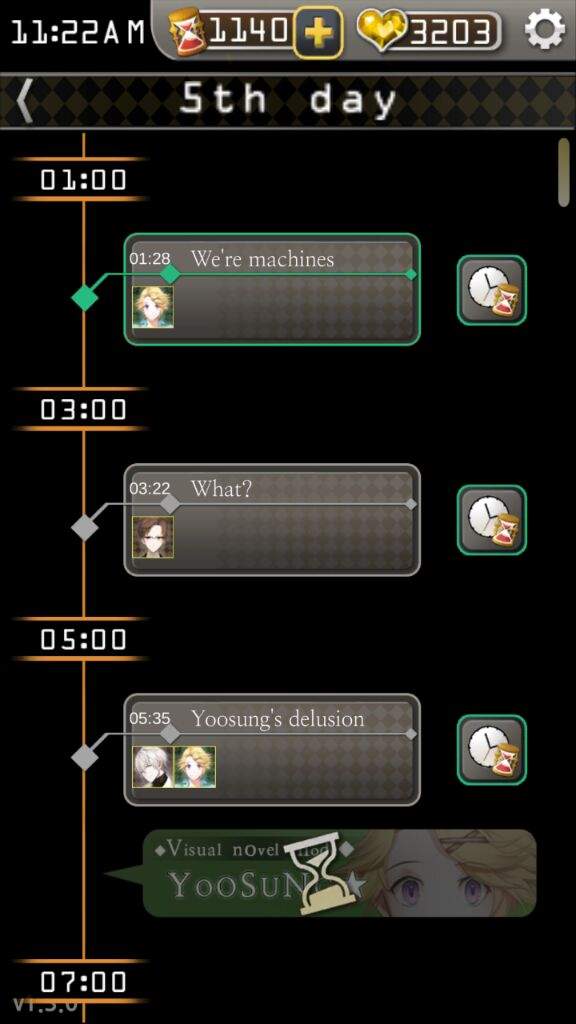
While Cheritz’s most recent game, Mystic Messenger, looks like pretty much dating sim you’d download on Android, it quickly turns the tables with a relatively simple game mechanic. Most dating sims operate on a “turn” system; you get so many turns, each of which progresses the story, and when you run out, you have to wait until the next day to get more turns (unless you pay for them, which is how the games make money). Unlike other dating sims, MM occurs in real-time. After you start the game, chats open up as time progresses, to the extent that if you don’t start the game at midnight, there’s no way to complete everything to 100%. Here’s the kicker though, if you don’t respond to a chat by the time another chat starts (the time of which varies), you miss out on participating. (Unless you buy it separately, which is how this game makes its money).

The real time method of the game, which takes place over 11 days

The real time method of the game, which takes place over 11 days

So why would MM deviate from tradition ways of framing dating sims? Simply put, it keeps players playing their game. In a tradition dating sim, you play for a day and when you’re out of turns, you quit. Maybe you come back the next day, but there’s no guarantee that you do. The story cannot progress without you, so it’s not a problem. In MM though, the story will go on. The characters will chat with each other, even if you aren’t present. There isn’t any taking a break for a few days, because a few days could cost you the entire game. Even missing a conversation could ruin your attempts to romance whichever character you choose. As a result, the game encourages a sort of “drop-everything” type of play. This keeps players engaged with the game. It’s aided by the fact that each new message received sends a notification to your phone, which leads to a constant checking of the device or the game to ensure that you aren’t missing anything.

Given that the game takes place over the course of 11 days, if the player wants to play through every romance (just good endings) that guarantees at least 55 days of consistent playing, which is probably more than many AAA games out there. Essentially, real-time serves as function to both keep players playing, or alternatively for less avid players, to get them to pay money in order to complete the game.

The hour glasses next to the chat mean you missed them, but can purchase them for money

The hour glasses next to the chat mean you missed them, but can purchase them for money