In my last blog post, I spoke about how my generational experience might influence my expectations for Final Fantasy X; I’m glad to say that I’m not alone. An editor for Playstation Lifestyle named Heath Hindman provides a reflection that compares his thoughts on the game in 2002 (when the game was recently released) with […]
In my last blog post, I spoke about how my generational experience might influence my expectations for Final Fantasy X; I’m glad to say that I’m not alone. An editor for Playstation Lifestyle named Heath Hindman provides a reflection that compares his thoughts on the game in 2002 (when the game was recently released) with a post in 2014 (when the newer, HD version of the game came out). In his 2014 piece, Hindman talks about his frustration with the “high encounter rate” which is defined by a shattering of the screen or wavy distortion that opens to a fight scene. A guest commentator, Dark Anima, wrote a post for GameCentral of Metro, and considers the battle system in FFX to be the best in all RPG. This reader comments on the slow-paced, turn-based mechanic that allows for more strategic game play. Unfortunately, I am still in agreement with Hindman: I prefer few, quick battles to resume the story than leveling up my character.
These constant fights interrupt the player’s ability to explore, which the player is left yearning for after just 5 minutes of game play. In 2002, Hindman considered the “linearity” of the game to be its biggest flaw. The game teases the player with its graphic game world scenery, but the character is still extremely limited in where he can move. According to Hindman, the game rewards those players who do explore all the terrain by placing treasure chests with useful items in far corners of the map. In certain parts of the story, the player is not allowed to re-visit an unexplored path, which can be considered a game-over with consequences.
Overall, I enjoyed the game for its story, but would not consider this RPG a good videogame for 2016. As a player, I craved more exploration and less film-like scenes.
References:
Heath Hindman, “Final Fantasy X Then And Now: Has The Game Changed, Or Have I?” Playstation Lifestyle, 2014. See http://www.playstationlifestyle.net/2014/02/09/final-fantasy-x-then-and-now-has-the-game-changed-or-have-i/
Heath Hindman, “Final Fantasy X Review,” RPG Land, 2002. See http://rpgland.com/games/reviews/final-fantasy-x/
“Dark anima,” “Final Fantasy X is the best game ever – Reader’s Feature” Metro, 2016. See
http://metro.co.uk/2016/07/09/final-fantasy-x-is-the-best-game-ever-readers-feature-5995861/
Bastion is a fairly unique indie game set in a world recently ravaged by an undefined calamity that tore the ground itself apart beneath the characters’ feet. Its central conceit, and the one that separates it from other games of its type, is that an in-game narrator relates the events of the story as you […]
Bastion is a fairly unique indie game set in a world recently ravaged by an undefined calamity that tore the ground itself apart beneath the characters’ feet. Its central conceit, and the one that separates it from other games of its type, is that an in-game narrator relates the events of the story as you play through it. This narrator provides insight into the history of the environments and enemies the player encounters and comments on almost anything they do.
The inclusion of the omnipresent and seemingly omniscient narrator is an interesting choice, one that to my knowledge few other games have attempted. It certainly fits with the story-centric focus of Bastion, though. The gameplay is fairly uncomplicated, rarely deviating from the basic tropes common to isometric action RPGs. The player can carry two weapons and one special skill at a time, each of which is mapped to a different button, and must use their weapons to defeat foes in the environment. There are some more involved character building aspects – players rapidly gain more weapons than they can carry and must chose which to upgrade and take with them, for example – but most of these building opportunities occur in the game’s central hub, fittingly called The Bastion.
The fairly uncomplicated nature of the gameplay actually works well when combined with the narrator, as it allows the player to focus on what he is saying even in the most difficult encounters. The narrator really likes to talk, and most of his lines that aren’t about the protagonist’s actions reveal facts about the world and its previous inhabitants (he describes an early arena, a bar called the Sole Regret, as “One of Caelondia’s most famous watering holes”). His anecdotes are folksy and clearly opinionated, but they keep the player constantly engaged in the story and, together with the game’s excellent music and vibrant art style, add a surprising amount of life to this dead world.
But having a narrator also sets up a certain distance between the player and the game, especially so when he begins to talk about the motivations of the Kid, Bastion’s silent protagonist. I had just destroyed the petrified form of the Sole Regret’s bartender, Rondy, when he made the above comment, suggesting that the Kid destroyed the statue out of respect for the dead bartender. The first time I ran through the Sole Regret, I destroyed the statue of Rondy primarily to see what the narrator would say about it. The Kid apparently has his own motivations for what he does in game, and the narrator knows more about them than we do.
The fact that the narrator possesses knowledge that we don’t gets a little more disturbing when you realize that he doesn’t seem to want to reveal all of it. This becomes very apparent the first time the player meets the narrator, who is a character residing at the Bastion. The narrator does not reveal what exactly was discussed during his first conversation with the Kid or even what the Kid says – players have to read the descriptions of the items the Kid brings to the narrator for this information. The narrator seemingly managed to get through this and several other conversations without revealing his name – he remains “the Stranger” past completion of the fourth level. But the most ominous instance of his reluctance to reveal information is that he still has not revealed the higher purpose of the Bastion despite implying that there is one. Supposedly, it’s capable of “fixing” calamity. But the idea of fixing something that caused as much damage as the calamity did defies logic, and the Stranger has not revealed how it will do so.
Admittedly, the Stranger is a storyteller – the game’s framing device is that he’s telling the story of the Kid’s exploits to another party, who is presumably also in-game. And you don’t want to reveal everything about a story right away, or there’ll be no suspense. But its hard to view his reticence as anything but ominous given the nature of the setting, and the way Bastion’s framing device works it can’t be just us he’s hiding things from.
My first experience with Dragon Quest V was a little embarrassing. In high school, I tried my hand at the game for over an hour but couldn’t even make it past the first area. After talking to every NPC, searching every bookshelf and chest – all to no avail – I finally resorted to an online guide (purists … Continue reading Docked at the Pirate Bay→
My first experience with Dragon Quest V was a little embarrassing. In high school, I tried my hand at the game for over an hour but couldn’t even make it past the first area. After talking to every NPC, searching every bookshelf and chest – all to no avail – I finally resorted to an online guide (purists forgive me).
Pirate players of DQV don’t get to see or explore anything beyond this initial area.
Considering the notorious difficulty of “old-school” JRPGs, my troubles would have actually been par for the course for games of this genre. DQV and many titles like it extend their already epic playtimes by refusing to guide the player any more than necessary. And when these games do offer direction, it’s often in the form of a cryptic or easy-to-miss piece of advice: a villager hints that a ghost only appears at night, or an in-game tome reveals the secret weak point of a boss enemy.
Alas, my inability to progress past the first scene had nothing to do with my Dragon Quest V’s difficulty nor my own inability to hurdle it. This was, though, still a case of JRPG developers withholding information from a clueless player.
I learned from the online walkthrough that when dev team ArtePiazza ported DQV from its home on the SNES to the Nintendo DS handheld, they inserted an intentional glitch to impede the progress of players who pirated the game. Essentially, DQV‘s code contains a series of authenticity tests, and if the game fails these, the game blocks the player from moving beyond the first area. In legitimate copies, the first chapter closes via a cutscene where the boat docks and the player ventures forth; in illicit copies like my own, that event simply isn’t triggered, so us pirates are fittingly stuck at sea for the duration of our playtime.
This time-travel animation loops endlessly in pirated copies of Chrono Trigger DS
Anti-piracy measures in video games like DQV’s endless boat ride are not uncommon. In pirated copies of Chrono Trigger DS – another SNES-to-DS port of a classic JRPG – a typically 5-second long animation of a wormhole instead loops forever. Some games punish pirates by ratcheting up the difficulty (see: Earthbound), while others opt for a more whimsical approach (see: Alan Wake, which slaps a fun pirate patch on the main character’s face). Game-publishing simulator Game Dev Tycoon goes meta by blocking thieving players from turning an in-game profit.
Anti-piracy patch (pun intended) in Alan Wake
These mechanisms are, in my opinion, a purer example of video games pulling pranks than the ones Ian Bogost describes in his chapter on the same topic. Here, Bogost cites Easter eggs and parody games as the videogame equivalent of pranks (38-39). I agree that these mechanisms do replicate the joking or mocking attitude found in most real-world pranks, but they ultimately fail to capture something that I consider an essential element: the uneven power dynamic between the prankster and the victim.
In most pranks, the prankster enjoys a moment – however brief – of complete control and total knowledge over the situation. Meanwhile, the victim of the prank is helpless and clueless, stuck pondering why the doorknobs are so slippery, why the mouse won’t work, or why this damned game can’t seem to load. The victim is saved only by a sudden “a-ha!” understanding of the situation, or by the prankster revealing his/her work – whichever comes first. I certainly had that shameful epiphany when I learned about DQV’s infinite boat ride glitch, and while I couldn’t spin around to find the game’s developers giggling at my struggle (or just grinning vindictively, more likely), I’d like to imagine they had a similar, preemptive satisfaction when they added the glitch to the game’s code.
This time around, I’m playing DQV on a legitimate DS cartridge, not a downloaded ROM file.I can’t honestly claim that the developers’ prank swayed me from my pirating ways entirely, but their effort did alert me to the human developers behind the game, and to the human pranksters chuckling in the next cubicle over. For consumers like myself, who try to justify ‘casual’ piracy by claiming that an already wealthy company/record label/developer surely won’t miss a few extra bucks, that reminder is sometimes enough.
Cited
Bogost, Ian. “Pranks.” How to Do Things with Videogames. U of Minnesota P, 2011, 37-44. Print.
In my last game log, I analyzed how the designers of Super Smash Bros. for Wii U reward longtime, dedicated gamers by packing their game full of intertextual references to so many different kinds of games for the 50+ characters in Smash. Super Smash Bros. seemed designed to be intertextual, bringing many characters (Nintendo and … Continue reading “A Hardcore Casual”
In my last game log, I analyzed how the designers of Super Smash Bros. for Wii U reward longtime, dedicated gamers by packing their game full of intertextual references to so many different kinds of games for the 50+ characters in Smash. Super Smash Bros. seemed designed to be intertextual, bringing many characters (Nintendo and non-Nintendo) under a fighting competition. In this light, Super Smash Bros. sounds like a typical fighting game for dedicated, “hardcore” gamers. The fact that there is a community of professional (paid) and extremely dedicated Smash players seems to support Super Smash Bros’s hardcore-ness (a topic for another game log). However, Super Smash Bros. doesn’t fit neatly into the binary of casual v. hardcore games. In fact, the game is extremely popular, as the Wii U iteration 4.9 million copies so in its lifespan (and the 3DS version of the game sold 8.23 million copies as well) (Nintendo Sales). Super Smash Bros. caters to all kinds of people and balances between casual and hardcore gaming effectively.
In his book A Casual Revolution, Jesper Juul outlines five components that make up his definition of a casual game: a positively-charged fiction, accessible usability, interruptibility, a tiered difficulty and lenient punishment, juiciness, which is “excessive positive feedback for every successful action the player performs” (Juul 50). Does Smash fit in this casual framework? Not really, but there are some casual components that Smash is built on. First, most Smash characters—save Solid Snake, Samus Aran, Ganondorf, and a few others—come from positive game worlds like the Mushroom Kingdom, Kirby’s Dreamworld, or Pikmin, even if these positive fictions mask a lot of cartoon violence. Second, Smash is very much a game of controlled short bursts of playing with the multiplayer mode being designed as a series of short matches that can have time limits. Turning off Smash only means leaving a single match that can easily be re-created later (unless you’re in single player mode, which, again, is a series of matches that are easily reproducible). There’s no story or large time investment Smash requires up front (unless you’re playing the Subspace Emissary in Super Smash Bros. Brawl). The units of play are quick morsels of action, not a full course RPG meal. Third, Smash has a tiered difficulty system in terms of its overall controls, where players can learn more and more advanced moves (wave-dashing and such) if they wish, or keep spamming down+B with Pikachu. However, these controls aren’t necessarily “easy to learn, hard to master” (Juul 41). With a GameCube controller, there are about 7 buttons along with the move stick that controls a player’s actions, as well as directional variants for each button; for a Wii remote held horizontally, there are 3 (4, if you like taunting) and a directional pad, which simplifies the control schemes a bit. However, Smash’s controls aren’t easy to pick up and play right away. In order for someone to learn Smash, it takes a lot of lectures from other players and playing the game over and over again. Then, after someone learns the basics, competitive mastery (wave dashing, timing tilts, etc.) is lightyears away. I do mean that in terms of time commitment and physical impossibility (for me, at least). The game further contradicts casual standards by not rewarding players for every single action (juiciness). Smash doesn’t hold the player’s hand nor reward every action. So, Smash scores a 2.5 (somewhat positive fiction, interruptibility, tiered difficulty) out of 5 on Juul’s Casual scale.
Smash is an interesting example of how blurry the distinction between casual and hardcore games really is. Smash appeals to many and doesn’t exclude based on its cartoonish atmosphere; however, Smash can offer dedicated gamers an arena of competitive mastery and genuine challenge. In this way, Smash toes the line between casual and hardcore to large financial and critical success.
Works Cited:
Juul, Jesper. “Ch.2: What is Casual?” A Casual Revolution. Cambridge: MIT Press, 2010. Web PDF.
In her article, “Game Characters as Narrative Devices. A Comparative Analysis of Dragon Age: Origins and Mass Effect,” Kristine Jørgensen examines the way that Dragon Age: Origins uses supporting characters to drive its plot. Namely, she claims the game leaves the player-character “relatively open for the player’s interpretation, only leaving certain clues that point in…
In her article, “Game Characters as Narrative Devices. A Comparative Analysis of Dragon Age: Origins and Mass Effect,” Kristine Jørgensen examines the way that Dragon Age: Origins uses supporting characters to drive its plot. Namely, she claims the game leaves the player-character “relatively open for the player’s interpretation, only leaving certain clues that point in the direction of a fictional individual.” In other words, the player-character gets influenced by the situations affecting supporting characters, but how characters react to these scenarios though gets left entirely up to who the player thinks the player-character ought to be.
I agree with Jørgensen that within the game “depth is hinted at in dialogue options, as each option reflects a different attitude and emotion, but it is up to the player to fill in motivations behind the choices that the PC is making.” The dialogue options give the players the ability to react to in-game events. They can threaten people they disagree with and get into fights, handle a situation rationally and peacefully, or try and bargain and make a profit. These choices then reflect back on the player’s perception of the player-character’s personality.
The dialogue options include being polite or threatening. The player’s choice of dialogue then “forms” the player-character’s personality.
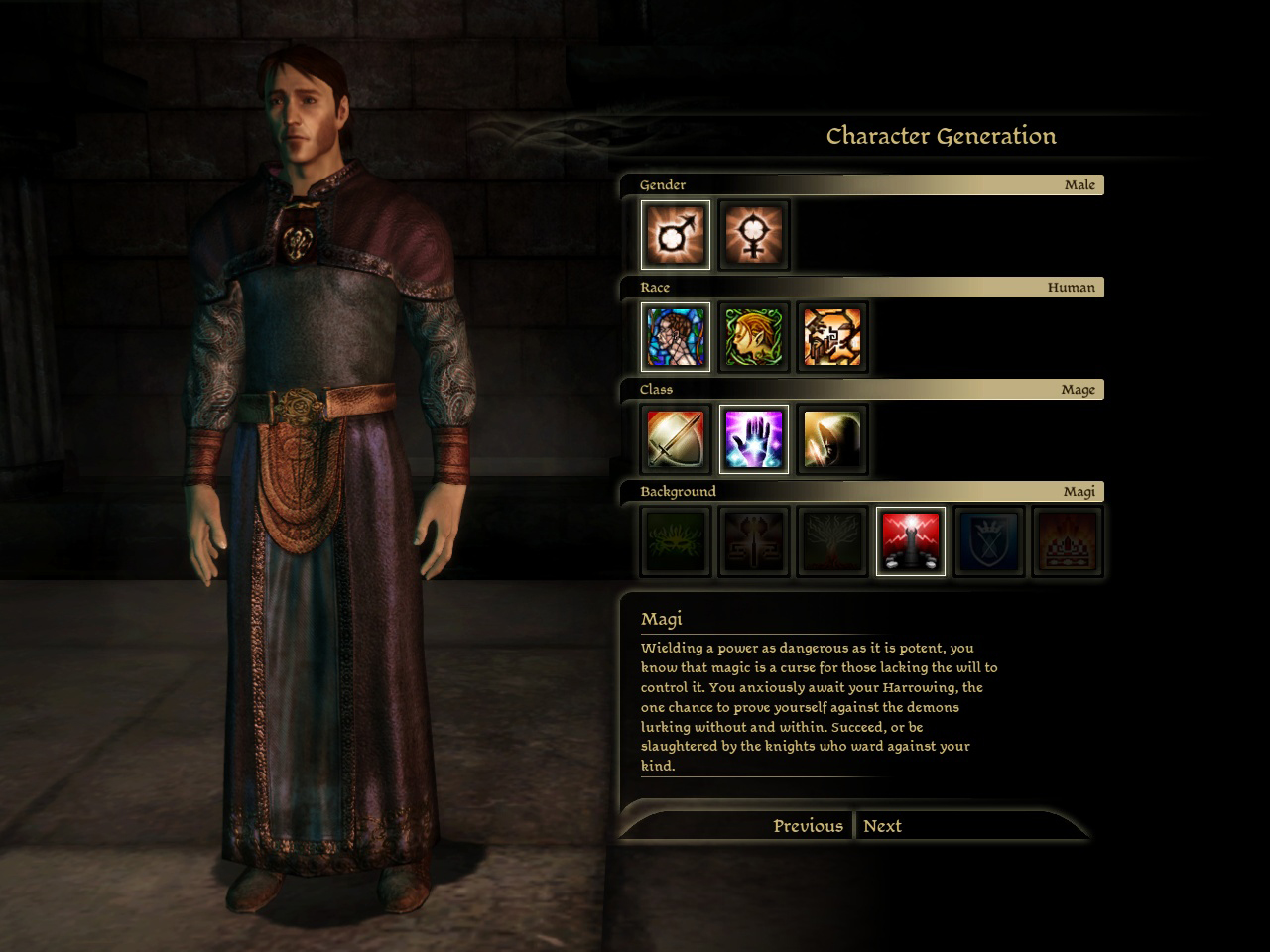
I disagree though that the player-character “is more of a blank canvas that the players can add a greater variety of personalities onto.” For example, depending on the race (human, elf, dwarf) and class (warrior, mage, rogue) the player chooses, they may have limited options of origin story. If the player wishes to play a mage they get locked into the single mage route, a human non-mage also gets locked into a route. Only non-mage elves and dwarves have choices, and then they only get to pick between two options. These origins can shape the narrative and personality of a character. For example, in the human route, the player-character loses their entire family, while in one of the elf origins, a journey through the forest goes terribly wrong. Additionally, at times in the game, certain characters with the player-character as if they know them, even if the player has had no previous exposure to them. In the human origin, when first meeting the king he speaks with you as if he knows your family and you know him, despite the player having little information on the character. While it makes sense for the player-character’s backstory, as a member of the noble family, to know of the king, the player won’t have the information, making the scene strange. The player themselves doesn’t know the character, but is expected to based on the player-character’s origin. This makes the character less of a blank slate, and more of a structure already built but waiting to be finished. It gives the player freedom to flesh out the player-character, but only via a world that has already been constructed.
Character origins gets determined by these choices, which then impacts what happens to the player-character, and therefore shapes their personality.
Sources:
JøRGENSEN, K.. Game Characters as Narrative Devices. A Comparative Analysis of Dragon Age: Origins and Mass Effect 2. Eludamos. Journal for Computer Game Culture, North America, 4, nov. 2010. Available at: http://www.eludamos.org/index.php/eludamos/article/view/vol4no2-13/192. Date accessed: 03 Oct. 2016.
In his essay on gamic action, Alexander Galloway notes that many turn-based role-playing games (RPGs) and strategy games are essentially games of menu navigation, wherein most or all gameplay takes place within menus (14). This is certainly the case for Square Enix’s 1992 RPG classic for the SNES, Dragon Quest V: The Hand of the … Continue reading War Stories→
In his essay on gamic action, Alexander Galloway notes that many turn-based role-playing games (RPGs) and strategy games are essentially games of menu navigation, wherein most or all gameplay takes place within menus (14). This is certainly the case for Square Enix’s 1992 RPG classic for the SNES, Dragon Quest V: The Hand of the Heavenly Bride (henceforth abbreviated to DQV). Much like early entries in its sister series Final Fantasy, players coordinate and complete battles in DQV by issuing commands to their party members. Players choose from “Fight”, “Tactics”, or “Flee” at the start of each turn; once the party’s actions are locked in, the protagonists and enemies trade blows until one side falls.
Dragon Quest V’s battle screen
Interestingly, DQV (and most other games in the Dragon Quest series) renders battles from a first-person perspective. High-quality pixel portraits of demon foes confront the player, and enemy attack animations gradually grow in size to create an illusion of moving through the screen and toward the player. Similarly, the protagonists’ own attack animations emanate not from sprites of the heroes (which are never shown during battle) but from thin air, as if the player himself/herself is wielding the whip, staff, or axe. This setup stands in marked contrast to the battle scenes of early Final Fantasy games, which display both the player’s party and any enemies meeting on the battlefield.
Final Fantasy’s battle screen
I could certainly write an entire game log entry on the effects of having DQV’s enemies face and attack the player directly, and of the heightened identification this induces with the game’s protagonists. However, I’d actually like to zero in on a particular scene, where DQV exploits its first-person battle perspective to heighten the tragedy of an early plot twist.
DQV’s story spans the entire lifetime of the game’s silent Hero (capitalized here because the player does get to choose the protagonist’s first name), so at least a little exposition is necessary for me to explain the scene I have in mind. The game’s first few hours depict the Hero’s childhood as he embarks on incrementally more exciting adventures, from freeing a helpless villager trapped under a boulder, to saving a tortured wildcat kitten, to ridding a haunted castle of its ghosts.
This first act concludes with the biggest adventure yet: the Hero has traveled to the royal capital with his father, and within minutes are tasked with retrieving a kidnapped prince. The Hero and father track the kidnappers to their hideout, where the father rescues Harry and tasks his son with guiding the prince out of the cave and back to safety. They are inches away from freedom when a demon lord appears and swiftly defeats the Hero and prince.
The father arrives moments too late and engages in battle with the demon lord. At this point, the game transitions unexpectedly from exposition to gameplay, and the player is for the first time handed control of the Hero’s father. Battle proceeds as expected for a few turns, but is then interrupted by a sudden twist: the demon lord scoops up the unconscious Hero and holds a scythe to his neck, daring the father to continue attacking risk his son’s life.
The moments following the Hero’s father’s death in DQV
Naturally, the selfless father refuses. The game transitions back into the battle screen, but now, the player is robbed of any autonomy. He/she must simply watch as the Hero’s father stands resolute and accepts the demon lord’s attacks. It takes over a minute for the father’s massive health bar to reach zero, at which point the battle concludes and the father dies (permanently and canonically, unlike typical in-battle deaths).
It would have been wounding enough to simply show the Hero’s father, up to this point invincible and infallible, suddenly slain in a cinematic interlude. But by transporting the tragic event into the battle screen, the player becomes acutely aware of a number of factors, all of which heighten the scene’s emotional resonance. First, we experience the true resolve of the father’s love for his son as he withstands a barrage of attacks from the villain. Second, our surprise at this narrative twist is compounded by a shift in gameplay, as the typically free battle menu is suddenly converted from a gameplay interface to a mere set piece. Finally, we are aligned with the father and placed in a scenario painfully similar to his own: desperate to act, but forced to endure.
Cited
Galloway, Alexander. “Gamic Action, Four Moments.” Gaming: Essays on Algorithmic Culture. University of Minnesota Press, 2006.
Henry Jenkins, in his article “Game Design as Narrative Architecture,” highlights how “the experience of playing games can never be simply reduced to the experience of a story.”(page 2) The story of Final Fantasy X dominates in such a way that ludologists would be disappointed. Neither the game mechanics nor the rules present enough complexity […]
Henry Jenkins, in his article “Game Design as Narrative Architecture,” highlights how “the experience of playing games can never be simply reduced to the experience of a story.”(page 2) The story of Final Fantasy X dominates in such a way that ludologists would be disappointed. Neither the game mechanics nor the rules present enough complexity for me to engage deeply in game play (maybe that’s because it’s 2016 and my expectations are generation-specific). There was more game play during my second session but the lack of player freedom to explore the game world frustrated me. Because the character is only allowed to walk in certain directions, the map is not only unnecessary but causes tension between the diegesis and non-diegetic world. Playing Final Fantasy X made me appreciate Portal for a variety of reasons: Portal is an interactive, puzzle-based game whose evoked meaning about institutional confinement is best delivered through game play while Final Fantasy X does not offer the same level of player engagement. Although Jenkins encourages us to regard game consoles “as machines for generating compelling spaces” (page 4), I think Final Fantasy X took advantage of the PlayStation 2 console to better market its game. Would it have survived in theaters? Probably not. But for a video game to advertise “stunning 3D graphics” and “enhanced facial motion system” allows it to flourish in the game market and beginning divorcing the medium from film.
There were not spaces being generated often, but I would consider my game play analogous to pressing fast forward while watching a DVD; it gets the character where he needs to be and advances the narrative. The game is great at environmental storytelling by providing the staging ground for narration, but the diegetic text that pulls me from the the diegesis and montages that supposedly pull me further into the diegetic presence is a continuous tension that prevents me from being simultaneously immersed and engaged during game play.
References:
Henry Jenkins, “Game Design as Narrative Architecture”
In his article, “Genre Trouble,” Espen Aarseth argues that games “focus on self-mastery and exploration of the external world, not exploration of interpersonal relationships.” He makes exceptions for multi-player games and those where the player is god-like. However, Dragon Age: Origins falls into neither of these, but defies the second part of Aarseth’s claim, for…
In his article, “Genre Trouble,” Espen Aarseth argues that games “focus on self-mastery and exploration of the external world, not exploration of interpersonal relationships.” He makes exceptions for multi-player games and those where the player is god-like. However, Dragon Age: Origins falls into neither of these, but defies the second part of Aarseth’s claim, for interpersonal relationships play a key role in the progress of the game.
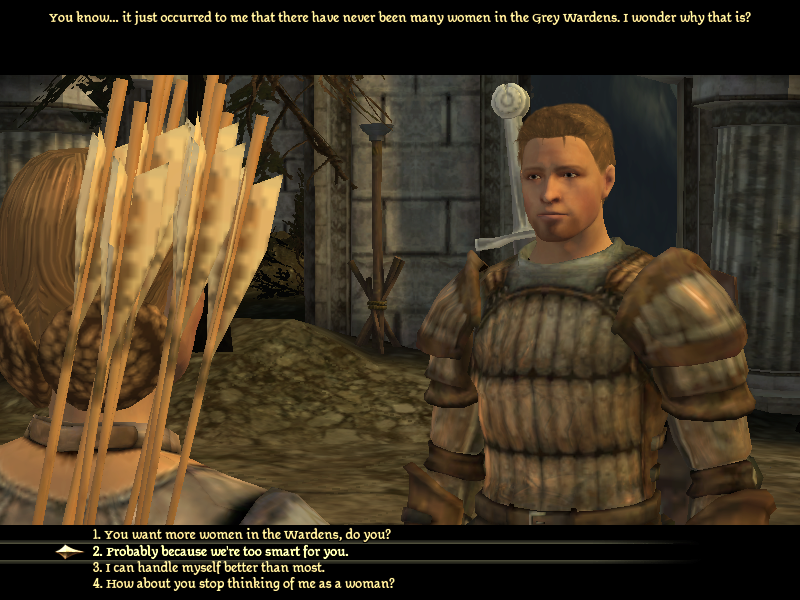
Players can converse with their companions (and anyone they meet) at will, and those conversations change and develop as the game progresses. Companions gain approval when the player make decisions they agree with, and disapproval when they disagree with the player’s actions. As a result, they either open up to the player, or shut them out. If a player gains high enough approval, they can unlock the companion’s personal quests, providing them with more gameplay material. If their approval falls too low however, the companion may opt to leave the party and the player loses them forever. While the player can monitor approval (and thus avoid these options) certain decisions automatically cause a companion to leave. In other words, companions act as independent people, with their own opinions and actions.
Depending on the answer the player chooses, the character will react differently.
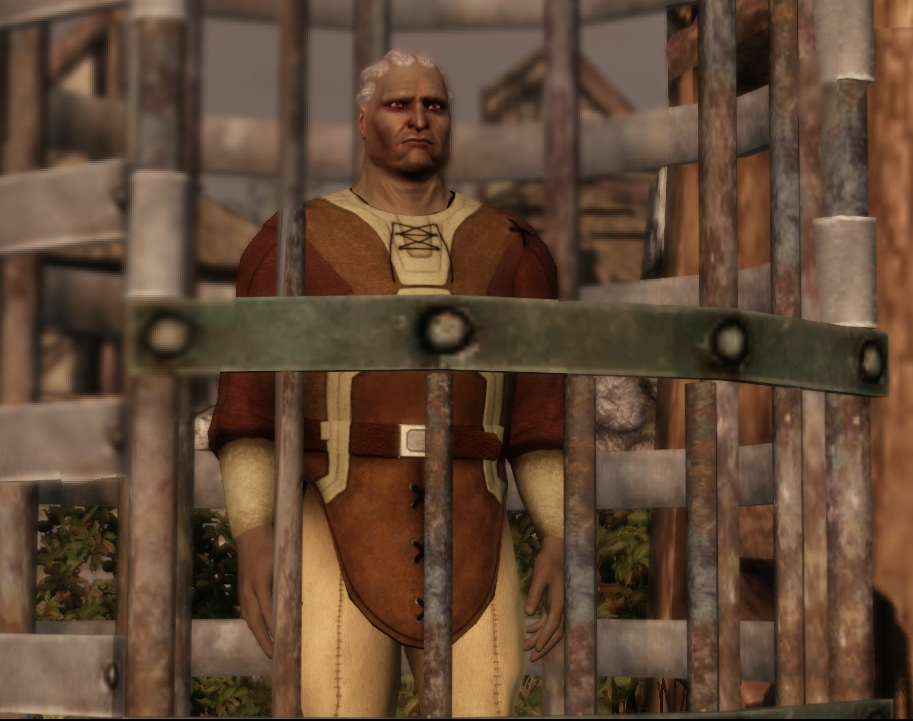
Additionally, one of the companion’s key roles is how their presence alters the options of gameplay. For example, when in the village of Lothering, if the player tries to free an imprisoned man without high enough persuasion, the woman in charge will refuse, and thus he cannot be unlocked as a companion. However, if you happen to bring along Leliana (another companion), the player automatically gets permission to free the man.
The imprisoned man can only be released from the cage (and join the party) if certain decisions are made.
Aarseth would likely argue that these moments fall more under film, rather than his notion of “simulation” which makes games different from other media. Yet, during these “cut-scenes,” the player still gets to choose dialogue options, which the companions then react to accordingly. The player simulates speaking. Granted, Aarseth wrote his article several years before Dragon Age: Origins, and other games like it had hit the shelves. Back then the capacity of choice in games was usually limited to “yes” and “no” answers for accepting quests, or featured dialogue answers that had no real effect on the characters spoken to. However, nowadays, his argument no longer stands as games like Dragon Age, Skyrim, and others have shown.
Other than briefly watching friends play Final Fantasy X, this is my first time playing it from the beginning. It was originally released for the PlayStation 2 in 2001. The game has text and voice to drive the plot forward, which I found exciting at certain times and distracting during other moments. During the first […]
Other than briefly watching friends play Final Fantasy X, this is my first time playing it from the beginning. It was originally released for the PlayStation 2 in 2001. The game has text and voice to drive the plot forward, which I found exciting at certain times and distracting during other moments. During the first 30 minutes of the game, the player is not allowed to skip any film nor save, but at times, is allowed to pause the game while the “background” music continued. In films, the music is always synchronized with on-screen action. But during the cinematic interludes of Final Fantasy X, pausing the game did not pause the music, which not only confused me but gave its game music a fluid identity between the diegetic and nondiegetic world. Another aspect that had a flexible identity was deciding the character’s name; there is a scene in which the character must talk to a group of AI. They ask the character for his name, and a menu pops up to give him a name. The game imitates many features in film, from the camera angles to the montages used for transitions. They were so integrated with one another, that sometimes it was confusing to know when the player should move the character!
The game introduction included more of the player “watching” than “playing.” That difference is the same distinction that exists between engagement and immersion in video games. Immersion (or spatial presence, as it has been termed by Jamie Madigan) needs the player to believe in the world and its context. On the other hand, engagement is similar to the feeling of “flow” (a psychology term for undivided attention and involvement during an activity). While playing Final Fantasy X, the game created a feeling of immersion but I found myself bored – almost frustrated at times – with how unengaging it was. The narrative drove so much of the immersion that I began to feel bored. Frustration built as I yearned for more game play and not so much watching the cinematic storyline. The characters didn’t help, because they drilled in the plot by saying phrases like “listen to my story” and “this is your story, it all begins here.”
The session ended when the game provided me a “Traveller’s Save Sphere,” which stores the character’s HP and MP and allows the player to save game play. The sphere wants to be a diegetic machinic part of the game, although I did not feel so comfortable with the game’s decision to integrate the nondiegetic with the diegetic. I’m excited to continue, although I hope this time, I hope I can expect more “play” time.
References:
Galloway, A. “Gamic Action, Four Moments,” from Gaming, pp. 1-38.
Madigan, J. “The Psychology of Immersion in Video Games” The Psychology of Video Games. Web. 2010.
The 2009 Bioware game Dragon Age: Origins tries to present a free, open game space that players can navigate at will, but at certain moments in the game, that illusion breaks. Once past the initial cut scenes, a player can move around the freely and talk to anyone they encounter. Depending on who the person…
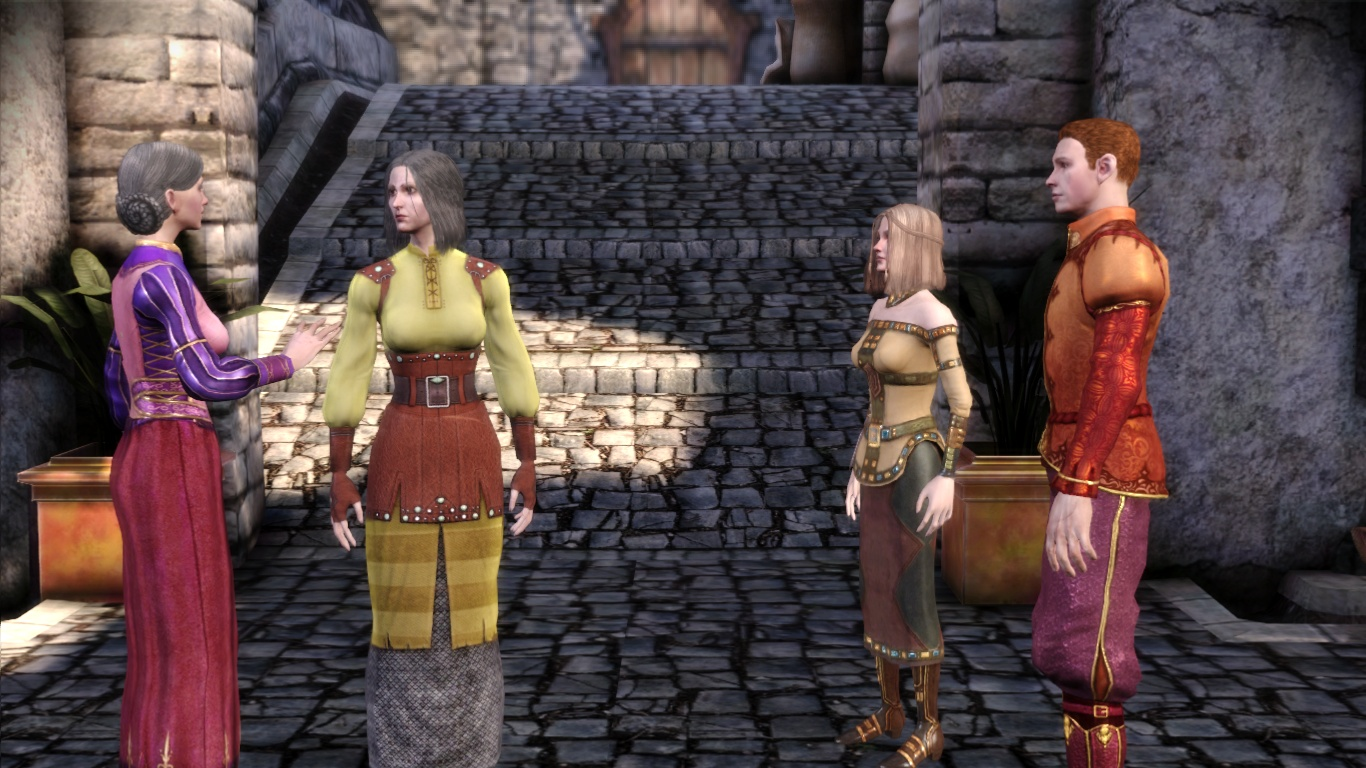
The 2009 Bioware game Dragon Age: Origins tries to present a free, open game space that players can navigate at will, but at certain moments in the game, that illusion breaks. Once past the initial cut scenes, a player can move around the freely and talk to anyone they encounter. Depending on who the person is, the player may be able to have a full conversation with them or they may just get a simple response. The longer dialogues usually reveal important information or at least deepen knowledge about the game world. Some of these dialogue exchanges trigger automatically, when the player enters a certain area or approaches a character, while other must be actively sought out. The automatic triggers do not violate the freedom of the game because they normally make sense in context (your mother stops you to speak with you about a pressing issue, a guard calls you over to deliver a message, etc.) and the others allow the player to express their freedom by choosing who to talk to.
Your mother introducing the player to her friends.
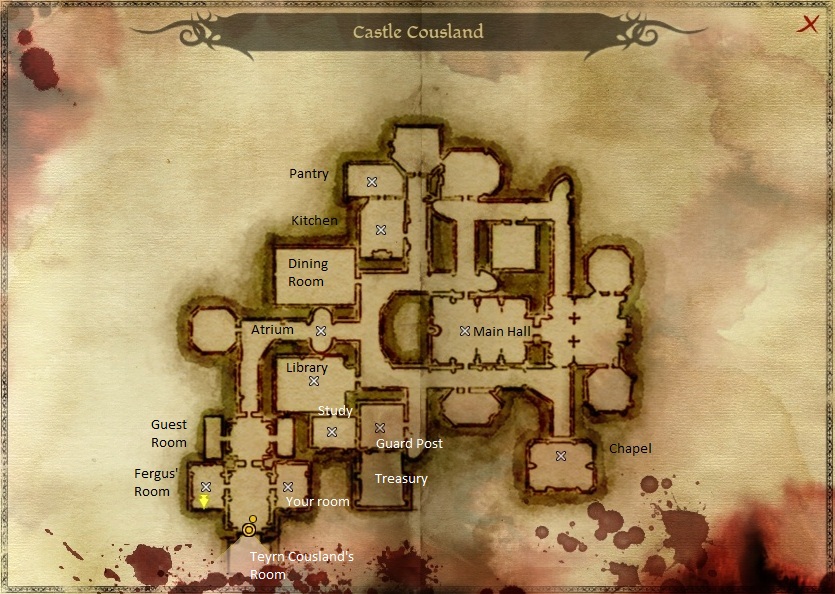
However, the simple response conversations jar the player from the game. When speaking to the guards at the Cousland Castle, almost every one responds to a female player character with “Good day, my lady” in the exact same voice. The guards essentially exist as mindless clones, repeating the same phrase over and over again, regardless of how many times they’re spoken to. Some of these characters say different things each time, but even then a player can cycle through the responses with repeated clicks. It makes the player aware that the game world is not actually real. Similarly, while the player can move from place to place within a given area, they cannot always leave that area. In the Cousland Castle, the player can move about its rooms, but cannot go out into the rest of the world. The player is given the illusion of freedom, but only to a certain extent.
A map of the area you can explore when first starting a Cousland playthrough.
Dragon Age: Origins seems to suggest the coming of the open-world genre. It seems then that these jarring moments come from a lack of computing power, as well as to force narrative. In 2009, the game and the computers it was played on didn’t have the memory to handle a full open world with every character being different. The player also cannot always go where they wish because then the story could not progress in the chronological order the writers laid out.