Horror, Mystery, and First-Person Perspective

I started up a new file for Bioshock, which I’ve never played before, and the first thing I noticed was how “janky” the camera movement was. I normally play third-person games, because I like being able to see the character I’m playing and what’s around them. Bioshock doesn’t give players that freedom. They’re locked into…

Read More »

I started up a new file for Bioshock, which I’ve never played before, and the first thing I noticed was how “janky” the camera movement was. I normally play third-person games, because I like being able to see the character I’m playing and what’s around them. Bioshock doesn’t give players that freedom. They’re locked into a first-person perspective, which limits what they can see at any given time. This adds a new layer of challenge and intensity to the game. Intensity because as a player, you cannot see what’s lurking around every corner; you expect enemies at every turn. It adds a challenge because enemies can sneak up on you, attacking you from behind and gaining an advantage because you don’t see them coming. In a third-person game, a player generally has free movement of the camera and exists in a sort of “God-space” above the player-characters head, which makes it difficult to surprise a player if they see an attack coming. Essentially, Bioshock uses a limited perspective to heighten the horror-esque elements of the game.
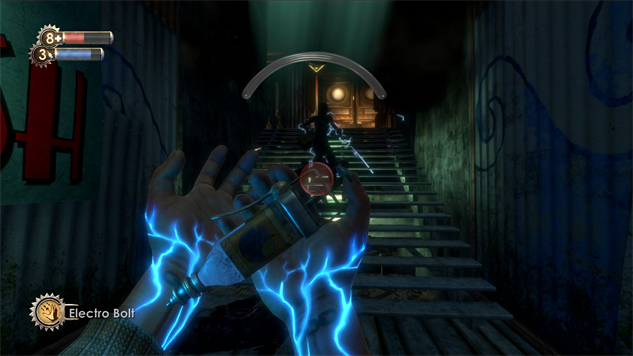
In Bioshock, the player can only see directly in front of them, which makes for a more intense experience

In Bioshock, the player can only see directly in front of them, which makes for a more intense experience

The first-person perspective in Bioshock harkens back to horror-films. Often, these types of films will feature a shot of the villain approaching a victim, carrying a weapon that can be seen on the camera, like most standard first-person shooters. Silence of the Lambs famously uses this method as “Buffalo Bill” stalks Clarice Starling around a dark basement using night-vision goggles.

Silence of the Lambs uses a first-person (shooter) perspective to heighten the scene's suspense

Silence of the Lambs uses a first-person (shooter) perspective to heighten the scene’s suspense

The difference is that in horror films, the first-person perspective usually comes from a “bad guy,” not the “good guy” protagonist of videogames. However, in both cases first-person perspective forces an element of mystery. For film, the mystery often comes from not knowing who the attacker is. The film then goes on to explore that mystery, with the villain reveal as the big surprise. In videogames though, the first-person perspective creates a mystery around the environment. The players must move around and explore in order to uncover the mystery. While the first-person perspective elicits horror and mystery in both media, it does so in different ways.

FPS, Gender, and Portal

As Kline describes in Digital Play, video games originated as “the play of an overwhelmingly masculine world, centered around themes of abstract puzzle solving, exploration, sport, and centrally, war” (107). He lists activities that society generally associates with men, and thus, makes the playing of video games a masculine activity. Portal subverts the notion of…

Read More »

As Kline describes in Digital Play, video games originated as “the play of an overwhelmingly masculine world, centered around themes of abstract puzzle solving, exploration, sport, and centrally, war” (107). He lists activities that society generally associates with men, and thus, makes the playing of video games a masculine activity. Portal subverts the notion of a gaming community meant for men by manipulating first-person identification.

In film, the viewer identifies with the camera and the perspective it shows, as though the camera itself acts as a character, that character being ourselves. Similarly, in video games that use a first-person perspective, the player identifies with the character they play. Since society takes video games as a male-dominated space, men generally assume companies make games for them, thus, in most first-person games, the player plays as a man. For examples, think Call of Duty and Bioshock. (I literally Googled “first person shooter male protagonist” and got a list of games that have female protagonists, which tells you how much male protagonists dominate the field.) Now, Portal complicates that identification by making the player-character, Chell, a woman. However, the player does not even see Chell throughout the game unless they go looking for her. Since the game lacks mirrors, the player must take advantage of the portals and fire them in such a way that they can look through one and see Chell. Otherwise, one could play through the entire game and not realize her identity, since there is no other indication of her gender. I think it likely came as quite a shock to male and female gamers alike that the character they were playing was, in fact, a woman.

The first-person perspective also prevents player’s from turning Chell, as a female character, into a sexual object. In third-person perspective games, while the player identifies with the player-character, there is a separation between them, as the player watches them, rather than seeing through their eyes. Hence, female characters from those types of games, like Lara Croft, often get objectified and sexualized. Objectifying or sexualizing Chell is incredibly difficult though, because the player is constantly seeing through her eyes. In order to sexualize her, the player must also, in a sense, sexualize themself. Additionally, Chell’s outfit prevents this sexualization because it covers most of her body, and makes her chest flat. It’s through the first-person viewpoint that Portal manages to subvert the first-person shooter genre, by removing the typical male protagonists.