
The Law of the Conservation of Personality

When reading Natalie Zarreli’s “Dial-a-Ghost on Thomas Edison’s Least Successful Invention: The Spirit Phone” I was particularly intrigued by how “for Edison [speaking to the dead] was a matter of strict science” (Zarreli).  She goes on to explain that Edison theorized that “like our bodies, our personalities have a physical form, made of tiny ‘entities’ similar to our current view of atoms. He thought these entities might exist after humans passed away—a personality-based residue of loose memories and thoughts, containing part of who a person was during life” (Zarreli). Our personalities are “indestructible” and in a way, this follows the law of conservation of mass. Our personalities—per Edison’s theorizing—cannot be created nor destroyed, only rearranged and transformed.
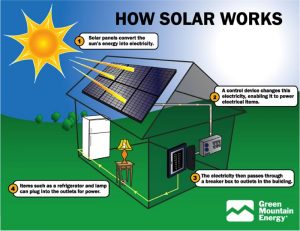
 

A diagram of how solar panels work. Source: Simmons, Tucker. “Alternative Energy.” Auburn University. 5 Jan. 2017.

This scientific approach was surprisingly convincing to me. Through the advancements of science, we have so much understanding of energy and its transformations. For example, through solar panels we take energy from the sun, convert solar energy to electricity, this powers our outlets, which powers our lamps, these lamps give off heat that we absorb, so on and so on… The energy is never created or destroyed, just transferred. By no credentials am I a scientist, but with this logic, I feel oddly convinced by Edison in that our personalities should still exist after our time, but just in another form. After reading Zarreli’s article, I not only feel as though spirits after death exist, but that there must in fact be a way to contact these spirits through technology. I doubt this spirit communication device looks similar to Edison’s original spirit phone, but maybe through more time, funding, and energy to this field we will be able to find out in our lifetime.

Ghost: New phone, who dis?

Source: The Manrepeller

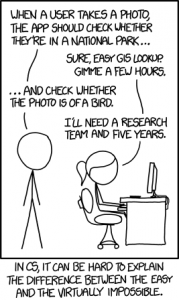
During the 1920’s, astonishing inventions such as the gas-powered car and Edison’s phonograph captured the public’s imagination about what technology could do.  Suddenly, “communicating with spirits didn’t seem much more impossible than harnessing electricity“. Both Thomas Edison and Thomas Watson, assistant to telephone inventor Alexander Graham Bell, experimented (separately) with building a “spirit phone” to connect with the dead.  Inventors and the public eventually realized that the dead don’t answer, preferring the caller to leave a voicemail, and the idea of communicating with spirits via telephone died. But this disconnect between what we imagine technology can do and the actual limitations of technology is theme that continues to baffle us, as shown in the comic below.

The comic xkcd demonstrates our idealistic expectations for technology and the reality we’re confronted with.

Elizabeth Losh highlighted some of the aspects of this disconnect at her recent talk at a FemTechNet conference. In the case of the spirit phone, the “material vs. transcendent” dichotomy is the most relevant.  When people could suddenly converse hundreds of miles away over the telephone using this new, non-tangible force called “electricity”, it seemed just as conceivable that a spirit could physically exist as micro-particles. Telephone users in the early twentieth century didn’t understand the physics of electricity and of phones like we do today.  As magical as a telephone seems, a phone functions because of material reasons, like wiring and microphones. As we mentioned in class, saving files to the cloud generates a similar confusion today about “material vs. transcendent”. While the user may think their files go to some literal, intangible “cloud”, the files are actually stored at a remote server farm. While it seems the amount of storage is limitless, you could eventually run out of your allotted space in your cloud, forcing you to delete some fire selfies.