Reflection: Injecting Death into Every Scenario

Looking back at my blog posts from this semester, it is hard to group them or assign one overall characteristic. They span the gamut from addressing Putin’s rise to power (and the death of truth) to critiquing zombie-horror as creatively cheap. I dragged the self-important digital natives who obsessively catalog their social media posts as if that would grant them immortality. The Atari games that ended up buried in a landfill achieved more mythic status than those solipsists.

I tended to make loose connections between my subjects and the traditional notions of death. Can a concept like “truth” die? How does social media change our relationship to the concept of dying? How does a video game “die” — and then become resurrected by social fascination and fetishization?

I felt most engaged when injecting discussions of death into unexpected places, whether it’s neo-liberal politics or the demise of Fyre Festival. I enjoyed considering death beyond its biological process; what are it’s cultural and social dimensions? How does it shape media we consume? How does our conception of death itself change over time?

My best posts responded to class content while also integrating readings from my other classes. I wrote “Postmodern Politics: Post-truth, Putin, and Power” in a state of crazed shock after watching Adam Curtis’ BBC documentary HyperNormalisation, which traces the rise of postmodern culture across a forty year timeline. I wrote “Fetishizing Trash: Atari and Material Lifecycles” after reading about how objects can provide concrete representations of abstract human concepts — whether that’s our sense of self or how we conceptualize video game culture.

I would have loved to write more about how death is being changed not just by our societal attitudes (it’s now socially acceptable to live-stream funerals!) but also by advances in technology. What ethical dimensions should we be concerned about when imagining the ability to upload and download consciousness, or mimic consciousness like in the Black Mirror episode “Be Right Back”?

If I take anything away from this class and my posts, it’s that elements of death and dying can be applied to almost any artifact or media in our postmodern, hyperreal world.

I Google searched “death in the digital age” and this was an image in the results. Photo from TheNextWeb.com; artist unknown.

Eulogy for Vine: RIP

Vine is dead. It is now exists as a glorious smattering of Vine Comps on YouTube, a digital time capsule refracting the memes, digital sensibilities and the very special way Vine content was crafted between 2013 and 2016.

Vine was a special oddball within the social media landscape. It spurred us to do the most and the be the most — #doitforthevine. It was the perfect outlet for our jumpy, hyped up attention span: 7 seconds, hit me. In 7 seconds, creators grabbed us with the weirdest, wildest, most outlandish and unexpected content. It had the feeling of being raw media while also, often, being meticulously shot and re-shot until all 7 seconds flow liked gold. Twitter bought Vine for a reported $30 million in 2012 before it even went live. But they couldn’t figure out how to monetize it, to hack dollars out of our creations, to inject it with gross advertising and sponsored content. So now Vine is dead.

Gabbie Hanna, who shared her Vine videos with 4.9 million follows, eulogized the Vine death via Twitter: “Vine being deleted is like an old friend i havent rly talked to in a while dying & even tho we werent close anymore it hurts to see them go.” 

Vine was a platform for creative, unexpected content — a place for creators to experiment outside of the commercialized bubble of YouTube or platforms heavily tied to your identity, like Snapchat and Instagram. With Vine, we could effectively become performance artists, where the social and cultural capital wasn’t tied to normative social performances (which it is, on basically, like, every other platform #normies).

In class, we spent time discussing how social media reacts when a person dies — the Facebook memorials, the popularity-ranked HeavenAddress pages. But here we can see what happens when a platform dies: we won’t be able to experience Vines like kids in 2014 got to experience Vines. But the content still circulates in YouTube compilations. The ghost of Vine — incomplete and inexact but still enough — lives on, for now.

Are parasocial relationships inherently inauthentic?


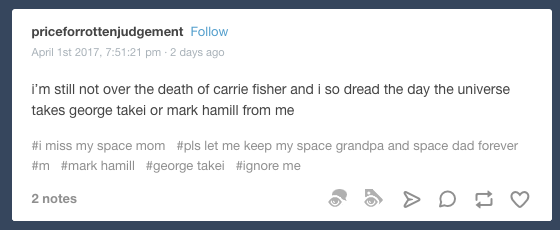
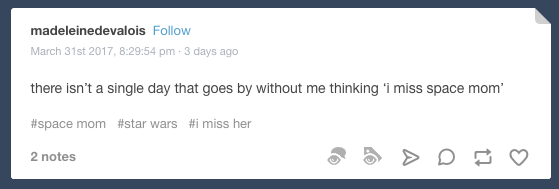
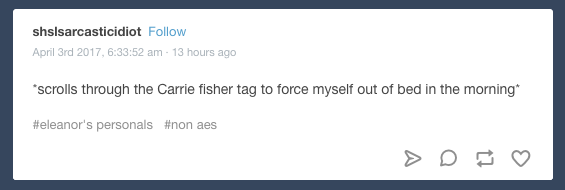
The part of our reading I found most interesting was the part addressing parasocial relationships with celebrities.  Of all the celebrity deaths of 2016, the one that provoked the greatest display of public mourning in my corner of the Internet was easily Carrie Fisher.  Just scrolling through her Tumblr tag for about five minutes, I came across these three posts.  Clearly, all three of these people feel a deep connection to her, whether as a motivating force or a parental figure (two posts refer to her as “space mom,” which is a common title of hers on the Internet).

Screenshot of a Tumblr post (shslsarcasticidiot.tumblr.com/post/159147131965/scrolls-through-the-carrie-fisher-tag-to-force)
Another Tumblr post (priceforrottenjudgement.tumblr.com/post/159091343154/im-still-not-over-the-death-of-carrie-fisher-and)
People really miss Carrie Fisher… (madeleinedevalois.tumblr.com/post/159055295573)


Sherlock describes these relationships as based on “false feelings of authenticity and intimacy” (168), and I want to push back on that assessment a little bit.   She quotes another scholar who claims that an online or public presence is “an artificial build-up of ‘personality'” (168).

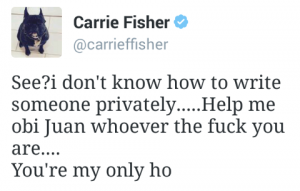
Carrie Fisher’s online presence is hilarious and authentic.  Her tweets do not look like they have been approved by a publicist.  I’ve included one of my favorite’s below.

A particularly hilarious tweet from Carrie (twitter.com/carrieffisher)

Either Carrie has a crazy good publicist who manages to craft a perfectly unpolished, authentic presence on Twitter, or she’s just tweeting away of her own accord.

Additionally, she’s written two memoirs that honestly document her experiences with mental illness and addiction (I only read part of Wishful Drinking, and that was years ago, but I remember that it was extremely funny).

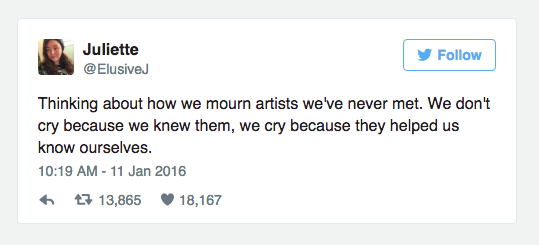
Do these Tumblr users have an actual, mutual relationship with Carrie Fisher?  Of course not.  But I think it’s unfairly dismissive to claim every celebrity’s social media presence is inauthentic.  I think Carrie sparked such an enormous display of grief not only because she portrayed such an iconic character, but because she was unapologetically herself.  She aged unapologetically.  She was mentally ill unapologetically.  Seeing someone own everything about themselves, even the messy parts, allows us to do the same.  I think about the following tweet a lot in reference to celebrity deaths.

This tweet sums it up pretty nicely (www.vox.com/2016/1/12/10755600/celebrity-death-grief)

In other words, I’m not trying to claim that parasocial relationships are the same thing as true, mutual relationships.  But I do disagree with this somewhat dismissive, cynical view of celebrities’ personas as inherently crafted and inauthentic.  Sherlock acknowledges that these feelings are not necessarily false “just because they are based on a falsity” (169), so she does acknowledge the significance of these relationships, but I don’t believe that they were were necessarily based on a falsity in the first place.  I think what makes Carrie Fisher, and others like her, stand out is the authenticity of their public personas.