
Sympathy for Monsters

While reading Carly Kocurek’s “Who Hearkens to the Monster’s Scream? Death, Violence, and the Veil of the Monstrous in Video Games,” I had a problem with one of Kocurek’s main assertions. In her essay, Kocurek states that in video games,

“Monstrousness heightens the dehumanisation of in-game enemies and justifies their execution. Players are right not to feel sympathy for the monsters… they are, by design, unsympathetic characters, mere impediments to game victory” (86).

Thinking about my own experience with videogames, I thought of one of my favorite games to play when I was a child: Kingdom Hearts. Though the game takes place in a rather complex universe, the series focuses on a young man named Sora who fights creatures known as Heartless with a mystical weapon called the keyblade.
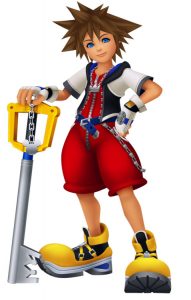
This image shows Sora with his keyblade.

The Heartless are creatures born from the darkness in people’s hearts. Once an individual is consumed by darkness, they become corrupted and turn into Heartless, as seen in the clip below (32:00-32:20).

Throughout the game, Sora is thus battling corrupted individuals: humans turned into monsters. Though the enemies of the game were once human, the player is justified in killing the Heartless, because of their now monstrous form, just as Kocurek describes in her essay.

When I was a child I readily accepted my need to kill the monsters and felt no remorse for doing so. The Heartless were inherently evil, so it was my job as the hero to kill them. Now, however, when I look at the backstory of the Heartless I cannot help but feel sorry for the creatures. I am sure that these humans do not wish to be consumed by darkness and become Heartless, yet the spreading darkness throughout the world causes them to become monsters. The keyblade frees the hearts from darkness, allowing the player to become a savior– killing the Heartless is an act of mercy rather than an act of violence. If we are mercifully killing monsters, do Kocurek’s assertions still stand? What does it mean when a player actually sympathizes with the monsters that they are trying to kill?
 

Fear Thy Neighbor: The Monster Next Door in “Dead Set”

In the chapter “Monster Culture (Seven Theses),” of Monster Theory : Reading Culture, Jeffrey Jerome Cohen does exactly as his title suggests, interpreting seven different types of monsters as cultural embodiments of specific fears, taboos, and desires within cultures. His fourth thesis, titled “The Monster Dwells at the Gates of Difference,” struck me as particularly relevant to today’s global climate. In this thesis, Cohen claims that “The monster is difference made flesh,” a “dialectical Other” that represents “an incorporation of the Outside, the Beyond…” (Cohen 7). This cultural fear of the invasive, dangerous Outsider is highly applicable within the context of contemporary society where the widespread fear of the “Other” is linked directly to the fear of terrorism and the need for protection, whatever the cost.

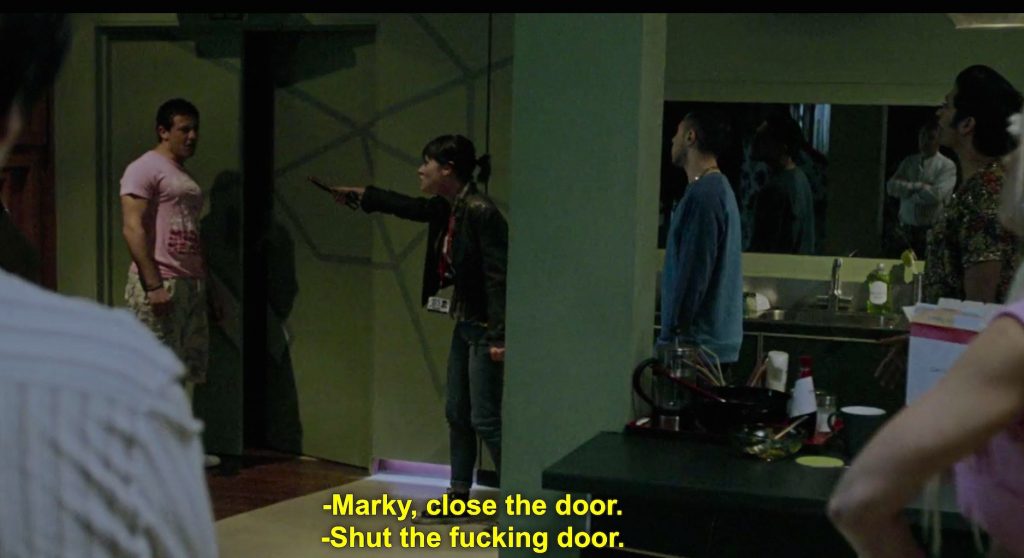
However, as I watched Episodes 1 and 2 of the TV mini-series Dead Set and attempted to apply Cohen’s fourth argument to the violent zombies on the screen, I began to wonder if perhaps there was an important nuance to be made in this thesis. While the zombies were physically on the outside of the safe house and then further estranged as “Other” by their cannibalistic behavior, they still existed right next door. Kelly is separated from a zombie by only a door just as Patrick and Pippa are cloistered away in a room while a zombie bangs in frustration on its entrance.  Despite their positioning as Outsiders, the zombies’ close proximity put them in a different category all together: that of the neighbor (rather than the stranger).

The only thing separating the “Big Brother” cast from the zombies is this door. Source: “Dead Set.” Season 1 Episode 2/5. Netflix.

This imagery of the neighbor is further reinforced by the fact that the reality show Big Brother is filmed within a constructed house reminiscent of Foucault’s panopticon in which the cast can’t see out but the film crew can see in. The physical and literal invocation of the house and surveillance immediately establishes a relationship between the inhabitants within and those on the outside. In one scene, Kelly taps on the one-way mirror and the audience sees what she cannot: a hungry zombie growling on the other side of the glass. In this moment, human and monster coexist next door to each other, only inches apart. The one-sided mirror serves the same delineative purpose as the traditional white picket fence that separates properties and neighbors. However, this barrier is soon penetrated when the zombie gets in through the door.

These zombies are violent, cannibalistic, wild, disgusting, and without any trace of humanity. What’s even more unsettling is that they still resemble the familiar faces of the cast and crew we met at the beginning of Episode 1 when they were human. The cinematic choice to maintain the physical identification of these original characters even as zombies is effective because it confuses the Familiar with the Other. The zombies are at once different because of their violence and familiar because of their faces. In this sense, the Other does not represent an Outsider from far away lands but rather the monster that’s living next door. I’ll title this eighth thesis, “The Monster Dwells at the Gates of…your own home.” One thing is certain, you can’t trust your neighbor. Time to get a bigger fence.

References: 

Cohen, Jeffrey Jerome. “Monster Culture (Seven Theses).” Monster Theory : Reading Culture. Minneapolis: University of Minnesota Press, 1996. Web.