THE CREATIVE NARRATIVE BEHIND THE CRAIGSLIST AD, THE CUCKOO CLOCK, AND THE JOURNAL ENTRY
Backstory
Mort Lindheimer loves the author Ray Bradbury. So much so, in fact, that he carried Fahrenheit 451 in his backpack during college wherever he went, the pages tabbed down and thumbed soft. It was Bradbury’s short story, There Will Comes Soft Rains, that kept Mort up late at night, fascinated by the concept of a mechanical house that, in the absence of human touch, breaks down against the backdrop of a “radioactive glow” (Bradbury 1). Mort doesn’t trust technology and he gets goose bumps thinking about the charcoal silhouettes of a man, woman, and their two children inscribed onto the walls of Bradbury’s fictional house after an atomic bomb.
Part 1: The craigslist ad
For his fiftieth birthday Mort’s wife, Calliope, purchased a miniature model of the Bradbury house on craigslist: a collector’s cuckoo clock that promises to recite the poem played in the children’s nursery each time the hour strikes.
Part 2: The clock
Mort is thrilled with Calliope’s gift and the two excitedly wait for the hour to strike to hear the poem recited. However, to their great disappointment, the clock makes no noise and what’s worse, the hands tick counter-clockwise. Disheartened, the couple finally go to sleep, leaving the clock on the dresser.
When they turn out the light, Mort hears a small buzzing noise, almost imperceptible and yet impossible to ignore. Exasperated, he realizes it’s issuing from the clock. He inches closer, pressing his ear against the clock to amplify the soft noise. What he hears is not a poem at all but rather a monotone voice repeating a short phrase with no inflection. It takes him multiple tries to decipher the fragmented words:
Intruder next to you
Do you see me here
Danger obscured
A chill runs through him and he looks instinctively around the room. Intruder? Thoroughly unsettled, Mort feels a sudden urge to get rid of the clock, sensing some inexplicable presence in the room. He grabs the clock and dumps it in the trash outside.
Part 3: Mort attempts to reconcile the events of the night by writing in his journal
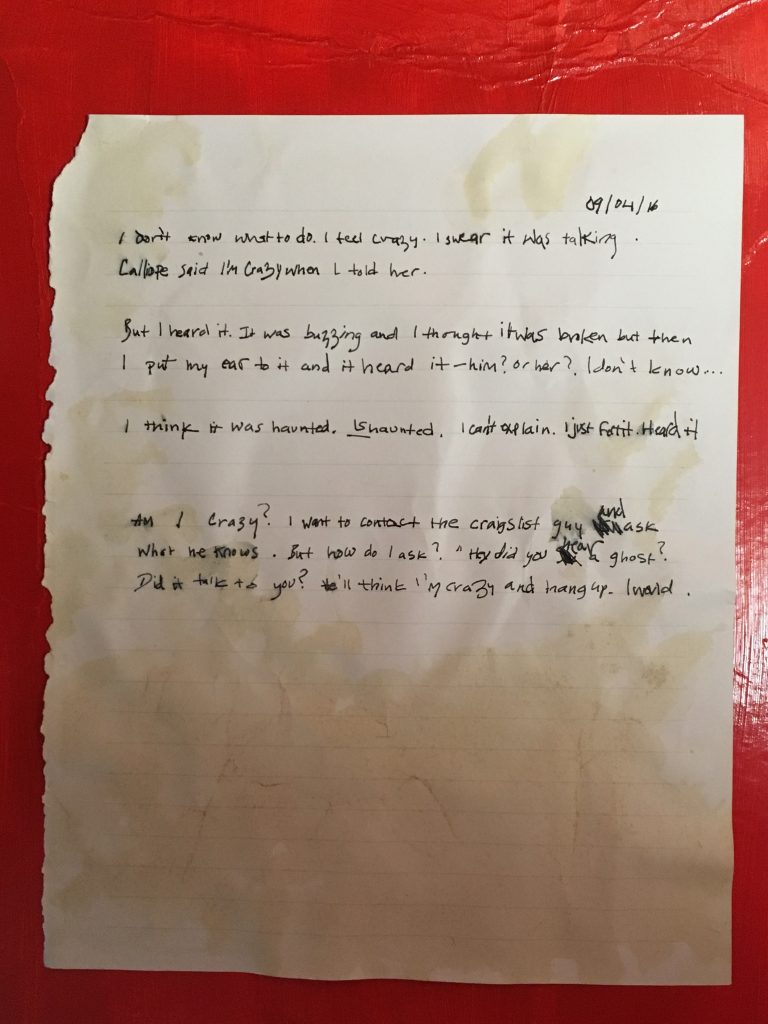
In the morning, Calliope is outraged by Mort’s rash decision. He himself is unable to explain the strange happenings of the night, as reflected in his journal entry.
Unbeknownst to the couple, the clock is haunted by the spirit of a real family of four from the Cold War era who met a similar fate to that of the fictional family outlined in charcoal on the walls of the house. When the artist created the clock he accidentally set the clock backwards, literally going back in time and summoning the dead of the historical past. The family became trapped within this miniature model, warning of danger and crying for help. This faulty clock is a home for the undead, a shrine for restless spirits. The “intruder” referenced in its warning isn’t a physical trespasser but rather the ubiquity of technology as an unrealized threat—danger obscured.
ARTIST’S EXPLANATION
The cuckoo clock is comprised of three main elements:
1. The charcoal images of the family on the wall that symbolize the danger of technology,
2. the light sensored-voice that speaks of imminent danger and symbolizes the intersection between advanced sound technology and death,
3. and the counter-clockwise clock, a nod to the postmodern blurring of boundaries between death and life and the construct of time.
When I first began this project I was inspired by Ray Bradbury’s concept of a mechanical house capable of self-regulating and functioning (almost) entirely independently. However, despite its human-like self-regulatory qualities, the house is ultimately unable to sustain itself without human presence. I tried to reflect this hyper-digitized space in my clock design. You’ll notice that the circuit playground is featured prominently. I chose this placement because I wanted to situate technology as central to the house’s identity. The decorations are also technologically produced; the bird is 3D printed, the engraved banner and wood birds are laser-cut, and even the grass is a synthetic silver color rather than green. Additionally, the warning message emitted by the circuit playground when the lights dim or go out is coded as a repetitive loop to highlight the limitation of the technology (it can only repeat, not respond or explain).
1. The charcoal images of the family on the wall symbolize the threat and danger of technology.
Bradbury’s reference to an atomic bomb is an important reminder that the ubiquitous presence of technology within society is dangerous as much as it is convenient. The black spots left by the family on the wall of the house are historically grounded. As Alan Taylor points out in “Hiroshima: Before and After the Atomic Bombing,” victims of the atomic bombings of Hiroshima left shadow-like imprints on buildings and roads. History is never far away in these discussions, and as Isabel Pinedo points out in her article “Recreational Terror: Postmodern Elements of the Contemporary Horror Film,” postmodernism itself can be understood as “the cumulative outcome of repetitive historical stresses, including the Holocaust, the bombing of Hiroshima, the Cold War, the war in Vietnam…” (Pinedo 18). References to Hiroshima can thus be seen as part of a larger cultural narrative that continues to haunt contemporary society through its unresolved memory in an increasingly technologically-driven world. Maria del Pilar Blanco and Esther Peeren note in their book Popular ghosts: the haunted spaces of everyday culture, “…ghosts therefore often operate as erratic monuments or hieroglyphs that signify a disturbing incident that happened in the past, a secret that has to be deciphered in order to understand the repercussions of the past” (Pilar 187).
With this in mind, I imagined the haunting in my project on multiple levels, both literally through the mechanized voice, and figuratively in the shadows that remind us of a larger technological death. When I was designing the audio element of the clock, I chose the circuit playground as my sound source, rather than a pre-recorded audio chip. The reason for this is because the circuit playground muffles sound and limits the contents of its message to Arduino’s basic speech dictionaries. The barely audible volume and incomplete message must thus be decrypted as cultural “hieroglyphs” —my attempt at exploring this concept of deciphering the past.
2. The light sensored-voice that speaks of imminent danger and symbolizes the intersection between advanced sound technology and death.
When designing and coding the sound component of the project, I was inspired by class readings regarding sound preservation and its connection to death. In his book The Audible Past: Cultural Origins of Sound Reproduction, Jonathan Sterne uses the example of the revolutionary introduction of the phonograph during the 19th century to explore the symbiotic relationship between popular conceptions of death and the power of the disembodied voice. Sterne describes popular beliefs of the time which justified a potential connection to the spirit world using the argument that “…media are forever setting free little parts of the human body, mind, and soul. If the voices of the dead were, indeed, free agents, perhaps they could then be enticed back into the world of the living” (Sterne 289). There’s a certain logic here; the fragmented, pixelated nature of technology offers the possibility of preserving human life in an equally fragmented (yet nonetheless present) continued existence. Given this logic, it’s not so hard to believe in ghosts: voices of the dead, fragmented as isolated parts, get trapped in human objects (such as a cuckoo clock). The clock serves as a metaphorical coffin for these spirits, “embalming” their voices (Sterne 293).
Blanco and Peeren speak of a similar relationship between sound and death, noting, “The utter non-referentiality of this medial space endorses a transgression of the dichotomy of ghostly and human realms, so that the dialectical questions evoked…(Is it ghostly? Is it real?) are swept off the table by the annihilating gesture of mediation” (Pilar 289). In other words, Mort can no longer distinguish what is real and what is merely a creation of his mind because he is a subjective mediator. His ears filter and interpret the sound of the clock in a meaning-making process subject to embellishment, mishearing, and forgetfulness. In his journal entry, Mort struggles to trust himself as a mediator and interpreter of what he heard. The transgressive nature of the auditory thus lies in the fact that it blurs the boundaries between the real and the unreal, placing the onus of this distinction on the human listener (Pilar 291).
This dissolving and blurring of boundaries through the hybridity of previously distinct categories and identities is characteristic of postmodernism and “…the erosion of universal categories, the collapse of faith in the inevitability of progress, and the breakdown of moral clarities” (Pinedo 17). Indeterminacy, the result of this erosion, leads to the conviction that we cannot know anything with certainty (from class discussion). This is reflected in Mort’s spiral of confusion and self-doubt in his journal entry. Equally important to the postmodern space is the triumph of intuition over rationality, and even the failure of rationality all together. Mort is unable to reason through this instinct to destroy the clock and he struggles to explain his actions to his wife for which there is no rational explanation.
3. The counter-clockwise clock is a nod to the postmodern blurring of boundaries between death and life and the construct of time.
Notice how the clock hands move counter-clockwise, the clock face is missing certain numbers, and the remaining numbers are off-center and miss-aligned. As we discussed in class, in postmodernism we witness a sort of “decanonization,” which is to say that those things that used to the be at the center of culture and society such as universal truth or linear time are questioned through a general skepticism of authority. In the case of the cuckoo clock, “decanonization” occurs through the destabilization of time as a construct. Traditional understandings of both death and life are informed by the perception of time as a finite, linear construct with a definite start and end. And yet, the ghosts that haunt the clock are summoned through the non-linear manipulation of time when the clock inverses its movement.
Elana Gomel explores the construct of time in great detail, emphasizing early on in her book Postmodern Science Fiction and Temporal Imagination that “…time is an illusion. The past, the present and the future coexist. This is not in flux, a flow, a rushing river, as it is so often envisioned in other texts…” (Gomel x). Linearity is an imagined ideal constructed in order to appeal to human rational and social organizational tendencies. But while postmodernism fractures and fragments “…both public and private time”, this does not mean that time ceases to exist (Gomel xi). Rather, as Gomel argues, “Time out of joint is still time, albeit crippled” (Gomel 4). In this postmodern reality, we must redefine time within new parameters of imagining; the counter-clockwise clock asks us to consider time outside traditional boundaries.
4. Additional thoughts
It’s important to note, too, the element of “participatory culture” at play in the design of the cuckoo clock. This term, discussed during class, refers to the fact that in modern society, anybody can make a fan video, a supercut, memes, fan fiction—etc. The cuckoo clock is the perfect example of this, itself a product of a fan base that seeks to replicate and reconstruct the reality of Bradbury’s narrative. This collector’s item must be situated within a larger concept of consumerist commercial culture. Historical trauma intersects with pop culture in an unsettling marriage between the real and the constructed.
5. Concluding remarks
Examining haunting from a technical perspective during production design allowed me to explore digital haunting on a hands-on level. It’s cool how a simple coding formula and a few basic words strung together can transform a product of logic into an object of the uncanny. Technology rides this line between the rational and the inexplicable in a way that makes its relationship to death all the more interesting.
Word Count: 2000
Special thanks to the Studio M Staff, particularly Brian Little and Tien Le, for their patience and support.
References
Bradbury, Ray. “There Will Come Soft Rains by Bradbury.” Google Docs. N.p., n.d. Web. 06 Apr. 2017. <docs.google.com/file/d/0BzbtlcAsIeTnTlNmSnhOV010bHM/edit?pli=1>.
Gomel, Elana. Postmodern Science Fiction and Temporal Imagination. New York: Continuum, 2010. Web. Continuum literary studies; Continuum literary studies.
Pilar Blanco, María del., and Esther. Peeren. Popular Ghosts : The Haunted Spaces of Everyday Culture. New York: Continuum, 2010. Web.
Pinedo, Isabel. “Recreational Terror: Postmodern Elements of the Contemporary Horror Film.” Journal of Film and Video 48.1/2 (1996): 17-31. Print.
Sterne, Jonathan. The Audible Past : Cultural Origins of Sound Reproduction. Durham: Duke University Press, 2003. Web. e-Duke books scholarly collection.
Taylor, Alan. “Hiroshima: Before and After the Atomic Bombing.” The Atlantic. Atlantic Media Company, 12 May 2016. Web. 06 Apr. 2017.