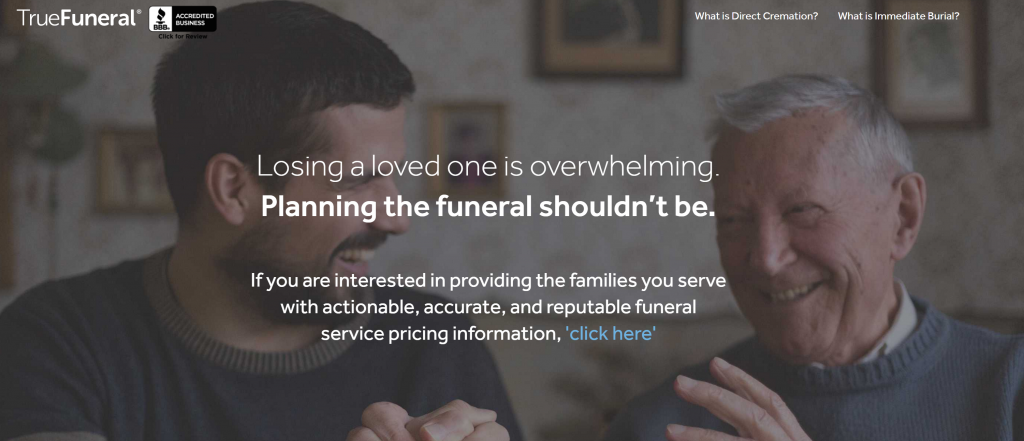
In the midst of stressful job applications, one of my apartment-mates told me about an interesting startup that she had applied for called TrueFuneral. Basically, their whole mission is to provide “online platform that empowers families with accurate and actionable funeral service pricing information” (quoted from their LinkedIn page). A couple things about this startup company strikes me as interesting with respect to our class discussion and readings. I checked out their TrueFuneral’s website, which was very straight-forward, clean, and simplistic in design. The first image that is spread across the home page is a young man and an old grandfather seeming to be in mid-laughter during a conversation. The words spread over their faces in large font size but non-aggressive font are “Losing a loved one is overwhelming. Planning the funeral shouldn’t be.” I immediately notice how this website and this company make the topic of death as “happy” and life-like as possible. No one is mourning, natural-like lighting is used for the photograph, people are laughing and living, there isn’t a funeral, coffin, ern, or any implication of a recent death in sight.
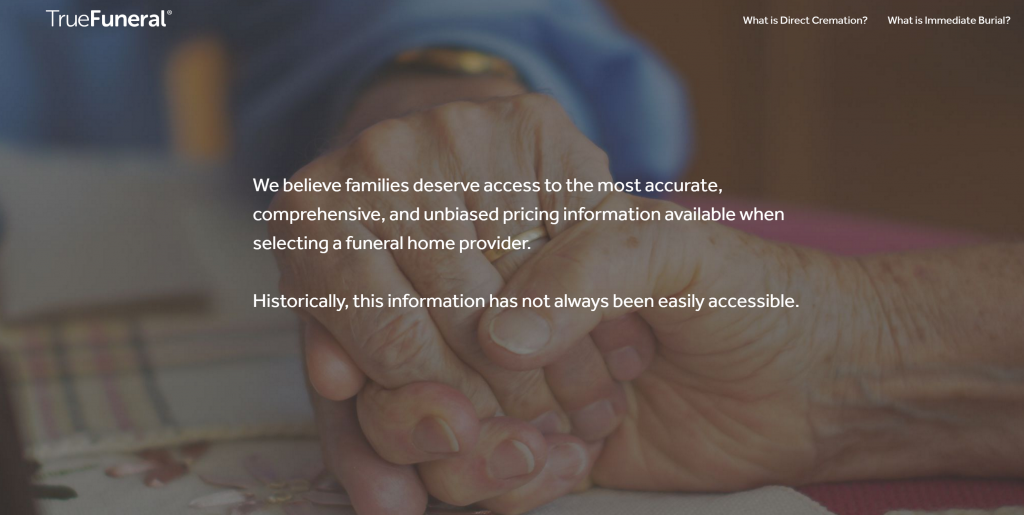
If you click the “About Us” link, more general information about the company shows up with similar photos. Mainly young people or families apparently dealing with a recent loss of their loved one. The only picture that displays old people is a zoomed in photo of a couple holding hands, but the frame of the image contains only their hands that are holding. Knowing that TrueFuneral is a company trying is profiting off of individuals and families grieving the loss of a loved one, whether there is mal-intent or not, this makes me feel a little conflicted. This company seems to do a good job of showing the best prices and options available for funeral services (or at least their website is doing a good job of convincing me of this). However, the fact that this company seems fixated on making its branding as far from death as possible makes me think about who is behind the scenes saying something along the lines of “Hmm… If we use this picture, will it attract more people to use our services over others and subsequently bring in more money for us?” This website made me think about the Australian memorial page that we looked at in class, and how the memorial pages that got the most “likes” were of those who were the least likely to have been associated with death (a natural one at least). I think it is also important to mention that my apartment-mate said that the company is going through a name change! Instead of TrueFuneral, the company will soon be called TrueSolace! So even the name of the company shifted its attention from the dead to the mourning. I guess it makes sense, this company can’t profit off of the dead!
Though in class we discussed and read in class on whether there is a place for us to police grieving, I think in this case my policing of this company is different from that of our class’ criticisms on the Australian memorial page. The pages on the Australian website were made by those who were mourning. The TrueFuneral website, however, is made by a company trying to target those who are grieving.