
I grew up believing in ghosts for a very simple reason: my mom had seen one. I know the story like the back of my hand, beginning with the vision of my mom running through her grandmother’s three-story farmhouse and then the moment when she says she saw her dead granddad, PopPop, pushing a cart of books into the library he had always loved. My mom remembers standing there, observing him as he slowly moved through the hallway. She swears by this. I used to make her promise to come back and visit me as a “good” ghost too.
My mother is not the only one to believe in ghosts. Journalist Tiffanie Wen describes her own encounter with the paranormal when she noticed the image of a phantom man in the background of a photograph who was not in the room when the photo was taken. In her article, “Why do People Believe in Ghosts,” Wen takes on the task of exploring both national and international views on ghosts, death, and life after death, reporting that “…if you already believe in ghosts, or are told a place is haunted, you are more likely to interpret events as paranormal” (Wen). The imagination is powerful and it’s hard to say whether there’s any real grounds for paranormal activity other than simple tricks of the mind, sleep deprivation, and random accidents.

Thanks to my mother, I have been well-conditioned to believe in the paranormal. Which is perhaps why I personally identify with Thomas Edison and his belief that the dead can talk, which Natalie Zarrelli describes in her article “Dial-a-Ghost on Thomas Edison’s Least Successful Invention: the Spirit Phone.” Both Zarrelli and Wen highlight a connection between the belief in ghosts, spirits and souls and the human desire to deny mortality. Zarrelli quotes French journalist Philippe Baudouin who describes the promise of Edison’s “Spirit Phone” to “…turn the ancient dream of immortality into reality, in an attempt to cheat death” (Zarrelli). Similarly, Wen relies on the work of professor Christopher French who highlights “…the emotional motivation for these beliefs”, underscoring the fact that “The vast majority of us don’t like the idea of our own mortality. Even though we find the idea of ghosts and spirits scary, in a wider context, they provide evidence for the survival of the soul” (Wen). This fear of an absolute end without continuation is arguably the greatest tragedy of mankind for we must reconcile our finite existence and the feeling of insignificance this awareness engenders.
I argue that this fear of mortality stems from the fact that we are conditioned to understand human existence only through its embodied experience. This explains Edison’s determined conviction that personalities are in fact “entities” or small particles comparable to atoms, an interesting choice of language grounded in physicality. Edison’s language contrasts disembodied explanations for the afterlife (that is, those theories that don’t present ghosts, spirits and souls in an identifiably human or physical form) which are harder to grapple with. I imagine this is why science’s tangibility is often more appealing than religion’s indefinable concept of faith and God. Even in religion though, (and I can only speak to a Christian perspective here), God is often depicted as a white man because human tendency ascribes an image to the spiritual presence as a means of conceptualizing such abstract power.
While it’s been almost a century since Edison’s failed “Spirit Phone” invention, Episode 1, Season 2 of Black Mirror demonstrates the extent to which Edison’s obsessive preoccupation with death remains ever embedded within our cultural conscience. For example, the program that Martha buys following Ash’s death serves as a sort of modern day “Spirit Phone,” relying on Ash’s social media presence to reconstruct the particles of his personality in a synthesized replica of his living body.
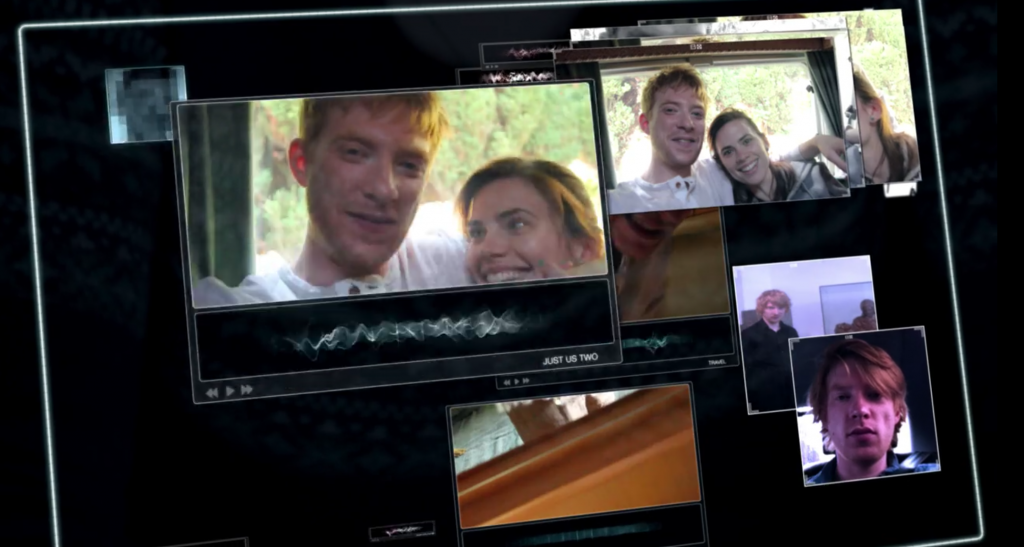
Thomas Edison introduces the belief that our personalities continue to exist as tangible “entities” long after our death, describing “…a personality-based residue of loose memories and thoughts, containing part of who a person was during life” (Wen). Black Mirror applies this notion, using the power of technology to literally bring Ash’s personality to life. Edison notes, however, the fractured nature of these living personalities and Martha observes holes in Ash’s embodied performance, a fragmented version of the man she once loved. While Black Mirror demonstrates the possibility of a successful “Spirit Phone” (and even “Spirit Body”), this success is mitigated by the realization that even when we do communicate and interact with the dead, this communication is fractured at best, and traumatizing at worst.
References:
- “Black Mirror.” Season 2 Episode 1. Netflix.
- Wen, Tiffanie. “Why Do People Believe in Ghosts?” The Atlantic. Atlantic Media Company, 05 Sept. 2014. Web. 27 Feb. 2017.
- Zarrelli, Natalie. “Dial-a-Ghost on Thomas Edison’s Least Successful Invention: the Spirit Phone.” Atlas Obscura. N.p., 18 Oct. 2016. Web. 27 Feb. 2017.