
Facebook notification: Wish Jane a Happy Deathday!

Hachem Sadikki, a Ph.D. candidate in statistics at University of Massachusetts, predicted that the year the number of dead people on Facebook outnumbers the living is the surprisingly-close 2098. I could hypothetically be around to see that (assuming I still care about social media at that point – I’ll be 103). There are some understandable assumptions Sadikki had to make: he assumed that everyone who dies is memorialized, that Facebook’s exponential growth will eventually plateau, and he used the U.S. death rate (provided by the CDC) for the entire globe. But his results have been confirmed by others, such as Randall Munroe (of xkcd fame) who estimated that this outnumbering will occur in the 2060s (assuming Facebook’s growth plateau’s, like Sadikki) or in the 2130s (assuming Facebook continues to grow).
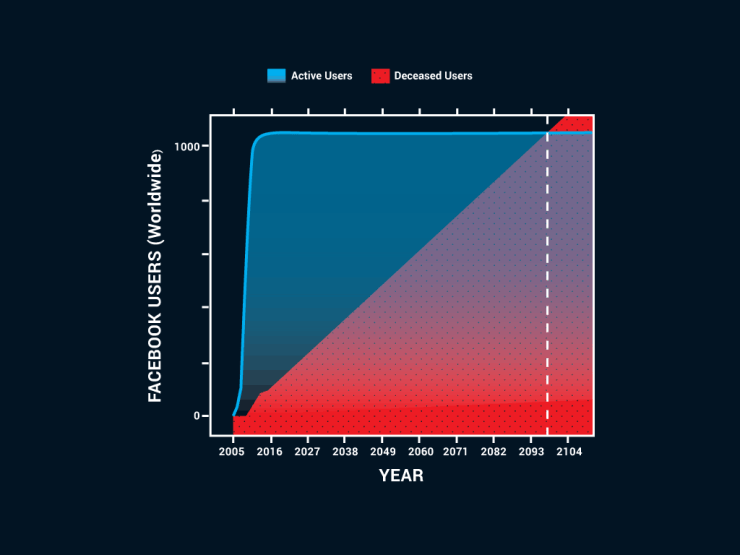
Sadikki’s results. Note the astonishing explosion of growth in active users from 2005-2016 and the intriguing slight plateau in number of deceased users around 2014-2016 (comments about reasons why are welcome!)

These numbers are intriguing but with the recent “death” of Vine, I wonder which will die first:  Facebook or its user base? Meaning, will we reach this cross point of number of deceased users equaling the number of active users before Facebook becomes obsolete? Munroe briefly explores Facebook’s future in his post and his take-away is that either Facebook falls out of favor (generating the 2060s scenario) or it continues on its current path (the 2130s scenario). I like exploring the Facebook-falling-out-of-use scenario, envisioning a Facebook that eventually evolves into the memorial sites that we’ve chuckled at in class. What if Facebook becomes an acceptable, everyday, communal mourning site? People wake up each day get a reminder to write on someone’s wall for their “death day”, comment and reminisce on pictures and videos, perhaps even chat with family members of the deceased. The idea probably won’t catch on, but it’s an amusing future to envision.

 

Would Thomas Edison have had a Facebook profile?

Natalie Zarrelli’s article Dial-a-Ghost on Thomas Edison’s Least Successful Invention: the Spirit Phone  was informative, thought-provoking, and ultimately self-fulfilling. I had never been made aware, as I assume is the case with the rest of the general public, that Thomas Edison ventured into the spiritual nature of being. While I do understand that this is largely because of the failure that the device encountered, I would have assumed that this new approach towards reaching the undead would have been documented more often. This makes me wonder whether it was a societal norm that prevented Edison’s machine from being documented more thoroughly, as science was not seen among those fields that would take such matters highly, or give them importance.

The main question that came to mind when thinking about Edison’s failed technology was his displeasure at being ranked among those who believe in mind reading and the nature of dreams. It seems that Edison thought that he was too “high” for such grouping, but I believe this to be a great fault within the scientific community. All theories are the same, regardless of how one wishes to convey them. When theories become a reality, they are no longer theories but  actual proven facts. So, is Edison justified in saying that he did not want to be grouped among these people in a 1921 Literary’s Digest? Why does the scientific community completely disregard the “supernatural” when their own theories could also be categorized as “supernatural” because they have yet to be proven? Ultimately I believe that this dichotomy is what prevents our society from advancing further in our technological exploits. Why choose to not work with a certain group of people simply because you don’t disagree with their own “scientific” method? Openness to all ideas/ theories/ suggestions are what make for a more progressive venture into the unknown. Would Edison have made greater strides with his Spirit Phone had be chosen to be more open to the supernatural? Perhaps.

An issue of the Literary Digest from the year Edison was featured.

The last line in the article caught me by surprise. “While we don’t know if Edison was correct in his theory that our personalities inhabit physical ‘entities’, nor if he could hear them on his spirit phone, at least the inventor’s idea of using technology to speak beyond the grave lives on.” Not only does this idea live on, but it is an actual thing. I formerly referenced Facebook’s “Remembering” feature in a blog post. For those who are still unaware of the feature or are confused by what it does, it is meant to preserve a deceased person’s Facebook profile. Formerly, I viewed the feature as one creepy entity, as opposed to breaking it down. Taking Edison’s views of the personality that may still linger once deceased, I see the Facebook feature as being exactly that. Our physical form will be long gone, but the data that is stored on this social media will still be there. To Facebook we are not real people; we are a collection of data. Data from our searches, our likes, our favorite videos, and our shared posts. This data tells a story about us; effectively becoming the leftover personality that Edison believed in. Depending on technological advances within the next fifty years, we might be able to use this data to recreate life a la Black Mirror: Be Right Back.

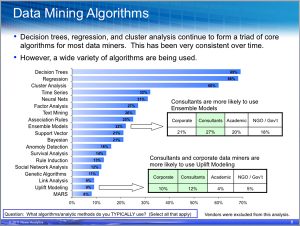
Facebook records so much information about us through these data mining techniques.