
Digital Lifecycles: Fyre Festival’s Death and Symbolic Immortalization

It’s been hard to look away from the train wreck that unfolded this past weekend on a “private” island in the Bahamas; I’ve been gleefully refreshing for updates on the massively failed Fyre Festival. Have the Fyre lawyers issued a statement responding to the multiple multi-million dollar lawsuits? Have any festival-goers actually received that apology phone call from festival co-founder Billy McFarland? Have any more employees come forward, disclosing delicious details about their totally inept bosses (who apparently couldn’t recognize the island wasn’t ready to host thousands of people from the view on their yachts)?

If you’ve been on the web this past week, you saw the panic of festival attendees unfold on Twitter while the rest of the web savored the moment to witness rich kids get punked by even richer kids in real time. Fyre marketed itself as a luxury get-away party, made complete by the presence of celebrities, models, and five star cuisine. Bored between musical sets? Hop on a jet ski and hunt for hidden treasure around the island — you may find cash, jewelry, or even cocaine from the eighties! (Somehow, a selling point in promotional materials was that the “private island” was “once owned by Pablo Escobar”).
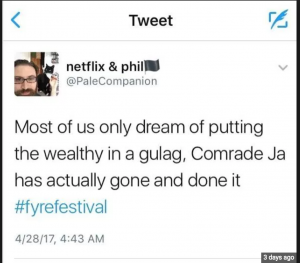
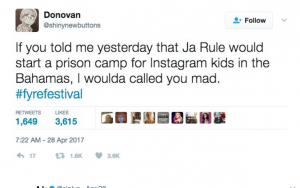
Of course, the festival presented in the flashy videos and sexy social media posts was never going to be a reality. Co-founders Ja Rule and McFarland cobbled together a media Frankenstein/siren hybrid from fantasy and the transmission of digital bits. Social sirens — the models and celebrities paid to post about the event — lured the masses close enough to be entranced by the slick surfaces constructed out of other festival footage.

Fyre Festival was born in digital space, and fittingly, it died there too. From the first tweets of barely constructed tents to celebrity lawyer Mark Geragos tweeting that he’s filed a fraud lawsuit, this was a distinctly digital lifecycle.

Video game scholar Raiford Guins detailed the lifecycle of failed 1980s Atari game E.T. The Extra Terrestrial. The game was panned by critics and returned en masse by consumers; Atari’s solution was to take all their copies of the game and unceremoniously dump them into a landfill. At this point, the game was cemented literally underground but also as a mythical representation within video game history. The physical death of the game cartridges was only the first step to immortalize the story of the game.

Just as Atari enthusiasts endeavored to uncover the game, I’m sure that Great Exuma island will begin to see its share of tourists searching for relics of dead Fyre Festival. The Festival died — in fact, it never really came alive outside of the digital promos — but the commentary and curiosity will live on. Enabled by the digital lens that shifted into hyper-focus on the event (cascades of tweets, incredulous Reddit threads, barrage of news articles), Fyre morphed from a festival into a totem where we can critically confront (and see, on uncomfortable display) celebrity obsession, conspicuous consumption, erosion of the social contract, and class consciousness among other abstract concepts. The fest may be dead, but Fyre-as-symbol lives on.


Narcissism in the Quest for Digital Immortality

Describing his stance on preserving the cyberspace self — constructed of by the mass of tweets and blog posts and Facebook statuses we accumulate over a lifetime — Paul Kimball brings immortality into the fold.   “We’re entering a world where we can all leave as much of a legacy as George Bush or Bill Clinton. Maybe that’s the ultimate democratization,” he told NYTimes author Rob Walker. “It gives all of us a chance at immortality.”

Walker traces the story of Mac Tonnies, a pretty regular guy who happened to update his blog nearly everyday and interact with online friends. Tonnies died unexpectedly. His blog become a shrine, a memorial, a viewing port into who Tonnies was as a person when he was living. Some of his digital friends reported seeking solace in his Twitter feed many months after he passed.

Even his parents, previously pretty unfamiliar with Tonnies blog (beyond what he chose to directly show them), told Walker that the personality crafted from these digital blocks were him. ““I can hear him when I read it,” his mother said.

Contrast this with Leslie Harpold, another person who spent time cultivating her online presence. With her unexpected death, her digital friends implored her family to keep her websites and social accounts alive. The family refused, believing that Harpold’s legacy doesn’t exist online. Instead, it “is with every person who knew her and loved her…People need to appreciate that she was a real person…[and] remember her as she was.” As she was, from this perspective, is situated in her physical interpersonal relationships and physical life rather than her online life.

This tension of where the self resides is nothing new. In the digital era, it becomes more and more clear that our self doesn’t reside squarely in one place or the other — completely online or completely embodied. Rather, we are hybrid cybernetic organisms negotiating the performance of self on multiple stages — online, offline, public, private….the complexities of stage and performance go on.

The issue with how to treat our digital remains after physical death is just another nuanced stage. How do prepare our performances of self even after we die? Many of the people Walker interview placed importance on documenting themselves, “creating a master repository of me” containing all their digital content, and achieving immortality. One software developer even proposed that institutions like governments or universities take over the preservation of individual’s digital content post-mortem.

I think this is a flimsy fantasy and indicates inflated egos and resistance of the inevitable. You are not special and you will not be remembered for hundreds of years. The “legacy” Paul Kimball is hoping for will be out of reach as soon your storage methods become as obsolete as floppy disks — which will happen fast. Your content is not you, it is only a portion of your overall performative self across those many stages. A life is not solely a collection of content. To act as if it’s cheapens human life. Beyond two generations, the likelihood is that your digital content becomes completely irrelevant. To act as if it won’t is narcissistic.

To then suggest that societal institutions are responsible for preserving highly individual expressions seems extreme. Social institutions are meant to preserve history and knowledge, making these repositories accessible for current and future generations — a place to reliably access our collective knowledge. Hyper specific details of each and every life — mainly consisting of the mundane, individual life — does not seem to fall under this purview. For all of human history, the far majority have died quietly and anonymously outside immediate social bonds. The few historical figures that do stand out often function as symbolic containers — rather than as individuals — for the values and practices of that particular society; the collective is imprinted upon them, and they become an avatar for understanding the rest of that society.

But we can’t all be the avatar. That avalanche of information is too much to process. What makes human unique is our capacity for symbolic thinking — we don’t process heaps of raw data like computers do, we instead engage with a semiological process that results in symbols — encoded as things like public figures, material objects, language — becoming containers for our most abstract human concepts. We rely on this collective symbolic framework to understand the world. Spending time fastidiously preserving all tweets or all Facebook statuses seems inconsequential given that the tides of time and human memory will do their work on even the most carefully preserved content — eventually, inevitability, the majority of it slips out of living reach.

An infographic about living and dead people throughout history from LiveScience.