Empathy for the Monstrous

Below is my podcast:

[soundcloud url=”https://api.soundcloud.com/tracks/310265778″ params=”auto_play=false&hide_related=false&show_comments=true&show_user=true&show_reposts=false&visual=true” width=”100%” height=”450″ iframe=”true” /]

And here’s my works cited:

Canavan, Gerry. “”We are the Walking Dead”: Race, Time, and Survival in Zombie Narrative.” Extrapolation, vol 51 no. 3, 2010, pp. 431-453.

“Halt & Catch Fire.” Supernatural, season 10, episode 13, The CW, 10 Feb. 2015.

Mezei, Sarolta. “Spectral Media Technology and the Vicious Brothers’ Grave Encounters.” HJEAS : Hungarian Journal of English and American Studies, vol 22 no. 1, pp. 167-180.

Pinedo, Isabel. “Recreational Terror: Postmodern Elements of the Contemporary Horror Film.” Journal of Film and Video, vol 48 no 1/2, 1996, pp. 17-31.

“Running.” Dead Set, season 1, episode 4, Zeppotron, 30 Oct. 2008.

Death in Dead Set

Death in Dead Set breaks some of the fundamental rules of film.  Actually, the entire series as a whole breaks some – if not all – of the rules in the 5 phases of disaster located in Susan Sontag’s “Against Interpretation.” Although this is fits into the horror genre, it contains certain sci-fi elements.

These include (Sontag 209-210):

  1. The arrival of the thing
  2. Confirmation of the hero’s report by a host of witnesses to a great act of destruction
  3. Conferences between scientists and the military take place, with the hero lecturing
  4. Further atrocities, the hero’s girlfriend is put in grave danger
  5. More conferences, whose motif is: “They must be vulnerable to something.”

Most importantly, “The films reflect world-wide anxieties, and they serve to allay them,” (225).

So why did Dead Set go with the ending it had? Why was there no explanation behind the disease? Why didn’t we get a close up of any scientists working in the background? Why was the ending so abysmal? All of these could be answered by the fact that this show is a giant metaphor, but still… the unexpected bleakness of the ending was totally shocking and somewhat unsatisfying.

Here’s a few things that riled me up, because I wasn’t expecting them:

NO ONE SURVIVES – not even the main heroine!

www.mediafactory.org.au/michael-liberale/2015/08/13/dead-set-and-zombie-audiences/%5B/caption%5D

“The rule, of course, is that his horrible and irremediable form of [disaster] can strike anyone in the film except the hero,” (222). Whelp. That’s thrown out of the window!

Those who commit heinous acts or sexually transgress make it to the FINAL episode, while the innocent die almost immediately (minus Riq).

In horror movies, who dies first? THE ONES WHO DO BAD THINGS! Even the ones who sexually transgress – i.e. commit adultery, lose virginity, etc – are typically thrown out of the window. Didn’t anybody watch Scream?

www.tes.com/lessons/Mt2fWMCEz9-7oA/scream%5B/caption%5D

Nevertheless, who dies before the scum of the show? Alex and Riq, the two most innocent characters.

The ONLY two likeable characters in the entire show are Alex and Riq. Alex dies somewhere halfway, while Riq is shot by Patrick in the end.  Matt points out that Riq is the only character that is not eaten or killed by a zombie. Even when all hell breaks loose and the gates open, the zombies jump over Riq to get to the other people. He was the only one who didn’t watch the show. He was the only uncorrupted protagonist.

On the other hand, who gets to live?

  1. The guy in the pink shirt who opened the door and got one of the members killed in the first place
  2. The piece of crap, Patrick, who stays on until the end. Admittedly, this made his death even more satisfying (though I couldn’t watch it!). Never has there been a character that I hated more than him.
  3. Gollum, the perverted old fool, lives long enough to kill everybody by opening the gate. Was this an act of revenge on the group for making fun of him? He was corrupted since the beginning, but he made it to the final episode. Yay.
  4. Kelly is a dear, but didn’t she cheat on her boyfriend? According to Jeffrey Cohen’s “Monster Culture (Seven Theses)”, those who commit sexual transgressions are doomed to die or become an outcast. Kelly turns this on it’s head, because not only does she survive the longest – she is one of the leaders in the group.

Something that was less surprising was this…

The bodies of the ONLY two minority characters are mutilated, plus they are the first two who die in the main group. Not sure if this is worth pointing out, but it did come to mind almost immediately. Another metaphor?

dawningcreates.com/tag/dead-set/%5B/caption%5D


Works Cited

Brooker, Charlie. Dead Set. E4. directed by Yann Demange. Netflix. 

Cohen, Jeffrey Jerome. Monster Culture (Seven Theses). 4-25. 

Sontag, Susan. Against Interpretation and Other Essays. New York: Delta-Dell, 1966. 209-225.

 

End to Screen Culture

If I were to choose one line that resonated with me the most, it would be where Joquin quotes the King James version of Revelation 20:13, saying

“And the sea gave up the dead which were in it; and death and hell delivered the dead which were in them: and they were judged every man according to their works.”

While I still dislike the way in which he presented this, I think he hit the nail on the head when it comes to summarizing the situation.  Dead Set shows us an apocalyptic zombie outbreak through the lens of a screen society, and I prefer to believe Joquin when he says that everything may be happening because a God “is judging our culture, and smiting us accordingly.”  Let’s face it, in the show and in today’s world, screens are everywhere, and society can seem to revolve around staring at a screen for long periods of time.  I’d venture to say that we’re all already somewhat zombie-like, and condemning society  to literal zombification for eternity might not be that big of a change(on a large scale of course, for you and I being a zombie might shake things up a bit).  The participants of society are simply changing form, and they’re continuing to do the same things that they were doing before, staring at screens.

For me, Dead Set creates an all appropriate, and terrifying, ending for the screen culture of today.

Kelly turns to the television in an attempt to find out what is happening. Captured from Dead Set episode 1 via Netflix

Sources:
Bishop, K. W. (2010). American Zombie Gothic: The Rise and Fall (and Rise) of the Walking Dead in Popular Culture. Jefferson, NC: McFarland & Company, Inc.

Brooker, C. (Producer). (2008). Dead Set. United Kingdom: Zeppotron.

~~~~~~~~~~~~~~~~~~~~~~~~~~~~~~~~~~~~~~~~~~~~~~~~~~~~~~~~~
Totally aside from the ideas above, isn’t the idea of a life-and-death battle with the dead pretty cool, less cool if the dead win I suppose

Captured from Kabaneri of the Iron Fortress Episode 2


Zombie/Horror Tropes in Dead Set

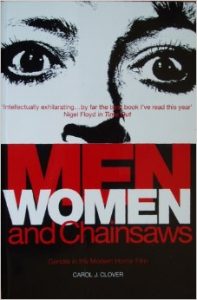
We’ve discussed the trope of the Final Girl a few times in class – basically, she’s the last survivor of the horror film (typically, but not always, a slasher film).  Conveniently, she’s usually a virgin (unlike the sexually active women, whose deaths many scholars interpret as punishments for sexual transgressions) and brunette (again, possibly interpreted as displaying more innocence/less sexuality).    Although she doesn’t fit the paradigm exactly (she’s not a virgin), when Kelly was trapped in the diary room after the rest of the characters had died, I immediately thought “Final Girl!”  While Kelly isn’t a virgin, she’s certainly less sexual than the other female characters, who are built like models and appear to rely on their looks and sex appeal as reality TV stars.  Kelly is the most rational, down to earth (read: masculine) woman on the show, so it’s fitting for her to assume the role of the Final Girl.

The term “Final Girl” was first coined in 1992 by Carol J Clover in this book. Source: amazon.co.uk

After I finished the last episode, I went to tvtropes.org to read up on the Final Girl  (that’s where I learned the bit about her usually being a brunette, which I had never heard before).  If you’re a regular consumer of media/pop culture, tvtropes.org is a very easy rabbit hole down which to fall.  As I usually do when on the website, I found myself with about a dozen tabs open, reading up on different tropes and seeing how they fit Dead Set.

I’ll come out and say it: I don’t think Dead Set  was a particularly original zombie show.  The reality TV element was interesting, and it was certainly enjoyable and well-written, but especially after seeing how many major horror tropes it fits, it strikes me as pretty standard zombie fare.  Here are some horror/zombie tropes I found while browsing tvtropes.org, and how they fit  Dead Set. (Tropes are all linked to their pages on the website both for citation purposes and in case you’re interested in doing any further reading).

The Zombie Apocalypse trope page reflects many elements seen in Dead Set: the collapse takes place quickly, people lose their humanity in the fight for survival, and there isn’t a happy ending.

The tropes entitled Black Dude Dies First and Bury Your Gays are pretty self explanatory: Angel, a black woman, is the first of the housemates to die and become reanimated, and Grayson follows not soon after.

Not Using the “Z” Word is another standard zombie trope displayed in Dead Set.  The characters never say the word “zombie” and act as if they exist in a world without them (like we mentioned in class).  This trope is an awfully common one called Genre Blindness.

Room Full of Zombies occurs, unsurprisingly, when a character enters a room flooded with zombies, like Kelly does when exiting the diary room.  The trope of Our Zombies Are Different, in which zombies depart from the usual shambling, reanimated corpses, covers the zombies’ speed.  The zombies also fit the tropes of Flesh-Eating Zombie and Plague Zombie.

I could keep going, but this post is already long enough.  What I’m trying to illustrate is that in terms of plot and characterization, Dead Set doesn’t strike me as very original.  While I didn’t find the show predictable, it was certainly familiar, and didn’t depart much from the mainstays of the zombie genre.

(If you’re looking for a somewhat weird, extremely creative and original zombie movie, I recommend Pontypool. It’s on Netflix, it’s pretty short, and it’s like no zombie movie you’ve seen before.)

Intelligence Isn’t Enough: Why the Housemates Lost to the Zombies

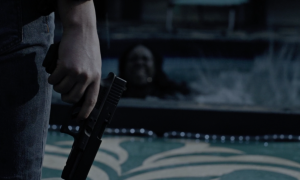
While watching Dead Set, I was struck by the scene in which Kelly watches zombie Angel flopping around in the pool, and comments that she believes the surviving humans will beat the zombies because the humans are smarter than them. It was apparent well before this that the zombies were not particularly brilliant, emphasized by the way in which they seem incapable of opening doors and spend most of their time scratching at them. Yet, both before this moment and in the following episodes, it is clear that the humans are not winning the fight against the zombies, so I considered why.

A screenshot from “Dead Set,” Season 1 Episode 3. Kelly prepares to shoot zombie Angel. Accessed via netflix.com.

I was drawn to the section of American Zombie Gothic in which Kyle William Bishop addresses how humans are in fact the biggest threat to each other in many zombie films. He writes, “The symbolic threat of the zombies remains a fundamentally frightening part of these films, but because the threats of bodily harm, rape, and murder are real-world potentialities, both in and beyond the zombies, such scenes become all the more terrifying by being inescapable in supposedly escapist movies (Bishop 24-25).” There certainly are aspects of this in Dead Set. For example, the cops threaten to shoot the survivors, Marky almost shoots Riq, and of course Patrick and Joplin’s scheme in the final episode is relatively treacherous. However, I also noted that in an equally real way the humans were threats to themselves. Since they are not mindless zombies, several characters show very human emotions such as empathy and fear that end up resulting in their own deaths. For example, Grayson was clearly struggling with the idea of having to kill his friend Angel, and his hesitation in stabbing her cost him his life. Alex and Riq also seemingly would have been safe staying in the farmhouse, but Alex’s connection to Riq, and Riq’s desire to see Kelly again both drive them to their eventual deaths. In some ways, it seems as if those who become most like their zombie counterparts and lose some of the defining features of humanity have the best chance of survival. While I watched, I felt as though this set the characters up for a rather bleak outcome no matter what: either they died because of their humanity, or in fighting “the other,” they lost what made them better, or at least different, in the first place.

Bishop, K. W. (2010). American Zombie Gothic: The Rise and Fall (and Rise) of the Walking Dead in Popular Culture. Jefferson, NC: McFarland & Company, Inc.

Brooker, C. (Producer). (2008). Dead Set. United Kingdom: Zeppotron.

Avoiding the Z-Word

So far in my viewing of the first two episodes of Dead Set, a British television series about filming a Big Brother TV show during a zombie apocalypse, no one has used the word “zombie”. The characters use vague pronouns like “it” or “them” of “things”, but never settle on a name for the undead* monsters.

Devina as a zombie. Source: Zombie Guide Magazine

Why not use the z-word? As a novice to the zombie apocalypse genre, perhaps referring to the monsters as “things” and not “zombies” is common. This does add to the confusion and heightens the terror around the monsters. By not calling them “zombies”, a well-known and defined category of monster, the audience is left more uneasy and does not know (entirely) what to expect from the creatures – like these creatures, which are fast-moving zombies (who can’t climb gates, or swim, apparently).
Another reason could be that in the world of the show, the idea of a zombie doesn’t exist. As a result, the characters have never seen horror films or TV shows with zombies and don’t have that familiar classification for the undead.

Since we knew several of these characters before they changed, perhaps the show avoids “zombie” because referring to them as an other is dehumanizing. Often the characters still refer to known zombies by their given names, such as the producer Peter and contestant Pippa when talking about the (now zombie) host Davina. By still using their names, killing them has an emotional aspect since the characters still associate their human versions with the creatures.

Whatever reason the writers used, not using the term “zombie” irked me as a viewer and resulted in several fumbling “th-th-those THINGS” in the dialogue.
* Shakespeare frequently used “un” words to draw certain emphasis to the opposite of the word or the revocation of a verb, such as “unking” or “unbroke” (both from Richard II). Since one becomes a zombie after dying from a zombie’s bite and returning to “life”, using a Shakespearean interpretation of “undead” makes the for an interesting analysis of the zombification process. Terming them “undead” reflects their transformation back through a reversed process of dying.

Fear Thy Neighbor: The Monster Next Door in “Dead Set”

In the chapter “Monster Culture (Seven Theses),” of Monster Theory : Reading Culture, Jeffrey Jerome Cohen does exactly as his title suggests, interpreting seven different types of monsters as cultural embodiments of specific fears, taboos, and desires within cultures. His fourth thesis, titled “The Monster Dwells at the Gates of Difference,” struck me as particularly relevant to today’s global climate. In this thesis, Cohen claims that “The monster is difference made flesh,” a “dialectical Other” that represents “an incorporation of the Outside, the Beyond…” (Cohen 7). This cultural fear of the invasive, dangerous Outsider is highly applicable within the context of contemporary society where the widespread fear of the “Other” is linked directly to the fear of terrorism and the need for protection, whatever the cost.

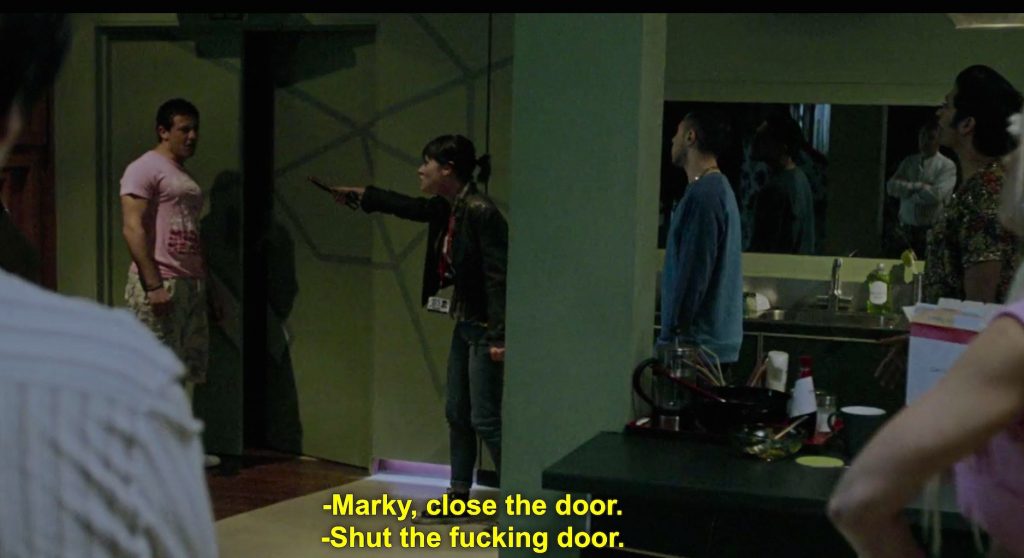
However, as I watched Episodes 1 and 2 of the TV mini-series Dead Set and attempted to apply Cohen’s fourth argument to the violent zombies on the screen, I began to wonder if perhaps there was an important nuance to be made in this thesis. While the zombies were physically on the outside of the safe house and then further estranged as “Other” by their cannibalistic behavior, they still existed right next door. Kelly is separated from a zombie by only a door just as Patrick and Pippa are cloistered away in a room while a zombie bangs in frustration on its entrance.  Despite their positioning as Outsiders, the zombies’ close proximity put them in a different category all together: that of the neighbor (rather than the stranger).

The only thing separating the “Big Brother” cast from the zombies is this door. Source: “Dead Set.” Season 1 Episode 2/5. Netflix.

This imagery of the neighbor is further reinforced by the fact that the reality show Big Brother is filmed within a constructed house reminiscent of Foucault’s panopticon in which the cast can’t see out but the film crew can see in. The physical and literal invocation of the house and surveillance immediately establishes a relationship between the inhabitants within and those on the outside. In one scene, Kelly taps on the one-way mirror and the audience sees what she cannot: a hungry zombie growling on the other side of the glass. In this moment, human and monster coexist next door to each other, only inches apart. The one-sided mirror serves the same delineative purpose as the traditional white picket fence that separates properties and neighbors. However, this barrier is soon penetrated when the zombie gets in through the door.

These zombies are violent, cannibalistic, wild, disgusting, and without any trace of humanity. What’s even more unsettling is that they still resemble the familiar faces of the cast and crew we met at the beginning of Episode 1 when they were human. The cinematic choice to maintain the physical identification of these original characters even as zombies is effective because it confuses the Familiar with the Other. The zombies are at once different because of their violence and familiar because of their faces. In this sense, the Other does not represent an Outsider from far away lands but rather the monster that’s living next door. I’ll title this eighth thesis, “The Monster Dwells at the Gates of…your own home.” One thing is certain, you can’t trust your neighbor. Time to get a bigger fence.

References: 

Cohen, Jeffrey Jerome. “Monster Culture (Seven Theses).” Monster Theory : Reading Culture. Minneapolis: University of Minnesota Press, 1996. Web.

Being a zombie, with and without actually being dead.

The beginning of Dead Set was interesting to say the least. At first I did not think that the disasters all over the U.K. would be tied to zombies until we see the car driver get attacked. I am not a fan of scary/horror movies or shows, so being scared at first was a natural reaction. However, what came after that wave of emotions really surprised me. As I began to see more and more people getting attacked by the undead I began to think back to Marjorie’s violent actions in A Head Full of Ghosts. Every time a zombie takes a bite out of a human I picture Marjorie biting into the priest.

Zombies biting into human flesh, akin to Marjorie’s actions.

Following this method of thinking I can see how Marjorie herself might be similar to the zombies on the show. They are both not in a fully conscious(assuming zombies are different people than their human counterparts) or autonomous state. Their actions are influenced by factors out of their reach, and they are not the same person that they were before. I like to believe that Marjorie ultimately did suffer from a mental illness, and that led to her actions. I think this connection brings up the more important issue of how we deal with those that have mental illnesses. In the show we see that the human’s first action is to freak out, which is understandable because they are being attacked. However, when Marjorie begins to act strangely, her parent’s first reaction is to freak out as well. Mental illnesses are  highly overlooked and misunderstood in our modern day society. I think the lack of understanding allows those affected to become a “zombie” in a sense by being marginalized.

I’d like to keep developing the idea of what it means to be a “zombie” by tying it into the name of the class. I think that Death in the Digital Age is best embodied through Facebook’s “Remembering” feature. For those who are not aware this is a feature that allows for people’s Facebook profiles to remain online after they have passed. When one visits the deceased person’s profile there is a sign that reads “Remembering _______” with the blank space filled in by their name. As I am looking through several of these pages on my own Facebook account I realize that this too is a way that one can become a “zombie”. The deceased are no longer on this earth, yet their presences is still felt. We can see where they have been, what they have liked, and even what they looked like. Yet, they are gone. This is similar to how zombies  in the show are no longer living, yet continue to be present.

Facebook’s “Remembering” Feature

To a certain extent we can say that these Facebook profiles haunt us. We as friends of the deceased may not have asked to see the “Remembering” feature, yet it still there. We may never come across it, or may consistently encounter it. Regardless, the page exists and will trigger mixed feelings. Technology has allowed for all of us to become zombies once we have passed. Whether or not some of us approve of that is a question that should be brought forth. Should we consent to this feature? Should friends of the deceased be notified that this is happening and be asked if they are ok with viewing it in their feed? These are questions that should be discussed.


Zombies, the abject, and the idea of haunting in “Dead Set”

The most disturbing element of Dead Set was certainly the gore, at least in my experience. I’m not a horror fan, and thus turn my head or close my eyes during the inevitably violent moments of my favorite TV shows or movies. Watching Dead Set, a TV series with a pair of undoubtedly gory opening episodes, I began to wonder what the appeal of this horror was.

As Jefferey Jerome Cohen gets into in his article “Monster Culture (Seven Theses),” part of this horror has to do with the abject. According to Kristeva, the abject (in this case, the blood and guts of human bodies as zombies devour them, and the excrement of the survivors trapped in the house) is “tempting as it is condemned” (19).

This push and pull between attraction and disgust is obviously very relevant when explaining the appeal of the horror genre in general, especially violence and gore. The use of zombies plays into the idea of the abject quite effectively, as they are essentially the walking abject–humanoid figures completely devoid of humanity.

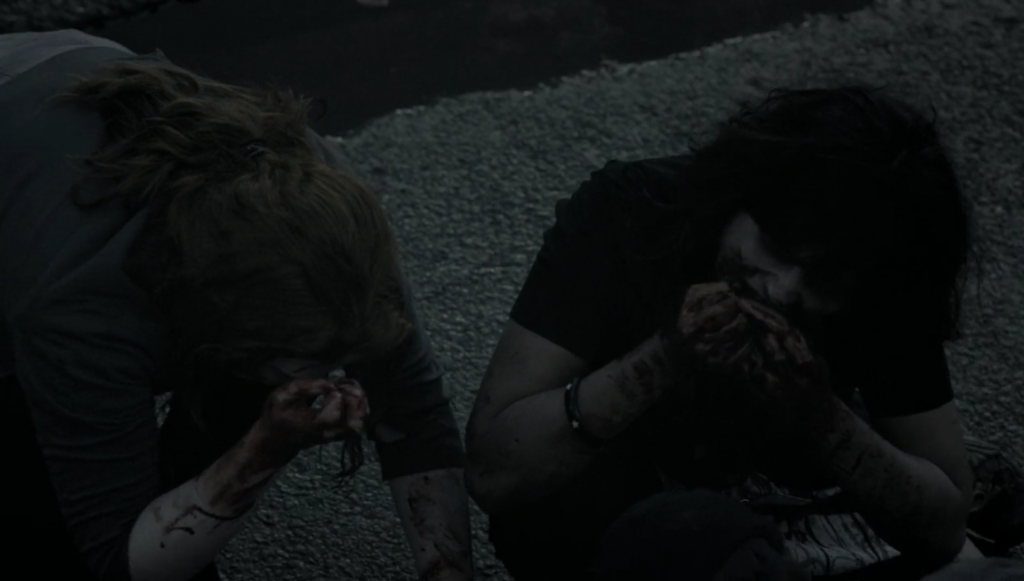
Claire, a former Big Brother employee, devours one of her victims. Source: Netflix

Another aspect of the zombies that I found interesting was the way in which they carry “haunting.” This occurred to me in the context of Claire and Kelly’s relationship. Shortly before the zombie apocalypse set in, Claire revealed that she had also slept with the man that Kelly cheated on her boyfriend with. Claire’s body now holds two sorts of haunting to Kelly: a reminder of the mistake she made in cheating on her boyfriend (she destroyed the zombie of the guy himself, which is interesting), and also the imminent haunting of death should Claire catch up to her. I’ll be interested to see how this zombie haunting continues as more people ostensibly succumb to zombiehood.