sarahfunderburg.com/undeadcelebs
password: bobross
Artist Statement
“When the original ceases to exist, yet can be seen to live on in the media, the possibility of an extended immortality can be implicitly evoked. The fact that all this happens within the realm of entertainment and popular culture, where, for many, the exercise of a willing suspension of disbelief has become almost second nature, makes the entire proposal even more persuasive.” Alexandra Sherlock, 173
“Always the photograph astonishes me, with an astonishment which endures and renews itself, inexhaustibly. Perhaps this astonishment, this persistence reaches down into the religious substance out of which I am moulded; nothing for it: Photography has something to do with resurrection. (Barthes 2000 [1980], 82). [sic]” Roland Barthes, quoted in Sherlock, 174.
——–
I wanted to consider the idea of the celebrity in a captured image and its meaning in our digital era. The photograph was long considered an object of truth, far removed from art and reinterpretation, but with the advent of digital photography, the manipulation of photos has become ubiquitous, and practically synonymous with photos of celebrities. Whenever we, as a culture, see a photograph of a famous person, whether it be in a magazine or on the red carpet, we often assume that it has been “doctored”; that is to say, altered in a manner favorable to the celebrity.
Photographs have an aura of permanence—of a temporary moment permanently transcribed with the camera’s technology. When considering this, I found that the concept of the image reminded me of the way Sterne described early audio-recording technology in Resonant Tomb. Of course, the first rudimentary audio recordings and these high-definition photographs appear to have little in common—certainly not in terms of medium or quality. These altered photos are intended to strike the middle ground between ephemerality and permanence, just as the first audio recordings did (Sterne). Sherlock writes, “Photography marked a new era in the reproduction of self: Each time we are photographed we reproduce (Giles 2000, 51), and each reproduction lives on into the future as a record of our existence” (166). These reproductions are what I consider.
Consider this quote: “Barthes believed that all photographs (and potentially all forms of visual representation) contain a paradox between life and death—the moment is dead but the photograph is alive and present, and this paradox is the punctum that pricks our attention” (Sherlock 170). As Sherlock defines it, Barthes’ punctum “Is what punctuates a photograph: something that jumps out and grabs your attention, for whatever reason. It is usually something that the viewer does not fully understand and sparks the viewer’s curiosity” (170). Barthes names five possible punctums: the two I want to engage with in this project are “contortions of technique or trickery,” and “the ‘lucky find’” (Sherlock 170).
The trickery is my post-production digital manipulation of photos of award ceremonies and music festivals, altered to include dead celebrities, and on two occasions, celebrities who were killed on Twitter (more on that later). This is not quite necromancy as Sherlock has it (the celebrities aren’t talking back), but more of a reanimation or reinvigoration of the dead celebrity. The “lucky find” is also at work, being that hopefully the “Photoshopping” is effective enough to incur some searching on the part of the viewer for the uncanny subject: What haunts this image?
As Sherlock phrases it, “To suggest that we are fooled by these living images of the dead would be misleading—rationally we know that the subject is deceased. However, the cultural avoidance of death can provoke an ever-greater fascination and curiosity, a curiosity quenched by the further consumption of death-related popular culture (Durkin 2003). Images of those that have since died have a special effect and can evoke spine tingling feelings of creepiness.” (169-170) In this case, you all are hyperaware of these celebrities’ deaths given the nature of this context, which is why I included the Twitter deaths of still-living celebrities.
This project is also about the para-social relationships “the public” has with fame. As Sherlock explains, “Horton and Wohl coined the term para-social to explain the bond—facilitated by the media—that many viewers felt with particular television personalities and presenters” (168). Meyrowitz complicates this phenomena further, stating: “Even an awareness of the para-social mechanism is not enough to permit escape from its ‘magic’” (128). These photographs blur the boundaries between reality and fiction, honor and disrespect, and preservation versus peace. When do we let a celebrity rest? Think of Marilyn Monroe’s twitter—she is long gone, yet we still insist on conversation. To borrow a phrase from Sterne, these photos deal with “Death as a receding limit” (199). Imagine them as being captured at a fictional award ceremony that happened yesterday.
As mentioned earlier, Britney Spears and David Guetta had “Twitter deaths.” This is to say, these people are still among the living, but Twitter, at one point or another, insisted otherwise. Both Guetta and Spears’ names became trending topics alongside the hashtags #RIPDavidGuetta and #RIPBritney, in 2011 and 2016, respectively.
Britney Spears’ Twitter death included headlines the likes of “Everyone Thought Britney Spears Was Dead Because Of A Savage Twitter Hack” (Elite Daily), “PSA: Britney Spears Is Still Very Much Alive: The Sony Music account’s tweets reporting her death are false” (Elle), and “Sony Music apologizes for Britney Spears RIP tweets” (Fox News). Fox News explains Spears’ Twitter death with a strange tone: “Sony is well aware of the damage a hacked account can cause, especially when it impacts an entire service such as the PlayStation Network. The latest Sony hack is on a much smaller scale, though, with the only real consequence being lots of upset Britney Spears fans.” Indeed, Spears’ Twitter murder is of little consequence to them.
David Guetta’s Twitter death is treated with more levity and much less general coverage on the internet. His Twitter death is a kind of internet in-joke, more useable in memes than headlines, perhaps due to the fact that it occurred five years earlier than Spears’. As Twitter user @danababy97 has it:
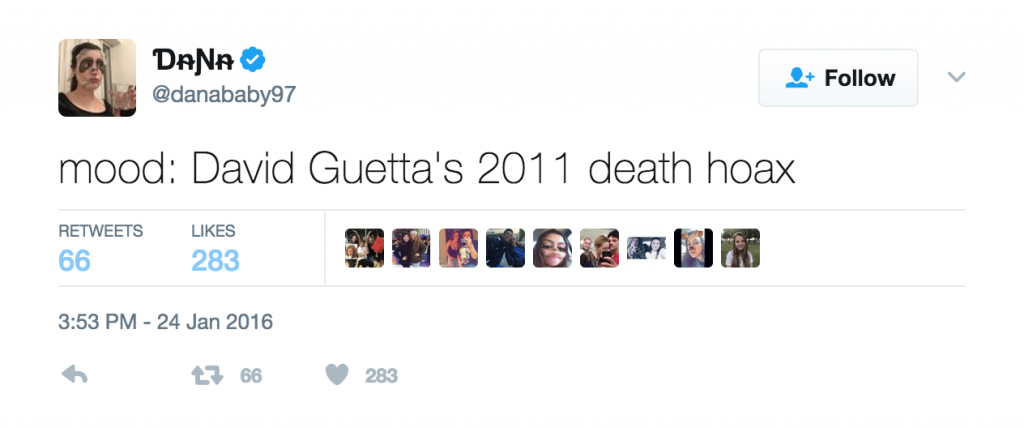
@danababy97’s tweet: “mood: David Guetta’s 2011 death hoax”
Meyrowitz discusses this strange kind of murder even though it’s unlikely he anticipated something like Twitter culture, having written No Sense of Place in 1985. He wrote:
The para-social relationship has also led to a new form of murder and a new type of murder motive […] The para-social murder. In both love and hate, normal and bizarre, the para-social relationship is a new form of interaction. It has some of the traditional characteristics of both live encounters and communication through books, but it is, in fact, neither” (121)
I would argue that these Twitter murders rely on para-social interactions, further complicated by the user reciprocity (retweets, etc.) that Twitter encourages. These celebrities, digitally murdered on Twitter, live on in the way that “matters.” However, as Sherlock phrases it, “To what extent can digital representations substitute for those they refer to, and how could the death of the “original” affect public perceptions of the representations that continue to be perpetuated in popular culture? Ultimately, what effects might these digital ghosts or even reincarnations have on popular perceptions of death and mortality?” (165)
Meyrowitz sums up what I hoped this project would access pretty well:
Ironically, but appropriately, the media provide the most ritualized channels of mourning. Radio and television present specials and retrospectives. And many people use the telephone to contact real friends who shared the intimacy with the para-social friend. But the final irony is that, in some ways, the para-social performer does not die. For the only means through which most people came to know him or her—records, films, and videotape—are still available. The relationship is frozen, rather than destroyed. In part, it is the potential and hope for increased intimacy that dies, and the never to be face-to-face consummation of the relationship that is mourned. (120)
With these manipulated images, I wanted to “unfreeze” and refigure the relationships, casting doubt in some cases on the living status of these celebrities. Imagine what Meyrowtiz would do with the knowledge of the expanse of internet-mourning today—the Twitter funerals, Oscar and Grammy in memoriam slideshows, the endless barrage of grief-stricken updates on Facebook and Instagram. Sherlock follows this thought: “Paradoxically, while death has become less visible, mourning, particularly in response to the death of a public figure, has become more visible. The Internet and the media facilitate a new type of ritualized, collective mourning that potentially serves to distract mourners from the physical reality of death” (169).
The nature of the “reality” I have created here depends on this idea about the reproduction of images given in Sherlock: “The representation is even more real if you have never met the original—it is the original” (168). Without further evidence, how do we know for certain that what we’re seeing isn’t true? The people who engineered the Tupac hologram knew this was a powerful question to ask of celebrity.
CONCLUSION:
I found several aspects of completing this project thought-provoking beyond the comparison/analysis of the photos I manipulated and the sources I included. One of those thoughts has to do with the format of this project, being an accessible/public page on my website. What does it mean for someone to look at this page not knowing the context? Would they imagine these celebrities/people as living again? Sherlock also accesses this thought: “To what extent can digital representations substitute for those they refer to, and how could the death of the ‘original’ affect public perceptions of the representations that continue to be perpetuated in popular culture? Ultimately, what effects might these digital ghosts or even reincarnations have on popular perceptions of death and mortality?” (165) The lack of clarity was unsettling enough for me to install a password. Furthermore, Is this illegal? Sure, the images are licensed for public use, but who owns the rights to these celebrities’ “personality rights”? (In reference to the article we read, “These are the most influential dead people on Twitter”). Would they have been O.K. with being visually included at these events?
The next thing I found myself concerned with was that I was performing a sort of celebrity audit; In making the images, I would ask: Would this famous dead person have been famous enough to be in this situation? This idea was particularly central to Alan Rickman sitting behind Ryan Gosling, the Smith family, and more (Image 8), and Paul Walker in the Ellen selfie instead of Bradley Cooper (Image 4). Furthermore, this audit reaches another level in terms of the celebrities I chose to include in the project at all; the ones I have included already passed some sort of fame test. I found myself wanting to continue in the vein of these arbitrary inter/intra-celebrity classifications. As uncomfortable as this made me, it occurred to me that this kind of categorization is someone’s job. Think of the “rest in peace” segment at the Oscars and Grammy’s every year: What is the criteria for making the cut?
Sherlock mentions this idea: “In his article on fame, Halberstam describes it as a measure of having lived a ‘worthwhile, or at least noteworthy, life’ (1984, 96), making a mark on the world and gaining assurance that one’s existence has been noticed” (167). That seems like a vague set of criteria to me.
The last element of the project I found unsettling was the effect the formatting of my webpage had of creating a sort of dead celebrity “Where’s Waldo,” a virtual necromancy game. Ultimately, what does it mean to visually bring these people back to life in this way? As one of our questions in class asked, what does a social life look like for the dead? Hopefully, these images do something to answer that question in the context of celebrity—though I may have more questions than answers.
Word count: 1,990
Works Cited document
PDF of Artist Statement