High-Tech Warfare: Dehumanizing The Enemy

Another sightings post, another episode of Black Mirror. This semester I had the pleasure of reading one of the longest books I’ve ever read, War and Peace for my Russian Studies course. The majority of the book takes place during the Napoleonic War between Russia and France. One of the most prevalent themes in this book was the dehumanization of the enemy in times of war. To speak about this topic, Dr. Denham came to visit our class. One of the most prevalent things in all war novels is the dehumanization of the enemy by the government. From epics to propaganda posters to media hysteria today, dehumanizing the enemy has been one of the most convincing ways to get humans to kill each other. This Black Mirror episode takes dehumanizing the enemy to a whole different level.

The episode starts with a protagonist named Stripe who is an American soldier deployed in Denmark to eradicate mutated humans called “roaches.” He, like all the other soldiers have a neural implant MAAS that enhances senses and processes data via augmented reality…it also gives sex dreams while sleeping. Stripe and his crew are sent to a remote village to hunt for roaches.

motherboard.vice.com/en_us/article/men-against-fire-review-black-mirror-season-three-episode-five%5B/caption%5D

Above is a picture of what the Stripe viewed the roaches as. After an altercation with a roach, Stripe was flashed by an LED device and the roach escaped. The device causes damage to Stripe’s MAAS implant yet both the doctor and the psychologist clear him for another mission. At another mission he sees his crew killing not roaches but actual humans. He flees with a woman and her child who are technically roaches. The device broke his MAAS implant and allowed him to see the roaches as they are-humans. Roaches are actually the victims of an ethnic cleansing that were believed to be genetically inferior. MAAS alters the soldiers perceptions and views the roaches as ugly zombie like creatures to continue the prejudice and the propaganda of genetically inferior humans. After his crew mates find him and kill the woman, he is sent to military prison. While in prison, the military personnel explain to him what MAAS truly is and playback his consent that has been wiped off his memory and killings of the roaches-now as ordinary humans. He consents to a second memory wipe and is discharged.

What makes this episode interesting and terrifying is that the government and media use the same ploys to encourage to kill. Whenever a horrible atrocity occurs in United States, one of the first questions asked by the media is whether the perpetrator is Muslim. Donald Trump for instance uses awful and sweeping rhetoric that plays into this propaganda. Phrases such as “Islam hates us,” or “Bad Hombres,” and the ever famous “They’re rapists,” dehumanize certain groups of people that allows for war and violence against them. The other interesting part about this episode is the commentary of drone bombings. Technology has improved many parts of our lives, yes, but it also found better and faster ways to kill at a huge rate. MAAS, like drones do not see the enemy as humans but rather as targets to be eliminated without remorse. However, I truly hope humanity has learned it’s lesson from attempted ethnic cleansing of the past and I hope this episode can teach us to use technology for life rather than death.

Heaven is a Place on Earth…in a Database

After discussing various episodes of Black Mirror in class, I decided to go ahead and binge watch all of the episodes. One of the episodes that stuck out to me specifically for this class was episode 4 of season 3,  “San Junipero.”  The episode is ultimately about life after death through technology. San Junipero is a virtual town full of dead people’s consciousness who are able to live as their younger selves forever. The living but dying can visit the town for up to 5 hours per week as a trial to test whether they would like to be uploaded into the town. As with many Black Mirror episodes, the music can explain what’s really going. The songs: “Heaven Is a Place on Earth”, “Fake,” “Living in a Box,” and “Girlfriend in a Coma,” almost have ironic meanings since this heaven on earth is “fake” and is a literal box of data. The episode plays with our society’s notions of heaven and fear of death.

Different religions have different explanations as to what happens to humans after death. San Junipero provides it’s own explanation and relief from the anxiety of impending death and the fear of the unknown. The dying know exactly what to expect and have a choice of when to die and where they will go after death. The episode, like “Be Right Back” also plays with the notion of intimacy and love of something that isn’t totally real. If someone you loved chose to be in San Junipero would you follow? The episode shows the romance of an elderly dying woman and a middle age paraplegic woman, yet in San Junipero they are young, beautiful and healthy.  The question still remains   can technology replicate personality and unique qualities that make up a person? If stripped away of all the imperfections, are you still the same person?

I also found a very interesting article about a company that claims it can transfer consciousness to an artificial body. The company “Humani“, promises that within 30 years they can cheat death. Using nanotechnology, and artificial intelligence, Humai is saving the way people talk, their behaviors and thought process to recreate consciousness. The CEO of the company, Josh Bocanegra said, “I don’t think of it as fighting death. I think of it as making death optional. I personally cannot imagine why someone would want to die, but I respect everyone’s wishes.” I would imagine this endeavor is very expensive and if the technology is sound, will only provide access for the very rich. It is also problematic since we all know how finicky technology could be. What happens if the data becomes corrupted or broken, a virus is installed or God(?) forbid hackers try to infiltrate the system. The last scene of the episode truly shows the frailty of San Junipero and this technology as the after life of individuals is stored in a huge warehouse run by robots. If an accident occurs, will your afterlife be cut short?

Possession in The Exorcist and “Be Right Back”

While reading Barbara Creed’s “Woman as Possessed Monster” from The Monstrous Feminine I could not help but draw parallels between Creed’s examples from The Exorcist and the Black Mirror episode “Be Right Back.” Creed actually drew me to make this comparison when she pointed out that part of the horror of The Exorcist stems from Regan’s possession creating an other out of an otherwise known character. Though The Exorcist deals with the possession of a young girl by a demonic entity, “Be Right Back” showcases a different kind of “possession” through Ash’s online persona inhabiting the body of a robot modeled to look exactly like him.

To Creed, “the possessed or invaded being is a figure of abjection in that the boundary between self and other has been transgressed” (32). In The Exorcist, the abjection is seen through a female body, as Creed claims it is most often (32). However, in “Be Right Back,” the abjection is seen through the workings of the male body. This can be seen simply in Regan and Ash’s “bodily excretions,” something Creed claims, “must be treated as abject” (38). In The Exorcist, Regan’s possession leads her to urinate publicly and projectile vomit, something that places a distinction between the self—the true Regan, who would not commit these actions—and the other—the demon controlling Regan. In “Be Right Back,” the creators take the opposite approach. Ash’s robotic form need not ever have bodily excretions, and this lack of bodily excretions illustrates the possession and thus abjection. By manipulating the bodily excretions of Regan and Ash, the viewer is forced to recognize the fact that these characters have become an other, and thus something to fear.

Seen here in The Exorcist, Regan’s excretion of bodily fluid marks her as an other.

Regan and Ash’s “otherness” can also be seen in the sexuality brought on by their possession. While Regan’s possession plays on an incestuous mother-daughter relationship, all of Regan’s sexuality is brought to the viewer’s attention by the fact that she is possessed by a demon, which causes her to shout obscenities and her desire to act on her sexual impulses. Regan’s otherness is created by her manifestation of sexual desire, but Ash was a sexual being before his possession. His possession,  gives increased autonomy and skill with regards to sex, something real Ash lacked, thus classifying him as an other or possessed being.

Works Cited

Creed, Barbara. “Woman as Possessed Monster: The Exorcist” The Monstrous-Feminine: Film, Feminism, Psychoanalysis. New York: Routledge, 1993. 31-42. Print.

Image Citation

horrordigest.blogspot.com/2010/01/pukeapalooza-best-vomit-in-horror.html

Examining “Be Right Back” under a postmodern lens

Ash

Black Mirror’s “Be Right Back” holds several elements of postmodern horror. The most notable is the creation of Ash, the monster. Similar to the classical monster found in Mary Shelley’s Frankenstein, the postmodern monster is one who, “violates the social norm and blurs the lines between ‘me/not me, human/nonhuman, life/death,'” (Pinedo 21). Some obvious questions include:

  • How human is the new Ash?  What is the line between man and machine?
  • In a world where it is almost second-nature to document each passing moment electronically, do we ever truly die? If  robot Ash could repossess ALL of Ash’s memories – and not just the digital ones – could he escape death?

The existence of such an uncanny character, as evidenced by many previous posts, is difficult to outright commend or vilify. Ash’s existence “blurs the boundaries between good and evil, normal and abnormal,” and leaves us feeling unsettled (21). Nevertheless, Ash’s existence is not immediately condemned in other posts on this thread. For example, Aaron uses his post to claim that, “temporary rebirth would allow the grieving person to better their emotional state,” as in the case of the pregnant Martha. Although Ash’s replacement is essentially a “monster,” he made Martha feel better. Therefore, having a temporary ‘partner’ could potentially benefit society. There is, however, an emphasis on temporary since this situation seems unnatural.

Martha

Similar to Nancy in A Nightmare on Elm Street, Martha “survives because she rejects the rational belief that dreams are not real and instead puts her faith in the irrational premise that collapses dream and reality,” (22). Martha decides that she cannot live without Ash even if he is in a synthetic form. She couldn’t push robot Ash over the edge of the cliff, because his very existence blurred the lines between reality and fiction. Martha survives by choosing to live in this fiction and putting aside rational thought (that being: turn the poor robot off, follow the five stages of grief, and get back to normal life – maybe even meet someone new?). The irrationality of her actions in the end are exactly what save her. Imagine if she had pushed the sobbing, begging image of her husband to its death? Wouldn’t the consequences have been much worse? How could she live with herself?

“Nothing is what it seems to be in a postmodern horror,” (22). Truly, nothing is what it seems. I wonder if Martha dates or has other people come over to her home. I wonder if she still has contact with her family, or if she completely abandoned them. In the end, all we are left with are the images of Martha, Ash, and their daughter alone in their home.

Death

“Horror exposes the terror implicit in everyday life: the pain of loss, the enigma of death, the unpredictability of events… terror is a routinely repressed aspect of everyday life,” (26).

Why is death such a foreign concept for us? Death is a natural part of life, but we rarely see it in a modernized world. The only times we encounter death on a daily (if daily) basis is through the news where it’s linked to violence, disease, or accidents. Even Ash died in an accident and in the end Martha couldn’t let him go… Any thoughts?


Works Cited

“Be Right Back.” Black Mirror, season 2, episode 1, Channel 4, 1 Feb. 2013. Netflix. 

Pinedo, Isabel. “Recreational Terror: Postmodern Elements of the Contemporary Horror Film.” Journal of Film and Video48.1/2 (1996): 17-31.

Universal Studios. An image of Frankenstein’s monster (Boris Karloff), Wikipedia, 1935.

To Minimize Emotional Damage, Keep Your AI as an Acquaintance

In “Be Right Back” from Black Mirror (season 2, episode 1), I was blown away with the technology like the ultra-slim, durable phones and the protagonist Martha’s design display that she uses for work. Even though we have similar technology today, or at least the “grandparents” of such devices, I found it fascinating to imagine using such technology. However, I wasn’t as amazed with the text-based virtual “Ash” that Martha interacts with when her husband first dies. With the recent expansion artificial intelligence into our everyday lives, such as through Apple’s Siri or Amazon’s Alexa, interacting with various artificial intelligence machines (AIs) is becoming commonplace. Creating a text-based AI to represent a person from their publicly available social media data seems like a plausible technology within the next five years.

Note that this prediction does not mention that the AI would even come close to passing as the specified human. The widespread AIs in today’s world (such as Siri or Alexa) are weak AI, meaning they excel on narrowly defined tasks, such as “Siri, who sings this song?” or “Alexa, how warm is it today?” To mimic a human, a strong AI is needed, one that has a broad, robust, human-like intelligence that can learn new things. Strong AIs are much more difficult to develop and getting humans to believe the machine is thinking is even more challenging. A common test (known as the Turing test) to determine whether an AI is “thinking” or not is to have humans spend five minutes individually interacting with the AI through the computer terminal. At the conclusion of the trial, the human decides if she was interacting with a person or a machine. If the machine fools humans in over 70% of the trials, the machine is considered to be thinking. In the episode, Martha goes through periods of believing in “Ash” (far beyond the 70% threshold) but each mistake “Ash” makes jars Martha into immediately emotionally reclassifying “Ash” as an imitation of her dead husband, and not his reincarnation. Since there is such as strong emotional connection between the user and the AI, the mistakes are more costly and Martha becomes less inclined to want to believe in the bot, limiting its effectiveness. Taking this episode as a “case study”, I think that using social media would enhance a generic AI’s personality but given the emotional toll seen in Martha, using this data to represent or recreate a specific known person would detract from its believability and effectiveness.

Martha becomes so attached to Ash’s AI, she orders a full-sized replica of Ash to complete the illusion of his reincarnation. katalinawatt2012. Digital Image. seenthefuture.blogspot.com/2013/02/studies-in-dystopia-black-mirror-be.html%5B/caption%5D
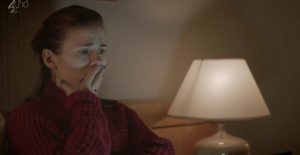
P.S. Messaging with Cleverbot is a fun way to experiment with  human-AI text discussions.


When you can’t move on, recreate them.

As a sentient human being, I understand the need that Martha felt when she lost Ash. Losing a loved one, especially when they are your spouse, is a difficult situation to navigate through. For this reason I understand her actions when she chose to recreate Ash in physical form. Martha was lonely and needed the comfort that she had recently lost. Were we to take the program that allowed Ash to be recreated and put it out into the world, I do not believe that it would be chaotic. For a small amount of time after Ash’s “rebirth” she genuinely felt better and it showed through her physical appearance. However, I think this program would have to be regulated and temporary.

The main issue that I have with the recreation of Ash is that it allowed Martha to become obsessive over an animate object that had no soul and technically was not real. She continuously denied calls from her sister and consistently updated the faux Ash about the progress of the baby. These actions are all very strange and indicate an obsession, as she was becoming absolved into a world that was not real.  We can also see that the obsession does not cease, as years later the faux Ash is still living at the house. A temporary rebirth would allow the grieving person to better their emotional state. In Martha’s case, she was pregnant. I am not too well versed in the process of pregnancy, but I do know that the emotions that the mother feels impact the development of the baby. In cases such as Martha’s, this program would be beneficial.

One of the ethical questions that came up as I watched the episode deals with the dead person’s ability to consent to being recreated. The first consent issue arises when Martha is signed up for the program even though she does not wish to become involved. The second issue is: would the dead person want to be recreated in such a manner? What if Ash, while living, has heard of the program yet had asked Martha to not do it? How can we determine what the dead would like to have done? I see the ethical dilemma arise from the fact that someone may not wish to be “rebirthed”, yet a grieving family member may go against these wishes. Does a person still have rights to their identity and digital footprint after they have passed? These are the questions that we must figure out before this becomes  a reality.


Sources:

Photo 1

Photo 2