
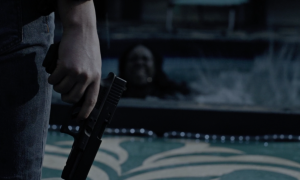
While watching Dead Set, I was struck by the scene in which Kelly watches zombie Angel flopping around in the pool, and comments that she believes the surviving humans will beat the zombies because the humans are smarter than them. It was apparent well before this that the zombies were not particularly brilliant, emphasized by the way in which they seem incapable of opening doors and spend most of their time scratching at them. Yet, both before this moment and in the following episodes, it is clear that the humans are not winning the fight against the zombies, so I considered why.
I was drawn to the section of American Zombie Gothic in which Kyle William Bishop addresses how humans are in fact the biggest threat to each other in many zombie films. He writes, “The symbolic threat of the zombies remains a fundamentally frightening part of these films, but because the threats of bodily harm, rape, and murder are real-world potentialities, both in and beyond the zombies, such scenes become all the more terrifying by being inescapable in supposedly escapist movies (Bishop 24-25).” There certainly are aspects of this in Dead Set. For example, the cops threaten to shoot the survivors, Marky almost shoots Riq, and of course Patrick and Joplin’s scheme in the final episode is relatively treacherous. However, I also noted that in an equally real way the humans were threats to themselves. Since they are not mindless zombies, several characters show very human emotions such as empathy and fear that end up resulting in their own deaths. For example, Grayson was clearly struggling with the idea of having to kill his friend Angel, and his hesitation in stabbing her cost him his life. Alex and Riq also seemingly would have been safe staying in the farmhouse, but Alex’s connection to Riq, and Riq’s desire to see Kelly again both drive them to their eventual deaths. In some ways, it seems as if those who become most like their zombie counterparts and lose some of the defining features of humanity have the best chance of survival. While I watched, I felt as though this set the characters up for a rather bleak outcome no matter what: either they died because of their humanity, or in fighting “the other,” they lost what made them better, or at least different, in the first place.
Bishop, K. W. (2010). American Zombie Gothic: The Rise and Fall (and Rise) of the Walking Dead in Popular Culture. Jefferson, NC: McFarland & Company, Inc.
Brooker, C. (Producer). (2008). Dead Set. United Kingdom: Zeppotron.