The Safety Coffin and Other Outdated Death Technologies

My first thought while reading about the rise of QR Codes in Graveyards was, “Oh I hate pulling out my phone and scanning those codes”- While my second thought was shame about how few seconds it would take to scan the memorial and do it for a deceased family member or friend.

Like the author of the article, I doubt that QR codes will stay current/updated very long. Technological advances today are moving way too fast to invest in something for eternity. I could be wrong, but I think that most advertising campaigns are slowly phasing out QR Codes, because I can’t remember the last time I saw someone prompt me to scan one, and I also can’t remember the last time I actually scanned one.

This article made me think of the many outdated technologies that have infiltrated the death industry. Contrary to popular belief, Walt Disney was not frozen by cryogenics. Specifically relating to graveyards, I was reminded of the “Safety Coffins” that became prevalent in the Victorian Era. These coffins had a bell that raised out of the ground a few feet, connected to a rope that family would place in the deceased’s hands. In case their loved one was not really dead, this bell and rope system allowed them to pull the bell and signal people above to dig them up.
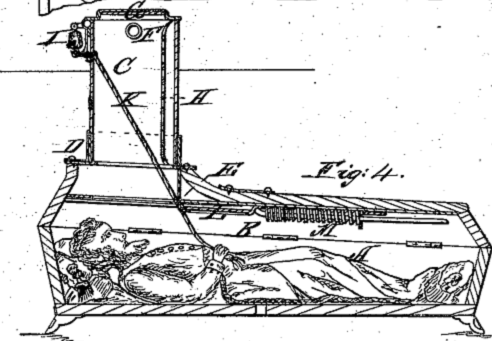
 

Source from GhostHuntingTheories.com


Over time the fear of being buried alive subsided and the safety coffin fell out of fashion. When you look at these coffins now, they seem absurd right? I hope that people don’t look at the graveyard QR Codes in a similar way if/when they fall out of fashion.


Source from Slate.com

The Problem With Memorialization on Websites

While reading the article “Gravesites and Websites: A Comparison of Memorialisation,” there was one quotation the particularly stuck with me. In discussing memorial websites, the authors state that “these sites are supportive of both the process of remembering someone as gone and being with someone as a continuing presence” (40). While I agree that memorial sites can serve to remember someone who is gone, I took issue with the authors use of “being with someone as a continuing presence” (40).

My first big issue with this statement is that a person’s presence on memorial site is not a dynamic presence. When someone dies, everything that they have done up until that point becomes fixed—there are no opportunities for a new or different presence. For example, think of new-Ash in “Be Right Back.” He was constructed from everything that the real Ash had ever posted online. He did not have the meanings or thoughts that the real Ash had, nor was he able to become a new person. And in my opinion, one of the fundamental aspects of humanity is our capacity for change.

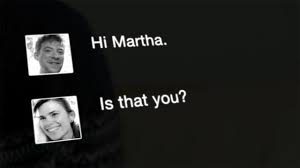
My other issue with saying that memorial sites serve to allow us to be with someone as a continued presence is that I feel that it does not encourage people to move on. Similar to how Martha was unable to move on from Ash’s death once she found his online presence (something that seems to me like a futuristic memorial page), if others use memorial sites to be with their deceased loved ones, they will never be able to achieve closure over their loved one’s death.

Though taking place in the future, Ash’s online persona is a sort of memorial page that prevents Martha from moving on from his death.

I do believe that memorial sites can be cathartic. They can serve as locations for people to leave a message to the deceased. However, if memorial sites are being used for someone to feel that their loved one is still with them, then the sites could become a problem.

The existential nightmare of “Dead Set”

Faced with the news of the complete collapse of society,  the characters are faced with dismal fates based on their transgressions relating to their participating in the reality show Big Brother.

Most in line with the blunt zombie symbolism is Riq. Riq sees love beyond his initial safe house. He sees a viable future, even if it means leaving the safety of the farm house. It is also established that Riq doesn’t watch Big Brother. The zombie infection is a poison which the show defines as coming from the Big Brother TV show, and Riq is by all measures immune to it. Riq doesn’t have that ugliness inside of him that enjoys watching shows like Big Brother, which essentially makes him immune to the zombie plague. I know that comes off as kind of a leap, but Riq is the only person who doesn’t die at the hands of a zombie. Furthermore, when Joplin opens the gates they all run past Riq, not stopping to feed on him.  Of all the characters, Riq is one of the few that never ends up turning.

Patrick Getting eaten in the final episode of Yann Demange’s 2008 series Dead Set.

I make a point to say that Riq is “one of the few” that doesn’t turn because Patrick also doesn’t turn. Perhaps it is because Patrick is just too dismembered (a lovely bit of narrative symmetry there) to be able to become a zombie, but more likely is that Patrick’s disdain for his own program kept him from turning. Patrick’s production created the outbreak (on a figurative level, of course) yet he shows nothing but disdain for the cast and crew. In one particularly disturbing scene, Patrick cheers on the zombies as he feeds them with his own flesh, possibly analogous to him feeding the violent, tribal instinct which keeps reality shows like Big Brother on the air?

Finally, I’d like to give a big shout-out to Joplin for realizing the existential meaningless of what he has helped create. It is up to the viewer as to what was going through Joplin’s head when he opened the gate, but I like to think it went a little something like:

“I’m going to escape these horrible people who don’t like me and called me Gollum.”

“The horrible crowd of zombies (Big Brother fans) are similarly awful. This is a factor that in my previous rage blinded me to.”

“Patrick just killed an innocent, non-infected man. Perhaps I have once again been manipulated.”

“Well, if you can’t beat ’em, eat ’em!” *opens gate*