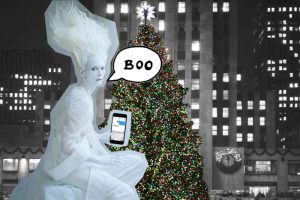
A spooky phone available for purchase on Terapeak.com
Edison’s experiment and the modern-day talk of it in the Atlas Obscura article harkens back to the idea of “haunting,” and how haunting manifests itself in our everyday use of technology. Edison’s “spirit phone,” though certainly not an effective apparatus for contacting the dead, is still at work haunting us today as we read articles about it. The trajectory of Edison’s spirit phone, too, has a haunted storyline. Think of the editor of the 1948 English version of his diary who “killed” the chapter on the spirit phone, thereby contributing to the murder of this part of Edison’s legacy (despite the recognition it got during his lifetime).
However, Edison’s failure to reach the spirit world with technological innovation does little to dissuade the belief in such a world—if anything, we could consider it a contribution to this mysterious place. Edison’s idea that the particles of every personality were indestructible lends itself to the idea that the whole world is haunted with these former humans. In some sense, to Edison, the debate was not over whether these “ghosts” existed, but rather if they could be reached. This thinking is a far cry from ghost-detecting apps or Ouija boards.
Edison’s failed spirit phone is not the most interesting part of the story, at least not to me—to think that Edison, a great innovator and inventor, would seriously consider accessing the personalities of the departed is one thing, but considering it in context is fascinating. When imagining a world in which the phonograph seemed an attempt to fool death, it’s not impossible to see why people of the 1920’s would believe that literally anything is possible, and why the phone call from the dead remains such a popular horror trope.
Natalie Zarrelli’s article Dial-a-Ghost on Thomas Edison’s Least Successful Invention: the Spirit Phone was informative, thought-provoking, and ultimately self-fulfilling. I had never been made aware, as I assume is the case with the rest of the general public, that Thomas Edison ventured into the spiritual nature of being. While I do understand that this is largely because of the failure that the device encountered, I would have assumed that this new approach towards reaching the undead would have been documented more often. This makes me wonder whether it was a societal norm that prevented Edison’s machine from being documented more thoroughly, as science was not seen among those fields that would take such matters highly, or give them importance.
The main question that came to mind when thinking about Edison’s failed technology was his displeasure at being ranked among those who believe in mind reading and the nature of dreams. It seems that Edison thought that he was too “high” for such grouping, but I believe this to be a great fault within the scientific community. All theories are the same, regardless of how one wishes to convey them. When theories become a reality, they are no longer theories but actual proven facts. So, is Edison justified in saying that he did not want to be grouped among these people in a 1921 Literary’s Digest? Why does the scientific community completely disregard the “supernatural” when their own theories could also be categorized as “supernatural” because they have yet to be proven? Ultimately I believe that this dichotomy is what prevents our society from advancing further in our technological exploits. Why choose to not work with a certain group of people simply because you don’t disagree with their own “scientific” method? Openness to all ideas/ theories/ suggestions are what make for a more progressive venture into the unknown. Would Edison have made greater strides with his Spirit Phone had be chosen to be more open to the supernatural? Perhaps.
An issue of the Literary Digest from the year Edison was featured.
The last line in the article caught me by surprise. “While we don’t know if Edison was correct in his theory that our personalities inhabit physical ‘entities’, nor if he could hear them on his spirit phone, at least the inventor’s idea of using technology to speak beyond the grave lives on.” Not only does this idea live on, but it is an actual thing. I formerly referenced Facebook’s “Remembering” feature in a blog post. For those who are still unaware of the feature or are confused by what it does, it is meant to preserve a deceased person’s Facebook profile. Formerly, I viewed the feature as one creepy entity, as opposed to breaking it down. Taking Edison’s views of the personality that may still linger once deceased, I see the Facebook feature as being exactly that. Our physical form will be long gone, but the data that is stored on this social media will still be there. To Facebook we are not real people; we are a collection of data. Data from our searches, our likes, our favorite videos, and our shared posts. This data tells a story about us; effectively becoming the leftover personality that Edison believed in. Depending on technological advances within the next fifty years, we might be able to use this data to recreate life a la Black Mirror: Be Right Back.
Facebook records so much information about us through these data mining techniques.
When reading Natalie Zarreli’s “Dial-a-Ghost on Thomas Edison’s Least Successful Invention: The Spirit Phone” I was particularly intrigued by how “for Edison [speaking to the dead] was a matter of strict science” (Zarreli). She goes on to explain that Edison theorized that “like our bodies, our personalities have a physical form, made of tiny ‘entities’ similar to our current view of atoms. He thought these entities might exist after humans passed away—a personality-based residue of loose memories and thoughts, containing part of who a person was during life” (Zarreli). Our personalities are “indestructible” and in a way, this follows the law of conservation of mass. Our personalities—per Edison’s theorizing—cannot be created nor destroyed, only rearranged and transformed.
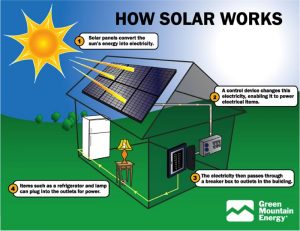
A diagram of how solar panels work. Source: Simmons, Tucker. “Alternative Energy.” Auburn University. 5 Jan. 2017.
This scientific approach was surprisingly convincing to me. Through the advancements of science, we have so much understanding of energy and its transformations. For example, through solar panels we take energy from the sun, convert solar energy to electricity, this powers our outlets, which powers our lamps, these lamps give off heat that we absorb, so on and so on… The energy is never created or destroyed, just transferred. By no credentials am I a scientist, but with this logic, I feel oddly convinced by Edison in that our personalities should still exist after our time, but just in another form. After reading Zarreli’s article, I not only feel as though spirits after death exist, but that there must in fact be a way to contact these spirits through technology. I doubt this spirit communication device looks similar to Edison’s original spirit phone, but maybe through more time, funding, and energy to this field we will be able to find out in our lifetime.
I grew up believing in ghosts for a very simple reason: my mom had seen one. I know the story like the back of my hand, beginning with the vision of my mom running through her grandmother’s three-story farmhouse and then the moment when she says she saw her dead granddad, PopPop, pushing a cart of books into the library he had always loved. My mom remembers standing there, observing him as he slowly moved through the hallway. She swears by this. I used to make her promise to come back and visit me as a “good” ghost too.
My mother is not the only one to believe in ghosts. Journalist Tiffanie Wen describes her own encounter with the paranormal when she noticed the image of a phantom man in the background of a photograph who was not in the room when the photo was taken. In her article, “Why do People Believe in Ghosts,” Wen takes on the task of exploring both national and international views on ghosts, death, and life after death, reporting that “…if you already believe in ghosts, or are told a place is haunted, you are more likely to interpret events as paranormal” (Wen). The imagination is powerful and it’s hard to say whether there’s any real grounds for paranormal activity other than simple tricks of the mind, sleep deprivation, and random accidents.
The photo that sparked Wen’s interest in ghosts. Source: Wen, Tiffanie. Untitled. N.d. The Atlantic. Web. 27 Feb. 2017.
Thanks to my mother, I have been well-conditioned to believe in the paranormal. Which is perhaps why I personally identify with Thomas Edison and his belief that the dead can talk, which Natalie Zarrelli describes in her article “Dial-a-Ghost on Thomas Edison’s Least Successful Invention: the Spirit Phone.” Both Zarrelli and Wen highlight a connection between the belief in ghosts, spirits and souls and the human desire to deny mortality. Zarrelli quotes French journalist Philippe Baudouin who describes the promise of Edison’s “Spirit Phone” to “…turn the ancient dream of immortality into reality, in an attempt to cheat death” (Zarrelli). Similarly, Wen relies on the work of professor Christopher French who highlights “…the emotional motivation for these beliefs”, underscoring the fact that “The vast majority of us don’t like the idea of our own mortality. Even though we find the idea of ghosts and spirits scary, in a wider context, they provide evidence for the survival of the soul” (Wen). This fear of an absolute end without continuation is arguably the greatest tragedy of mankind for we must reconcile our finite existence and the feeling of insignificance this awareness engenders.
I argue that this fear of mortality stems from the fact that we are conditioned to understand human existence only through its embodied experience. This explains Edison’s determined conviction that personalities are in fact “entities” or small particles comparable to atoms, an interesting choice of language grounded in physicality. Edison’s language contrasts disembodied explanations for the afterlife (that is, those theories that don’t present ghosts, spirits and souls in an identifiably human or physical form) which are harder to grapple with. I imagine this is why science’s tangibility is often more appealing than religion’s indefinable concept of faith and God. Even in religion though, (and I can only speak to a Christian perspective here), God is often depicted as a white man because human tendency ascribes an image to the spiritual presence as a means of conceptualizing such abstract power.
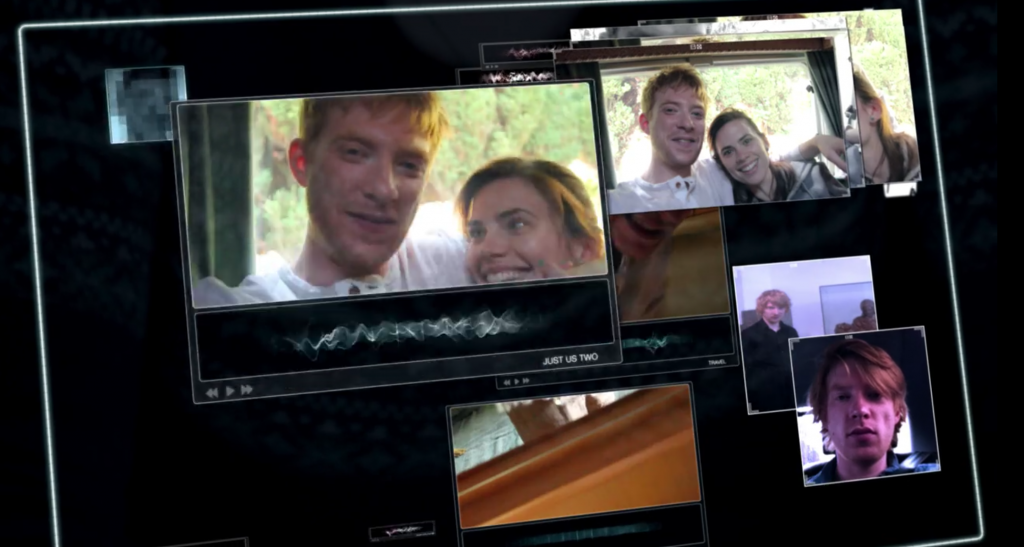
While it’s been almost a century since Edison’s failed “Spirit Phone” invention, Episode 1, Season 2 of Black Mirror demonstrates the extent to which Edison’s obsessive preoccupation with death remains ever embedded within our cultural conscience. For example, the program that Martha buys following Ash’s death serves as a sort of modern day “Spirit Phone,” relying on Ash’s social media presence to reconstruct the particles of his personality in a synthesized replica of his living body.
The program uses Ash’s social media to bring his personality back to life much like Thomas Edison’s failed “Spirit Phone” promised to contact the personalities of the dead. Source: “Black Mirror.” Season 2 Episode 1. Netflix.
Thomas Edison introduces the belief that our personalities continue to exist as tangible “entities” long after our death, describing “…a personality-based residue of loose memories and thoughts, containing part of who a person was during life” (Wen). Black Mirror applies this notion, using the power of technology to literally bring Ash’s personality to life. Edison notes, however, the fractured nature of these living personalities and Martha observes holes in Ash’s embodied performance, a fragmented version of the man she once loved. While Black Mirror demonstrates the possibility of a successful “Spirit Phone” (and even “Spirit Body”), this success is mitigated by the realization that even when we do communicate and interact with the dead, this communication is fractured at best, and traumatizing at worst.
References:
“Black Mirror.” Season 2 Episode 1. Netflix.
Wen, Tiffanie. “Why Do People Believe in Ghosts?” The Atlantic. Atlantic Media Company, 05 Sept. 2014. Web. 27 Feb. 2017.
Zarrelli, Natalie. “Dial-a-Ghost on Thomas Edison’s Least Successful Invention: the Spirit Phone.” Atlas Obscura. N.p., 18 Oct. 2016. Web. 27 Feb. 2017.
Ghost Hunters‘ Grant Wilson (Left) and Jason Hawes (Right) via Sloss Fright Furnace
When reading Natalie Zarelli’s article about Thomas Edison’s spirit phone, I couldn’t help but think of one of the guilty pleasures of my middle school years–paranormal TV shows, particularly Syfy’s Ghost Hunters. And at the very end of the article, Zarelli puts my thoughts on paper, mentioning ghost hunters in the context of their equipment and its connection to Edison’s spirit phone.
The now-cancelled show’s titular ghost hunters came in the form of ex-Roto-Rooters Jason Hawes and Grant Wilson and their TAPS team (The Atlantic Paranormal Society–yes, they included“the” in their acronym), who certainly followed in the paranormal footsteps of Edison. The Ghost Hunters used some pretty expensive equipment, ranging from FLIR thermographic cameras, EMF meters, night vision cameras, digital thermometers, and normal video cameras in addition to some interesting one-off uses of devices like geiger counters, geophones, ion generators, and white-noise generators. The equipment functioned much in the same way that I use it here; it basically is meant to sound scientific and lend credibility where there is little (thankfully I have the Internet on my side to tell me what these devices are supposed to do and some knowledge of the scientific method).
If the Ghost Hunters consciously or subconsciously used Edison and his spirit phone as inspiration for their work, that’s the extent of scientific influence on their process. Prominent skeptic Benjamin Radford puts it nicely, saying “…you may own the world’s most sophisticated thermometer, but if you are using it as a barometer, your measurements are worthless.”* The Ghost Hunters used all their high-tech equipment in a rather unscientific manner, misusing devices, making up functions, and drawing little connection between paranormal evidence and their gear. To the show’s credit, it almost acknowledged its faulty methodology, shifting focus to become almost as much about the TAPS team’s interpersonal relationships as it was about ghost-hunting (a docu soap in the vein of Deadliest Catch).
Despite the show’s questionable nature, it met with immense popularity and was even one of Syfy’s longest running reality shows. It also acted as a harbinger of a cultural movement, an indicator of renewed fascination with the paranormal that inspired both a host of other ghost-hunting shows and a surge in amateur ghost-hunting. In fact, Ghost Hunter’s popularity seems to mark a revival of the spiritualism of the 1920’s that Edison sought to tap with his spirit phone–a phenomenon that demonstrates a continued desire to bridge the gap between the living and the dead in our modern day.
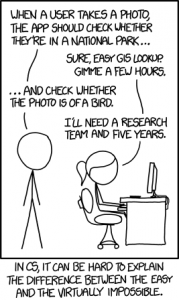
During the 1920’s, astonishing inventions such as the gas-powered car and Edison’s phonograph captured the public’s imagination about what technology could do. Suddenly, “communicating with spirits didn’t seem much more impossible than harnessing electricity“. Both Thomas Edison and Thomas Watson, assistant to telephone inventor Alexander Graham Bell, experimented (separately) with building a “spirit phone” to connect with the dead. Inventors and the public eventually realized that the dead don’t answer, preferring the caller to leave a voicemail, and the idea of communicating with spirits via telephone died. But this disconnect between what we imagine technology can do and the actual limitations of technology is theme that continues to baffle us, as shown in the comic below.
The comic xkcd demonstrates our idealistic expectations for technology and the reality we’re confronted with.
Elizabeth Losh highlighted some of the aspects of this disconnect at her recent talk at a FemTechNet conference. In the case of the spirit phone, the “material vs. transcendent” dichotomy is the most relevant. When people could suddenly converse hundreds of miles away over the telephone using this new, non-tangible force called “electricity”, it seemed just as conceivable that a spirit could physically exist as micro-particles. Telephone users in the early twentieth century didn’t understand the physics of electricity and of phones like we do today. As magical as a telephone seems, a phone functions because of material reasons, like wiring and microphones. As we mentioned in class, saving files to the cloud generates a similar confusion today about “material vs. transcendent”. While the user may think their files go to some literal, intangible “cloud”, the files are actually stored at a remote server farm. While it seems the amount of storage is limitless, you could eventually run out of your allotted space in your cloud, forcing you to delete some fire selfies.
Our class discussion of zombies the other day immediately reminded me of one particular episode of Black Mirror: “Men Against Fire.”
***SPOILER ALERT***
In this episode, soldiers are fitted with special technology in their senses (eyes, noses, etc.) that augment and modify their senses. They are able to see holographic maps and blueprints so as to more efficiently breach enemy inhabited buildings. Essentially, they are equipped with military-grade virtual reality goggles, but they are not clued in on just how powerful the technology they use might be.
Throughout the episode, soldiers hunt these creatures called “roaches” throughout the countryside. These “roaches” are horrible looking humanoid creatures reminiscent of zombies and they are very clearly monstrous. The main character is a new soldier and ends up killing his first roach while out on a run. In the thrill of the moment and in the face of such monstrosity — he stabs a roach to death, repeatedly stabbing the growling creature until it falls still and silent.
Towards the end of the episode, his military-grade augmented senses start to glitch out. We come to find out that without his modified vision, the “roaches” that he has been hunting are actually humans just like him. The government developed technology that was able to monstrosize an entire race of people because they were other, less than, or genetically inferior — and convince one group of humans to kill another because they thought of them as “roaches” rather than people.
In class, we discussed how video games make it easy/necessary to kill aliens, Nazis, robots, masked men, zombies, terrorists, monsters, pests and vermin. What’s so horrifying about this episode is the combination of a real technology — virtual reality — with real world realities in which we demonize entire groups of people. Some might argue that video games teach us that it is acceptable to kill things that are less than human, and when we mix that with a world that in some ways is becoming more and more like a video game — things get scary.
Dead Set: Season 1 Episode 1 (2008). 13 Feb. 2017 via Wonder Alliance
Perhaps it’s just me, but I find myself stuck in postmodern-analysis mode, so I couldn’t help but focus that lens on the first two episodes of Dead Set. As part-time of zombie-aficionado, I found myself wondering: have any of the characters on Dead Set ever seen a zombie movie? It seems as if zombie-media doesn’t exist in the universe of the show (although Big Brother certainly does, and Big Brother “stars” have cameos throughout these two episodes). Many other zombie narratives take a similar approach, separating their characters from the cultural zeitgeist of zombies–even in parodies of the genre like Shaun of the Dead (2004) and Zombieland (2009) that revel in the fact that they are zombie movies. Maybe this is my inner armchair-zombologist speaking or maybe it’s the requisite irrationality of the horror genre or maybe it’s even the stupidity of some of the characters but, quite frankly, the characters on Dead Set make some pretty dumb decisions during the zombie apocalypse.
Such lack of knowledge would indicate an unfamiliarity with the zombie subgenre. Yet the characters seem intimately familiar (if not obsessed) with TV and the medium as whole. The fictional show takes place partially on the set of a real-life TV show, and the characters playing the crew reference past seasons and characters from the same TV show. Plus Dead Set plays on Big Brother’s audience and the nature of reality tv itself, depicting the audience’s shallowness and distance from reality before slaughtering them in one big “fuck you” (in the show’s parlance) to the devotees of the reality game show. And if that isn’t enough, they bring up real-world TV shows repeatedly, ranging from a brief mention of I’m a Celebrity to a distraction technique inspired by One Man and His Dog.
The kicker however, comes in the beginning of the second episode. Here, they rattle off zombie-movie tropes, blaming bioterrorism (“loony gas”), unbridled scientific ambition from the government or military (“GM foods”), and finally the dreaded “Wi-Fi” for the outbreak. With this moment, Dead Set cements styles itself with some of the self-awareness that characterized the horror-comedies mentioned above. Though the infection itself is played much straighter than those of Shaun of the Dead and Zombieland, the show itself doesn’t shy away from some of the darkly funny moments that accompany its death and destruction, using this balance to help viewers focus on other messages of the show (which we have yet to see completely) rather than just the horror or comedy that’s used to communicate them.
So far in my viewing of the first two episodes of Dead Set, a British television series about filming a Big Brother TV show during a zombie apocalypse, no one has used the word “zombie”. The characters use vague pronouns like “it” or “them” of “things”, but never settle on a name for the undead* monsters.
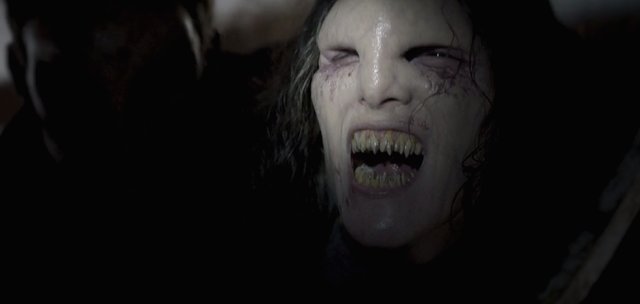
Devina as a zombie. Source: Zombie Guide Magazine
Why not use the z-word? As a novice to the zombie apocalypse genre, perhaps referring to the monsters as “things” and not “zombies” is common. This does add to the confusion and heightens the terror around the monsters. By not calling them “zombies”, a well-known and defined category of monster, the audience is left more uneasy and does not know (entirely) what to expect from the creatures – like these creatures, which are fast-moving zombies (who can’t climb gates, or swim, apparently).
Another reason could be that in the world of the show, the idea of a zombie doesn’t exist. As a result, the characters have never seen horror films or TV shows with zombies and don’t have that familiar classification for the undead.
Since we knew several of these characters before they changed, perhaps the show avoids “zombie” because referring to them as an other is dehumanizing. Often the characters still refer to known zombies by their given names, such as the producer Peter and contestant Pippa when talking about the (now zombie) host Davina. By still using their names, killing them has an emotional aspect since the characters still associate their human versions with the creatures.
Whatever reason the writers used, not using the term “zombie” irked me as a viewer and resulted in several fumbling “th-th-those THINGS” in the dialogue.
* Shakespeare frequently used “un” words to draw certain emphasis to the opposite of the word or the revocation of a verb, such as “unking” or “unbroke” (both from Richard II). Since one becomes a zombie after dying from a zombie’s bite and returning to “life”, using a Shakespearean interpretation of “undead” makes the for an interesting analysis of the zombification process. Terming them “undead” reflects their transformation back through a reversed process of dying.
Zombies have become such a popular concept in popular culture that it is now ubiquitous as an entire genre of media: be it literature, film, or interactive. However as a tool for effective storytelling, different zombies serve different purposes. Rarely are the zombies the actual cause for discussion, rather we tend to focus on characters that have yet to become zombies. Interestingly, when Dr. Sample assigned the first two episodes of Dead Set to us, he remarked that it involved ‘fast zombies’. The development of the zombie genre has allowed for a crude classification of these undead flesh eaters. The immense diversity in zombie depictions have created film classics such as Shaun of the Deadand 28 Days Later, two movies that could not possibly be more different in tone.
Dead Set’s zombies would appear somewhere along the bottom right. Photo courtesy of visual.ly.
So ‘zombie’ serves as a sort of umbrella term. Judging whether zombies are haunted or not might not be as simple as one might expect. In determining this, one must consider not only the zombies themselves, but also how they are depicted in the medium as well. Did the viewer/reader know the infected before they turned? Are there vivid descriptions of their faces, their eyes, and other things that one would normally associate with being human? If so, the answer is likely yes. Some of the most disturbing depictions of zombies are when the zombie itself retains a part of their former life, such as particular idiosyncrasies– a facial twitch, a walking gait, or a particular location. The undead husk invokes memory of the once living human, and both the remaining characters and the viewer are haunted.
In Shaun of the Dead, the zombies are slow and dumb, and are often dispatched with cricket bats blows to the head. While the viewer sees former friends turned zombies, the interactions are brief, which perhaps contributes to the levity of the film. The zombies simply serve as a plot device that spurs character development, which also agrees with the generally comical tone of the film. On the other hand, Consider Dead Set. The viewer is given at least a brief introduction to quite a few characters before they turn–this feature is a privilege that an episodic format allows due to its longer total length compared to say, standalone films. Perhaps this is why one of the most critically acclaimed zombie works, The Walking Dead, is a television show while the best zombie movies tend to slashed-type hack ’em ups. One thing is for certain–when you talk about zombies, be sure you know exactly what you’re talking about.