Tourism from the Perspective of a Developing-Country Native

Yankovska and Hannam opened my eyes in Dark and toxic tourism in the Chernobyl exclusion zone. I was unaware of the negative aspects that Chernobyl faced as a result of the touring that takes advantage of a horrible radioactive disaster. The few times that I have seen the city mentioned are in movies that seek to dehumanize the area, or emphasize the disasters it was witness to. Because of these reasons I agree with the points that the article makes about the inhumanity found in Chernobyl tourism. However, i’d like to push back on the belief that tourism is “an oppressive, passive, and ignorant system.” These are  the words that my classmate Christine Choi uses in her blog post.

She later goes into depth about her statements, but never fully discusses the fact that her generalization is dangerous. Tourism in Chernobyl is horrible, that is something that cannot be argued. When you go to another country to be “fascinated” by the troubles that these people go through, you may want to think twice about using the word “human” to describe yourself.  But, and this is where I differ from Christine’s blog post, not all tourism is bad. I get the feeling that a majority of people who read the article will be extremely biased against tourism, but they need to realize that this is a case specific example. Not all tourism seeks to monetize the real world pain and suffering of others.

I would like to speak personally from the point of view of someone who has seen tourism have positive benefits. I was born in Ecuador, which is still known as a developing country. One of Ecuador’s main sources of revenue is tourism, due to its appeal as an “exotic” getaway. The Galapagos Islands alone make up such a huge part of that tourism revenue, and they are not a result of a population’s pain. Since Ecuador became a hotspot for tourism, the infrastructure of the country has become a lot more developed. Streets that were not paved are now up to standards when compared to United States roads. Sectors of the country that before were considered uninhabitable are now buzzing with new businesses and buildings. Tourism works for the country of Ecuador.

The Galapagos Islands and their beauty drive tourists here every year.

I am not only speaking from my own perspective, but that of my ancestors too. When speaking with my grandparents, they often tell me stories about the country before my time. Poverty was rampant, and the country was not developed at all. Is it possible to go a category below developing country? If so, my grandparents claim that it would be classified as such. All of this changed when the country began to focus more on its image and the gain that it stood to make from the beautiful Galapagos Islands. Tourism came. The country took off.

A statistic that demonstrates how much tourism in Ecuador has skyrocketed.

Chrsitine believes that all tourism is bad and harmful, but she does not see the error in that huge generalization. Some tourism can be bad (Chernobyl) but it is not always so.I wish to state that I am implying replying to he post because I believe that other classmates may share her sentiments. I think it would be a tragedy to think of tourism as wholly negative when it has positively impacted other countries/regions. Ecuador is still a developing country, but as a native I hope that it will reach a better status. If and when it does, you can bet that tourism will be a major reason that it occurred.
A Naive Discussion of Heterotopia and Chernobyl via one of Dr. Sample’s Favorite Sentences

I’m making a bold statement: the following sentence is in Dr. Sample’s Top 10 Favorite Sentences among the articles we have read for DIG 215:

“Chernobyl is a heterotopia that allows us to gaze upon a post-apocalyptic world in which the familiar and uncanny collide.” Stone (2013, p. 91)

This sentence is taken from “Dark and toxic tourism in the Chernobyl exclusion zone“, who originally quoted it from P. Stone’s “Dark tourism, heterotopias and post-apocalyptic places: The case of Chernobyl.” Not only is the sentence construction elegant and word choice exquisite, but the use of the word “uncanny” really seals the deal here with a spot in the top 10. Admittedly, the word caught my eye, I reread the sentence, hemmed and hawed for a bit, and then realized I had a very small understanding of what the sentence was saying. Let’s unpack the sentence in the context of today’s article, starting with “heterotopia”.

As I learned from the very helpful Wikipedia article, heterotopia is a human geography term used to describe spaces of otherness, with multiple layers of meaning yet irrelevant, simultaneously physical and mental. Often the term is used to describe moments, like looking at yourself in a mirror or coming of age while away at boarding school. From my understanding (and please help me clarify this), describing Chernobyl as a heterotopia conveys that it has become a moment for examination, a memory, that has been perversely protected by its radiation and remains in a timeless state as a “ghost town” (Yankovska and Hannam 1). This preserved town allows us to view a “post-apocalyptic world”, one that has resulted from “the darker aspects of scientific advancement and human experience” (Yankovska and Hannam 2). After all, nuclear power and weaponry are controversial topics today, with their benefits for energy production and devastating consequences. In this world the effects of the nuclear power plant explosion are everywhere, via warning signs and protective clothing visitors must wear. But signs of the everyday remain everywhere in this sort of “ghost town” because during the accident people were inaccurately promised that they would be able to return home for their belongings in a few days. Thus, the “familiar” home scene and “uncanny” nuclear accident wreckage have collided to create a memorable, unsettling scene.

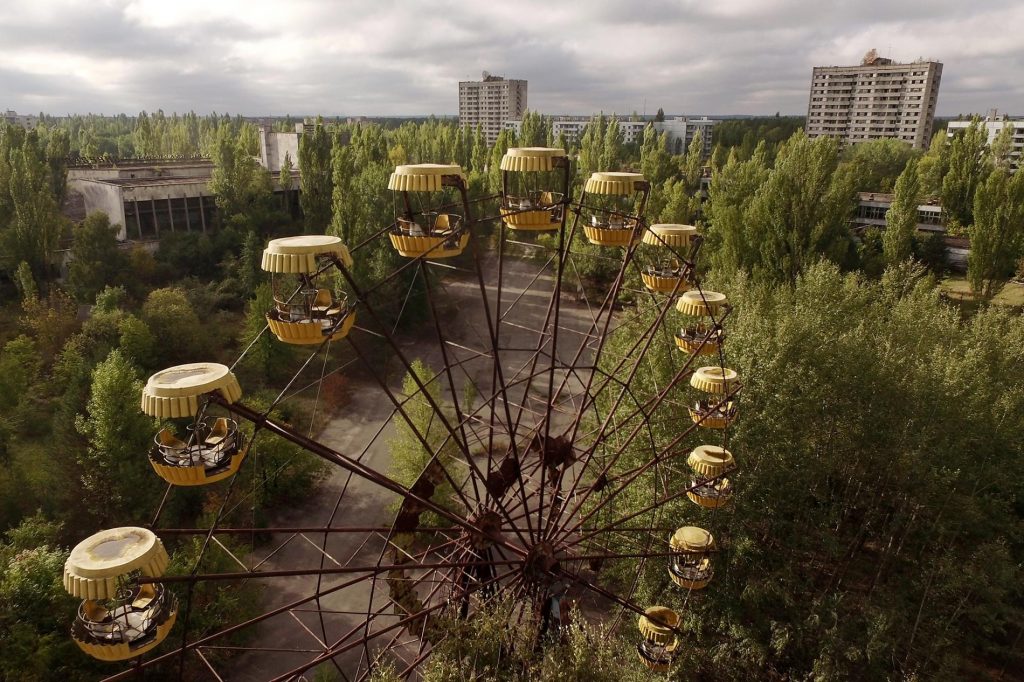
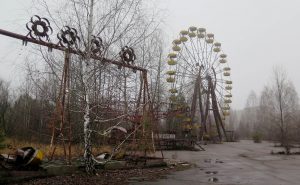
A perfect example of the collision between the familiar and uncanny: a brand-new amusement park in Pripyat that never opened. The article can be found here.

Ganna Yankovska & Kevin Hannam (2014) Dark and toxic tourism in the Chernobyl exclusion zone, Current Issues in Tourism, 17:10, 929-939, DOI: 10.1080/13683500.2013.820260

Tourism Is A Euphemism for Ignorant Travel

In reading Ganna Yankovska and Kevin Hannam’s “Dark and Toxic Tourism in the Chernobyl Exclusion Zone,” I found myself disgusted with tourism as an oppressive, passive, and ignorant system. Throughout the article we see tour guides state how many tourists come to be “entertained” and “fascinated” by a tragic event in which people still suffer from the aftermath of radiation. I find it hard to believe that these tourists go to Chernobyl to mindfully educate themselves on a disaster that has helplessly sought support and activism. We live in a day and age where Google, databases, books, and vlogs can shed light to so much more information than what they may take away from one tour. These tourists visit Chernobyl to essentially be in their version of a virtual-reality horror story. As soon as they get back on their plane to America or Western Europe, they can take their VR goggles off at any time and go right back to their ignorant and passive existence.


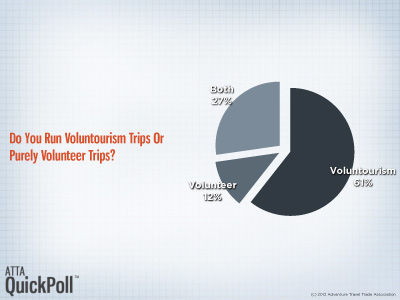
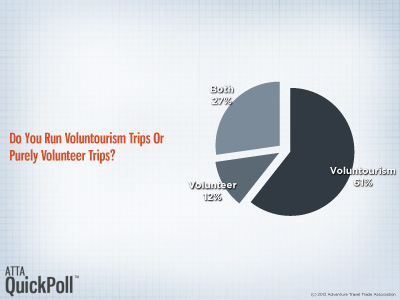
This article made me think about a similar concept commonly referred to as “voluntourism.” An article criticizing voluntourism mentions seven great criticisms to the wasteful and ineffective industry of going on “service trips” to foreign countries.

Source: Adventure Travel News

I encourage you to read all seven criticisms, but one that relates to my sentiments on the Yankovska and Hannam article is that these trips are an “egregious waste of money.” The voluntourism article gives some stats like “Two weeks on a medical trip to Tanzania can cost you $3,040, not including airfare, which is roughly $2,000. If six people go on this two week trip, that’s more than enough money to pay for a local doctor’s annual salary. Let that sink in.” Now if tourists to Chernobyl would like to genuinely help Chernobyl in its political, environmental, societal, and economic efforts, then the thousands of dollars they spend on plane tickets and tour agencies can instead be directly given to those already experienced social activists, journalists, and scientists in Chernobyl.

Dark tourism and Père Lachaise cemetery in Paris, France

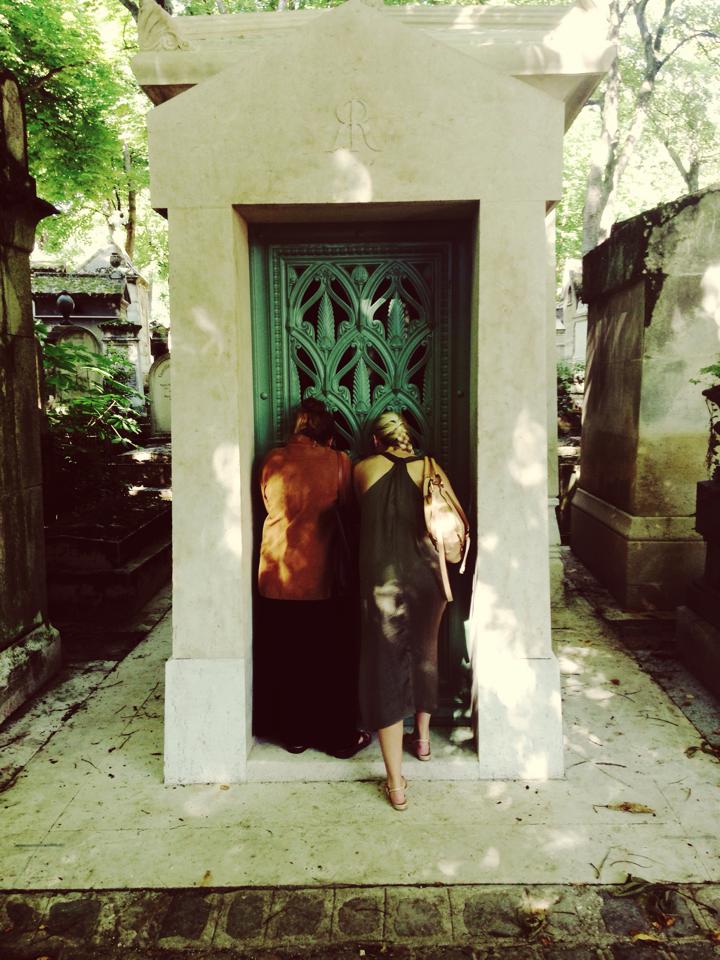
My friends peering into a tomb at Père Lachaisse.

Before reading the Yankovska and Hannam article, I didn’t consider myself someone who had participated in dark or toxic tourism, but while reading, I realized I’ve been to several places that might constitute dark or toxic tourism. The ones that came to me off the top of my head were the Anne Frank house, D-Day site, and Père Lachaise cemetery. Père Lachaise is a massive cemetery in between the 11th and 20th arrondissements, and I visited it multiple times in the summer of 2014. This would be an example of dark tourism instead of toxic, since no environmental disaster occurred on the grounds.

The reason Père Lachaise is such a draw to tourists is not only because of its size (it’s by far the largest cemetery in Paris) but also because the high number of famous people buried there: Chopin, Géricault, Oscar Wilde, to name a few. But I’d say the biggest attraction, at least to my generation, is the grave of Jim Morrison.

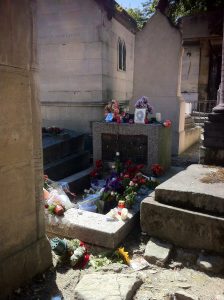
Jim Morrison’s grave

You can wander the cemetery for basically days without encountering a grave that you want to see–which is where the true dark tourism begins.

On our first trip there, my roommate and I picked up a scavenger hunt-like map with numbers and corresponding names to the most famous people at the cemetery. Though this map wasn’t particularly helpful, since the cemetery expanded in a completely arbitrary and confused manner, it still felt a bit strange to be hunting around in a solemn place like a cemetery, sometimes point and yelling when one of us found the “right” grave. The cemetery closes early–around 4–because it takes so long to clear the grounds and make sure no trespassers remain. This creates an eerie feeling as the afternoon winds down and you start to see fewer and fewer people around, until you realize it’s 4. Père Lachaise itself doesn’t do much to play up its spookiness for tourist purposes, but this probably has to do with the fact that entry is free. I’d still consider the general experience of wandering the cemetery actively looking for certain deceased people a kind of dark tourism.


The Commodification of Sites of Tragedy and Death

Yankovska and Hannam’s “Dark and Toxic Tourism in the Chernobyl Exclusion Zone” prompted me to attempt to recall other examples of dark tourism in the world … and I struggled – so I Googled. What I found was that “dark tourism,” which has made its name known more recently as socially unaware tourists choose to post macabre selfies from sites of death and tragedy on social media, has been around for a long time. Mark Twain wrote of Pompeii in Innocents Abroad, the Taj Mahal is a tomb on just about everyone’s travel bucket list, and tourists flock to bloody sites such as Gettysburg battlefields and Holocaust concentration camps.

An abandoned Ferris wheel stands on a public space that has become overgrown with trees since the city of Pripyat was evacuated in the wake of the 1986 Chernobyl disaster. Source: National Geographic

In “Is ‘Dark Tourism’ OK?” Robert Reid argues that while dark tourism is certainly nothing new, the way in which it is represented and marketed definitely is. Reid maintains that what makes or breaks the acceptability of a dark tourism site is the intention behind the place. The commodification of death and tragedy might leave a bad taste in our mouths, but I think it comes down to why the sites are marketed as tourist destinations in the first place. Sites such as Auschwitz, for instance, are places of historical significance and can serve as a space for healing and recognition of the gravity of events that took place there.

So my question is: where do we draw the line? Visitor centers? Cafés? Gift shops? At what point does the commodification and touristic tendencies of these sites taint the experience of the grave atmosphere of such places?

The Science of Vampires

Fusion’s article “If death becomes optional, will only the rich get to live forever?” reminded me of a recent conversation I’d had with a friend in which we discussed the “vampires” of Silicon Valley. Researchers have found that blood transfusions of newer, younger, blood plasma seems to reverse, or at least stall the aging process. In this way, those who can afford it may be able to seriously extend their lifespans by “consuming” the blood of young donors, who would likely be compensated monetarily.

Could something as common as blood could be the secret to immortality? Source: Gawker


A team at Professor Thomas Rando’s neurology lab at Stanford answered one of the most perplexing questions researchers have faced regarding longevity: Why do all the tissues in a body age at roughly the same rate?

They hypothesized and tried a number of theories out on laboratory mice. Their experiment worked better than expected. Stem cells in the older mice started to divide again, restoring muscle, liver and even brain cells, when transfused with the plasma of the younger mice.

Something from the young donor blood was making the stem cells behave as if they too were young again — at the very least, stalling the aging process.

Various tests have shown that the effects of these transfusions are present in muscles − including the heart, bones and nerve cells. It promotes repair of spinal injuries and encourages the formation of new olfactory neurons. All of this seems to be linked to more active stem cells. Initially, the research will be used to see how these transfusions might serve as a treatment, or perhaps cure, for Alzheimer’s and dementia patients. The promise and potential of such bodily interference, however, appears extensive.

The social ramifications of such research are stunning when you really think about them, as Fusion’s article suggests. If this is the way forward to longevity, certainly the rich will live longer, but we must also consider from where/whom this blood is drawn and what that means in a world where our economic inequalities are so plainly written on our bodies.

Source: Forbes

Getting in touch with your ROOTs

This article detailing the theoretical ‘singularity’ (coined by me and deliberately so) brings up the interesting phenomena in which Memorial Pages of the dead outnumber the profiles of the living on Facebook. In our previous discussions, we have talked about antiquated equivalents to modern day social media platforms. For example, text messaging now may be analogous to telegraph or letter sending in the past. These memorial pages contain vast, diverse accounts of a person’s life. Looking at one of these pages may be akin to flipping through a photo album of a recently deceased loved one.

As we have stated repeatedly, one of the primary differences between today’s media and the media of old is the accessibility/the ease with which something may be done. Perhaps the reason why the concept of memorial pages may seem disconcerting is because many of the things posted on Facebook are often whimsical, spur of the moment thoughts and events, rather than a hand-written letter or pencil sketched portrait.

Services such as ancestry.com offer insight into one’s family tree, at times discovering quite the history.

Is this the reason why looking at photos of a long-deceased great grandparent might not seem so strange? It might also be because it’s not such a personal look into their lives. Exploring the concept of ancestry, recent advances in digitalization of historical databases have made some able to easily ‘look up’ their ancestors through services such as ancestry.com. In the not too far future where the majority of Facebook users are dead, even basic information parsers might not be necessary–one could simply keep click on the ‘parents’ section of their parent’s profiles, and so on.

So unlike ancestry.com, where you might be supplied to years of birth and death, occupation, and a nice posed photo, in the future the curious will be able to see that embarrassing Facebook status from 6th grade about the gurl that got away. Regardless of what you might think of memorial pages, that seems quite frankly utterly terrifying for all parties involved.

Check-In at Noon, Check-Out Never: Death in a Sharing Economy.

In her article “Airbnb has a dead people problem: The morbid side of the sharing economy,” Kashmir Hill introduces yet another tension between death and technology: sharing economy start-ups such as Airbnb and Getaround (the Airbnb equivalent for vehicles). Renting a stranger’s car or home gets a lot more bizarre when that person accidentally happens to be dead. This phenomenon is not entirely uncommon; for example, “ghost cars in the system” from dead owners are often realized months late and “…it’s possible they’d continue to be rented post-owner-mortem as those rentals require no action by the car’s owner beyond checking to make sure it’s cleaned out between rentals.” Case in point: during his Airbnb stay, Jordan Ruttenberg discovered that the young woman whose home he was renting had died. In need of lodging and having already paid for the rental, Jordan decided to stay the two weeks until the end of his rental, describing the experience as creepy but necessary. His traveling companion, however, chose to leave immediately. The worst part? It took 4 months for Airbnb to even notice the woman had died—and only after Newsweek published an article describing Jordan’s experience.

Airbnb is one of the many sharing economy start-ups on the market. Source: Untitled Photo of Airbnb Logo. N.d. Airbnb. Web. 29 Mar. 2017.

So why was it so creepy for Jordan to stay in the woman’s apartment after her death? Nothing had physically changed in the apartment by her death (after all, she had died in an entirely different state) and besides, Jordan never knew or met the woman in person. Why was this space quickly transforming into an uncanny site rather than the vacation spot it was supposed to be? I believe the answer to this question lies in two fundamental problems. First, the concept of invasiveness is at play in Jordan’s unease. Occupying this woman’s space was only okay when she was living and thus able to consent to his presence in her home. But what happens then when she’s dead and he’s living in this intimate, personal, and (semi-) private sphere of her life. Does he no longer have a right to be there? There is a certain level of violation at play in this scenario; Jordan’s physical presence presents a threat to the preservation of this woman’s space.

Secondly, it’s important to note that Jordan continued to stay in the apartment after her death because he had already paid for the rental and he wanted his money’s worth. At its foundation, Airbnb is a transactional service. I myself always find it a little jarring to inhabit someone’s personal, private space often without ever meeting them in person. It’s certainly strange, commercializing the personal. How do we prioritize the dueling realities of a space that is at once a home and a business? The discussions we’ve had in class recently regarding social media and digital inheritance echo this Airbnb dilemma: When someone dies, what do we do with their highly personal artifacts (homes, Instagram, etc.) that also occupy a public domain? And how do we balance what is ethnical with what is fair; it may not be ethically right to stay in the dead woman’s apartment but it’s also not fair if Jordan, broke and without other lodging, loses both money and shelter through no fault of his own.

A New York street. Source: Untitled Photo of New York Street. N.d. The Daily News (New York). Web. 29 Mar. 2017.

Inhabiting the space of a dead person is a reminder of our own mortality. We are forced to bear witness to the mundane and banal continuity of an apartment that doesn’t die with the person or somehow disappear. The value and meaning of objects and furniture (and their intentional placement in a living space) are imbued by its owner, and not necessarily inherent to the objects themselves. Thus, when we die, our memories, photos and possessions, once so inherently tied to the space and our identity within it, lose their importance . The apartment, while unchanged physically, lost its human value, no longer a sacred embodiment of its inhabitant’s identity (“it’s a piece of me”), but rather a transactional piece of property.

References:  Hill, Kashmir. “Airbnb Has a Dead People Problem: The Morbid Side of the Sharing Economy.” Fusion. N.p., 11 Feb. 2015. Web. 30 Mar. 2017.

The social inequality in grief opportunities

While visiting Fusion’s series on the future of death, I was particularly intrigued by two articles. These articles, titled “We calculated the year dead people on Facebook would outnumber the living” and “If death becomes optional will only the rich get to live forever?”, brought to light a question regarding grief that had yet to cross my mind. In class we have discussed the multiple ways that people grieve on social media, yet we never touch the topic of those who do not have this luxury. How do poor people, or those without access to the internet, grieve? How are their options limited, and in what way?

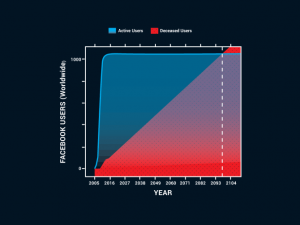
In “We calculated the year dead people on Facebook would outnumber the living”  Kristen Brown discusses her attempts to estimate when the number of dead Facebook profiles would outnumber the ones of those living. In her attempts she was turned down often, until Hachem Sadikki  from the University of Massachusetts offered his services. The resulting estimate stated that around the year 2098,  the social media platform would be overpopulated with dead profiles.

Sadikki’s calculations on a graph.

The more I thought about Facebook being overpopulated with the profiles of the dead, the more my mind strayed to to thinking about those that do not have Facebook profiles, or even simple access to the internet. How would they grieve? These questions began to develop as I read “If death becomes optional will only the rich get to live forever?” which discusses the possibilities of age and death defying technology.  In this article Manu Saadia discusses the possibilities of this type of technology only being available to those who are extremely wealthy. I one hundred precent agree with this statement, as I do not believe that such groundbreaking technology would be made available for cheap. Both of these articles led to me reflecting on the exclusion of people that are not in the digital atmosphere, and therefore we do not discuss in our class.

How do people from developing countries grieve if there are no Facebook walls to posts on? How do indigenous people grieve if they have chosen to live their lives without any technological advancements? These are questions that we should also be asking. I can imagine that those who struggle to make ends meet in several countries around the world do not have much time to engage in any of the grieving actions that we have discussed in class. A farmer who heavily depends on his crop for sustenance and family support does not have the time/opportunities to grieve as we do. It is possible that they do have time to grieve, but I believe that they do not have nearly as many opportunities as those who have time to select the “Remembering” option on Facebook.


The dsitribution of Facebook users worldwide.

As stated before I do understand that our class focuses specifically on Death in the Digital Age, its in the class title! However, I think that discussing these questions in class give us a more worldly view of how grief is seen or performed. By comparing the grieving performances or feelings of different societies and cultures, we can achieve a deeper understanding of the norms that we see in our own  social media sphere. Inequality if often discussed in terms of race and class, but no one discusses the inequality to express feelings or perform grief. It exists.

A Different Kind of Digital Death

So far in class, we’ve spent a fair bit of time discussing what happens to a people’s digital accounts once they die, yet we’ve spent little time talking about what happens to one’s account once a service itself dies.

Kashmir Hill’s Fusion article “This Start-Up Promised 10,000 People Eternal Digital Life—Then It Died” focuses on that very concept as it examines the death of Intellitar, a Black Mirror-esque online memorial service that closed its doors in 2012. The service that Intellitar offered seemed very much like a modern-day precursor to robo-Ash in Black Mirror’s “Be Right Back”–the company charged $25 a month to turn a collection of personal data provided by users to create an “immortal” avatar of the user.

Intellitar CEO Don Davidson’s “Immortal” Avatar via Popular Science

But we see in the article that one’s avatar, and therefore, one’s digital immortality, is contingent upon the lifespan of the company. As Hill points out, the text files, photos, and other media uploaded to Intellitar might be easy to back up. However, the more complicated proprietary parts of the service–the avatars themselves and the technology behind them–could not be backed up by the basic user.

We entrust so much of ourselves–literally our own identity and memories, in this case–to these digital sites and services without considering the mortality of the site or service. But digital services die frequently too.

R.I.P. Club Penguin via Polygon

Online game services provide a similar (albeit lower stakes) scenario to that of Intellitar. Game services like World of Warcraft, EVE online, and even Club Penguin (rest in peace, it dies today on March 29) have provided digital spaces for people to sink countless hours and dollars into, but those games last only as long as their servers run. Once they’re taken offline, everything the user has given them–time, money, effort, even pieces of themselves–dies too.