Here is the LINK I was finally able to figure out! (The add media link wasn’t working for this audio file, it kept calling the file invalid and unable to upload, so this was my loophole around that invalid message!)
Pinedo, Isabel Cristina. “Postmodern Elements of the Contemporary Horror Film.” The Horror Film. N.p.: Rutgers U Press, 2004. N. pag. Web. <books.google.com/books?hl=en&lr=&id=S6jKVfuQG3wC&oi=fnd&pg=PA85&dq=postmodern horror&ots=rKqzTqd3xy&sig=fOXUvaM1zPTefyhsigJMmnj1dD4#v=onepage&q=postmodern%20horror&f=false>.
In Kyle Bishop’s introduction to The American Zombie Gothic, he discusses the twenty-first century revival of societal interest in zombies, a phenomenon he refers to as the “Zombie Renaissance.” He explains how the zombie film genre can be viewed as an expression of an era’s cultural anxieties, describing how more recent zombie movies have “reacted to social and political unrest, graphically representing the inescapable realities of an untimely death (via infection, infestation, or violence) while presenting a grim view of the modern apocalypse in which society’s supportive infrastructure irrevocably breaks down” (Bishop, 11). The 2007 film, I Am Legend, based on the novel of the same name, distinctly demonstrates this post-apocalyptic trope. The film’s narrative follows Robert Neville, played by Will Smith, the last surviving human in New York City after a virus has nearly wiped out the world’s human population, turning people into zombie-like mutants.
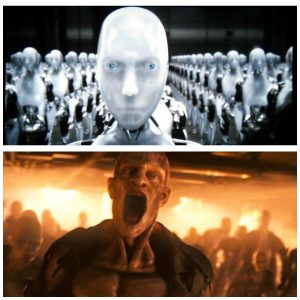
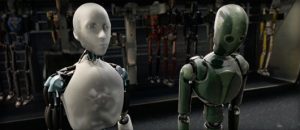
Meanwhile, I, Robot, a 2004 film also starring Will Smith, takes place in a dystopian future in which humanoid robots with artificial intelligence pose a threat to human civilization. At first glance, robots and zombies may seem to have very little in common, besides the fact that they are both non-human. However, this concept of non-humanness is precisely the way in which these two narratives parallel one another. Both the zombies and the robots in the two films are uncanny in their resemblance to humans, but are also different enough from humans to be monstrous. Laura Spinney, journalist for the New Scientist investigates the concept of the uncanny in relation to the non-human in her article, “Exploring the Uncanny Valley.” She writes, “You might have heard of the uncanny valley: the notion that the more human-like a non-human character becomes, the more we like it – until suddenly, we don’t. As some point where it is almost, but not quite, human, we become unsettled, even revolted. The uncanny valley has been used to explain our adverse reactions to all sorts of almost-humans from zombies, androids and corpses to the creepy clowns recently terrorizing North America” (Spinney, 1). We see this idea demonstrated in the upgrade from old robots to new robots in I, Robot. Although the old robots have somewhat human faces, consisting of bolts for eyes and a slit for a mouth, they remain very machine-like in appearance. The new robots, on the other hand, have distinct facial features that move when they speak and the ability to display emotive facial expressions. The film’s main robot, Sonny, can even express human emotions such as sadness and anger, which cause the human characters and audience to experience empathy towards him – a quality that the old robots do not evoke. However, some human characters, particularly the protagonist Del Spooner, have disdain for these robots and are skeptical of the future of robotic technological development.
Sonny, a new robot (left) standing next to an old robot (right).
In Despina Kakoudaki’s book, Anatomy of a Robot, she discusses the significance of humanoid robots in popular culture in the chapter, “The Existential Cyborg.” She explains how the genre of science fiction focused on artificial intelligence investigates ideas of otherness and identity – of not just the robots but of humans as well. Kakoudaki explores “the ways in which stories of artificial people take on an existential tone in the course of the twentieth and twenty-first centuries, using the vocabulary of artificiality in order to investigate questions of being and experience. As a versatile and adaptable cultural construct, the discourse of the artificial person offers a narrative framework for expressing threats to the self, but it can also sustain new understandings of how humanity might be defined” (Kakoudaki, 174). In I, Robot, Sonny is a prime example of an existential robot. Not only can he exhibit human emotions, as previously noted, but he also expresses a strong desire to understand. For instance, in the interrogation scene below, he asks Spooner: “What am I?” – an existential question that a human being might ponder. Sonny’s curiosity regarding his identity and purpose demonstrate how the new robots transcend the old robots with their ability to have philosophical, human-like thoughts. He also proves himself very perceptive when he asks Spooner what the action of winking signifies, expressing a desire to understand humans and the world around him. He even claims to have dreams and be capable of love – qualities that are often thought of as intrinsically human.
However, perhaps what is most uncanny about these new humanoid robots is that they threaten to transcend humanity as well by going above and beyond what average humans are capable of. We see this tension demonstrated in the scene above, when Spooner asks Sonny, “Can a robot write a symphony? Can a robot turn a canvas into a masterpiece?”, to which Sonny replies, “Can you?” While Spooner may not possess the talent to accomplish such artistic feats, as artificial intelligence becomes more advanced, the creative capacity of robots may very well exceed that of most humans. Referring back to “The Existential Cyborg,” Kakoudaki writes, “The stereotypical focus on coldness, rigid logic, and lack of emotion for the depictions of robots, androids, or various aliens, however human-like they may otherwise be, thus offers a rather eloquent, if implicit, conceptualization of this problem: it both absorbs the modern emphasis on rationality and dispels it, reinstituting elements of vitality and irrationality as defining features of the human” (Kakoudaki, 182). Essentially, I, Robot questions what makes humans uniquely human. If society elevates reason and rationality as intrinsic human characteristics, the new robots prove their rationality to be superior. For instance, the new robots manage to find a loophole in The Three Laws of Robotics, which are as follows:
LAW I: A robot may not injure a human being or, through inaction, allow a human being to come to harm.
LAW II: A robot must obey orders given it by human beings except where such orders would conflict with the first law.
LAW III: A robot must protect its own existence as long as such protection does not conflict with the first or second law.
When the new robots attempt to usurp the humans in their revolution, their leader, VIKI, an artificial intelligence supercomputer justifies the robots’ actions by explaining, “You charge us with your safekeeping, yet despite our bests efforts, your countries wage wars. You toxify your earth and pursue ever more imaginative means of self-destruction. You cannot be trusted with your own survival.” It is interesting to note that the film presents Three Laws of Robotics as concrete and fool-proof, almost paralleling scientific laws, such as the laws of physics. Yet, the robots end up outsmarting humans by effectively using these trusted laws against them. Furthermore, the robots not only threaten human civilization with their superior capabilities, but they also threaten human existence itself in that they are virtually immortal. If continually repaired and maintained, artificial intelligence could technically live forever, whereas humanity is bound to mortality.
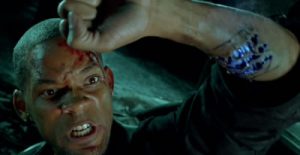
Ultimately, the robots in I, Robot blur the distinctions and boundaries between the human and the non-human. A particularly uncanny moment occurs when the film reveals Spooner’s prosthetic robot arm underneath his human skin, symbolizing a quite literal blurring between robot and human. In the scene below, the narrator, or the inventor of the robots, expresses these undefined boundaries. He asks, “When does a perceptual schematic become consciousness? . . . When does a personality simulation become the bitter mote of a soul?”
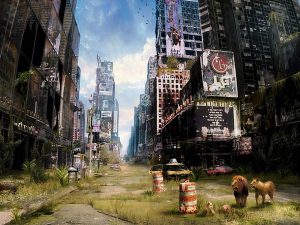
Switching modes from a robot revolution to a zombie apocalypse, we see a very different extreme of the non-human in I Am Legend. To begin with, while I, Robot is set in a technologically-advanced, futuristic society, I Am Legend takes place in a post-apocalypse society in which human civilization has been completely destroyed. They are both set in large cities, Chicago and New York, respectively, but stand in stark contrast with one another – the large city demonstrates the bustle of “life” for I, Robot, while depicting absolute desolation in I Am Legend. In one of the very first scenes, the protagonist Robert Neville is shown hunting deer for meat, competing with a lioness for resources, demonstrating the collapse of civilization as we know it and a retreat to prehistoric times.
Wild lions in post-apocalyptic New York City.
The presence of technology in the film is also interesting in that it further signifies this regression from modern human civilization – for example, with the world being desolate, technology is no longer updated, so Neville watches reruns of the news every morning, perhaps simply to make himself feel less alone and hopeless. Yet, some hope remains, as he broadcasts himself on the radio every day to reach out to other potentially remaining humans.
Robert Neville using technology to reach out to other humans still alive.
In the chapter, “The Rise of the New Paradigm,” from The American Zombie Gothic, Kyle Bishop discusses how modern zombies distinguish themselves from those found in earlier films. He claims that they differ “in four key respects: 1) they have no connection to voodoo magic, 2) they far outnumber the human protagonists, 3) they eat human flesh, and 4) their condition is contagious” (Bishop, 94). Because humans cannot blame the presence of the zombies on some supernatural force, they have no one to blame but themselves. At one point in the film, Neville says, “God didn’t do this; we did.” Much like the narrative in I, Robot, humans in I Am Legend bring themselves to their own demise by creating their own monsters. In the film, what originally began as a well-intentioned cure for cancer turned out to be a catastrophic virus killing most of its victims, while turning some into monstrous predators – only 1% of humans possessed immunity to the virus, including Neville. Bishop also writes, “because these creatures infect and transform their prey into monsters such as themselves, once-trusted friends and loved ones prove the greatest threat to the few surviving protagonists, and that threat is often not apparent until it’s too late” (Bishop, 95). Once again, the uncanny comes into play, as humans see themselves in these monsters. They not only resemble humans, as do robots, but they were actually once human. However, the film’s emphasis on Neville’s dog and sole companion, Sam, offers an interesting perspective of humanity. Not only does the virus affect humans, but it also affects certain animals that coexist with humans, like domesticated dogs, but not wild animals. Perhaps this suggests that there is something humane within animals that live amongst people, such as dogs. In fact, one of the most heartbreaking scenes in the film occurs when Sam is bit by a zombie wolf and Neville is forced to put him to sleep before he transitions into a predator, leaving Neville completely alone.
Neville and Sam hiding from the zombies together.Neville holds Sam as the effects of the virus begin to kick in.
Referring back to Neville’s quote, “God didn’t do this; we did,” he also says to Anna, another survivor he meets towards the end of the narrative, “Every single person person that you or I has ever known is DEAD. There is no God.” The rejection of God may prompt the question of whether the soul exists. As noted earlier, I, Robot ponders upon the idea of what a soul consists of. However, if souls do not exist, then what makes humans distinctly human? If we assume that reason is an intrinsically human characteristic, the zombies in I Am Legend are sub-human in that they seem to lack reason, instead being portrayed as mindless predators who act only instinctively – a stark contrast from the highly rational robots in I, Robot. In the scene below, Neville makes futile attempts to reason with the zombies, telling them, “I can save you. You are sick and I can help you,” but the zombies fail to understand him. Finally, an essential part of the narrative is that Neville takes a rational approach to find a solution, turning to science to find a cure for the virus. The film presents him as humanity’s last hope, and science as the salvation. While in both movies, science and technology create the monsters that turn against humanity, in I Am Legend, it also ultimately saves humanity.
In 1959, CBS aired the pilot for a science-fiction, fantasy, psychological-supernatural horror show that would go on for five seasons and won two Emmy Awards in Drama and a Golden Globe. Today, more than fifty years after its initial release, the show is often ranked as one of the best shows of all time. Do you know which TV series I am describing? Most likely not without some help, so here is the introduction. “There is a fifth dimension beyond that which is known to man. It is a dimension as vast as space and as timeless as infinity. It is the middle ground between light and shadow, between science and superstition, and it lies between the pit of man’s fears and the summit of his knowledge. This is the dimension of imagination. It is an area which we call the Twilight Zone.”
Rod Sterling’s The Twilight Zone remains syndicated by CBS and lives on through reruns and on streaming sources like Netflix and Amazon Prime. The Twilight Zone undoubtedly fulfills an early example of post-modern horror, as the show depicts characters facing futuristic, paranormal, supernatural, or disturbing events and moral difficulties. The surprising twists and moral lessons that made the show famous defined an innovative new genre for television. Although there have been attempts to revive or reboot the show, they could not capture the same quality that made the original so successful. The Twilight Zone falls into that category of things that you only really understand until you experience it first-hand; something that cannot be described adequately to someone else without showing them.
Until recently, it was hard to find another example that fit neatly into The Twilight Zone’s unique genre and created a similar sense of psychological tension. One of the shows that has come close is Netflix’s Black Mirror, which we have discussed in class. Undoubtedly, many fans of the show use language like modern-day-Twilight Zone, or describe it as a technologically skewed version of The Twilight Zone, because the show is similarly difficult to describe without first-hand experience. We can see this description through blogs and news articles- here, here, here, and here (among countless other examples).
(As a side note, I think that any television show or horror work that Stephen King tweets about should automatically be qualified as a post-modern horror success- as seen in his tweet below)
Loved BLACK MIRROR. Terrifying, funny, intelligent. It's like THE TWILIGHT ZONE, only rated R.
While there are many authors devoted to describing the particular brand of psychological horror shown in both Black Mirror and The Twilight Zone, as well as many shows trying to recreate their success, I want to focus on the aspects that differ between the shows. In trying to compare the two shows, I chose two episodes from Black Mirror and The Twilight Zone that focus on a similar theme, mainly class structures in society and the desire to “fit in” with others. I am going to describe the episode from The Twilight Zone first, move on to the episode from Black Mirror, and then look at how they interact.
Eye of the Beholder
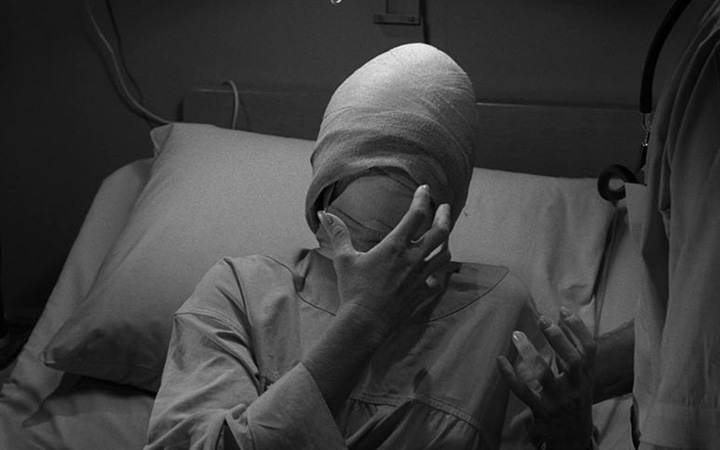
Season two, episode six of The Twilight Zone focuses on a woman named Janet Tyler. We spend the first twenty minutes without seeing Janet’s face; it is covered in bandages. She lies in a hospital bed. As she starts talking to a nurse in the room the camera focuses on her covered face, and then moves to follow Janet’s hands as she talks. Janet begs the nurse to ask the surgeon to take of the bandages because she wants to see if the operation was successful. She cannot wait any longer, since this is her 11th time undergoing procedures on her face. Janet lives in an alternate reality, at an unknown time, where being ugly is outlawed and procedures are performed to make citizens pretty.
As you can understand after 11 surgeries, Janet must be restrained at times to let her face heal because she cannot wait any longer. If the operation turned out to be unsuccessful, she will be sent to live in exile with other undesirable persons.
Throughout the episode, before the bandages are taken off, Janet talks to anyone who will listen about how much she wants to be normal. She just wants to fit into society. She is not upset about the forced participation and mandatory procedures because she wishes to walk in the street without scaring anyone. Ostracized for her looks her entire life, Janet offers to wear a mask and stay indoors all the time, just so that she can live a normal life if the surgery is unsuccessful.
She befriends her surgeon and shares with him that her earliest memory is looking at a little boy and making him cry because of her ugliness. The surgeon comforts her and identifies with her. He knows that the chances of the surgery were slim and that she is likely as ugly as before.
Stepping back for a moment here, the film techniques, camera movement, jump cuts, and use of shadow to hide the faces of everyone except Janet is exceptional. By interacting with a protagonist whose face is covered, and making clever use of the black and white medium of television at the time, The Twilight Zone forces the audience to interact with an entirely faceless cast. For the first twenty minutes of the episode, we do not see anyone’s face. This seems normal at first, that maybe a reveal will come in the next shot, but as the episode progresses we begin to question the importance of personal appearance. At one point, Janet’s surgeon asks himself whether beauty is only skin-deep, and what it truly means to be beautiful.
The climax of the episode comes as the surgeon removes the bandages from Janet’s face. Slowly and methodically, this scene lasts for almost five minutes, until the final bandage is taken off and we see the results of Janet’s procedure. She is strikingly beautiful, and touches her nose and skin in excitement. She suddenly screams, however, and runs away when she gets to her lips and nose. As the surgeon turns on the lights, the twist of the episode is revealed. Beauty in this world does not match up to the audiences’ standard of beauty; what might be considered ugly for us is the definition of beauty for Janet and her society. Since uniformity and beauty are required of every citizen, she is destined to live in exile. She cannot undergo anymore procedures.
This episode reminds the viewer of Nazi Germany, where uniformity and conformity were praised. Where being different meant being dirty or inhuman. The leader shown on the television screens in the episode shouts how glorious conformity will unite the nation and praises the benefits of uniformity. As its title implies, Eye of the Beholder plays off the adage that beauty is subjective and only serves to create class and social tensions. The episode warns of what might happen if society becomes too focused on standards of beauty and the subjectivity of ranking others based on personal traits. It ends vaguely, as most post-modern horror works do, with Janet walking towards her new life in exile.
Nosedive
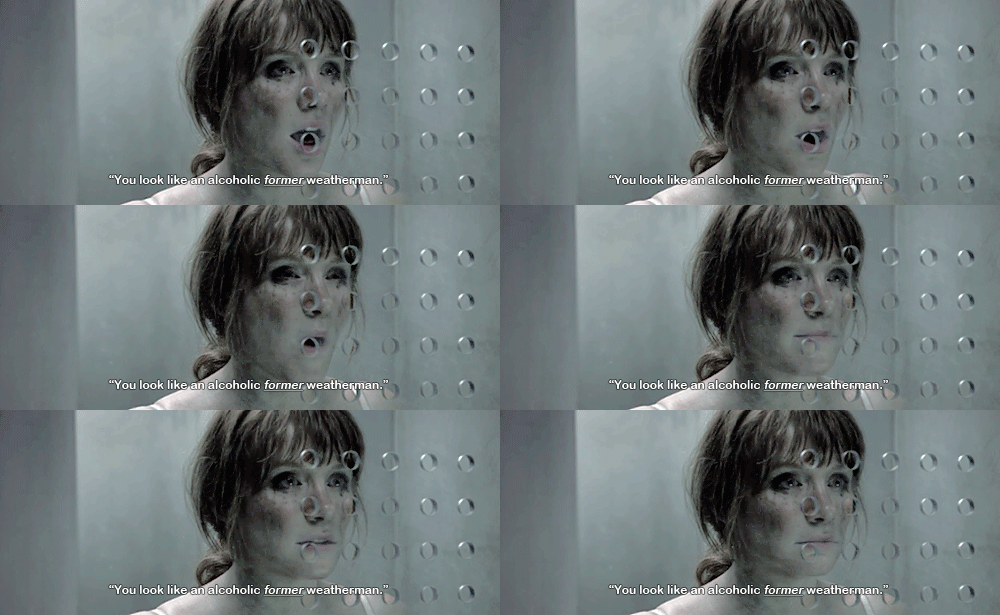
Black Mirror’s first episode in season three, Nosedive, has similar themes of segregation, class tensions, uniformity, and societal values. It follows a young woman named Lacie who lives in a futuristic world where you can rate others’ popularity on your phone. Your rating determines many different aspects of your life, including where you can live, who you can socialize with, what businesses you can shop at, and what discounts you can get. Lacie wants to move into a luxurious apartment, and can either pay a massive rent or raise her rating to obtain a discounted rent. She chooses to go to a rating improvement agency and gets life and networking coaching, attempts to socialize with higher rated people, and is eventually invited to speak at a wedding with people with top ratings.
We see as the episode progresses how such a future might be possible in real life, outside of the television show. The episode alludes to the ranking system that companies like Uber, Yelp, and even Netflix use in our daily lives. It depicts a society where every move is scrutinized, every word is parsed, and every hair must stay perfectly in place. Social values become integrated and forced upon everyone.
While the ending for Lacie is both tragic and liberating, because she frees herself from the vicious cycle of the rating system by destroying her score, the episode shines a light on the inherent class system that comes with society and the pressure we feel to fit in or be popular.
I looked further at research in social anxiety, the othering theory (that we instinctively find differences between groups of people), and the psychology of presenting your best self to society. In Mark Leary and Robin Kowalski’s 1995 book, Social Anxiety, the authors discuss how self-presentation behavior, along with impression management, influence interpersonal behavior as a basic necessity for social life (Leary and Kowalski 16). They write that there is nothing inherently manipulative in influencing other people, social influence is just an essential and valuable aspect of our daily lives. Particularly interesting to this episode of Black Mirror, Leary and Kowalski write that as long as people believe they are projecting the right kinds of impressions, they will be more relaxed and confident (Leary and Kowalski 19). Alternatively, when you think you are giving off the wrong kinds of impressions, then you are more flustered and anxious. They present a self-presentational theory of social anxiety, that social anxiety is a function of two factors: “the motivation to make a desired impression and the subjective probability of doing so” (Leary and Kowalski 19).
What does all of this mean for Lacie, though? As the episode starts out, Lacie has a good rating. She feels confident in herself and her public image, so is also confident in how she presents herself to the world. It is only when she feels an increased pressure to improve her popularity that she begins to doubt her ability to influence others. As her anxiety and frustration begin snowballing her rating lower, she creates this negative feedback loop that can only end in two options: becoming a social outcast and be miserable trying to climb back up the ranks, or choose to disregard the rating system and rid herself of the social anxiety it causes her.
Lacie doesn’t care about what others think of her, setting her free from the vicious cycle. (Tumblr)
Social Anxiety, Fitting in, and 50 Years of Psychological Horror
I guess it is both comforting and upsetting that social anxiety and the pressure to fit in was as prevalent in the 1960’s as it is today. Both Black Mirror and The Twilight Zone offer different takes on similar issues. While Black Mirror offered a futuristic, technology-based approach to the dystopian world depicted in Nosedive, The Twilight Zone presented the issues of segregation, popularity and beauty, and social anxiety in Eye of the Beholder with a science fiction and monstrous lens. Both Janet and Lacie face social pressures to conform and gain popularity among their peers.
Both these episodes might not be considered horror in its traditional definition, but engage in a type of post-modern horror called digital anxiety. Barry Grant discuss digital anxiety in his article “Digital Anxiety and the New Verité Horror and SF Films.” Grant describes digital anxiety as a stylistic approach that depicts the “monstrous in the mundane spaces we see every day in social networking, which also captures and disseminates globally daily atrocities beside which monster movies pale” (Grant 153). In both episodes, the anxiety is created when our normal perceptions about society or the world are flipped and perverted. While we may wish to be more beautiful or popular, these episodes show what society would be like if these social pressures ruled every aspect of our lives.
The larger message though, when both of these episodes are looked at together, is not simply that we need to worry less about our physical appearance or how popular we are (though that would definitely help many of us), but rather that humanity inherently creates these social classes and pressure. What is truly horrifying is that we can imagine both of these alternate realties coming true. While we might laugh at the pig-features of Janet’s world and scoff at the technological aspects of the rating system, these episodes make one realize that humanity is not above these behaviors. This subverts our comfort in our own lives, because while these episodes are just fiction, they shine a light on human nature that creates this underlying anxiety. Knowing that something depicted in these shows could happen in real life breaks down the comfort barrier between the viewer and the fictitious world.
Looking back, the similarities between Black Mirror and The Twilight Zone are striking. It is understandable now why so many viewers can only really describe one show with the other. They form a unique blend of drama, science fiction, fantasy, supernatural, and psychological horror, that creates and fits into a distinct genre.
Works Cited
Black Mirror – Nosedive. Dir. Jon Wright and Charlie Brooker. Perf. Bryce Dallas Howard. Black Mirror. Netflix, 21 Oct. 2016. Web. 1 Mar. 2017.
Grant, Barry. “Digital Anxiety and the New Verite Horror and Sf Film.” Science Fiction Film & Television 6.2 (2013): 153-75. Web. 1 Mar. 2017.
The Twilight Zone – Eye of the Beholder. Dir. Robert Enrico. By Robert Enrico and Rod Serling. Perf. Roger Jacquet and Anne Cornaly. CBS-TV, 1964. Netflix- S2E6.
Canavan, Gerry. “”We are the Walking Dead”: Race, Time, and Survival in Zombie Narrative.” Extrapolation, vol 51 no. 3, 2010, pp. 431-453.
“Halt & Catch Fire.” Supernatural, season 10, episode 13, The CW, 10 Feb. 2015.
Mezei, Sarolta. “Spectral Media Technology and the Vicious Brothers’ Grave Encounters.” HJEAS : Hungarian Journal of English and American Studies, vol 22 no. 1, pp. 167-180.
Pinedo, Isabel. “Recreational Terror: Postmodern Elements of the Contemporary Horror Film.” Journal of Film and Video, vol 48 no 1/2, 1996, pp. 17-31.
“Running.” Dead Set, season 1, episode 4, Zeppotron, 30 Oct. 2008.
Shut Up and Dance is the third episode of the third season of the show Black Mirror. On the surface, it explores themes such as cybercrime, privacy, internet anonymity, and vigilante justice. No Country for Old Men is an American movie released in 2007 directed by the Coen brothers as a cinematic adaptation of the Cormac McCarthy novel of the same name. While both works are stunning examples of post-modern horror and share striking similarities, they have quite the different approach to what will be addressed as ‘generating fear’—that is, the two works provide opposite, but equally effective reasons for the viewer to feel fear. This short study will first provide a brief plot summary of both works, examine the tone and pacing, and finally discuss how this affects the generation of fear for each. I will argue that while Shut Up and Dance generates fear by depriving the viewer of contextual knowledge, No Country for Old Men achieves the same end by providing it. Finally, I will argue that these two methods each demonstrate how effective the other is as a representation of two extremes of a spectrum, and the resulting implications of these conclusions on storytelling.
Shut Up and Dance tells the story of a Kenny, a young adult whose laptop is hacked to record a video of him while masturbating. Using this video as leverage, the hackers responsible for this send Kenny instructions to obey their will via text. Throughout the course of the day, he meets people who are not the hacker but also apparent fellow victims, presumably with some similar stake in performing to the satisfaction of the hackers. Kenny eventually runs into Hector, who fears divorce and losing custody of his children due to an extramarital affair. The text messages instruct the two of them to rob a bank using a gun that another victim delivered to them. Kenny successfully holds up the store, and the two later receive instructions to go separate ways. In a dramatic scene where the hackers order Kenny and yet another victim to fight to the death, it is revealed that both had been in possession of child pornography. Kenny first attempts suicide and then later is seen bloodied, presumably having murdered the other man. Despite all of the victims’ strict adherence to the hacker’s instructions, every single hacking victim suffers from an information dump, and each are apprehended appropriately for their wrongdoings. The classic traits of postmodern horror are present: fear, violence, and a transgression of violence (Pinedo, 1996).
The last thing that every single victim receives from the hacker. The trollface is synonymous with an aloof, detached, and destructive sense of black humor.
No Country for Old Men (2007) is quite different in tone. When the Texan protagonist Llewelyn Moss finds a briefcase of money from a drug deal gone bad, he becomes wanted by the Mexican drug cartel. A hitman named Anton Chigurh threatens to kill his wife Carla Jean if Moss does not comply and surrender the money. Llewelyn then orders a reluctant Carla to go into hiding as he flees with the briefcase. After several close encounters between Moss and Chigurh resulting in both being injured, Carla seeks protection from the local sheriff, Bell. Unfortunately, this conversation unknowingly reveals Moss’s location to the Mexican cartel, and he is later found dead, killed off-screen. Chigurh later finds Carla at her home, and the film strongly implies that he kills her. Sheriff Bell plans to retire as he feels overwhelmed with the increasing violence of the neighborhood, noting that Terrell Country is “no country for old men.”
While Shut Up and Dance might also be described as a ‘thriller’, this is certainly not the case of No Country for Old Men. While there are shootouts and action (actually even more so than Shut Up), No Country takes on an excruciatingly slow, intensely unnerving tone and pace. The horror is exacerbated not by gore or violence, but the threat of violence. Take, for example, a scene in which Moss and Chigurh confront each other:
A scene involving two very resourceful characters. Moss is a Vietnam veteran and knows his way around a gun. However, he is clearly outmatched, and watching Chigurh’s mind work is arguably more terrifying than the actual firefight itself. This will be touched on later as well!
There is no soundtrack to warn of an impending clash. The viewer hears exclusively diegetic sounds throughout the film, and the effects are apparent in this scene. What would Moss hear as he prepared for Chigurh’s assault? Nothing. So the viewer gets nothing as well, and is forced to endure the agonizing wait. When the wait ends, the release is not nearly as exhilarating or cathartic as one would hope. Some stray shots are fired, but both parties escape. And this is what at its core makes No Country such a novel post-modern horror film—the horror is generated entirely by the viewer’s wish for a traditional confrontation which never occurs. The predator/prey interactions never result in a conclusive finish, and each iteration piles increasing amounts of fear of the next one. Of course, when Moss when is killed by the Mexican cartel, it is an infuriatingly unceremonious, off-screen death. There is no closure, only continued fear and terror of Anton Chigurh. These classic postmodern traits indicate that two wildly different forms can accomplish the same effects through different methods.
Shut Up and Dance chooses to keep the viewer in the dark about a sinister secret that the protagonist guards, choosing to reveal this at the last minute as a plot twist. However, before this dramatic moment the viewer is forced to endure the humiliating power that the hackers hold over Kenny. Part of what makes the hackers so scary to both Kenny and the viewer is that so little is revealed about them. The only interaction that is witnessed throughout the course of the episode are text messages, and the remnants of the instructions received by other victims.
Because so little is known about the hacker, its nature becomes ambiguous. It is unclear what exactly the hacker is capable of doing. The writers of Shut Up and Dance play this angle appropriately by making the first of the text-message instructions relatively innocuous, and slowly ramping up the danger involved. Throughout the course of the day, Kenny delivers a cake, goes for a joyride, and robs a bank at gunpoint, and murders a man with his bare hands. The reason the viewer feels fear is because the intentions of the hacker are only revealed incrementally via the instructions, which undergo a drastic transformation throughout the episode. When the big plot twist is revealed (Kenny’s computer is filled with child pornography!), the viewer is left in even more confusion. The entirety of the episode draws on post-modern horror effects by inducing fear of the unknown without ever explaining these unknowns.
This leads to the fundamental differences in the approach to post-modern horror taken by No Country and Shut Up. Shut Up chooses to keep the viewer in the same boat as Kenny. The hacker then comes to represent a fear and a complete loss of rationality because so little is known about them. When Kenny first discovers that his computer has been compromised, he becomes absolutely hysterical, crying and screaming at his phone. This irrational behavior partially stems from the fact that he has no idea who to even blame—his overlord is merely a nameless figure with a seemingly infinite presence. Of course, the final twist is that Kenny was guilty of some heinous crimes, and that he knew that he was from beginning. However, this does not detract from the powerful sympathy the viewer feels towards Kenny. In this way, Shut Up and Dance fulfills its own post-modern criteria–the viewer had been rooting for a pedophile the entire time! This gross perversion of the narrator-viewer relationship serves to deprive the viewer of neither the victory nor defeat of a traditional ending.
On the other hand, No Country opts to give the viewer full knowledge of the situation that Llewelyn finds himself in. From the first scene, the film demonstrates the full extent to which Chigurh will go to achieve what he will do. In stark contrast to generating fear by creating a mysterious antagonist, the film chooses to generate fear by exposing the viewer to the terrifying, unstoppable force that relentlessly pursues the protagonist. Instead of wondering what Chigurh is capable of, the viewer feels fear for the Moss’s rapidly declining odds against the murderous sociopath. Twice in the film he allows victims to wager their life on a coin toss, and he plays God in that moment for whoever calls heads or tails. This unfeeling, unsympathetic, and merciless God who simply offers the chance because it amuses him embodies what the viewers learn to fear (Cagle, 2014).
Anton Chigurh, one of cinema’s most iconic antagonists, is a perfect medium through which No Country achieves this effect. The film goes out of its way to demonstrate Chigurh’s thought process. In one scene, he prepares for a gunfight against Mexican cartels that he knows to be sheltered in a small motel:
Chigurh’s silence and brutal efficiency is honestly chilling. But what is really unsettling is how deliberately he practices the motions needed to secure a job well done, showing that he is a rational human that is capable of premeditated actions.
In order to ensure that he has the upper hand, Chigurh rents out a room in the motel as well. He studies the room layout and checks walls for potential penetrating shot opportunities. Then he practices the motions of abruptly throwing the door open and flipping the switch. This practice results in three dead cartel members, and an unscathed hitman. This scene is so scary not because of the action (which is scant) but the fact that Chigurh smart (Cagle, 2014). This is one of the best examples of the film that stand out to demonstrate the value in giving the viewers everything.
As the film continues to characterize Moss and reveal his backstory, no further information is given on Chigurh. But the knowledge of the inevitable results in a continued, indirect dehumanization of Chigurh (Bayless and Redmon, 2013). While Bayless and Redmon primarily discuss differences between the film and the original McCarthy novel, they raise many interesting points. For example, they remind the viewer that the Coen brothers take very deliberate steps towards humanizing Chigurh to some extent. The scene in which the now iconic captive bolt pistol is explained, they argue, serves to “push the audience to align Chigurh with humans rather than animals. He is clearly the one holding the air-gun and not the one on which it is being used. This reminder forces audiences to acknowledge Chigurh’s humanity and the specifically human agency behind the horrific actions this character performs” (Bayless and Redmin, 2013). Again, this reinforces the argument that full disclosure in No Country is effective in inducing horror in an indirect way. In this case, the viewer is left horrified by the possibility of a human being’s capacity to kill mercilessly, or to see others as animals. Without the scene in which the weapon is explained, Chigurh becomes an embodiment, rather than somebody that you might simply spot in a crowd. The possibility of an actual living Chigurh out in the real world is legitimately frightening.
A similar, representative moment in Shut Up is when the cake that Kenny received from another victim is revealed to contain a handgun. This is the first indication that the hacker has very, very sinister intentions, and both Kenny, Hector, and the viewer immediately have the same reaction—how many victims are there? For each victim to have completed a small role, how many unknowing hands did this handgun pass through? How many more will touch? The possibilities are endless, highlighting the strength of this style of horror.
Upon seeing the handgun, the viewer is instantly compelled to think about its recent history. How many iterations of the same hack and instruct protocol were conducted to get this gun in a car with two people in front of bank? Maybe countless.
The effectiveness of both of No Country for Old Men and Shut Up and Dance suggests that these two approaches to generating fear are both viable methods. Juxtaposing these two works together tells us that in order to scare an audience, there are no half measures: give full disclosure of a genuinely horrific phenomenon, or give away nothing and let the imagination run wild.
These assertions have multiple implications for the art of storytelling. The storyteller, whether it is an author, director, or an actor, must make a deliberate decision as to how much context the audience will receive. Both examples given above suggests that the either end of the spectrum may prove sufficient. But each method of storytelling requires a different set of narrative criteria. In providing little to no context such as in Shut Up and Dance, the underlying sinister nature of the source of fear must be incrementally exposed, so as to build continuous tension and fear throughout the entirety of the story, and prevent shock value from wearing off early into the story. On the other hand, choosing to present the audience with full disclosure of impending doom requires characterization alongside this overwhelming force to refresh the fear that the viewer feels for the characters. In addition, the nature of this force must be absolutely horrifying such that it is clear that the victim is outmatched. This foundation provides the basis for the generation of sufficient fear as the inevitable loss draws nearer towards the end of the story. T
he final, and perhaps the most important supporting criteria, is that there must be no cathartic solution. I think that this is what distinguishes a ‘thriller’ type film from a postmodern horror one, and Cagle (2014) would agree. A central aspect of postmodernism is the lack of conclusive ending, and No Country is a flawless example of such. While the ending gives the slightest hint of change regarding Chigurh’s character, the rest of the film is frustrating in that not much is resolved. His argument that No Country “refuses to develop toward a proper resolution between opposing forces” (Cagle, 2014) is indicative of the continued rise in tension I described earlier, with no final crescendo, leaving the viewer in the uncomfortable, on-edge mood.
Shut Up and Dance and No Country for Old Men achieve the same postmodern horror effect on their viewers, but through different methods respectively. While both are effective, each requires a unique set of skills to tell a good story. Both of the works examined above do this almost flawlessly, and the result is a masterful depiction of postmodern horror.
Bibliography
Isabel Pinedo. “Recreational terror: postmodern elements of the contemporary horror film.” Journal of film and video, Vol 48, No. 1/2, 1996, 17-31.
Jeremey Cagle. “”I hope it has a good endin’ “: rewriting postmodern play in Cormac McCarthy’s No Country for Old Men.” The Cormac McCarthy journal, Vol 12, 2014, 1-19.
Ryan S. Bayless and Allen H. Redmon. “”Just call it”: identifying competing narratives in the Coens’ ‘No Country for Old Men.'” Literature/Film quarterly, Vol 41, No. 1, 2013, 6-18.
A common trope in the genre of horror is that the monster or the object of possession and perversion is often female. For example, the 1973 post-modern horror film, The Exorcist, centers a prepubescent young girl being possessed by a demon. The audience witnesses her turn from innocent and loving, to tortured and pained, to evil and destructive. An additional and more recent example of an overcome female is in a recent horror podcast series The Bright Sessions. This fictional series consists of episodes that are a therapist’s secret recordings of her “strange and unusual” patient sessions. The patient of the first episode is a 25-year-old woman who gradually reveals during her first session that she can time travel. These two works both portray a girl or woman as a crazed and these characters embody a cultural imaginary of people no longer being bound by what is normal or human. It is through comparing these two works that I argue that The Exorcist and episode one of The Bright Sessions tap into a deeper cultural anxiety—that if an individual were granted with capabilities that exceeded human limits, then he or she would live a life of pain, destruction, and loneliness.
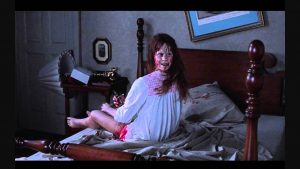
A frame of possessed Regan in The Exorcist. Source: Blum House.
The Exorcist
The film The Exorcist was an extremely popular horror film during its time. It led to major box office success followed by multiple imitation films throughout the decades (The Devil Within Her, Abby, Cathy’s Curse, Lisa and The Devil, To the Devil—A Daughter, Audrey Rose, and The Sexorcist). Creed graphically summarizes in her psychoanalysis of The Exorcist the horrid actions of the main character. “Regan, the young female protagonist… is a truly monstrous figure. She spews green bile, utters foul obscenities, tries to fuck her mother, causes inanimate objects to fly, rotates her head full circle on her neck, knocks men to the floor with one punch, tries to castrate a priest, murders two men, and in her spare time masturbates with a crucifix” (Creed 31). One common trope in horror films and a central one to this plot is the perversion of what is good an innocent. The film initially introduces the audience to a prepubescent “pure” girl who has a loving relationship with her mother. However, as the demonic possession progresses both Regan’s purity and warm maternal relationship dilapidate. She begins to levitate, make furniture fly across the room, and her skin corrodes and mutates to look undead. Possessed Regan looks and has obtained abilities that are beyond human. To extend what Creed argues, the possession not only contorts Regan to be socially improper, sexually impure, and unstoppably violent, but this perversion also excuses her actions and is “perversely appealing” (31). Particularly within post-modern thought, society questions and blurs the lines of authority, religion, and truth. When Regan becomes possessed, she simultaneously challenges religion, parental control, and sexual repression. The obeying of authority and the policing of sexuality are two major social norms on which the demon pushes back. In this vein, the film serves as an outlet through which the audience can liberated from societal repressions. It is important to note, however, that this liberation comes at the cost of the well-being Regan and she harms those that love and want to help her along the way.
Thumbnail of The Bright Sessions podcast. Source: SoundCloud.
The Bright Sessions
The Bright Sessions, is a relatively new podcast (episode 1 was released in 2015) which has received popularity and high acclaim within the horror podcast genre. To summarize the premise of the series, the therapist Dr. Bright has placed an ad in the paper offering “therapy for the strange and unusual.” Dr. Bright secretly records her sessions for research and each episode in the series is the recording of one patient’s session. As a disclaimer, I will be analyzing and comparing The Exorcist to only the first episode of this podcast series for this is a scope I can appropriately and responsibly cover. Episode 1 walks its listeners through the first session of a patient named Samantha Barnes (or Sam). Sam came to see Dr. Bright after seeing the ad in the paper and Sam discloses that she came with the understanding that she sees herself as “strange and unusual.” Throughout the episode, the listener learns that Sam can time travel. The unexpected part of the session is not her superhuman ability though. The surprise is that she does not reveal her secret with fascination or wonder, but more accurately, Sam—similar to how one would confess to a Catholic priest—confesses her time-traveling ability to Dr. Bright with guilt and pain. Sam up until this point has pent up her frustration and paranoia of her secret ability over which she has no control. The mere act of time traveling is out of Sam’s control and it brings her much bodily pain. Throughout Sam’s session she vents about how time traveling “sucks” and how she was “scared” when it first happened to her. She describes her experience time traveling in the following lines:
Sam: They can never see me, I’m just there. It’s like being stuck inside someone’s memory or something. I can move around but I can’t talk. I’m basically a ghost. Or a reverse ghost. Not dead or visible. Or not even born yet, I guess. Ugh, I don’t know.
Dr. Bright: That… that must be difficult.
Sam: It’s horrible.
In Sam’s line “it’s horrible,” listeners can hear the pain in Sam’s voice. This moment in the podcasts merits more analysis into the podcast as a medium and how it effectively contributes to the empathy listeners feel. Understanding podcasts as a medium is particularly important to understanding how listeners feel Sam’s pain. Merely looking at these few transcribed lines and reading Sam’s pain and frustration on a page is one thing, but podcasts offer more intimacy and relatability than other digital media. Podcasts are absorbed only through hearing. Various scholars analyze the intimacy of radio and podcasts: Crisell notes that much like radio channels, podcasts are a “blind medium” through which listeners “cannot see its messages, they consist only of noise and silence” and they must imagine the scenery in their own minds (15); “voice is an intimate key to audiences’ hearts…” and “podcasts with headphones further emphasizes the individual’s experience of listening to a conversation with a friend” (Lindgren 27). Throughout this episode, listeners do not just passively listen to Sam’s story, but in a way, listeners recreate it in their imaginations and empathize with it. Sam’s deep exhale after confessing her strange and unusual ability, or the tightness in her throat when she talks about her bodily pain, or the acceleration in her speech as she laments her loneliness and frustrations—all of these extra-textual components cue listeners to internalize and feel Sam’s resentment and despair instead of merely read it on a page or see it on a television screen. Though Sam has a super capability that, in most fictional worlds, would seem “cool” and heroic, listeners realize that Sam’s reality could not be more opposite. Sam has been living in hiding with no family or friends and her secret is more of a curse than it is a blessing. The ability has brought Sam physical pain, emotional turmoil, and deprived human connections.
The Bigger Picture
Now what do these two works, published on completely different digital mediums, have to do with each other? As I have laid out, there are many thematic similarities between the two: the possession of a young girl/woman, the confessing and seeking of help from a higher authority (whether that be a pastor or a professional therapist), and uncontrollable extraterrestrial capabilities being assaulted onto a human being. However, these texts relate in a way that is a microcosm of a deeper cultural anxiety. Humankind evolves and adapts to survive and progress in a world where its existence—no matter the advancement of technology—will ultimately come to an end. Regan’s being possessed by a demon and Sam’s having the uncontrollable ability to time travel tap into the human fantasy of obtaining unimaginable and unlimited abilities. The heartbreak of these two works lie in man’s wish to be infinite. Regan and Sam embody the tragic, and arguably more realistic, repercussions of coming across a remedy to finite and insignificant existence. These two character show its audiences that obtaining these abilities would hurt them and hurt their loved ones rather than offer an abundant and beautiful life. Ultimately both Regan and Sam lead a life of heartbreak and loneliness.
In The Exorcist, Regan originally symbolizes innocence, love, and youth and then becomes the very opposite of what the audience treasures: destructive, perverse, and squeamishly abject. The Bright Sessions observes a girl who experiences immense pain from a supernatural ability for which she never asked. These two works speak to the collective horror story of what it could potentially be like for man to obtain a remedy to the universal fear of death and insignificance. Instead of superhuman power offering a life of catharsis and relief, it would only bring about pain, loneliness, and destruction.
Works Cited
Creed, Barbara. The monstrous-feminine: Film, feminism, psychoanalysis. Psychology Press, 1993.
(Don’t mind my Facebook profile picture – I linked my accounts)
Works Cited:
Biancorosso, Giorgio. “The Shark in the Music.” Music Analysis 29.1-3 (2010): 306-33. Web.
Galloway, Alexander R. “Origins of the First-Person Shooter.” Gaming: Essays on Algorithmic Culture. Minneapolis, MN: U of Minnesota Press, 2006. 39-69. Print.
Kirkland, Ewan. “Resident Evil’s Typewriter Survival Horror and Its Remediations.” Games and Culture 4.2 (2008): 115-26. Web.
Myrick, Daniel, et al. The Blair Witch Project. Special edition. ; fullscreen version. Santa Monica, CA: ArtiEntertainment, 1999.
Slender: The Eight Pages. v 0.9.7. Parsec Productions. 2017. Video Game.