I tended to make loose connections between my subjects and the traditional notions of death. Can a concept like “truth” die? How does social media change our relationship to the concept of dying? How does a video game “die” — and then become resurrected by social fascination and fetishization?
I felt most engaged when injecting discussions of death into unexpected places, whether it’s neo-liberal politics or the demise of Fyre Festival. I enjoyed considering death beyond its biological process; what are it’s cultural and social dimensions? How does it shape media we consume? How does our conception of death itself change over time?
My best posts responded to class content while also integrating readings from my other classes. I wrote “Postmodern Politics: Post-truth, Putin, and Power” in a state of crazed shock after watching Adam Curtis’ BBC documentary HyperNormalisation, which traces the rise of postmodern culture across a forty year timeline. I wrote “Fetishizing Trash: Atari and Material Lifecycles” after reading about how objects can provide concrete representations of abstract human concepts — whether that’s our sense of self or how we conceptualize video game culture.
I would have loved to write more about how death is being changed not just by our societal attitudes (it’s now socially acceptable to live-stream funerals!) but also by advances in technology. What ethical dimensions should we be concerned about when imagining the ability to upload and download consciousness, or mimic consciousness like in the Black Mirror episode “Be Right Back”?
If I take anything away from this class and my posts, it’s that elements of death and dying can be applied to almost any artifact or media in our postmodern, hyperreal world.
I Google searched “death in the digital age” and this was an image in the results. Photo from TheNextWeb.com; artist unknown.
Vine is dead. It is now exists as a glorious smattering of Vine Comps on YouTube, a digital time capsule refracting the memes, digital sensibilities and the very special way Vine content was crafted between 2013 and 2016.
Vine was a special oddball within the social media landscape. It spurred us to do the most and the be the most — #doitforthevine. It was the perfect outlet for our jumpy, hyped up attention span: 7 seconds, hit me. In 7 seconds, creators grabbed us with the weirdest, wildest, most outlandish and unexpected content. It had the feeling of being raw media while also, often, being meticulously shot and re-shot until all 7 seconds flow liked gold. Twitter bought Vine for a reported $30 million in 2012 before it even went live. But they couldn’t figure out how to monetize it, to hack dollars out of our creations, to inject it with gross advertising and sponsored content. So now Vine is dead.
Vine was a platform for creative, unexpected content — a place for creators to experiment outside of the commercialized bubble of YouTube or platforms heavily tied to your identity, like Snapchat and Instagram. With Vine, we could effectively become performance artists, where the social and cultural capital wasn’t tied to normative social performances (which it is, on basically, like, every other platform #normies).
In class, we spent time discussing how social media reacts when a person dies — the Facebook memorials, the popularity-ranked HeavenAddress pages. But here we can see what happens when a platform dies: we won’t be able to experience Vines like kids in 2014 got to experience Vines. But the content still circulates in YouTube compilations. The ghost of Vine — incomplete and inexact but still enough — lives on, for now.
A postmodern-horror-video-delivered-in-a-postmodern-medium sighting! Alan Resnick emerges!
Resnick is a video artist whose first YouTube creation was an uncanny video series on the tutorial genre. “alantutorial” oscillated between hilarious and disturbing as a high-pitched, odd character demonstrated how to eat a bag of chips or pick up a blue chair off the ground. His seemingly useless tutorials often escalated in unexpected and weird ways — like when he starts crying and throwing a tantrum when he can’t actually figure out how to pick up the blue chair off the ground.
Resnick proceeded to create short videos for Adult Swim; his combination of dark humor with uncanny horror became his signature. In “Unedited Footage of a Bear,” the frame opens on a literal bear. He is majestic, calm, and free. It’s the only moment of peace in a video that quickly devolves into chaos, panic, and violence.
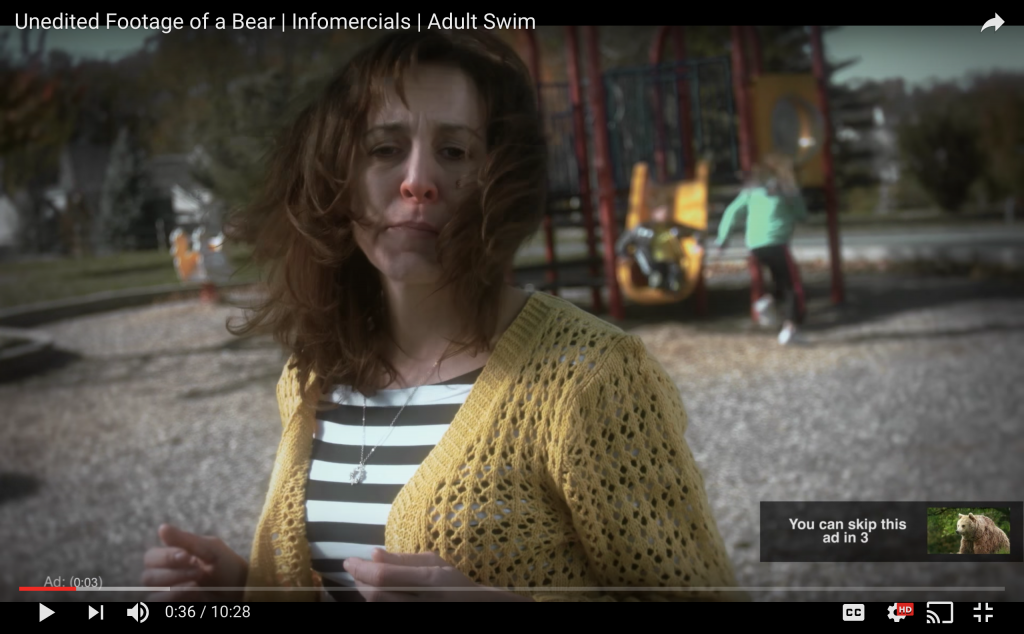
But first, the footage fades into an ad. A mom sneezes and looks miserable as her kids beg to play — she happily pops a pill and get back to her regular life!
Screenshot “Unedited Footage of a Bear” YouTube
If you let the video continue to play, the mom gets into her car, smiling widely. She is still performing for the “commercial” as a cheerful female voice lists off a barrage of side effects in rapid succession. Slowly, as the voice fades, the mom’s facial performance drops. She drives back into her “real life,” looking exhausted as she rolls through her neighborhood.
Yes, that ad and that performance was a little postmodern Russian doll! This is media embedded in media, a video that sprawls beyond the typical YouTube format, an ad and a performance of an ad embedded into a larger narrative. If the viewer clicks “Skip Ad,” it actually directs them to a fake website for the drug the fake commercial was touting, Claridryl.
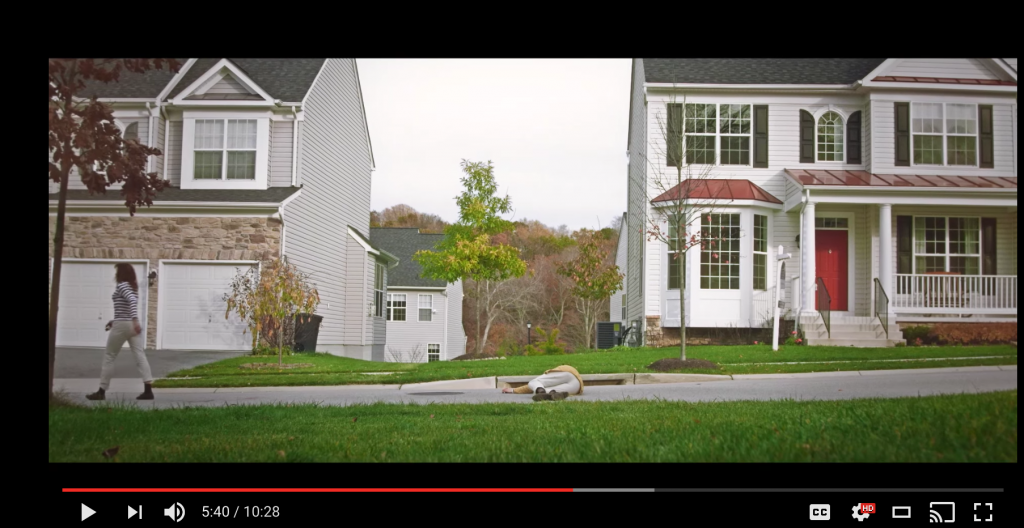
The rest of the video imagines the mental breakdown of this mom, as her Claridryl alter-ego — spun out on pharmaceuticals that triggered total darkness rather than enhanced health– hijacks her life. There is one scene where the mom is literally beaten and run over by this alter-ego, suggesting a total lapse of control.
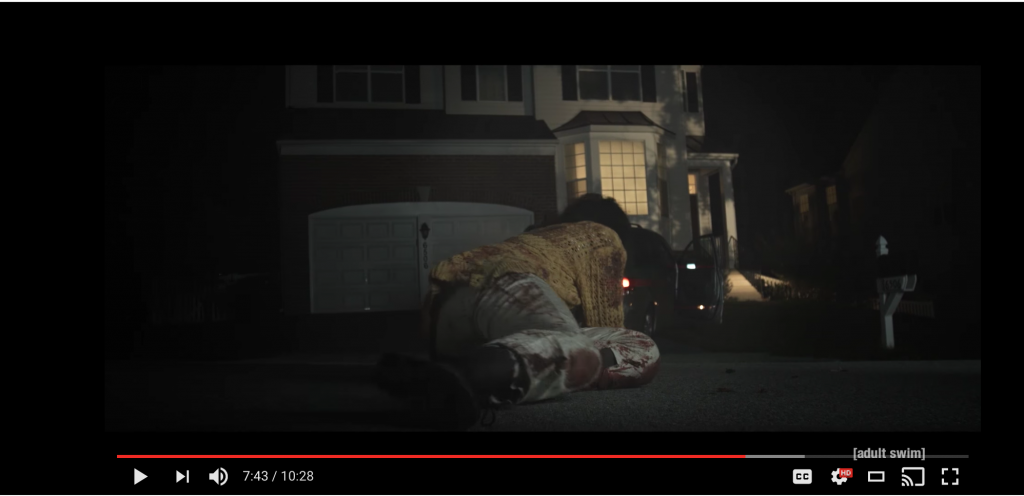
This is reminiscent of the postmodern body horror we discussed in Paul Tremblay’s A Head Full of Ghosts. The horror is located in failure of the body to adhere to societal standards, an ambiguous loss of control and the tension between mental illness and demonic possession. This all appears the case in UFOAB as the alter-ego proceeds to ransack the mom’s house and threaten her children while the mother writhes on the ground outside the house, beaten and bloodied, able to witness the destruction but not get up or control it.
Mom (right) is beaten in the street by her alter-ego (left). Screenshot.Mom does not have the power to stop the horror inside the house. She crawls on the ground outside but cannot get up. Screenshot.
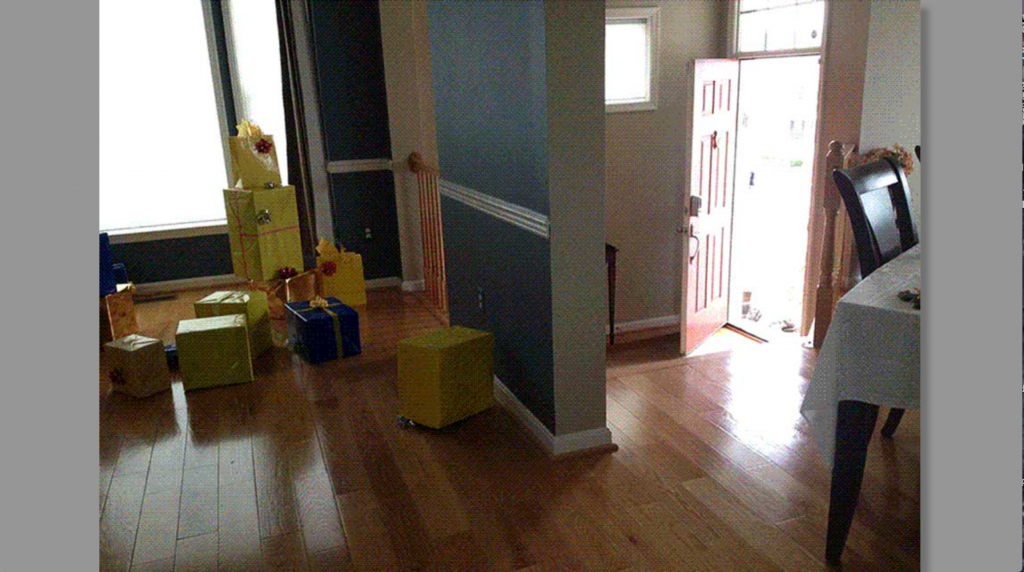
This postmodern narrative is set within an equally postmodern media format that combines nested video footage with an interactive website. As users click around on the Claridryl website, they will find surprising hidden “easter eggs.” For instance, you’ll notice a house in the background of the main banner image. If you click on the house, it draws it slowly into the foreground — and then it takes up the entire screen, but becomes an interactive, click-able image-scape. You can actually enter and explore the house as it appeared in the video in scenes where the alter-ego took over.
Entering the house from the video via the Claridryl website. Screenshot.
Linger on the main part of the website for too long, and it will slowly fade to grey…with a tiny GIF of the alter-ego perpetually running towards you.
Screenshot Claridryl website with alter-ego running figure.
Resnick achieves a totally creepy experience by layering his content and diversifying his mediums. The horror or Claridryl spans beyond the ten minute video; that horror builds and builds as you click through the nauseatingly designed website, as you find the house discover other uncanny imagery within it, as you are left with so many unanswered questions as blue and red police lights descended on the mom’s still bloodied body.
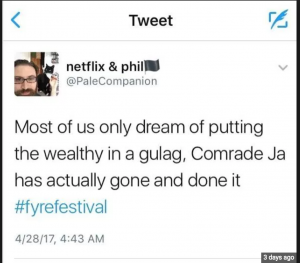
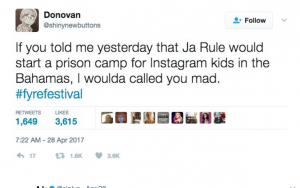
If you’ve been on the web this past week, you saw the panic of festival attendees unfold on Twitter while the rest of the web savored the moment to witness rich kids get punked by even richer kids in real time. Fyre marketed itself as a luxury get-away party, made complete by the presence of celebrities, models, and five star cuisine. Bored between musical sets? Hop on a jet ski and hunt for hidden treasure around the island — you may find cash, jewelry, or even cocaine from the eighties! (Somehow, a selling point in promotional materials was that the “private island” was “once owned by Pablo Escobar”).
Of course, the festival presented in the flashy videos and sexy social media posts was never going to be a reality. Co-founders Ja Rule and McFarland cobbled together a media Frankenstein/siren hybrid from fantasy and the transmission of digital bits. Social sirens — the models and celebrities paid to post about the event — lured the masses close enough to be entranced by the slick surfaces constructed out of other festival footage.
Video game scholar Raiford Guins detailed the lifecycle of failed 1980s Atari game E.T. The Extra Terrestrial. The game was panned by critics and returned en masse by consumers; Atari’s solution was to take all their copies of the game and unceremoniously dump them into a landfill. At this point, the game was cemented literally underground but also as a mythical representation within video game history. The physical death of the game cartridges was only the first step to immortalize the story of the game.
Just as Atari enthusiasts endeavored to uncover the game, I’m sure that Great Exuma island will begin to see its share of tourists searching for relics of dead Fyre Festival. The Festival died — in fact, it never really came alive outside of the digital promos — but the commentary and curiosity will live on. Enabled by the digital lens that shifted into hyper-focus on the event (cascades of tweets, incredulous Reddit threads, barrage of news articles), Fyre morphed from a festival into a totem where we can critically confront (and see, on uncomfortable display) celebrity obsession, conspicuous consumption, erosion of the social contract, and class consciousness among other abstract concepts. The fest may be dead, but Fyre-as-symbol lives on.
In 1982, Atari dumped what was dubbed by numerous video game critics as the “worst game ever made” into a landfill in a nondescript New Mexico town. E.T. The Extra Terrestrial sales bombed. So, it was loaded into trucks and driven off to be crushed, buried and forgotten about.
Years later, conspiracy theories, curiosity, academic research and even a Canadian entertainment company bent on uncovering Atari’s trash swirl around this dumping story.
Why? By all accounts, it was terrible game. No one seemed to enjoy playing it; consumers returned the game en masse and retailers slashed the prices, unable to sell more. It was developed in only five weeks. It lacked interesting game-play and had awful graphics. Raiford Guins wrote that the little alien looked “too haggard” for comfort. (217). It seems like most of the play experience involved falling into pits over and over again.
It again begs the question — why is there all this fanfare for such a terrible game?
Typically, Guins points out, the dumping process is not publicized or even in public view. It hurts to see the objects we imbue with so much social power — objects that become fetishistic representations of self, social relationships and all kinds of other abstract human concepts — become trash. The symbols we attached are shed and all that’s left is a physical, material shell. The magic is lost and the use value comes too sharply into focus — we have to look away.
It’s perhaps why dumping grounds can elicit anxiety, sadness, and dread. Perhaps it’s also why the US exports up to 40% of our e-waste overseas. It’s easier to bear if it’s out of sight. Trash reveals the “doleful truthfulness” of objects; we are literally driven to a state of mourning when confronted with objects severed from their fetishistic dimensions. (Guins, 227).
A landfill in Austin, TX. Landfills could almost be characterized as ‘uncanny’ spaces; they unsettle the way we interact with objects in our daily lives by instead presenting them as disposable and wholly material.
Atari’s E.T. game was trash, technically — was was crushed by bulldozers and packed beneath the ground with dirt. However, something interesting happened: it wasn’t forgotten and it hasn’t seemed to take on the “doleful” characteristic of other trash.
The process of secrecy and new-found rarity drew people’s attention and maintained interest the game. The cartridge may have lost its status as a usable game with desirable gameplay, but it gained status as a concrete emblem of video game history. It fits neatly into the myth of Atari by providing a physical representation. The game itself may be buried in the ground, but mystery, rarity, and its capacity to concretize history all prevent it from decomposing as trash. E.T. may have been dead and buried in the 1980s, but today it is still alive and well in the social mind.
The 2014 Fuel Industries excavations of the Alamogordo, NM landfill where Atari dumped. Photo taken by Chris Kohler.Fuel Industries actually unearthed Atari cartridges during their excavation! Photo by Chris Kohler.
Works Cited:
Guins, Raiford. “Landfill Legend.” Game After: A Cultural Study of Video Game Afterlife. Cambridge, MA: MIT, 2014. 207-35.
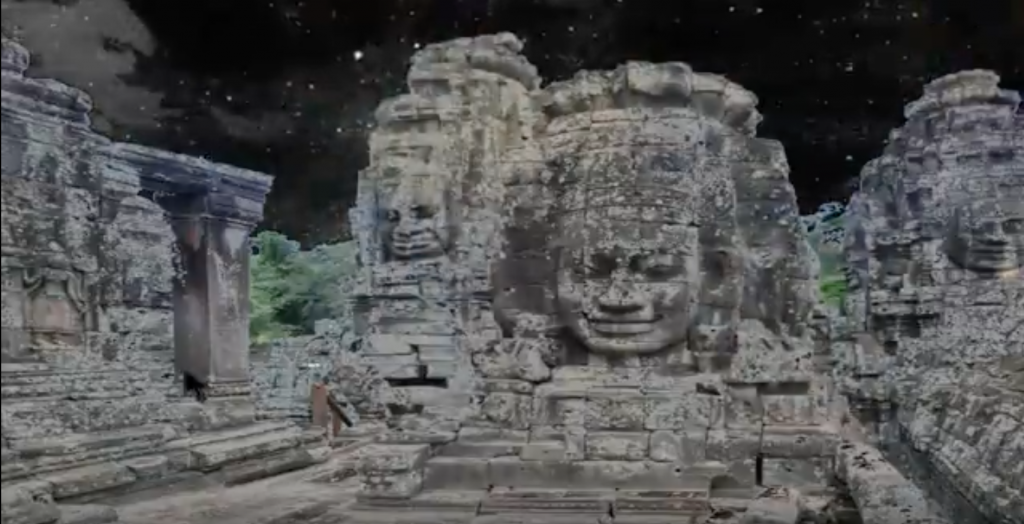
Shrine File is a corrupted collection of data that dictates passage of the self. When your physical form fails, where is the self enshrined?
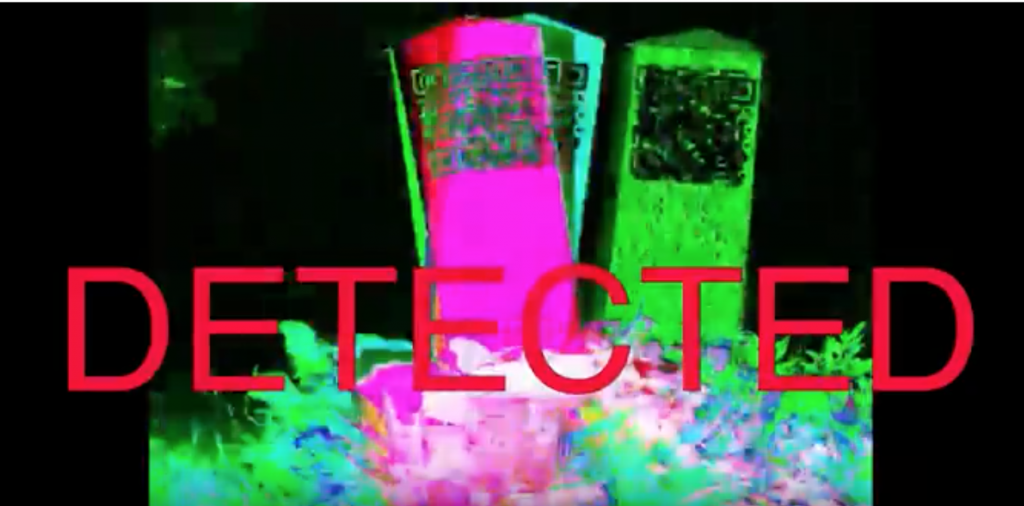
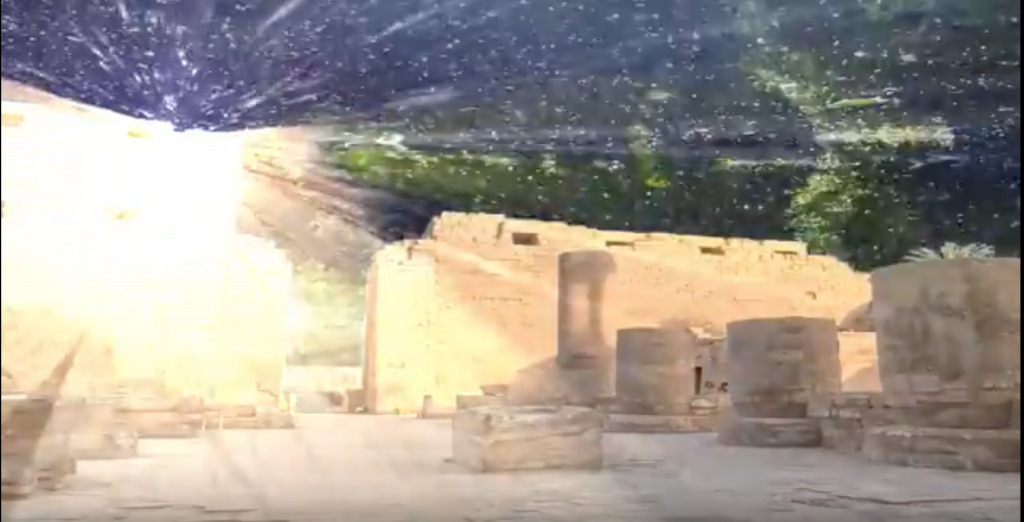
The file visually imagines the digital intersection of sacred and profane: 360 videos of ancient tombs and chapels are layered with everyday masses of human flesh alongside suggestions of an infinitely folding universe. Tombstones branded with digital codes melt into a physical human hive. The file exists between the moment of life and death. The moment the self can be digitally enshrined before dissipating. It exists between the individual self and the collective human cloud.
Emile Durkheim wrote that “religious and profane life cannot coexist in the same space…religious and profane life cannot coexist in the same time.” (The Elementary Forms of Religious Life). Man is not sacred: he creates this through ritual and belief. The ritual sets the sacred apart from everyday life. The afterlife wisps beyond our everyday grasp, but with the digital shrine we draw it closer. Our afterlife becomes a “tangible” set of digital artifacts — how do we populate them, position them, secure them, maintain them?
The digital shrine becomes the totem laden sarcophagus. We spend the lifetime preparing the Shrine File so that we can die immortal.
“A coded human existence is one without the singularity of the liberal subject. Instead of a multiplicity of singular wills or a cacophony of different spirits and personalities, subjects are transcribed into codes operating via variations of ones and zeroes.” (Anna Piepmeyer). Choose ENCODED: the file imagines such a human code. Individuality is transformed at the moment of physical death: from the gravestone emerges a collective force, a glitched soul enmasse. “We are now on the threshold of a new mutation.” (Slavoj Zizek).
Is the coded mutation/the hive/the noosphere simply a colossal collective of the everyday profane? Or does it elevate into the realm of gods? For Durkheim, sacred cannot exist unless differentiated against profane. The binary is necessary to construct separate sacredness. The glitched, grubby digital is a profane shell, unreliable and easily broken. The collective hive, jacking the code as a ground, remains sacred.
Choose TEMPLE: “Join us,” screams the chorus as they whirl through ancient sacred grounds. Can you know a sacred god or the devil through these secular, digital bits? Instead of a physical site, we embed the mementos of self here, in these holy reconstructions. Navigate your keystrokes to mourn, to memorialize, to pray.
This project arose out of the integration of digital death into everyday life. For centuries, death was aesthetically understood as a “natural part of life,” where physical grave sites “connected [living communities] with the death and [gave] a sense of unity with nature even in the face of the chaos of death.” (Graham, 38).
The “back to nature” — through land or water burial or burning — death process was ritualistically separated from the fabric of everyday life.
Spending time in online space is an everyday part of life; so can something like Facebook Memorial walls ever cultivate a sense of sacredness amongst the profane streams of daily chatter? When presented with so much content, whether kids taking selfies at a funeral or heartfelt condolences posted online, can any of it be sacred if none of it can be separated from the profane?
Brubaker, Hayes, and Dourish examined Facebook as a site for death and mourning. They note how “features like the Newsfeed often continue to inject death into otherwise typical Facebook use.” (157). Interview subjects varied between feeling like Facebook was cold and impersonal and feeling like it was a productive way to “make readers feel a little more at ease about the death.” (156).
Graham et al. addressed a digital memorialization page called HeavenAddress in their exploration of physical and digital grave sites. Unlike Facebook, HeavenAddress is specifically made for remembering the dead. But it still reeks of normative social media qualities — people can like and share the obituary pages, tap “love u/miss u/thank u” buttons, and leave digital candles and flowers. In the most contrived move, users can also vote on words to create a word cloud inspired by the deceased.
Brubaker et al. would characterize something like HeavenAddress as a feature of postmodern death: the boundary between public and private mourning is eroded, and many of the publicly expressed feelings are expressions of individualism, not collectivism. The social sharing and writing is oriented around digitally performing for the living.
Online bereavement provides immediate connection across physical boundaries and social groups, which Brubaker et al. call temporal, spatial, and social expansion. Because of this convenience of connection, death will never go offline. But how we choose to approach death online should be a matter of concern.
For Durkheim, the distinctions a society chooses to make between sacred and profane is the basis for truth and collective memory of the society. Sacred rituals produce “continuity over generations,” and in this way, “societies become conscious of themselves and their history.” (Coleman, 67).
If digital forms of death content are to provide a sacred space and collective memory, then they must become ritualized and separate from typical forms of online content. Already, online users can access 360 view videos of temples, chapels, and ancient religious ruins; I can imagine a world where accessing simulations of sacred sites become part of the digital death ritual.
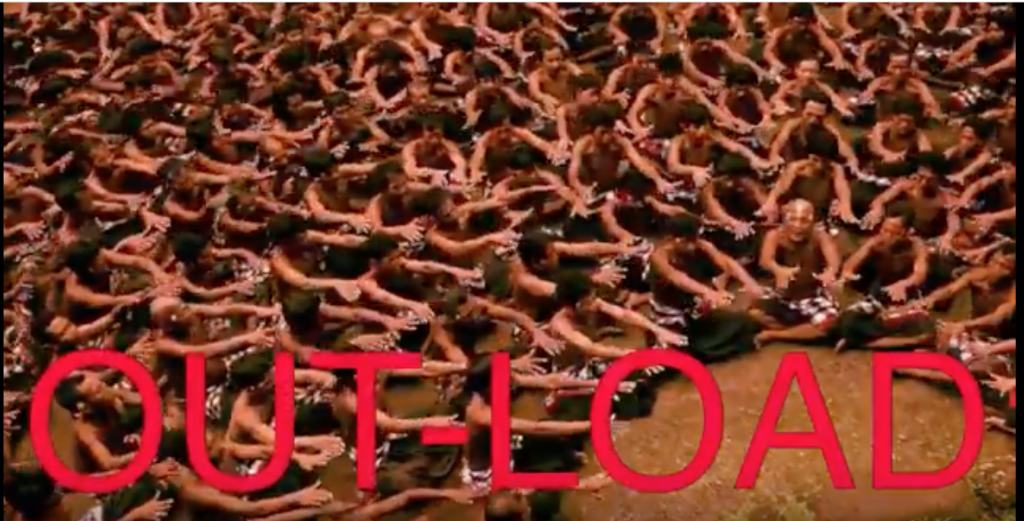
On the flip side of imagining this sort of ritualized online visit to the TEMPLE is the process of being ENCODED; to ritualistically shed the cult of individuality and tap into the collective. Perhaps this is the point where instead of using the remnants of a digital self to remember and memorialize an individual (and to leverage mourning as a way to express the individual self), the content is passed into the collective memory. “Detected/in-loading/load” text on the ENCODED video generally suggests a sort of information gathering, akin to Facebook, but the uploading process is without individual imagery.
The two videos are halves of an imaginary file, corrupted by age and outdated technology. It is a capsule of futuristic digital death rituals discovered even further in the future. The audio tracks are suggestive of myth, mystery, and secrecy — one, a rock song that when played backwards allegedly contains Satantic messages (this, out of 80/90ies heydey of deliberate backmasking that became so dramatic that California passed a bill banning backmasking that “can manipulate our behavior without our knowledge or consent and turn us into disciples of the Antichrist”). The second is a non-verbal synthed chant layered and repeated to provoke a feeling of otherworldly, unbounded encounters.
For the digital world to become a more significant meaning container for death, we have to be deliberate about separating our death rituals from the everyday flow. Postmodernism dictates that these boundaries between sacred and profane will erode and collapse; but when that happens, our collective consciousness becomes flimsy and our collective memory myopic. Ritualizing death as sacred, even in online space, reminds us of our mortality while simultaneously creating a collective consciousness that transcends the individual.
Works Cited:
Brubaker, Jed R., Gillian R. Hayes, and Paul Dourish. “Beyond the Grave: Facebook as a Site for the Expansion of Death and Mourning.” The Information Society 29.3 (2013): 152-63. Web.
Coleman, Elizabeth Burns, and Kevin White. “Stretching the Sacred.” Negotiating the Sacred: Blasphemy and Sacrilege in a Multicultural Society. Canberra, A.C.T.: ANU E, 2006. 65-78. Print.
Graham, Connor, Michael Arnold, Tamara Kohn, and Martin Gibbs. “Gravesites and Websites: A Comparison of Memorialisation.” Visual Studies 30.1 (2015): 37-53. Taylor and Francis Online. Visual Studies. Web.
The screen flickers between close-up images of graphite stained fingernails, bands of light oscillating over windows that snap open and shut, and eerie Martian landscapes. All are punctuated by the peculiar audio drones and pitches, an avant-garde soundtrack composed by Karlheinz Stockhausen. So constructs the twenty minute psycho-drama directed by the Quay Brothers in the year 2000, In Absentia.
The Quay Brothers in 2001 for OffScreen
The short film follows the story of a woman, albeit lacking specific details. She is shuttered up in an institutional-looking manor. She obsessively sharpens pencils and writes letters, filling the pages with sentences laid atop sentences so that the meaning is indiscernible. She ritualistically places broken pencil tips outside her window. She drops the letters down a grandfather clock, whose base is visually filled with similar letters. Because she chooses not to postmark them? Because she is not allowed to? Because she is imprisoned? Because the letter recipient is dead?
Excerpt from film
These gaps in detail are left to simmer. Instead, the Quay Brother present a demonic animation roaming a hallway. They sometimes switches to a barren, wind-swept landscape dotted with indiscernible, hulking technology that suggests space travel.
They layer multiple horror tropes into this quiet, uneventful, but definitely nightmarish world. The manor is a haunted house — or perhaps even more specifically, a haunted asylum. The woman walks that thin line between mentally ill and demonically terrifying — viewers are conflicted about whether to pity or fear her. The entire set is haunted by bands of light that only temporarily illuminate the viewer’s frame.
The Brothers give us plenty of room to wallow in the uncertainty of this postmodern piece. Demon or human, alien or human, phantom or human, sane or insane…the viewer is left without concrete answers. In 2000, people had yet to experience social media or the ability to watch YouTube on a touchscreen phone. But the Brothers still incorporated some of the core anxieties about technological communication — how do we communicate? Do the tools we use to communicate connect us or isolate us?
The audio is peppered with the sound of the woman laughing. Quickly, that laughter is distorted and begins to sound like chimpanzee screeching, then all together alien. She traces words so carefully with her pencil on paper, following each stroke of the pencil with her finger, but when the viewer witnesses a shot of the page the letters are completely muddled. In both speaking and writing, her message is corrupted — the mediums, these human technologies meant to enable communication, betray her. She is trying to communicate and she fails.
The alien/demonic presence can be tied to the technological obsessions of the time. Starting in 1998, NASA’s New Millennium Program was launching probes to Mars and satellites into Earth’s orbit. Our reality was expanding with new, imagined worlds outside of Earth. The barren Martian landscapes of In Absentia point to the obsession with the mysteries of space. There seems to be a desire to explore this final frontier and make meaning out of what we can’t understand.
The haunted manor where the woman writes letters.
The woman in her room, ritualistically sharpening pencils.
One of the Martian-esque landscapes.
The clay demon.
While the woman is seated at her chair, there are moments when a third hand slides up her back or across her shoulder. She is shown several times swatting and gripping at her neck, as if she continues to feel a ghostly touch in the otherwise empty room. Her internal world is haunted (suggesting the ambiguity of her sanity) while her external world is also haunted by those space age mystery landscapes. It is a hybrid haunting which expresses itself in various canonical forms: ominous alien light flickering over mysterious landscapes, a literal clay demon roaming the hallways, and the horror of possessed insanity.
Ultimately, the film dedicates itself to a real woman: “E.H., who lived and wrote to her husband from an asylum.” The Brothers said in an interview that they only later learned that audio creator Stockhausen’s “mother was imprisoned by the Nazi’s in an asylum, where she later died.” This directly connects the film to an important core piece of postmodern horror: body horror. The physical body become the irrational site of insanity, possession, evil — all societal fears channeled into an unsocialized body.
The Quay Brothers made their film eerie and horrific with gothic lighting, uncanny close ups, minimalism, and the vague suggestion of insanity, imprisonment, demons, aliens — the ambiguity is quiet and assured. Emerging in the the video art scene more than ten years later, Ryan Trecartin’s work is distinctly a product of current culture. Both artists embroil the viewer amidst many of the same themes despite dramatic stylistic differences. Trecartin’s shots are shaky and often hand held, shedding any professional aires, while the Quay Brothers so obviously labored to get big, serious shots. Trecartin immediately makes use of in media res — dumping the viewer into the middle of action, no explanation. In Center Jenny, the initial shot is explosive: a car is being destroyed by people wearing green screen outfits, chattering manically in a green lined room. Girls with heavy handed make up screech and chatter, their voices synthed up and pitched to other-worldly as they roam a decrepit warehouse.
Ryan Trecartin performing in “Any Ever.” Still from YouTube.
Center Jenny follows several groups of girls who are all named “Jenny.” Each group is a reality television type archetype taken to the extreme — the Taylor Swift good girl, the Bad Girls Club drama queen, the boy-obsessed pretty girl, the Queen Bee, the girls who basically just background fodder hoping to get a personality assigned to them. They exist on various levels and are trying to level up to become a more potent “Jenny.” Everyone wants to become closer to the “The Source” — the Center Jenny, the ultimate, perfected Jenny.
The film uses extremes and maximalism to strip down the process of social norming, social cohesion, groupthink, and the way we construct identities. There’s a long process in which one “left of center” Jenny (meaning, non-conforming) is hazed by higher level Jenny’s and eventually re-inducted into the higher level group once she is rendered docile. Her eyes glaze over completely white and she gapes at the screen as if lobotomized. Obviously, she gets a cute makeover, too.
Another girl, with dramatic purple contouring, straight black hair and 90s Vans lounges on what looks like a makeshift MTV music video set: lawn furniture under multi-color lights in a warehouse. She leans back on a hammock as the lights flicker and her friend undulates to uncanny music — it looks as if aliens had found a time capsule from the coolest teenager in the early 2000s and tried to reconstruct the aesthetic. And that wouldn’t be off base for Trecartin; at one point, the girl looks up into the camera and drones, “The only thing I’ll ever study is Human Era Hazing and how awesome it is.”
There are several points in the film when the Jenny’s refer to the “human era” and the “Earth version” of various things, suggesting the MTV teenage cool girl and the gaggles of Jenny’s aren’t just extreme versions of culture today. The Jenny’s are futuristic, their uncanniness — the way the viewer can recognize social norms and identity archetypes but still feel so overwhelmed by the unfamiliar vehicle — stems from their literal alienness. They are not human; they are something else, approximating all human culture through the lens of our most popular media.
This crystallizes towards the end of the film when a group of Jenny’s, waiting to level up or to be assigned a personality, meet a character who describes how they evolved from “animations,” which evolved from humans. This suggests that the Jenny’s are constructed from human archetypes and media, explaining why each Jenny acts like she’s in a reality TV fever dream while also being obviously aware that she is performing. The Jenny’s operate more as a collective hive than as individual, heterogenous humans — another indication of their archetypical identity. At one point, the MTV cool girl even screams at her friend — “Bitch, you’re not real! You’re just in my system!” Her friend fires back, “I am you, get out.”
MTV alien Jenny
Level 1 Jenny
A higher level Jenny hazing a low level Jenny.
Left of Center Jennys
Jenny’s waiting to be assigned personalities.
Trecartin doesn’t use any traditional horror motifs — no gore, no jump scares, no supernatural activity. The the warehouse functions somewhat like a haunted house, with its sprawling, mysterious, inaccessible nature. The girls are alien animations, and the audio would surely meet Stockhausen’s standards for being avant-garde and creepy. But Trecarin’s real horror takes the form of a cultural mirror; the Jenny’s are the most derivative parts of our culture, norms, and socialization reflected back to us.
According to Jeffrey Cohen’s monster theory, horror villains represent the cultural anxieties of the particular era; the monster shows us how “our cultural assumptions about race, gender, sexuality” created it, and also demand to know why we “have created them” in the first place. (20).
In Absentia presents isolation, insanity, and being subject to an outside influence you can’t control — whether demons or alien — as being horrific. Center Jenny is the product when the landscape of In Absentia ferments for thirteen years. The world is controlled by non-human aliens, the Jenny’s are mentally unhinged by human standards, and rather than living in isolated, lonely existence, socialization is totally oversaturated.
Patrick Langley wrote that Trecartin “enacts a literal illustration of the electric mania of modern life.” But since we rarely perceive it to be as wild and desecrating as it actually is, when presented with an extreme portrait we are shocked and horrified. We are confronted by the biggest postmodern boogeyman: that we are not special, unique, sacred, or different. Langley goes on to describe “the instability of Trecartin’s vision of human identity” expressed in his films:
“Our engagement with culture is rendered as a form of enmeshing or interbreeding. Empathy is metamorphosis: when a character identifies with an idea or person, they adopt their vocabulary or physical characteristics. Trecartin’s films reject the binarism of real and virtual, male and female, self and other, gay or straight, rationality and madness, surface and subtext, style and content, time and space.”
Trecartin imagines and renders an extreme postmodern society. Identity is boundless, completely fluid and up for grabs. Whether through extreme isolation or extreme socialization, the Quay Brothers and Trecartin end up at the same point. They warn us about total loss of self, knowledge, and reality — we are swept away by alien possession or merged into a manic hive mind. In either case, both artists seem to suggest we are loosing something human. Confronted by the postmodern void, do we become isolated shells or oversaturated replicas?
Works Cited
Aita, Roberto. “Brothers Quay: In Absentia.” Offscreen. N.p., Sept. 2001.
In “Digital Resurrection,” Alexandra Sherlock brings up a paradox first written about by Roland Barthes. A photograph is a paradox between life and death: “the moment is dead but the photograph is alive and present.” (170).
An embodied death can be overturned in our minds by the presences of images and media of that person. The absence of an animated body no longer means that person is out of reach. Indeed, we need only to turn to celebrity deaths — where estates and listening companies make millions — to see the self enduring past the physical body.
Does this change our understanding of finality? Death as an inevitable, totalizing concept is softened when we can stream living videos, images, and audio of the deceased. “It is a living image of the dead thing,” Barthes wrote: “the photograph surreptitiously induces belief that it is alive.” (Sherlock, 170).
Sherlock also addressed death as disruption. The dead body “reminds us of our own fate, resulting in the disruption of identity, system.” (169). A celebrity death is a highly publicized sort of disruption — if even this beautiful, wealthy, famous person can die, it shatters the illusion of escaping our own fate.
Describing his stance on preserving the cyberspace self — constructed of by the mass of tweets and blog posts and Facebook statuses we accumulate over a lifetime — Paul Kimball brings immortality into the fold. “We’re entering a world where we can all leave as much of a legacy as George Bush or Bill Clinton. Maybe that’s the ultimate democratization,” he told NYTimes author Rob Walker. “It gives all of us a chance at immortality.”
Walker traces the story of Mac Tonnies, a pretty regular guy who happened to update his blog nearly everyday and interact with online friends. Tonnies died unexpectedly. His blog become a shrine, a memorial, a viewing port into who Tonnies was as a person when he was living. Some of his digital friends reported seeking solace in his Twitter feed many months after he passed.
Even his parents, previously pretty unfamiliar with Tonnies blog (beyond what he chose to directly show them), told Walker that the personality crafted from these digital blocks were him. ““I can hear him when I read it,” his mother said.
Contrast this with Leslie Harpold, another person who spent time cultivating her online presence. With her unexpected death, her digital friends implored her family to keep her websites and social accounts alive. The family refused, believing that Harpold’s legacy doesn’t exist online. Instead, it “is with every person who knew her and loved her…People need to appreciate that she was a real person…[and] remember her as she was.” As she was, from this perspective, is situated in her physical interpersonal relationships and physical life rather than her online life.
This tension of where the self resides is nothing new. In the digital era, it becomes more and more clear that our self doesn’t reside squarely in one place or the other — completely online or completely embodied. Rather, we are hybrid cybernetic organisms negotiating the performance of self on multiple stages — online, offline, public, private….the complexities of stage and performance go on.
The issue with how to treat our digital remains after physical death is just another nuanced stage. How do prepare our performances of self even after we die? Many of the people Walker interview placed importance on documenting themselves, “creating a master repository of me” containing all their digital content, and achieving immortality. One software developer even proposed that institutions like governments or universities take over the preservation of individual’s digital content post-mortem.
I think this is a flimsy fantasy and indicates inflated egos and resistance of the inevitable. You are not special and you will not be remembered for hundreds of years. The “legacy” Paul Kimball is hoping for will be out of reach as soon your storage methods become as obsolete as floppy disks — which will happen fast. Your content is not you, it is only a portion of your overall performative self across those many stages. A life is not solely a collection of content. To act as if it’s cheapens human life. Beyond two generations, the likelihood is that your digital content becomes completely irrelevant. To act as if it won’t is narcissistic.
To then suggest that societal institutions are responsible for preserving highly individual expressions seems extreme. Social institutions are meant to preserve history and knowledge, making these repositories accessible for current and future generations — a place to reliably access our collective knowledge. Hyper specific details of each and every life — mainly consisting of the mundane, individual life — does not seem to fall under this purview. For all of human history, the far majority have died quietly and anonymously outside immediate social bonds. The few historical figures that do stand out often function as symbolic containers — rather than as individuals — for the values and practices of that particular society; the collective is imprinted upon them, and they become an avatar for understanding the rest of that society.
But we can’t all be the avatar. That avalanche of information is too much to process. What makes human unique is our capacity for symbolic thinking — we don’t process heaps of raw data like computers do, we instead engage with a semiological process that results in symbols — encoded as things like public figures, material objects, language — becoming containers for our most abstract human concepts. We rely on this collective symbolic framework to understand the world. Spending time fastidiously preserving all tweets or all Facebook statuses seems inconsequential given that the tides of time and human memory will do their work on even the most carefully preserved content — eventually, inevitability, the majority of it slips out of living reach.
An infographic about living and dead people throughout history from LiveScience.
The zombie narrative is about reveling in the destruction of all our institutions. Society collapses and what little life is left turns into raw survival. The military, law and order, or the police can’t save us; the government is in ruins; everyone you know and love is dead. You’re on your own.
In this way, zombies actually fit neatly into Susan Sontag’s critique of 1950s and 60s science fiction films. Within the “aesthetic enjoyment of suffering and disaster,” she argues, one can see “…the hunger for a ‘good war,’ which poses no moral problems, admits of no moral qualifications…” (The Imagination of Disaster, 215 & 219).
Zombie Kelly stares into a camera within the Big Brother house and is broadcast across television screens in Dead Set, directed by Charlie Brooker.
While the scenarios zombies force living characters to confront may seem tinged with moralistic shadows, it does not actually seem ambiguous or complex to me. Sure, characters may wring their hands over whether to put a bullet in a friend who has just been bitten — but when it really comes down to it, if survival is the name of the game, there is only one choice.
The zombies are stripped completely of their humanity, rendered into feral inhuman beasts. So, again, when a character wrings their hands over whether there’s “any trace of them left in there” — we already know the answer and the outcome. There’s not any trace. They’re already gone, and either you will kill them or they will kill you. It’s an easy bullet to fire despite initial shock and reluctance. Moralistic deliberating is shelved in the interest of survival.
For a genre that seems at first to be soaked in the postmodern, I’m surprised that zombies actually seem utterly black and white. We want ultimate bad, we want easy answers but tough, gory, wartime-esque survival story along the way. We want to be able to see mass destruction and zombies getting blown up without that tinge of moralistic guilt — finally, an enemy who really deserves it no matter what. It doesn’t matter if Jane was a sweet lady when she was alive. She’s a zombie now and it doesn’t matter. One man for himself. Screw the system.
In American Zombie Gothic, Kyle Bishop presents zombies as “valuable cultural indictors” that “cathartically, yet perhaps more destructively,” re-create modern social anxieties on the screen. (26).
Watching the system and the public be torn to shreds is thrilling and satisfying and yes, many times cathartic. The zombie as monster does take on metaphors for our postmodern anxieties; they objectify our anxieties about mass infection, terrorist infiltration, the total destabilization of society — but it doesn’t offer any way to then channel those anxieties into something else. How does our consumption of zombies as monster change the way we interact with the everyday, real monsters (institutionalized marginalization, Muslin bans, internment camps, the terrifying triumphs of neoliberalism, etc etc etc etc etc)?
If anything, zombie narratives render me even more hopeless to combat these corrupted systems. Zombies, as Kyle Bishop points out, remind us of our proximity to inevitable death. (American Zombie Gothic, 21). So what’s the point of trying to change anything? Time to either become a brainless zombie or a gun wielding survivalist. It boils down to a morbid, delightfully easy choice — A or B — which is perhaps what we crave most growing up in a postmodern landscape with a multiplicity of choices.
In this way, I think zombies could actually be damaging to how we understand our individual influence in society and our perception of “the public.” The key to resistance and enacting social, institutional, and societal change don’t arise out of the landscapes destruction porn presents: the masturbatory media equivalent of watered down anarchism (with all the flash but none of the well articulated socio-political theory).
So consuming zombies is really about consuming the easy way out of the system. It strains our social contracts to their breaking points. When those amorphous, tenuous contracts finally break — a sigh of relief! — release from the postmodern soup. The life then actually becomes very uncomplicated: survival. That’s it.
I understand how and why the zombie has become a powerful symbol. However, I’m unimpressed by the quality of popular zombie works: it is destruction porn with vague societal commentary that barely rises above the horror visuals. The zombie medium has the potential to, as Jeffrey Cohen wrote in Monster Culture (Seven Theses), prompt us to reflect on how we interpret the world and “re-evaluate our cultural assumptions.” (20).
But the zombie only makes it half-way around to showing us the nature of our own society and what it could be instead; it get stuck in the reveling of destruction and the same old science fiction/horror tropes Sontag critiqued. It’s a fantastical catharsis but doesn’t push us further. Show me more zombie content that goes beyond the cheap, easy shot of critiquing the “public” or “consumerism.”
The zombie needs to show us more meaningful messaging to be a truly powerful societal mirror and crucible of change. We already know we’re suffering, exploited by neoliberalism and overwhelmed by the postmodern condition — now what do we do aboutit?
Zombies at the mall in 2004 film Dawn of the Dead, directed by Zach Snyder.