Death Post Digital Age?

Although we have talked about death in this digital age we are in now all semester, it is interesting to now think about post-digital age death. While it might not be a true visualization of future generations and how their deaths are remembered, it is interesting to see how death is portrayed and people’s lives are remembered (or not) in Station Eleven.

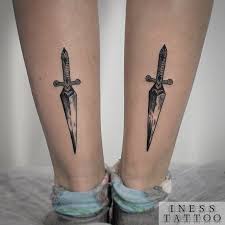
In flashbacks to when Kirsten is 15 and in her first year with the Symphony, we see a man that comes on too strong and is implied to have a want to assault her when she kills him. Two years later, Kirsten and the sixth guitar each kill a gunman in order to survive. For both lives she takes, Kirsten gets a little knife tattoo to remember them by.

Dagger Tattoos found here

On page 296, Kirsten takes a third life, the life of an archer, while August takes his first life ever. The advice we read going through Kirsten’s head after seems to be pretty telling of how killing and death is seen in this post apocalyptic world: it alters you but you will survive.

Survival is a main theme in the face of death in this post- digital age in Station Eleven. Are tattoos and altered lives of the surviving the only remembrance a life receives or can potentially receive in that type of age?   In the prophets old town there were the graves and all of those markers but s that truly remembering those who died if no one who stumbles upon those markers in the future knows who they were?

We may say that there is so much oversharing and lives are wasted on the internet nowadays, but at least there is something to go back and see parts of their lives if someone dies in the digital age, unlike with Kirsten and her friends who merely have the tattoos and the memories of those who have died. Who’s version of death is better? I like to think the digital age gives us access to people’s lives and lets them leave a legacy and a digital fingerprint in a world where they otherwise wold be a forgotten grave marker on the outskirts of town.

Death *of* the Digital Age

The first 12 chapters of Station Eleven left me thinking quite hard about what I would miss most about the Digital Age we are in now. I know that as a child who grew up surrounded with technology and easy access to the internet, I would have an immediate gut reaction of saying my phone or wifi or something to that effect. After this original reaction though, Station Eleven brought up all of the things that are 100 times more important than just one silly phone in the event of a catastrophe. Things like our cell phones are just a part of a past that is now contained in the wasteland of what I imagine to be city-wide landfills. I think things like not having access to medicine or having a permanent home might take the place of the most missed things of the pre-apocalyptic digital era in this book if I were to have lived in this type of scene with Kristen.

What really is intriguing in the chapters of 20 years post fall, is that there are so many still alive that don’t remember all this digital era nonsense. What would it be like to have almost no recollection of it and not be dependent on it like our society is today? If we aren’t dependent on technology and have somehow managed to figure out how to live without medics and pharmaceuticals, then I believe that things like food, safety, and water would be at the top of everyone’s priority list. However, Kristen and so many others don’t even live in houses! I understand the traveling theater and then giving life and beauty and joy to a landscape devoid of any type of happiness or other more digital type of entertainment, but what happened to all the houses? America is filled with suburbs and I don’t think those would’ve disappeared in this world, yet people are living in abandoned gas stations and Wendy’s and such. Why??? I want to know what happened to all the homes and houses!

Abandoned Wendy’s found here

Reconnected or Reborn?

*In my project, Reconnect, there includes a website (listed below), a complete text message thread (attached), and pictures of “the little black book” of information on victims and clients. Links are all listed below*

Reconnect site

Text Convo

Exploited Information

Client Log

Artist’s Statement

Reconnect

Annabelle and Abigail Morgan were identical twins born on September 3rd, 2000. They lived with their parents in Denton, Texas. To each other, they were Annie-bee and Abbie-bug; nicknames that had stuck from when they were little girls. Both girls were avid social media posters and texted each other non-stop, they were the other’s best friend. When they turned 13, Abbie started to feel slightly off but wasn’t really sure what was wrong. It took her sister finally dragging her in front of their parents almost a month later for Abbie to realize how sick she was actually feeling. At the doctor the next morning, their pediatrician couldn’t figure out what was wrong and sent her on to a specialist to get blood work done. He figured that since she was showing symptoms like fatigue, easy bruising, and shortness of breath, she could possibly have low iron levels. The results of that test were devastating. The doctors sat Abigail and her parents down and explained to them about how in healthy 13 year olds, white blood cell counts should be somewhere between 5,000 to 10,000. Abbie’s white blood cell count was off the chart high. The doctors told her anemic symptoms were what caused her to feel faint and show symptoms of anemia, but the main problem lay in her inability to fight off infections because of the rapid overproduction of her white blood cells. Abbie had acute leukemia.

Annie was next to Abbie’s side for the next three years monitoring blood cell counts, trying to ward off infections, and keeping her spirits high in the tough moments. Abbie started with a few rounds of chemotherapy, but at 15, her leukemia took a turn for the worse and she began radiation therapy and was even put on a stem-cell transplant list. On November 12th, 2016, Abigail lost her fight against leukemia.

Annie was devastated, she had lost her sister and best friend and didn’t know how she’d be able to go through a day, a week, let alone a year without speaking to Abbie at least one more time. Annie was constantly on her phone looking at old pictures and scrolling through their old text conversations. Although they knew her sister was sick and getting worse, accepting that she was gone now was hard for Annie. Her parents’ full attention was now on Annie 100% and she found it suffocating to try and heal while under such scrutiny. Her escape was online. While surfing on the internet day, another user in a random online forum about grief sent her a link to a very interesting site called Reconnect. It prompted her to enter her full name, cell phone number, and email, along with the person she was grieving’s full name and death day. Annie was hesitant about it but the site promised she would be able to text her lost loved one again and reconnect. When she went through with it, she shakily texted the number that the site emailed her, hoping beyond hope that her beloved sister would indeed be the spirit behind the texts.

For the next two weeks, Annie was slowly more and more convinced that Abbie was the one she was texting. As the site said it would, those texts did indeed help Annie come to terms with her sister’s death, but it also disguised a terrible scheme of identity theft. Unbeknownst to Annie, the “Abbie” she was texting a culmination of a bot that had taken all of her online social media activity and turned it into a book of information, including phrases she was prone to say and pictures, and a real human on the other end of the line that was slowly gathering the childhood best friend names, first pet names, and other such security type questions. The Reconnect site was a rouse to get grieving people that were desperate enough to believe they were talking to their loved ones again and manipulate them into handing over countless sensitive facts about themselves and their loved one, allowing the makers of the site to steal the identity of the passed loved one. The turnaround was amazing on how fast there was always a buyer on the dark web ready and in need of a legit ID that could be used for social security number purposes, voter ID purposes, and a number of other things that The Makers didn’t really care to concern themselves with as long as the money was wired to them. In the end, this reconnection of a lost sister turned into her rebirth as a new identity.

Behind the Piece

The idea behind this Haunted Media project is a combination of four themes presented in Cohen’s Monster Thesis, Zarelli’s Dial-a-Ghost, Walker’s Cyberspace When You’re Dead, and Bonazzo’s Do You Need to Control Your Online Identity After Your Death. Everyone grieves in different ways, however it is more and more common in this digital age for grief to be shared online. Since telephones were invented, this idea that technology could reach beyond that of our physical realm, has been present. In October 1933, the first such idea was born that the human personality doesn’t totally die and that there are small pieces living around, just waiting to be found and spoken to (Zarelli). While this might have been an idea for the telephone in the early days of technological advances, in our day and age we are so much further advanced that it is not a stretch to think that we may now have found a way to bride that link between the living and dead through technology. According to Statista, 98% of millennials own a cell phone, 96% text, and 93% use social networking and the internet in 2014. Taking this information, it is obvious that two young millennials such as Annie and Abbie are deeply entrenched in this age where technology is a main aspect of their lives and time. It’s not too far-fetched to believe that in her young grief, Annie fell for a rouse to reconnect with her sister one last time through the use of something as normal as her cell phone.

In Bonazzo’s piece about your online identity, he outlines how an online account is a digital asset in terms of information that can be stored from your usage of that account. In most states it is illegal to access someone else’s personal accounts, but what about those who do not care about it being legal? Differing accounts have ways of knowing when a loved one as passed on, such as Facebook moving the page to an inactive account and gives your ‘legacy’ managing duties of your page. This doesn’t delete any content online, merely holds captive for anyone to find. This got me thinking how this information could be used maliciously in Reconnect.

According to Cohen, a monster in the horror genre encapsulates seven basic thesis. Of these seven, about five are used to outline the ideals behind my ‘monster’ in the piece Reconnect. (To be clear, the monster is the person on the other end of the text conversation and the one selling the dead identities to buyers on the dark net). The five that are used to form this monster from Cohen’s monster theory are: The Monster’s Body is a Cultural Body, The Monster Always Escapes, The Monster Dwells at the Gates of Difference, The Monster Polices the Borders of the Possible, and Fear of the Monster is really a Kind of Desire. Reconnect’s monster form is one of an online participant in chat rooms and a speaker for the dead using their social media history. By using such a culturally relevant method of communicating is the first step to the digital age’s monster. Having an online platform as the means to communicate in the first place means that the monster can leave no trace if their technology usage is savvy enough and con therefore get away with no trace. Next, our online monster persona allows the victim to believe there is a connection to the outside world, seeing the monster as an Other being. This encapsulates the last three thesis in that our monster is a sign of the impossible happening (a loved one speaking from the dead), but yet it is just probable enough to warrant longing and desire for the phenomena to be real. Thus, the Reconnect monster was born to lure unsuspecting grieving family members or friends to talk to him in order to remake the dead person’s identity. In essence, this reconnection of loved ones leads to the rebirth of an identity for numerous purposes such as identity theft, illegal immigration, voting fraud, or organized crime.

This monster is only even possible because of what Abbie left behind; her sister and her online profile. Rob Walker cites your online profile and what you post as reflections of who you are and who you wish to be. This idea led to Reconnect’s monster to have its own bot that boiled down Abbie’s (and other previous victim’s) online profile into enough phrases and nicknames and such that the grieving victim was tricked into thinking there was still a bit of their passed loved one’s personality still texting them.

Ultimately, this haunted media project runs full circle when a death in real life can be remade through the internet and texting, enough so that a newly formed identity using Abigail Morgan and other passed names are still floating around and being used after her death. This use is a form of haunting in the digital age.


Word Count: 1595

References

Bonazzo, John. “Do You Need to Control Your Online Identity After Your Death?” Observer. N.p., 23 Feb. 2016. Web.

Cohen, Jeffrey Jerome. “Monster Culture (Seven Thesis).” page. Web. Found at: courses.digitaldavidson.net/dig215/documents/monster-theory-seven-theses.pdf

“Dial-a-Ghost on Thomas Edison’s Least Successful Invention: the Spirit Phone.” Atlas Obscura. N.p., 20 Oct. 2016. Web.

“Media use among Millennials 2014 | Statistic.” Statista. N.p., n.d. Web.

Transgressing the Boundaries for Horror?

Here is the LINK I was finally able to figure out! (The add media link wasn’t working for this audio file, it kept calling the file invalid and unable to upload, so this was my loophole around that invalid message!)

Sources:

Colva. “Postmodern Horror.” Web log post. Amused. WordPress, 30 Mar. 2010. Web. <colva.wordpress.com/2010/03/30/postmodern-horror/>.

“Criminal Minds: Internal Affairs.” Season Eleven. Netflix. N.d. Web. <www.netflix.com/watch/80076720?trackId=200257859>.

Cutts, David, Bert Dodson, and Edgar Allan Poe. Edgar Allan Poe’s The fall of the House of Usher. Mahwah, NJ: Troll Associates, 1982. Print.

“Dexter Season One.” Dexter. Netflix. N.d. Web. <www.netflix.com/watch/70085721?trackId=14170286&tctx=1%2C2%2Ced230b65-228d-45d8-ac7c-35ffae2f9605-254494021>.

Pinedo, Isabel Cristina. “Postmodern Elements of the Contemporary Horror Film.” The Horror Film. N.p.: Rutgers U Press, 2004. N. pag. Web. <books.google.com/books?hl=en&lr=&id=S6jKVfuQG3wC&oi=fnd&pg=PA85&dq=postmodern horror&ots=rKqzTqd3xy&sig=fOXUvaM1zPTefyhsigJMmnj1dD4#v=onepage&q=postmodern%20horror&f=false>.


Humans vs. Monsters: Who decides who dies?

The article by Kocurek brought up a very interesting argument that I could argue two different ways. On the one hand, to say that a specific group in a game is lesser than and equate them to monsters is a very dehumanizing and God-like way of choosing who gets to die. Kurocek hits the nail on the head when she closes her argument with this quote:

“History has provided enough examples of the efficacy of propaganda in legitimising the abuse and marginalisation of various groups of people that we should be wary in endorsing practices that bear the markers of propaganda”

By giving the game player the ability to kill off only the “wrong” type of human like or other characters in a game, it gives them the God-like type of power I mentioned earlier. No one should have that much power as to decide and kill an entire race of marginalized people, even if it is a just video game.

Now, the other side of this argument is also very compelling to me. To play devils advocate against Kurocek, videos games have been studied to an unfathomable extent. From this article published in 2015, the authors looked at the links between violent video games and risk factors on social behaviors (including violence. Ultimately they found that seeing and hearing violence at home or in their real environment resulted in a significantly higher propensity for violence in the participant group, not video game violence.

While this is just one study arguing another, this is a debate that really interests me. If there was a way to decrease violence in the real world and it was possible to do that through less violent video games, then that would be an amazing technique. The problem is that there is so much contradictory research that no one knows how to interpret it. An interesting turn in research will be with virtual reality. Will killing and violence in games become more prone to violence in real life when using a technology as advanced as vr and what are those future implications?

www.youtube.com/watch?v=xuxcNmk7Qmw

Above is an example game for virtual reality killing games found here.

Manipulation of the Innocent

After finishing A Head Full of Ghosts, I couldn’t help but feel sympathy for the multitudes of times innocent characters were taken advantage of and manipulated.  For starters, the most obviously manipulated character can be seen as child Merry; she always feels tricked by her sister, she gets roped into an entire TV show exploiting her young life, and the producers themselves almost seem like they’re only using her too. Perhaps the most shocking manipulation was the very end when Merry was tricked into poisoning her family. This also happens to be the part that I’m unsure who the manipulator actually is. I have doubts that the father actually had the poison in his possession ever, yet how would Marjorie get a hold of it on her own? And if it was from Marjorie, then why would she eat the sauce too?? My best option here is to guess at a couple things about Merry:

Potassium Cyanide …. found here
  1. Merry is not recounting the events correctly at all. For example, she even claims she knows the police report says how they found her with curled next to her mom, yet still has a vivid memory of the doors being open and her aunt finding her. Also, older Merry says police found no traces of searches for poison on the family computer’s hard drive-> how can this be if Marjorie showed her images of it from an internet search?? (pg. 272)
  2. Merry might also suffer from an undiagnosed mental illness. I find this theory very provoking because familial links in disorders runs much higher than the prevalence in the general population. Also, how could any child raised in the environment Merry was in, end up completely ‘normal’.
  3. Maybe Merry’s sister and dad were both ill. That would explain him having the poison and the different ‘tricks’ that her sister did throughout the book. (Note here that I am a complete skeptic about possession and such and look for ways to explain these phenomenon through science).

If my last guess is true, would that not make all of them (Merry, her sister, and her dad) innocent? If they are all innocent of blame because they truly did not know better or what they were causing, then who is the real manipulator or the cause of the family’s deaths in the end? It is this manipulation of the innocent that made me keep thinking and pondering this book long after I had finished the last word.


Regan: Why Her???

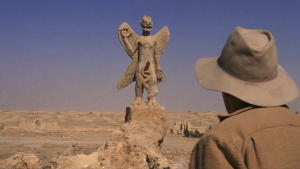
While watching The Exorcist, I had many grossed out moments but overall had two main thoughts that remained after the final scene. First, The Exorcist  had a very interesting beginning to me. While watching it, I was trying to figure out the whole time what the connection would be between the archaeological site and this little home of mother and daughter in D.C. and I don’t think my question was ever answered (although Barbara Creed drew some very nice parallels between the women in both places as witches in The Monstrous Woman). The very end of the movie showed a superimposed image of the weird bat-like demon statue that was at the archaeological site, but my main question was how did this demon choose this seemingly  innocent child to begin with?

Demon (Pazuzu) statue in Exorcist found here.

Father Merrin seems to be the link between the two physical places but it still feels odd as to why the child was possessed. For cinematic purposes, an innocent child that is still young enough for the words that she uttered and actions she performed while possessed had a very disturbing impact. The only reason I can think that Regan was chosen  was because of talking to “captain howdy” on the Ouija board she found in a closet but even then, in a city that big and populated, there has to be more than one Ouija board being messed around with. Maybe I am just being too cynical and unwilling to believe the impossible (meaning demonic possession) which brings me to my second observation.

I couldn’t help but think back to “Be Right Back” at certain points in this film because of the impossibility of certain actions. For example, when Regan moved her head in a complete circle, could stab herself without feeling the pain, or live seemingly without food because no one could go near her or her mouth, it drew a parallel to the human but not body of the replacement Ash in Black Mirror. Both films use human bodies in ways that are abnormal and impossible to conceive as reality in a truly “human” concept and instead force the viewer to see them as an other and come up with a different explanation of the actions taken before their eyes, possibly lending to the horror of the genres.