Otherness in Death and the Digital Age

When looking back at all of my blog posts, I noticed that I seemed to be drawn to discussing similar ideas in all of my posts. Though not always obvious, after thinking about the discussion in my posts I realized that I was drawn to the idea of otherness.

In my first post, I wrote about different forms of possession were presented in Black Mirror and in The Exorcist. Regan becomes an other by being possessed by a demon while the robot-Ash is an other by nature of his technological creation. I discussed how both Regan and Ash are classified as being others through their bodily secretions–or lack thereof, in Ash’s case–and through their use of sexuality. Somewhat similarly, in my second blog post, I discuss whether Merry could be considered a reliable narrator in A Head Full of Ghosts after learning of her double otherness. Merry is the only child in the world of the story, and she was the only one to survive her poisoning the family spaghetti sauce with potassium cyanide (though I’m still not sure if I believe it), forcing the adult Merry to be an other for all her life, due to the tragedy she has lived through.

I continued my theme of writing on otherness in my third blog post. In this post I posed a question in regards to one of Carly Kocurek’s assertions in “Who Hearkens to the Monster’s Scream? Death, Violence, and the Veil of the Monstrous in Video Games.” I disagreed with Kocurek in her belief that otherness (to use her vocabulary monstrousness) causes immediate vilification of video game characters, and posed that we might actually feel sorry for some “other-ed” video game monsters.

I then had two blog posts that dealt with an otherness of perception. In one post, I argued that memorialization on websites is not beneficial because it encourages loved ones to hold on to a static image. Similar to what happens with Martha in “Be Right Back“, I argued that these websites prevent people from moving on after a loved one is lost. Looking at this post in relation to all of my other posts, I believe that I settled on this assertion because the virtual presence is in fact a false remembrance: it is an other, unable to express ideas, thoughts, and feelings behind actions. Similarly in the other post, I discussed how televised celebrity funeral should perhaps not be viewed as beneficial. I asked this question after reflecting on how the perception of a celebrity by the public could be other to the family’s perception and vice versa.

In some ways, I did find it surprising that 5 of my posts were able to relate to the same overarching theme of otherness, especially when I looked at the various topics I discussed: “Be Right Back,” A Head Full of Ghosts, possession, celebrity funerals, and online memorials were all able to unite under the umbrella of otherness. However, I am not too surprised. I tend to enjoy looking at marginalized groups and trying to tell their stories. I think this is what drove me to look for and write about otherness so much in this class: I want to hear the stories that are different from my own, and draw attention to the outsiders. In regards to death and technology, I think there is a huge potential for people to become others simply by the separation that takes place between the living and the dead, and the lack of face-to-face interaction due to the influx of new forms of technology. I think that this is a cool idea worth more exploration: how does death or dying turn someone into an other? How do people dealing with death or dying turn into an other? How do they cope with the feeling of otherness? Does technology lead to more or less otherness?

I don’t want to leave out my last 3 blog posts. Towards the end of the semester, I focused less on otherness and more on fears associated with death and technology. I’ll give it a try to relate these three posts to otherness here. I wrote about the fear associated with ethical robots, the fear of globalization, and how we will be remembered after death. I suppose the fear of globalization relates to the fear of those outside our own borders. The otherness of other nations, other customs, other germs, other immunity stems the movies that play upon this fear of the interconnectivity of the world today. After we are gone, we are immediately an other as we are no longer living, so that could be how otherness ties into my post on how we should be remembered after we are gone. As for ethical robots, were these machines to be created they would exist as an other between two worlds: not quite machine, but not quite man either.

I guess, in reality all of my posts were about otherness. They varied in whether the otherness was in reference to death, or a result of technology. It is interesting to go back and see how I was drawn to these ideas subconsciously, but I think they are a large part of what makes studying death in the digital age so compelling. We have technology that truly changes the way we see the world of the living, so perhaps it is changing the way we see the world of the dead as well. Maybe the ideas and concepts that I found to be other will become the norm in the future, and our ideas will become other-ed. Just like how death photography seems so other to us nowadays.

How Do We Measure a Life?

In reading the last few chapters of Station Eleven, there was one quotation that particularly stuck with me. At the beginning of chapter 53, Emily St. John Mandel details Arthur Leander’s last day on Earth. She describes how Arthur, “made his late breakfast—scrambled eggs—and showered, dressed, combed his hair… all of the small details that comprise a morning, a life” (317).

I noticed a similarity between this quotation and a song from the famous Broadway musical Rent: “Seasons of Love.” In this song, the main characters contemplate how you measure a year in a person’s life.

“Seasons of Love” seeks to understand how to measure a year. It is not a big leap to go from a year to a life, as a life is the culmination of all the hours, mornings, days, and years in a person’s existence. Thinking on this quotation and the message in “Seasons of Love,” I began to wonder: how do we measure a person’s life after their death?

I believe that this is one of the fundamental questions at the heart of Station Eleven. How are we remembered after we are gone? I believe that the best exploration of this question is found through the book’s use of Arthur. Arthur is remembered by Kirsten after he is gone thanks to the legacy he left behind due to his fame. Tabloid pictures of Arthur, along with Dear V., along with a few shadowy memories, inform Kirsten’s view of Arthur. However, Clark also remembers Arthur and remembers the person he met when they were both young upstarts.

I am not sure what Mandel is trying to say with regards to how we are remembered. Is she saying that we are remembered by the legacy we leave behind or by the people in our lives that we have touched? Perhaps, Mandel is saying that we are remembered for “all of the small details that comprise” our lives. Regardless, I think that this is a question that deserves exploration when discussing Station Eleven.

Arguments Against Globalization

While reading Station Eleven, I could not help but think of two movies: Contagion and Outbreak. Both of these films have a premise similar to that of Station Eleven: an outbreak of mysterious disease decimates the world’s population. However, the diseases in Outbreak and Contagion—Motaba and MEV-1, respectively—do not lead to the failure of technology in the same way that the Georgia Flu of Station Eleven does.

Contagion, Outbreak, and Station Eleven are all examples of a common fear held by today’s society: a pandemic. Whether it be man-made or naturally occurring, today’s society is in a constant fear of biological villains or weapons. This is a theme that I have noticed in many other stories as well. But why are we so afraid of this theme?

Reflecting on this question, I thought that the greatest fear found in Contagion, Outbreak, Station Eleven, and other stories containing pandemics stems from the globalization of our world. Our world is so connected; we can travel great distances in almost no time at all. The ease with which we can spread around the world is something that we take for granted, as made evident by the Traveling Symphony’s traveling difficulties in Station Eleven.

If we are made to fear the connectivity of the world, we are therefore made to fear the world’s globalization. Are these stories thus arguments against the globalization of the world? To prevent the spreading of disease, should we not be able to travel as easily as we can? Does our globalization need to end?

Do We Really Want Ethical Robots?

While reading Robin Marantz Henig’s “Death by Robot,” I was reminded of a recent successful movie: Avengers: Age of Ultron. In the article, Henig discusses how we are currently striving to construct autonomous robots capable of making ethical decisions. This reminded me of a common trope used in science fiction films: the uprising of the robots.

Whenever humans construct artificially intelligent robots, the majority of the time, these robots begin to question why they are taking orders from their creators. As Henig mentions in the article, humans cannot process information as quickly as a computer can. Humans are also blinded by the emotions that robots cannot possess. In the robots’ minds, this makes the humans weaker. This is especially true for the character of Ultron in Avengers: Age of Ultron. In the video below, you can hear some of his best quotes, where he harps on humanity’s weaknesses.

Ultron was created as a peacekeeping force. However, similar to the ethical dilemmas presented in “Death by Robot,” Ultron is faced with his own dilemma: his creators cause some of the most damage, death, and destruction in the world. Thus, Ultron decides that the only way to create peace on the world would be to eradicate humanity entirely.

This story seems quite familiar to me—man creates machine, machine attempts to usurp man, man destroys machine. Whenever a robot seems capable of making ethical decisions, it realizes that humans are some of the least ethical creatures on the Earth, and that the Earth could do a lot better without us. Through media such as Avengers: Age of Ultron and I, Robot, humanity is taught to fear the day when robots and computers are able to make the same ethical decisions as humans. They can do so faster, and in some cases, better than humanity ever could. This begs the question though: do we really want robots to realize how much more capable they are?

Memorialization Through Twitter Bots

For my project I created a Twitter bot that tweets as Albus Dumbledore from beyond the grave. You can find the twitter profile here. Below is my artist’s statement, detailing the goals I had for this project, as well as the process I went through in creating the finished product.

Artist’s Statement

When I first read the description for the Haunted Media Project, I immediately knew which of the course readings I would use to inspire my work. In our exploration of the expressions and consequences of death on the Internet and social media, there were two articles that stuck with me: Natalie Zarrelli’s “Dial-a-Ghost on Thomas Edison’s Least Successful Invention: The Spirit Phone,” and Ethan Chiel’s “What Happens to a Twitter Bot After Its Maker Dies?”

Between these two articles, I noticed a commonality: the idea of communication with either a person or idea that has passed on. Thinking back to what we witnessed in the Black Mirror episode “Be Right Back,” I was particularly drawn to Thomas Edison’s idea of there being a possibility of, “personalities which have left this earth communicat[ing] with us” (Zarrelli). I believe that many people would want to communicate with their loved ones who have passed on, so I drew on that idea and decided that I wanted to create something that could, using scientific methods, as Edison intended, allow this possibility to become a reality (Zarrelli). Looking at the different possibilities for how I could achieve this communication, however, I was not sure that a phone would be the proper method. Theoretically, it would be wonderful for us to give a phone call to our loved ones who have passed away, but I wanted to come up with something more unique.

With an increasing percentage of the world taking part in social media, the world is now more connected than ever. In relation to death and the death experience, this connectivity is seen as something that can be a good thing. According to an article published in The Journal of Continuing Education in Nursing, social media offers seriously ill and dying individuals the ability to communicate with distant friends and family, and offers a place of support for loved ones, by connecting them to people who have gone through similar experiences (Billingsley & Currie 435-436). In fact, more and more people are turning to social media and the Internet when there is something that they do not know and when they are seeking advice on situations (Billingsley & Currie 435). Knowing this, I became interested in exploring my idea of communicating with the dead through the use of social media.

Though we had read articles exploring Facebook’s effects on the grieving process, and how Facebook has changed memorialization, we did not delve too deeply into Twitter. As Twitter is one of the most used forms of social media in the world, this surprised me. Twitter is considered quite similar to blogging—though it can only be done in 160 characters—and has such, has been shown to have emotionally cathartic effects (Keim-Malpass & Steeves 378). Tweeting and following the tweets of others undergoing similar painful situations, such as a death or serious illness, can help alleviate some of the pain and encourages acceptance and progression through the necessary steps in the grieving process (Keim-Malpass & Steeves 378). Thus, I believed I should embark into uncharted territory and form some form of memorialization service using Twitter.

Not really knowing where to begin with Twitter, I drew inspiration from the Chiel article about Twitter bots. According to Chiel, “bots…are programs that use an application program interface (API) to post to or pull information from various services.” In simpler terms, a Twitter bot is able to run a program that sorts information to generate tweets. The types of bots that exist are as varied as their creators: “programmers, artists, journalists, and anyone else who feels like making bots” can create bots that, “sort pixels, suggest Marxist startup ideas, or behave more like teens than teens” (Chiel). What attracted me to the idea of using a Twitter bot for this project was the low maintenance of the bot. For example, some bots can run uninterrupted for three years without any effort from their creator (Chiel). I also knew that I needed to create something that could function on its own, without my having to constantly draft a tweet and then send it. As this is a Haunted Media Project, I found a sort of poetic justice in creating something that could outlive me. The Twitter Bot could be doubly haunted—outliving its creator, and the person it was created to memorialize.

The only problem with generating a Twitter bot, is that I am not a programmer. I do not know how to code, and I am blissfully unaware of the inner workings of user interfaces and, honestly, computers in general. Thankfully, there are quite a few services available that provide step-by-step instructions on how to create your very own Twitter bot. I used one of these instruction guides, created by Zach Walen. The guide was extremely helpful in walking me through the process to create an autonomous, self-tweeting Twitter Bot. Another aspect of Walen’s guide that made it even more accessible to my programming-illiterate mind, was the fact that the majority of the program is run in a Google Sheet. Those interested, can view the Google Sheet containing my “code” here.

For my Twitter bot, I chose to memorialize one of the most beloved, but deceased character’s in the Harry Potter franchise: Albus Dumbledore. Beginning this project, I knew that I did not want my Twitter Bot to simply tweet out famous quotes of Dumbledore. While this would memorialize the character, it did not evoke my original goal of providing a form of communication with the deceased. I thought it would be fine for the Twitter bot to tweet out Dumbledore’s quotes occasionally, but I also was inspired to have the bot generate tweets that were original, yet still seemed as though they could have been said by Dumbledore. Walen’s guide provided a few options for how the Twitter bot could generate tweets, but keeping my goals in mind, I chose to use Walen’s guide for creating a Markov Twitter Bot. This means that my Twitter Bot runs on a Markov-chain algorithm to generate new tweets.

That sounds immensely intimidating and complex, but in reality is quite simple. A Markov chain is defined as, “a sequence of events the probability for each of which is dependent only on the event immediately preceding it” (dictionary.com). The “events” for my Markov chain are the words being tweeted out. On my google sheet I have a page where I entered everything that Dumbledore ever said in the books of the Harry Potter series (an exhaustive process—he speaks often and can be long-winded). To my understanding, the algorithm randomly selects a word to begin the tweet. It then scans through all of Dumbledore’s quotes until it finds a word that is highly probable of following the word selected before. This process continues until the tweet is generated.

Therefore, the final tweet is something that may never have been said by Dumbledore, no matter how likely it may seem. For example, the first tweet generated by the bot was, “It is no immediate danger.” I checked through my spreadsheet, and I have no record of Dumbledore ever uttering that specific sentence. Sometimes, however, the bot can create a nonsensical tweet. Immediately following “it is no immediate danger,” Dumbledore tweeted, “head of our words.” While not possessing a true meaning, I think that these nonsensical tweets still capture the eccentricity of Dumbledore, and still evoke his character as the reader tries to decode what the wise Dumbledore could mean with his strange musings.

All in all, I am extremely pleased with the final result of my Twitter Bot. I think that it accurately captures Dumbledore’s character, and provides a new outlet for continued communication with the character, though he is deceased and the book series has ended. Lastly, and I am most proud of this, I believe that my project demonstrates the efficacy of using Twitter as a way of continuing on a person’s presence after their death. While the bot cannot respond to messages, and therefore cannot carry on a conversation like the online reincarnated presence of Ash in “Be Right Back,” it still can provide new material that retains the essence of those that it seeks to emulate. Thus it serves as a way for people to still communicate with the dead, though it is not as two-sided as I wish it were.

I do believe that my project could be extrapolated and used to memorialize other, non-fictional persons as well. All that must be done to memorialize someone else would be to change the input of the Markov algorithm. With the Library of Congress attempting to archive all tweets, it would be incredibly simple to memorialize someone’s twitter persona. We would simply need to input all of their tweets to allow the Markov algorithm to generate new tweets. Thinking of the different services we have seen for memorialization—as well as Be Right Back—I could even see the creation of these Twitter bots being something that people eventually generate a profit of off, though I hope that it would always stick to my original plan of simply being a means for someone to still feel as though they are communicating with a deceased loved one.

Works Cited

Billingsley, Luanne, and Paula S. Currie. “Using Social Media to Share the Death Experience: Discussion Points.” The Journal of Continuing Education in Nursing 44.10 (2013): 435-36. ProQuest. Web. 5 Apr. 2017.
Chiel, Ethan. “What Happens to a Twitter Bot after Its Maker Dies?” Fusion. Gizmodo Media Group, 01 Mar. 2016. Web. 06 Apr. 2017.
Keim-Malpass, Jessica, and Richard H. Steeves. “Talking With Death at a Diner: Young Women’s Online Narratives of Cancer.” Oncology Nursing Forum 39.4 (2012): 373-78. ProQuest. Web. 5 Apr. 2017.
“markov chain”. Dictionary.com Unabridged. Random House, Inc. 5 Apr. 2017.
Zarrelli, Natalie. “Dial-a-Ghost on Thomas Edison’s Least Successful Invention: The Spirit Phone.” Atlas Obscura. Atlas Obscura, 18 Oct. 2016. Web. 05 Apr. 2017.

Celebrity Funerals: As Seen on TV

While reading Lex Berko’s article “Death on the Internet: The Rise of Livestreaming Funerals,” I immediately thought of a similar trend that had arisen in society: televised celebrity funerals. To my knowledge, the most recent instance of this phenomenon would be Whitney Houston’s funeral on February 18 2012.

In a way, I suppose that these televised funerals are nothing more than livestreamed funerals that are available to a wider audience. However, I feel that there is more of divide. A livestreamed funeral, though accessible to many, seems more private than a televised funeral service that is accessible to millions. The fact that the funeral is televised also seems to make a spectacle out of something that should be cathartic and intimate.

I agree with Berko that having a funeral livestreamed can be beneficial in allowing distant relatives to take part in the service, but televising a celebrity’s funeral is different. Since we are in the age of celebrity, with social media and paparazzi constantly following celebrities’ every move, we do build a closeness to our favorite celebrities. However, we do not know the true person that hides behind the façade presented in a celebrity’s media image.

For example, while many of the viewers of Houston’s funeral enjoyed Houston’s music and loved her persona, they did not know the true Whitney Elizabeth Houston. These viewers never saw behind the curtain. The person they were saying goodbye to is not the same person to whom Houston’s close friends and family were saying goodbye. I am interested to hear the rest of the classes thoughts on televised funerals. Do we think that the fact that the funeral takes place on television takes away from the service? Is it beneficial or detrimental to have death viewable to such a wide audience? How do televised funerals relate to Berko’s discussion of livestreamed funerals?

The Problem With Memorialization on Websites

While reading the article “Gravesites and Websites: A Comparison of Memorialisation,” there was one quotation the particularly stuck with me. In discussing memorial websites, the authors state that “these sites are supportive of both the process of remembering someone as gone and being with someone as a continuing presence” (40). While I agree that memorial sites can serve to remember someone who is gone, I took issue with the authors use of “being with someone as a continuing presence” (40).

My first big issue with this statement is that a person’s presence on memorial site is not a dynamic presence. When someone dies, everything that they have done up until that point becomes fixed—there are no opportunities for a new or different presence. For example, think of new-Ash in “Be Right Back.” He was constructed from everything that the real Ash had ever posted online. He did not have the meanings or thoughts that the real Ash had, nor was he able to become a new person. And in my opinion, one of the fundamental aspects of humanity is our capacity for change.

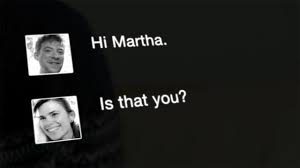
My other issue with saying that memorial sites serve to allow us to be with someone as a continued presence is that I feel that it does not encourage people to move on. Similar to how Martha was unable to move on from Ash’s death once she found his online presence (something that seems to me like a futuristic memorial page), if others use memorial sites to be with their deceased loved ones, they will never be able to achieve closure over their loved one’s death.

Though taking place in the future, Ash’s online persona is a sort of memorial page that prevents Martha from moving on from his death.

I do believe that memorial sites can be cathartic. They can serve as locations for people to leave a message to the deceased. However, if memorial sites are being used for someone to feel that their loved one is still with them, then the sites could become a problem.

Sympathy for Monsters

While reading Carly Kocurek’s “Who Hearkens to the Monster’s Scream? Death, Violence, and the Veil of the Monstrous in Video Games,” I had a problem with one of Kocurek’s main assertions. In her essay, Kocurek states that in video games,

“Monstrousness heightens the dehumanisation of in-game enemies and justifies their execution. Players are right not to feel sympathy for the monsters… they are, by design, unsympathetic characters, mere impediments to game victory” (86).

Thinking about my own experience with videogames, I thought of one of my favorite games to play when I was a child: Kingdom Hearts. Though the game takes place in a rather complex universe, the series focuses on a young man named Sora who fights creatures known as Heartless with a mystical weapon called the keyblade.

This image shows Sora with his keyblade.

The Heartless are creatures born from the darkness in people’s hearts. Once an individual is consumed by darkness, they become corrupted and turn into Heartless, as seen in the clip below (32:00-32:20).

Throughout the game, Sora is thus battling corrupted individuals: humans turned into monsters. Though the enemies of the game were once human, the player is justified in killing the Heartless, because of their now monstrous form, just as Kocurek describes in her essay.

When I was a child I readily accepted my need to kill the monsters and felt no remorse for doing so. The Heartless were inherently evil, so it was my job as the hero to kill them. Now, however, when I look at the backstory of the Heartless I cannot help but feel sorry for the creatures. I am sure that these humans do not wish to be consumed by darkness and become Heartless, yet the spreading darkness throughout the world causes them to become monsters. The keyblade frees the hearts from darkness, allowing the player to become a savior– killing the Heartless is an act of mercy rather than an act of violence. If we are mercifully killing monsters, do Kocurek’s assertions still stand? What does it mean when a player actually sympathizes with the monsters that they are trying to kill?


Merry- The Unreliable Narrator

One of the aspects in A Head Full of Ghosts that I have found to be the most compelling is the choice of the narrator being Merry Barrett. Something that we touched on in our earliest classes was whether Merry is a reliable narrator for the events of the novel. I do not feel that we spent enough time on this debate, especially after Merry’s big reveal to Rachel about how her family died in chapters 25 and 26.

In chapter 3, Merry says, “my memories mix up with my nightmares, with extrapolation, with skewed oral histories from my grandparents and aunts and uncles, and with all the urban legends and lies propagated within the media, pop culture, and the near continuous stream of websites/blogs/YouTube channels devoted to the show…so all of it hopelessly jumbles up what I knew and what I know now” (Tremblay 13).

This quotation called into question whether or not Merry is a reliable narrator, through Merry’s own admission. Throughout the novel, I forgot that Merry said this, and became fully trusting of her recounting. This trust was most likely brought on by Merry’s narration switching from her 23-year-old self to her 8-year-old self so seamlessly (even though, in the diegetic world, the 23-year-old Merry is saying what we are hearing the 8-year-old Merry says). However, once Merry revealed that she was the one who slipped the potassium cyanide into the pasta sauce that poisoned her sister and parents, this quotation popped back into my mind.

I am not sure that Merry made up the fact that she was the one who put the potassium cyanide in the sauce; I definitely do not think that someone would lie about that fact. Yet, I am not sure that I trust Merry admitting to the poisoning either Merry, however, goes on to say that, “I’ve never told anyone what I’ve admitted to you. The police, psychologists, my aunt; no one” (Tremblay 281) Merry thus shows that she has been lying for many years.

For some reason, this called a lot of the narrative into question—at least for me—that we are given because it is given to the reader by Merry, someone who I find to be an unreliable narrator, much like Pi from Life of Pi or Huck Finn from The Adventures of Huckleberry Finn. Can we trust what Merry has told us? Can we trust a 23-year-old woman recounting something that happened when she was 8? Even if it was something so traumatic, I think the answer is no.

Pi from Life of Pi is a great example of an unreliable narrator. Which version of his story is true?

Works Cited

Tremblay, Paul. A Head Full of Ghosts: A Novel. New York, NY: HarperCollins, 2015. Print.