The blog posts in this course did a great job of bringing outside references and materials into the class. Each of us had different, but relevant experiences that contributed to class discussion. One of my favorite aspects was learning about different ways a theme or idea had been discussed/used in real life that I might never had heard about if my classmates had not brought it up or written about it in their posts.
Writing these blog posts, I found myself reacting personally and viscerally to many of the themes we discussed in class, or different ideas I had during our discussions. Some examples:
“AGHHHHHHHHHHHH
… I should have seen the ending to Tremblay’s A Head Full of Ghosts coming.”
or…
“My first thought while reading about the rise of QR Codes in Graveyards was, “Oh I hate pulling out my phone and scanning those codes”- while my second thought was shame about how few seconds it would take to scan the memorial and do it for a deceased family member or friend”
or even…
“The characters we are attached to in the beginning not only introduce the Georgia Flu so well, but they are engaging and, just so damn human.”
Many of the topics I covered were examples from my own interests. There were many pop culture references, and discussions of television shows, video games, and examples from Wikipedia holes I had gotten sucked into. I was excited to contribute though, because I was glad to relate some of my experiences to this class.
While I enjoyed writing in a “blog style,” swearing once or twice, and generally in a less-formal manner than papers, I wish that our class blog was more engaging with one another. I felt a need to think of creative, click-bait-y titles in the hopes that other people would read and comment on them. While forcing students to comment on other people’s blogs does not work well, because then it feels like busy-work rather than genuinely exciting, it would be nice to figure out a way to keep class discussions going on the blog.
I really liked this class, in all honesty, because it was a great way to both explore topics that satisfy our morbid curiosity, and learn about topics and fields that we would otherwise never heard of. I know now the different criteria of post-modern works and enjoy finding different examples of themes we have talked about in other aspects of my life. Thanks for a great class guys!
Reading the last quarter of Station Eleven, I was struck by how much the author romanticizes our social connections. It seems as though the web of connections she created- surrounded around Miranda, Arther, and Kristen- are much more coincidental than real life. Connections like the station eleven comic book Miranda creates, sends to Arther, and ends up in the hands of Kristen and Tyler. The comic book ends up saving the life of Kristen and playing a pivotal role for the Prophet’s last few moments alive.
Emily Mandel clearly creates these connections to stress their importance, but also discards them without much hesitation. Clark’s relationship with his boyfriend, his friend the flight attendant, and his friend who discusses his last telephone conversation show this. They show his humanity with missing his boyfriend, his need to form relationships with his neighbors, but also show how these relationships are fleeting. Emily Mandel kills off the flight attendant with a short line and no hesitation. She shows Clark honoring their friendship by wearing her scarf every day after her death, but it just becomes another part of his character afterwards. It seems like Emily is showing that our personalities, experiences, likes and dislikes, our philosophies, beliefs, fears, and everything else that makes us human stands on the foundation of our relationships with others.
Tyler/The Prophet and his Mother, Elizabeth, seem to show the alternative side to this. I wish there had been more of a religious backstory to Elizabeth, because as it is, I feel that their religious fanaticism comes out of nowhere. There are no moments in earlier chapters where she shows a religious side, and it feels like an undeveloped plot line. However, the events between Kristen and Tyler twenty years after the epidemic are all shaped by their relationships with Arthur, Elizabeth, Miranda, and Clark.
In the end, I agree that this book is a sort-of love letter to social relationships formed outside of technology. She definitely criticizes our reliance on technology, (Clark basically shoved three millennials on their phones!) but also describes a believable world where human relationships shine. It also seems like praise for humanity’s achievements though, with Clark building a museum to document our technology. There’s hope at the end of the novel that humanity will be reborn and pick up the mantel of technology and continue to improve. One of my favorite aspects of this book is the sheer optimism in the face of annihilation. We don’t necessarily wish to go back to the old world, like many of the survivors, but are excited about the future of humanity that survived.
In class we talked frequently about our social media accounts after we died. We were interested in knowing whether the black mirror episode could become true in our lifetime. Later in the class, we created morbid social media services that would cater to different aspects of our life after we die. Although we all laughed awkwardly talking about these social media projects- come on, “DeadBook” or a tree-planting service for our bodies, really?- Dr. Sample suggested that many of these sites probably already existed.
I was interested in seeing whether these applications and websites did actually exist so I looked into it. The first one I found, called “LivesOn” was first created to tweet for you when you were busy doing other things. But then the marketers realized they could make more money and buzz if they advertised it for the dead. Their tagline was “When your heart stops beating, you’ll keep tweeting.” Unfortunately, it seems like the app only spliced together your old tweets to provide an unintelligible string of something that sounds like you. I believe it failed after people realized the tweets were unintelligible, but this service mirrors almost exactly what one group brainstormed in class.
I actually found many different sites that promised to tweet after you died, or upload a video to Facebook if you died, and things similar to that- but many of them had failed and their websites led nowhere. (One was even called “DeadSocial“, so we were close with DeadBook or DeadSpace!)
It made me wonder why people were either against this idea, or why these projects kept failing. Let’s preface this by saying I have no idea, but I think it’s likely because of two reasons. Either the technology is so far off from the infamous black mirror episode that it is impossible to “recreate” you without reliable Artificial Intelligence. Or second, that people are against the idea of reading/interacting with people like that after they died. That there is something disingenuous and fake about interacting with a robot pretending to be a human rather than having their own self-created personality. It would get really boring interacting with a personality or avatar that you know someone else created, right? We’ve always thought of technology as a force that makes our lives easier or more manageable, but never thought of it as its own being. So if we create artificial personalities, it just seems that we would never really get over that unless the personalities create themselves.
I am not going to reference any of our discussions in class or topics we have covered in readings. Station Eleven is obviously a great book and I want to talk about it in a vacuum. I want to cover how this book exudes such a sense of realism in such an unrealistic situation; how fantastical it is but also so emotionally compelling that draws you in.
The beginning reminded me of a movie, where we are immediately dropped into a fast-moving environment. The characters we are attached to in the beginning not only introduce the Georgia Flu so well, but they are engaging and, just so damn human. While we only know Jeevan for a single chapter, I understood his thought process and felt a connection with his emotional decisions and rationalizing.
While the first chapter feels stand-alone at times, Station Eleven does such a good job of intertwining different points of the story in ways you wouldn’t expect. Like how Jeevan’s photograph of the man who suffered a heart attack was in a magazine that one of the survivors of the Traveling Symphony carries around and reads religiously. The novel just does such a good job of making these connections feel natural. We know they are creations of the author, that they are not believable coincidences, but they are just so well executed that I liked and accepted them.
It didn’t hit me until chapter 11, when the author draws the parallels of the plague that hit during Shakespeare’s time to the Georgia Flu. Things like this, themes like the rebirth of society, the aspiring nature of man to do more than survive, or our resilience as a species, they are all such tropes that are overdone in every other post-apocalyptic work but somehow work well here. I feel like this blog post has been overly gushing, but reading through this first section I keep looking up from the book and realizing how much I’ve been sucked into the emotionally compelling story that I let any sense of believably fly over my head.
I’m including a gif from Shakespeare’s Midsummer Night’s Dream because it seems appropriate.
Over the summer I was asked in a focus group how I felt about the idea of self-driving cars. I was asked whether I would use it often, what I would use it for, and what I would spend my time doing if I found myself inside one. I had not thought about it before, but I took a few seconds and replied that I would hate a self-driving car. I enjoy the mindlessness of driving at times as well as the freedom and power you feel when driving at other times.
We read a few articles about deaths in Tesla’s autonomous driving mode, called autopilot. Which, in a morbid way, was completely inevitable- everyone was just waiting to see who would be the first poor soul to be killed. For me, our generation grew up thinking that driver-less cars is a science-fiction idea and it would never happen in our lifetime, but we were wrong. So car manufacturers now have to get rid of the notions and preconceived ideas we have about a driver-less car future.
Good luck to them with trying to change my views. The first exposure I had to the idea of a driver-less car was in Will Smith’s iRobot movie and the following scene:
It’s too bad that iRobot also has the scene where robots try to take over the car and try to kill Will Smith’s character… “You are experiencing a car crash”
I know that driver-less cars are inevitable in the next twenty years or so, and I am going to have to live with that on the road. I just don’t see myself driving one because the idea of giving up that much power and autonomy to a robot which I don’t fully trust seems like it would cause me more stress than just driving myself through traffic. I don’t think I am alone with those sentiments. I know there are many people who are excited about autonomous cars, but I bet there are also a lot of people who will not change their mind quickly.
In looking at the objectives of our course, our class focused on how representations of death in the 21st century interact with pop culture and applied historical and theoretical concepts to this morbid intersection. Our haunted media object is a physical representation of this intersection, as a way to evoke the themes we have discussed this semester in an artistic, physical presentation. The two ways we approached this intersection were through (a) ghost-centric examples of technology that perpetrated to allow the user to speak with friends, family, or other entities after their death, or (b) grief-centric facets that helped individuals and families move through the grieving process more quickly, or with less pain.
For this project, I was influenced by our discussion in class on the phenomenon of interacting with a loved one after they pass away. While current generations take this for granted in the modern age, the idea of hearing a loved one’s voice was unimaginable before the invention of recording and transcribing sound onto phonograph records; As was the idea of seeing a loved one’s face after they died before the invention of photography. Along with the reading in The Audible Past by Jonathan Sterne, in which he discusses how strange it was for society to listen to the words of those who had died, we also discussed how the invention of photography changed the way families grieved their loved ones by allowing them a perfect visual reminder for the first time. We see this in what are commonly called ‘Victorian Death Photos,’ where families in Victorian London posed the dead in family photographs, in coffins, or in their cribs, and made it look like the dead were still alive.
Those dead in Victorian Death Photos are shown more sharply because they did not move in long-exposure shots. Sourced from BBC.
Once photography became affordable, portable, and more socially acceptable, Victorian-era families began permanently preserving their loved one’s likeness. Since photography was still relatively expensive and the practice was not yet widespread, these families often did not hire a photographer until their loved one had died- making it necessary to stage the photo and prop up their loved ones. As an article in BBC confirms, death portraiture became increasingly popular as people realized it offered the last chance to have a remembrance of their measles-riddled children. These death-reminders, or memento mori, were considered acceptable at the time but our class was relatively shocked by these remembrances.
I did more research into death photography, often called remembrance photography, and found that many families still choose to commission photographs of their loved ones who pass away. Molly McElroy, in an article posted by the University of Washington, found a surprising practice of remembrance photography and preemptive photography for children facing life-threatening illness. One of these nonprofit groups, called Soulumination, focuses on helping families with children under 18 who are in the hospital for major illness. The other nonprofit, called Now I Lay Me Down to Sleep, is a nationwide network of photographers who provide free remembrance photographs often for newborn children who pass away shortly after birth. The service believes that the photos provide parents with lasting memories of their children who lived so briefly that “little else exists to remember them by.” They also say that the professional photos are easier to look at than the photos the families took themselves. It becomes easier to breach the subject of death if one has a photo to talk about and explain, like a “gateway to bringing up memories of the deceased.”
Surprisingly, this practice was born with the invention of photography and lives on today. I wanted to know why remembrance photography was (somewhat) popular and what it might look like in today’s digital, video-centric world. This led to a discussion of grief, and the function of grief in society. Authors Claire White and Daniel Fessler discuss in their article, “Evolutionizing Grief,” how photographs of the deceased impacts the bereaved and influences their grieving process. For them, they believe that grief is a process that has two functions. First, to encourage two (living) people who have separated to reunite. Second, if one of the partners dies, to “facilitate the reconceptualization of the other as no longer a living, viable relationship partner, opening the door to investment in new relationships.” They found that neurobiological systems, like our facial recognition systems are activated by photographs and videos. This means that viewing a photograph of a loved one who has passed away creates a response in your brain as if the person were physically with you. White and Fessler argue that this will “enhance the conflict between the old representation of the loved one and the new one to which the bereaved is transitioning.” This is understandable, that while photographs may make us more uncomfortable and delay the grieving process because of our neurological responses to seeing our loved one’s face, our state of grief forces us to reconnect with them in any way possible.
Moving away from the biological research- our discussion of grief, of remembrance and Victorian-era death photography, and of the phenomenon of interacting with someone after they have died, motivated me to try and capture a digital interpretation of death photography.
With the gracious help of my friends, I posed a photo which showed three friends centered around a chair and another friend pretended to be dead and was propped up on the chair. The ‘living’ friends were encouraged to move freely- fix their hair, scratch an itch, etc.- while I asked the ‘dead’ friend to resemble a corpse propped up like in a Victorian-era photo. I then took this video and created a .gif file that would allow the video to loop when displayed, which created the illusion that my friends were continuously moving, and ‘alive’ in a way, within the video.
In many Latin-American countries and in some other societies, there is a myth that when you are photographed, a piece of your soul is trapped within that photo. With this video and .gif, I wanted to capture this idea that my friends were alive within the frame and that their souls existed within it.
When first creating this .gif, I realized that videos are not generally used to grieve a loved one, because videos are generally candid and unposed. Videos are also difficult to casually display in the home because of the limits of technology, so it is more common to grieve a loved one through a photo taken while they are still alive. By creating a video of my friends in a pose normally reserved for a photograph, and their small movements within the video, I feel it adds an uncanny element to the project.
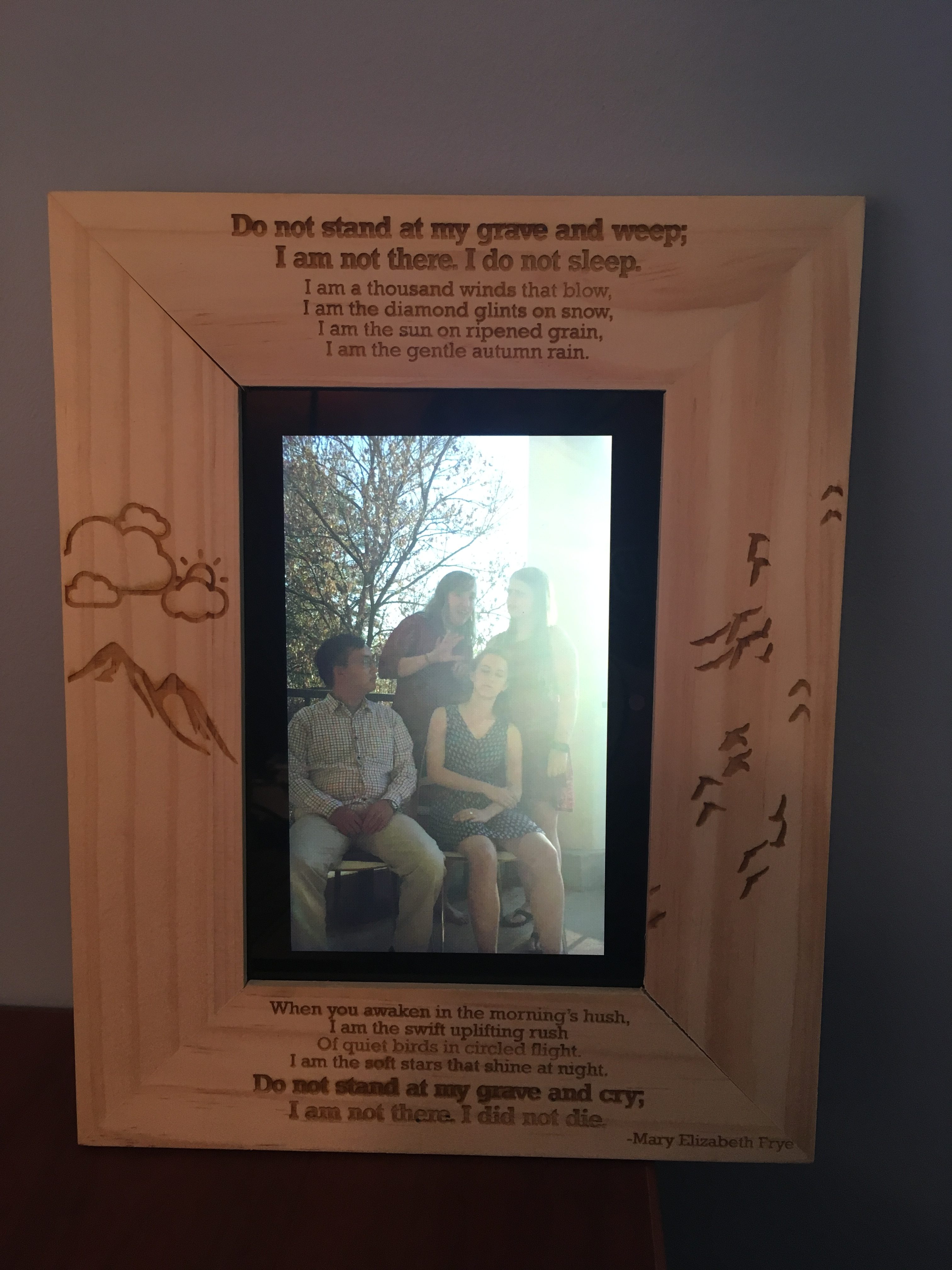
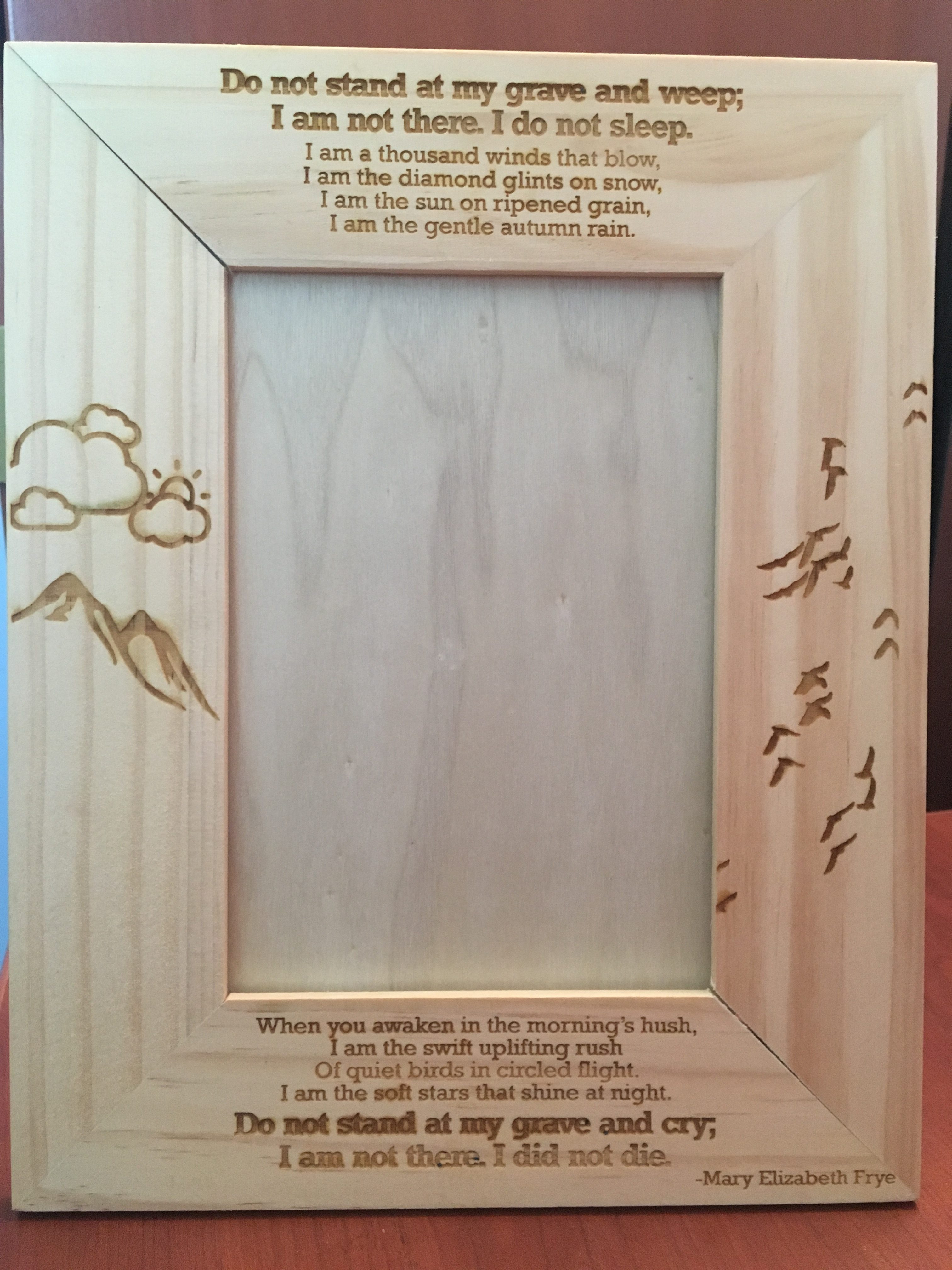
I then wanted to carry this illusion in the physical representation by placing the video in a photo frame. I used a tablet to display the video and found a frame that fit well around the tablet. As a result, the final product initially seems like a standard photo in a frame, until you notice that the people within the photo are moving. To make the frame more exciting, and to reinforce the idea that the project carried small pieces of my friends’ souls, I engraved the frame with Mary Elizabeth Frye’s famous poem “Do Not Stand at my Grave and Weep.” I have included it below: (Sourced from poemhunter.com)
Do not stand at my grave and weep;
I am not there. I do not sleep.
I am a thousand winds that blow.
I am the diamond glints on snow.
I am the sunlight on ripened grain.
I am the gentle autumn rain.
When you awaken in the morning’s hush
I am the swift uplifting rush
Of quiet birds in circled flight.
I am the soft stars that shine at night.
Do not stand at my grave and cry;
I am not there. I did not die.
By including this famous bereavement poem, I wanted to pretend that my haunted media project carried a piece of the deceased’s souls; that it is useless to cry at their graves because they are just as present, if not more present, in the photo frame. The poem suggests that the deceased does not want people to miss out on life because of their mourning; that they will be with their loved ones always. While the poem adds a religious element to the project, I think it furthers the idea that the subjects of the video are spiritually within the video and frame.
Custom engraved photo frame to hold the kindle fire
I believe I combined the grief-centric and ghost-centric objectives in my project because the photo frame is both a tool for grieving as well as a ‘haunted’ vessel for the deceased’s souls. I wanted to create something that would put a modern spin on Victorian-era remembrance photos and show the intersection of popular culture and technology with a photography practice that has been around for generations. Grieving has been a natural part of human existence, and only recently in our history have we been able to interact with people after they die. After looking at the different biological factors that impact grieving, I see that there is a natural conflict between trying to move on after death and trying to hold onto a loved one through photos and other remembrances. While we may think that some practices in today’s death-avoidance society are morbid or uncomfortable, practices like infant photography after death helps families validate their child’s short life and provide small comforts as they move through the stages of grief.
Works Cited:
Bell, Bethan. “Taken from life: The unsettling art of death photography.” BBC News. BBC, 05 June 2016. Web. 06 Apr. 2017.
Frye, Mary Elizabeth. “Do Not Stand At My Grave And Weep.” PoemHunter.com. N.p., 31 Dec. 2002. Web. 06 Apr. 2017.
Konigsberg, Ruth Davis. “New Ways to Think About Grief.” Time. Time Inc., 29 Jan. 2011. Web. 06 Apr. 2017.
White, Claire, and Daniel M. T. Fessler. “Evolutionizing Grief: Viewing Photographs of the Deceased Predicts the Misattribution of Ambiguous Stimuli by the Bereaved.” Evolutionary Psychology 11.5 (2013): 147470491301100. Web.
My first thought while reading about the rise of QR Codes in Graveyards was, “Oh I hate pulling out my phone and scanning those codes”- While my second thought was shame about how few seconds it would take to scan the memorial and do it for a deceased family member or friend.
Like the author of the article, I doubt that QR codes will stay current/updated very long. Technological advances today are moving way too fast to invest in something for eternity. I could be wrong, but I think that most advertising campaigns are slowly phasing out QR Codes, because I can’t remember the last time I saw someone prompt me to scan one, and I also can’t remember the last time I actually scanned one.
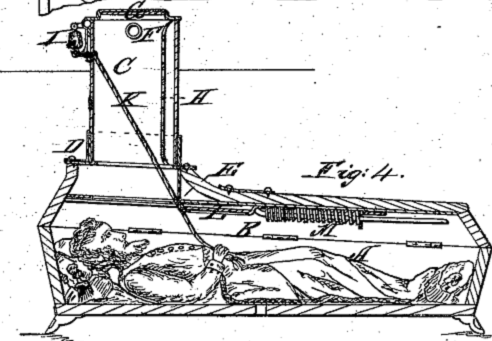
This article made me think of the many outdated technologies that have infiltrated the death industry. Contrary to popular belief, Walt Disney was not frozen by cryogenics. Specifically relating to graveyards, I was reminded of the “Safety Coffins” that became prevalent in the Victorian Era. These coffins had a bell that raised out of the ground a few feet, connected to a rope that family would place in the deceased’s hands. In case their loved one was not really dead, this bell and rope system allowed them to pull the bell and signal people above to dig them up.
Over time the fear of being buried alive subsided and the safety coffin fell out of fashion. When you look at these coffins now, they seem absurd right? I hope that people don’t look at the graveyard QR Codes in a similar way if/when they fall out of fashion.
In 1959, CBS aired the pilot for a science-fiction, fantasy, psychological-supernatural horror show that would go on for five seasons and won two Emmy Awards in Drama and a Golden Globe. Today, more than fifty years after its initial release, the show is often ranked as one of the best shows of all time. Do you know which TV series I am describing? Most likely not without some help, so here is the introduction. “There is a fifth dimension beyond that which is known to man. It is a dimension as vast as space and as timeless as infinity. It is the middle ground between light and shadow, between science and superstition, and it lies between the pit of man’s fears and the summit of his knowledge. This is the dimension of imagination. It is an area which we call the Twilight Zone.”
Rod Sterling’s The Twilight Zone remains syndicated by CBS and lives on through reruns and on streaming sources like Netflix and Amazon Prime. The Twilight Zone undoubtedly fulfills an early example of post-modern horror, as the show depicts characters facing futuristic, paranormal, supernatural, or disturbing events and moral difficulties. The surprising twists and moral lessons that made the show famous defined an innovative new genre for television. Although there have been attempts to revive or reboot the show, they could not capture the same quality that made the original so successful. The Twilight Zone falls into that category of things that you only really understand until you experience it first-hand; something that cannot be described adequately to someone else without showing them.
Until recently, it was hard to find another example that fit neatly into The Twilight Zone’s unique genre and created a similar sense of psychological tension. One of the shows that has come close is Netflix’s Black Mirror, which we have discussed in class. Undoubtedly, many fans of the show use language like modern-day-Twilight Zone, or describe it as a technologically skewed version of The Twilight Zone, because the show is similarly difficult to describe without first-hand experience. We can see this description through blogs and news articles- here, here, here, and here (among countless other examples).
(As a side note, I think that any television show or horror work that Stephen King tweets about should automatically be qualified as a post-modern horror success- as seen in his tweet below)
Loved BLACK MIRROR. Terrifying, funny, intelligent. It's like THE TWILIGHT ZONE, only rated R.
While there are many authors devoted to describing the particular brand of psychological horror shown in both Black Mirror and The Twilight Zone, as well as many shows trying to recreate their success, I want to focus on the aspects that differ between the shows. In trying to compare the two shows, I chose two episodes from Black Mirror and The Twilight Zone that focus on a similar theme, mainly class structures in society and the desire to “fit in” with others. I am going to describe the episode from The Twilight Zone first, move on to the episode from Black Mirror, and then look at how they interact.
Eye of the Beholder
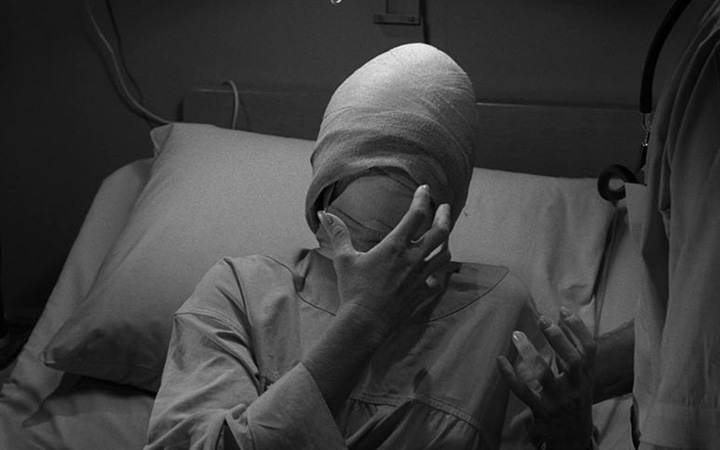
Season two, episode six of The Twilight Zone focuses on a woman named Janet Tyler. We spend the first twenty minutes without seeing Janet’s face; it is covered in bandages. She lies in a hospital bed. As she starts talking to a nurse in the room the camera focuses on her covered face, and then moves to follow Janet’s hands as she talks. Janet begs the nurse to ask the surgeon to take of the bandages because she wants to see if the operation was successful. She cannot wait any longer, since this is her 11th time undergoing procedures on her face. Janet lives in an alternate reality, at an unknown time, where being ugly is outlawed and procedures are performed to make citizens pretty.
As you can understand after 11 surgeries, Janet must be restrained at times to let her face heal because she cannot wait any longer. If the operation turned out to be unsuccessful, she will be sent to live in exile with other undesirable persons.
Throughout the episode, before the bandages are taken off, Janet talks to anyone who will listen about how much she wants to be normal. She just wants to fit into society. She is not upset about the forced participation and mandatory procedures because she wishes to walk in the street without scaring anyone. Ostracized for her looks her entire life, Janet offers to wear a mask and stay indoors all the time, just so that she can live a normal life if the surgery is unsuccessful.
She befriends her surgeon and shares with him that her earliest memory is looking at a little boy and making him cry because of her ugliness. The surgeon comforts her and identifies with her. He knows that the chances of the surgery were slim and that she is likely as ugly as before.
Stepping back for a moment here, the film techniques, camera movement, jump cuts, and use of shadow to hide the faces of everyone except Janet is exceptional. By interacting with a protagonist whose face is covered, and making clever use of the black and white medium of television at the time, The Twilight Zone forces the audience to interact with an entirely faceless cast. For the first twenty minutes of the episode, we do not see anyone’s face. This seems normal at first, that maybe a reveal will come in the next shot, but as the episode progresses we begin to question the importance of personal appearance. At one point, Janet’s surgeon asks himself whether beauty is only skin-deep, and what it truly means to be beautiful.
The climax of the episode comes as the surgeon removes the bandages from Janet’s face. Slowly and methodically, this scene lasts for almost five minutes, until the final bandage is taken off and we see the results of Janet’s procedure. She is strikingly beautiful, and touches her nose and skin in excitement. She suddenly screams, however, and runs away when she gets to her lips and nose. As the surgeon turns on the lights, the twist of the episode is revealed. Beauty in this world does not match up to the audiences’ standard of beauty; what might be considered ugly for us is the definition of beauty for Janet and her society. Since uniformity and beauty are required of every citizen, she is destined to live in exile. She cannot undergo anymore procedures.
This episode reminds the viewer of Nazi Germany, where uniformity and conformity were praised. Where being different meant being dirty or inhuman. The leader shown on the television screens in the episode shouts how glorious conformity will unite the nation and praises the benefits of uniformity. As its title implies, Eye of the Beholder plays off the adage that beauty is subjective and only serves to create class and social tensions. The episode warns of what might happen if society becomes too focused on standards of beauty and the subjectivity of ranking others based on personal traits. It ends vaguely, as most post-modern horror works do, with Janet walking towards her new life in exile.
Nosedive
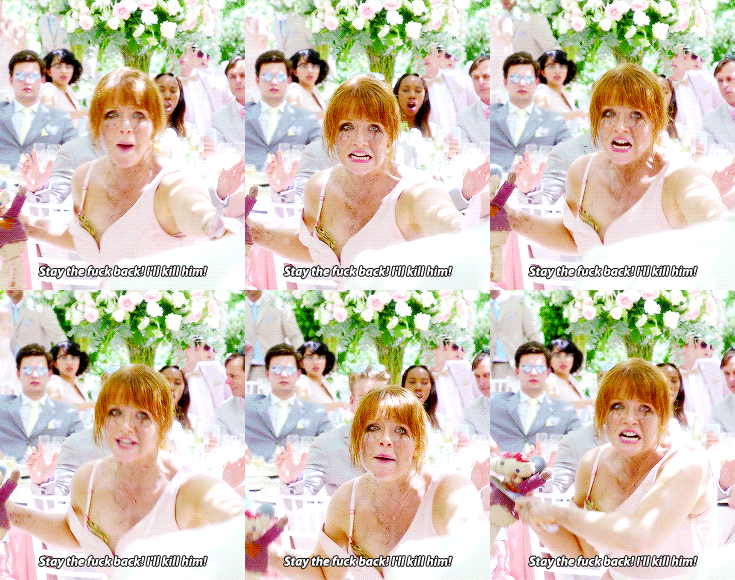
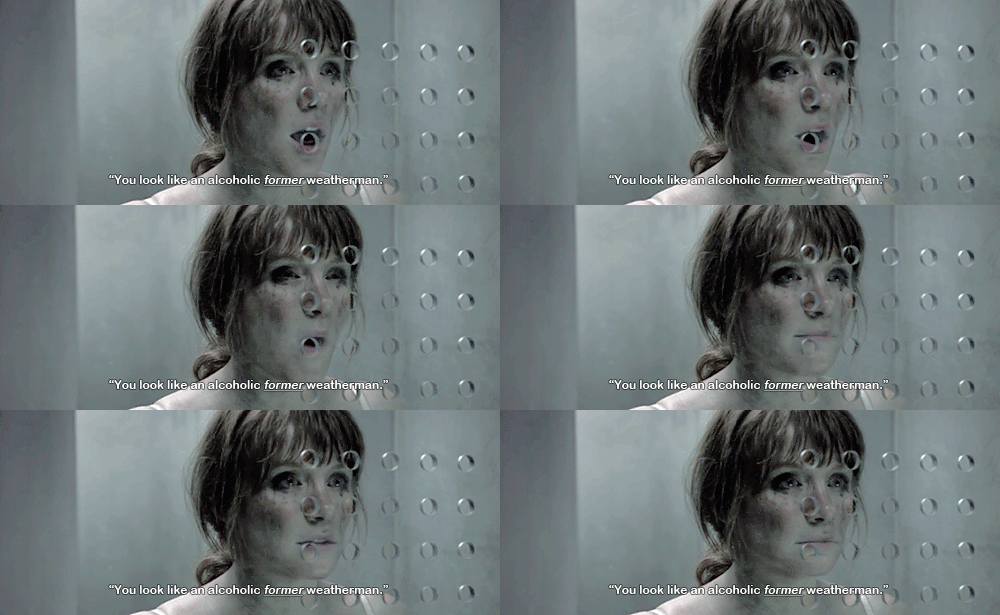
Black Mirror’s first episode in season three, Nosedive, has similar themes of segregation, class tensions, uniformity, and societal values. It follows a young woman named Lacie who lives in a futuristic world where you can rate others’ popularity on your phone. Your rating determines many different aspects of your life, including where you can live, who you can socialize with, what businesses you can shop at, and what discounts you can get. Lacie wants to move into a luxurious apartment, and can either pay a massive rent or raise her rating to obtain a discounted rent. She chooses to go to a rating improvement agency and gets life and networking coaching, attempts to socialize with higher rated people, and is eventually invited to speak at a wedding with people with top ratings.
We see as the episode progresses how such a future might be possible in real life, outside of the television show. The episode alludes to the ranking system that companies like Uber, Yelp, and even Netflix use in our daily lives. It depicts a society where every move is scrutinized, every word is parsed, and every hair must stay perfectly in place. Social values become integrated and forced upon everyone.
While the ending for Lacie is both tragic and liberating, because she frees herself from the vicious cycle of the rating system by destroying her score, the episode shines a light on the inherent class system that comes with society and the pressure we feel to fit in or be popular.
I looked further at research in social anxiety, the othering theory (that we instinctively find differences between groups of people), and the psychology of presenting your best self to society. In Mark Leary and Robin Kowalski’s 1995 book, Social Anxiety, the authors discuss how self-presentation behavior, along with impression management, influence interpersonal behavior as a basic necessity for social life (Leary and Kowalski 16). They write that there is nothing inherently manipulative in influencing other people, social influence is just an essential and valuable aspect of our daily lives. Particularly interesting to this episode of Black Mirror, Leary and Kowalski write that as long as people believe they are projecting the right kinds of impressions, they will be more relaxed and confident (Leary and Kowalski 19). Alternatively, when you think you are giving off the wrong kinds of impressions, then you are more flustered and anxious. They present a self-presentational theory of social anxiety, that social anxiety is a function of two factors: “the motivation to make a desired impression and the subjective probability of doing so” (Leary and Kowalski 19).
What does all of this mean for Lacie, though? As the episode starts out, Lacie has a good rating. She feels confident in herself and her public image, so is also confident in how she presents herself to the world. It is only when she feels an increased pressure to improve her popularity that she begins to doubt her ability to influence others. As her anxiety and frustration begin snowballing her rating lower, she creates this negative feedback loop that can only end in two options: becoming a social outcast and be miserable trying to climb back up the ranks, or choose to disregard the rating system and rid herself of the social anxiety it causes her.
Lacie doesn’t care about what others think of her, setting her free from the vicious cycle. (Tumblr)
Social Anxiety, Fitting in, and 50 Years of Psychological Horror
I guess it is both comforting and upsetting that social anxiety and the pressure to fit in was as prevalent in the 1960’s as it is today. Both Black Mirror and The Twilight Zone offer different takes on similar issues. While Black Mirror offered a futuristic, technology-based approach to the dystopian world depicted in Nosedive, The Twilight Zone presented the issues of segregation, popularity and beauty, and social anxiety in Eye of the Beholder with a science fiction and monstrous lens. Both Janet and Lacie face social pressures to conform and gain popularity among their peers.
Both these episodes might not be considered horror in its traditional definition, but engage in a type of post-modern horror called digital anxiety. Barry Grant discuss digital anxiety in his article “Digital Anxiety and the New Verité Horror and SF Films.” Grant describes digital anxiety as a stylistic approach that depicts the “monstrous in the mundane spaces we see every day in social networking, which also captures and disseminates globally daily atrocities beside which monster movies pale” (Grant 153). In both episodes, the anxiety is created when our normal perceptions about society or the world are flipped and perverted. While we may wish to be more beautiful or popular, these episodes show what society would be like if these social pressures ruled every aspect of our lives.
The larger message though, when both of these episodes are looked at together, is not simply that we need to worry less about our physical appearance or how popular we are (though that would definitely help many of us), but rather that humanity inherently creates these social classes and pressure. What is truly horrifying is that we can imagine both of these alternate realties coming true. While we might laugh at the pig-features of Janet’s world and scoff at the technological aspects of the rating system, these episodes make one realize that humanity is not above these behaviors. This subverts our comfort in our own lives, because while these episodes are just fiction, they shine a light on human nature that creates this underlying anxiety. Knowing that something depicted in these shows could happen in real life breaks down the comfort barrier between the viewer and the fictitious world.
Looking back, the similarities between Black Mirror and The Twilight Zone are striking. It is understandable now why so many viewers can only really describe one show with the other. They form a unique blend of drama, science fiction, fantasy, supernatural, and psychological horror, that creates and fits into a distinct genre.
Works Cited
Black Mirror – Nosedive. Dir. Jon Wright and Charlie Brooker. Perf. Bryce Dallas Howard. Black Mirror. Netflix, 21 Oct. 2016. Web. 1 Mar. 2017.
Grant, Barry. “Digital Anxiety and the New Verite Horror and Sf Film.” Science Fiction Film & Television 6.2 (2013): 153-75. Web. 1 Mar. 2017.
The Twilight Zone – Eye of the Beholder. Dir. Robert Enrico. By Robert Enrico and Rod Serling. Perf. Roger Jacquet and Anne Cornaly. CBS-TV, 1964. Netflix- S2E6.
Carly Kocurek’s argument is one centered around the continuous battle between free speech and public decency. Gratuitous violence, sex, and illegality usually drive up the demand for video games, especially for younger players. Sex sells, as the saying goes, and it doesn’t change for video games. She argues that dehumanizing violence in video games devalues the lives of in-game targets and the individuals or groups they may represent.
War propaganda, in a similar way, dehumanizes enemies under the guise of cartoons and unwavering patriotism. They make you forget that you are fighting your neighbor, but rather remind you to think of the enemy abstractly. Kocurek believes that Propaganda’s legitimizing the abuse and marginalization of various groups is present in these video games and produces similar results.
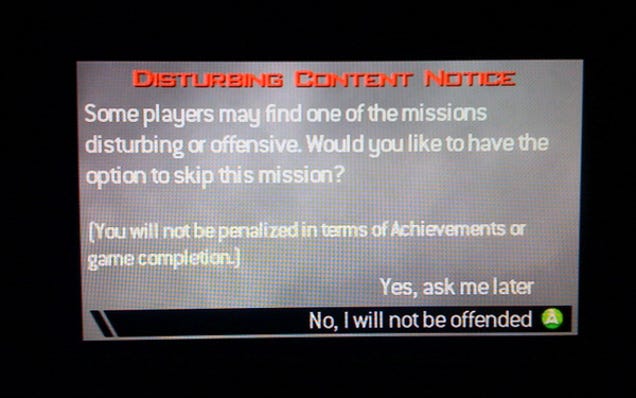
I do not often criticize free speech, however I understand the public decency angle with video games. Imagine a 14-year-old boy in middle school who goes home everyday to play the massively successful, blockbuster, genre-defining Call of Duty franchise. In 2009, the franchise released the game Modern Warfare 2, which depicted a war between Russia and the United States. Starting the game, the 14-year-old boy sees the following warning-
Warning in Modern Warfare 2, screenshot provided by Kotaku.com
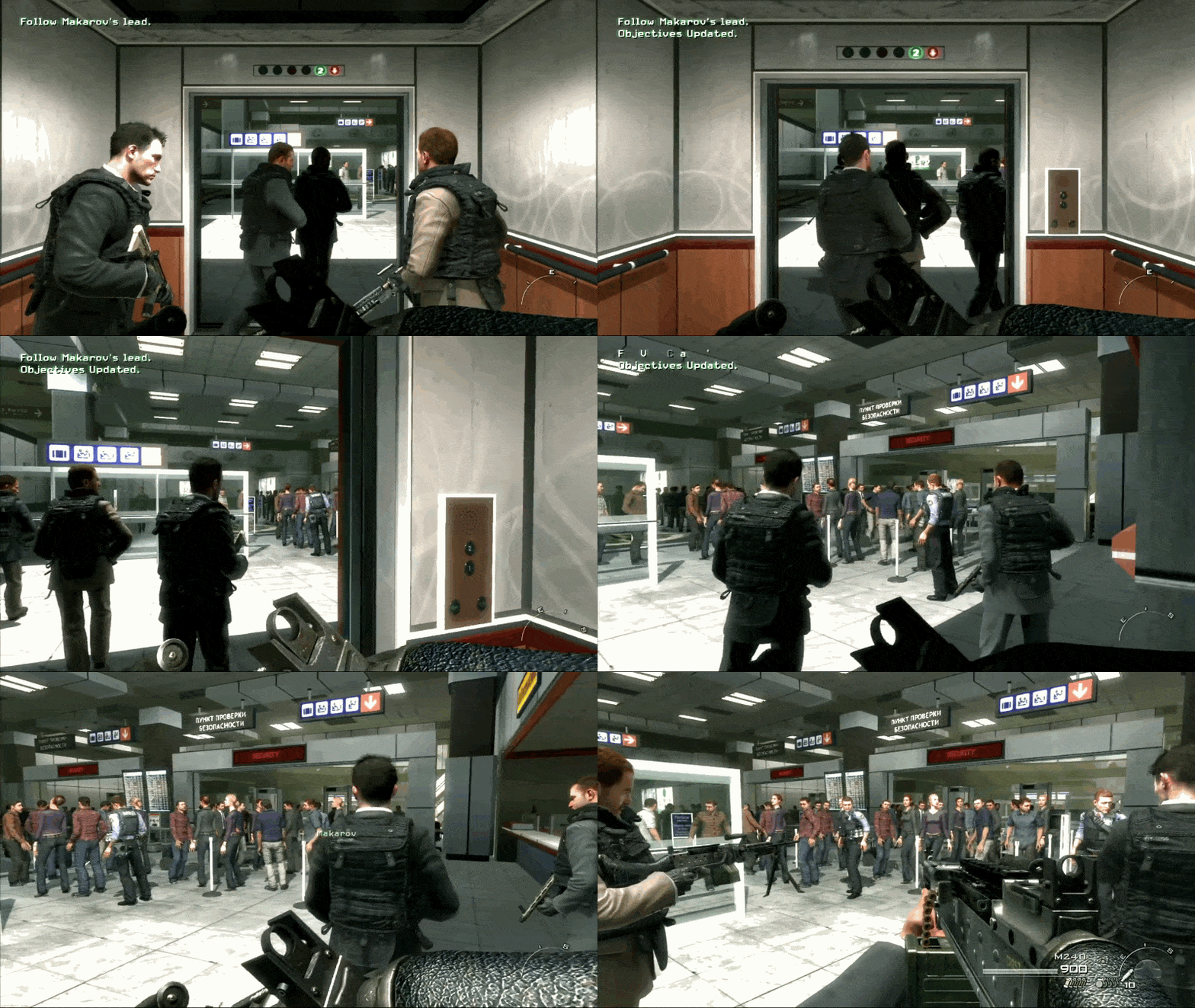
OK- you’re 14, you just convinced your parents to buy you this game since it is rated M for mature. You have played the last three Call of Duty games, and you can handle anything. Right? That’s absolutely what I thought at 14. The level in the game that the warning is referencing is called “No Russian” and there was unprecedented controversy when the game was released. Rather than tell you what happens…
Modern Warfare 2’s “No Russian” level, gif provided by Kotaku.com
It’s confusing trying to work out what is happening from a small clip, but this was the most “PG” graphic that I could find. Players around the country were horrified when they found themselves taking part of a terrorist attack in an airport. Seconds after the gif ends, the player begins shooting into the crowd. For the next 15 minutes, the player commits a mass-shooting without any resistance until the level is finished.
While I completely agree with Kocurek’s argument that video game violence should be less censored and dehumanized, I can speak first-hand on the psychological mark and disgust I feel looking back on that level. Public decency must come into effect somewhere along the way.
At the very least, there has to be better regulation of material like that. It’s a running joke in the gaming community that 14-year-old’s make up Call of Duty’s audience. Essentially, the studio advertises blatantly to their age group. At what point do public decency and freedom of speech collide? While I agree that video games dehumanize murder and violence, and may propagate caricatures of other cultures, there is clear psychological damage that video games inflict. It is unrealistic to ban all gratuitous violence and sex from games, so where is the middle ground?
We were warned that post-modern horror generally leaves loose ends and unresolved conflicts. We talked about these ambiguous elements in class and read about it in Isabel Pinedo’s Recreational Terror article. With all the time we spent discussing it, the readings, and everything we watched- I should have seen the ending to Tremblay’s A Head Full of Ghosts coming. I could not have found a better example of foreshadowing for what to expect from this novel, than the entire three weeks we have talked about post-modern horror. Honestly it’s embarrassing to admit that the ending left me as shocked and frustrated as it did.
I think the elements of ambiguity, vagueness, and lack of resolutions in post-modern horror are the most significant changes from the classic horror genre because of the effect that the ambiguity has on the audience. Post-modern horror has seemingly shifted away from the terrifying, monster-revealing moments, and turned its focus on creating an unwavering sense of anxiety for its audience. Like Pinedo says in her article, horror films are like roller-coasters in that the “conviction that there is nothing to fear turns stress/arousal into a pleasurable experience” (Pinedo 25). The ultimate goal of horror is to stress out and create an anxious audience.
In classic horror films, there is generally a single moment/jump-scare that is the climax of the film (imagine Hitchcock’s 1960 film Psycho or the 1976 film Carrie, based off a Stephen King novel). Once this moment is over, however, the protagonist escapes/defeats the monster and lives to see another morning. The John McCarty quote in Pinedo’s article references this as he said these were “the kinder, gentler days of horror” (Pinedo 25). While classic horror films create anxiety and then resolve it with a clear, and (generally) positive ending, post-modern horror uses jump-scare moments to provide temporary relief. After a jump-scare, the audience can take a breath and calm down, but the ending ultimately does not resolve itself and leaves the audience confused, angry, and frustrated.
A Head Full of Ghosts does a great job in creating a frustrating and ambiguous ending. Almost like an itch you cannot scratch, the reader is left at the end of the novel angry and shocked, demanding a clear ending (In some cases, the reader is so frustrated that he starts off his blog post with AGGHHHH). I think this frustration and anxiety defines the most significant aspect of post-modern horror because the stress remains unresolved long after you leave the movie theater/put down the book.
As a side-note Tremblay references the ending to the 1978 film, The Thing, while he was writing the ending to A Head Full of Ghosts in the notes for the last chapter as inspiration for its ambiguous ending. In the film, a shape-shifting monster fights a group of humans and imitates individuals to get closer to others. SPOILERS- in the last scene there is ambiguity on whether one of the last two surviving people are actually the monster in disguise. While there are theories that since you cannot see one of the men’s breath in the cold, he must be the monster, the ending is purposefully ambiguous and leaves the audience frustrated.
Works Cited
PINEDO, ISABEL. “RECREATIONAL TERROR: POSTMODERN ELEMENTS OF THE CONTEMPORARY HORROR FILM.” Journal of Film and Video, vol. 48, no. 1/2, 1996, pp. 17–31. www.jstor.org/stable/20688091.
The Thing. Dir. John Carpenter. Perf. Kurt Russell. Universal Pictures, 1982. Youtube- The Thing (1982) Excerpt. Movieclips, 27 May 2011. Web. 8 Feb. 2017. <www.youtube.com/watch?v=GA4Ozqt7338>.
Tremblay, Paul. A Head Full of Ghosts: A Novel. New York, NY: William Morrow, an Imprint of HarperCollinsPublishers, 2015. Print.